The Verizon Wireless HTC "Incredible," which sold out on its first day, now is being promised for additional sales on May 14, 2010. The delay pushes back by about 10 days the gap between the next round of Incredible sales and the first wave of HTC "Evo" sales, now slated for either June 6 or June 13, 2010.
The difference sets up a sales war between the Incredible and the Evo, both based on the latest HTC hardware and both using Android. The Evo is a dual-mode 4G and 3G device, though. Verizon Wireless has about a month headstart, but both devices are quite comparable in most respects.
Evo has huge potential for Sprint and Verizon Wireless, as they might finally be devices that can appeal to users who might otherwise default to the Apple iPhone.
link
Monday, May 3, 2010
HTC Incredible, HTC Evo Ship Dates Set up Huge Contest
Labels:
Evo,
Incredible,
Sprint Nextel,
Verizon Wireless
Gary Kim was cited as a global "Power Mobile Influencer" by Forbes, ranked second in the world for coverage of the mobile business, and as a "top 10" telecom analyst. He is a member of Mensa, the international organization for people with IQs in the top two percent.
Apple Gets DoJ, FTC Antitrust Attention
The Department of Justice and Federal Trade Commission reportedly are discussing which of the watchdog agencies will begin an antitrust inquiry into Apple’s new policy of requiring software developers who devise applications for devices such as the iPhone and iPad to use only Apple’s programming tools.
Regulators apparently are concerned the policy harms competition by forcing programmers to choose between developing apps that can run only on Apple devices, compared to platform-neutral versions.
The apparent interest shows that Apple has gotten big enough now to come under the typical scrutiny dominant firms always face.
The inquiry does not mean that there will be a full-blown investigation, only that there is some level of concern. Now that Apple's equity value ($237.6 billion) is bigger than Wal-Mart's ($201.7 billion), such scrutiny now will become an on-going concern for Apple, which will henceforth have to consider antitrust implications as part of its strategy.
That isn't to suggest Apple will face any immediate restriction of its freedom of movement. But that day is coming.
link
Regulators apparently are concerned the policy harms competition by forcing programmers to choose between developing apps that can run only on Apple devices, compared to platform-neutral versions.
The apparent interest shows that Apple has gotten big enough now to come under the typical scrutiny dominant firms always face.
The inquiry does not mean that there will be a full-blown investigation, only that there is some level of concern. Now that Apple's equity value ($237.6 billion) is bigger than Wal-Mart's ($201.7 billion), such scrutiny now will become an on-going concern for Apple, which will henceforth have to consider antitrust implications as part of its strategy.
That isn't to suggest Apple will face any immediate restriction of its freedom of movement. But that day is coming.
link
Labels:
antitrust,
Apple,
business model,
regulation
Gary Kim was cited as a global "Power Mobile Influencer" by Forbes, ranked second in the world for coverage of the mobile business, and as a "top 10" telecom analyst. He is a member of Mensa, the international organization for people with IQs in the top two percent.
Qwest: An Example of What to Do When Only "Bad" Choices Are Available
Sometimes a company might find it has only bad choices available to it. For Qwest, that might arguably be said to be case. Faced with huge debt burdens, Qwest sold off its high-growth wireless business and then spun off its cable-TV division.
The moves allowed U S West to trim debt, avoid expensive capital investments and maintain the healthy dividends long associated with a traditional telephone operator. But those moves also made a growth strategy nearly impossible, since other arguably comparable larger telcos such as AT&T and Verizon used wireless to underpin most of their growth over the last decade, while video services now are starting to be a material factor for the fixed services business.
From a short term financial perspective, divesting those assets was helpful, but strategically ensured that Qwest would not have the industry-standard growth drivers of wireless and video. Of the two, the lack of a wireless offering was most significant.
To be sure, Qwest had other problems. Its service territory was the least dense of any of the former Regional Bell Operating Companies, which would have been an issue even if Qwest had retained its wireless and video assets.
Nor will Qwest be the last company to face the problem of having only tough choices to make. That doesn't mean a firm cannot harvest the returns from a declining business for a time. That is precisely what EarthLink is doing, for example. But there is no long-term future.
Qwest, and many other firms in telecommunications, likely face issues not quite as severe as EarthLink does, but with the same limited set of strategic options. Communications remains a scale business, so the largest firms have had an advantage in both wireless and video. The largest firms also will have similar scale advantages for the next wave of potential innovations as well.
Though access providers of all sizes face some fundamental issues, such as their place and power within the Web and Internet ecosystems, wired services providers face such issues most acutely.
The moves allowed U S West to trim debt, avoid expensive capital investments and maintain the healthy dividends long associated with a traditional telephone operator. But those moves also made a growth strategy nearly impossible, since other arguably comparable larger telcos such as AT&T and Verizon used wireless to underpin most of their growth over the last decade, while video services now are starting to be a material factor for the fixed services business.
From a short term financial perspective, divesting those assets was helpful, but strategically ensured that Qwest would not have the industry-standard growth drivers of wireless and video. Of the two, the lack of a wireless offering was most significant.
To be sure, Qwest had other problems. Its service territory was the least dense of any of the former Regional Bell Operating Companies, which would have been an issue even if Qwest had retained its wireless and video assets.
Nor will Qwest be the last company to face the problem of having only tough choices to make. That doesn't mean a firm cannot harvest the returns from a declining business for a time. That is precisely what EarthLink is doing, for example. But there is no long-term future.
Qwest, and many other firms in telecommunications, likely face issues not quite as severe as EarthLink does, but with the same limited set of strategic options. Communications remains a scale business, so the largest firms have had an advantage in both wireless and video. The largest firms also will have similar scale advantages for the next wave of potential innovations as well.
Though access providers of all sizes face some fundamental issues, such as their place and power within the Web and Internet ecosystems, wired services providers face such issues most acutely.
Labels:
business strategy,
EarthLink,
Qwest
Gary Kim was cited as a global "Power Mobile Influencer" by Forbes, ranked second in the world for coverage of the mobile business, and as a "top 10" telecom analyst. He is a member of Mensa, the international organization for people with IQs in the top two percent.
Wireless Now Driving Broadband Business
It sometimes is hard to keep up with all the changes occurring in the communications business.
"In 2004, Wi-Fi was embryonic, the Motorola Razr was the hot phone, the BlackBerry was
a CEO’s email device, and Apple's most recognizable product was an orange-sicle laptop," says Bret Swanson, president of Entropy Economics LLC.
The point is that Internet innovation hardly has been a problem, and Swanson is not convinced creating new rules about "packet neutrality" actually would have a neutral impact on potential for further innovation on the facilities side of the Internet business.
But one of the sometimes unnoticed changes is the huge role wireless now plays in the broadband access business. In fact, by some measures wireless now accounts for the majority of bandwidth consumed by U.S. consumers, for example. Not surprisingly, that suggests wireless bandwidth is where key growth will occur over the coming decade as well.
"Wireless carriers invested $100 billion in just the past three years, and the United States vaulted past Europe in fast 3G mobile networks," he says. "Americans enjoy mobile voice prices 60 percent cheaper than foreign peers."
"And the once closed mobile ecosystem is more open, modular and dynamic than ever," he adds. "We estimate that between 2000 and 2008, total U.S. consumer bandwidth grew from just 7.9 terabits per second to 717 terabits per second."
"On a per capita basis, consumer bandwidth grew to almost 3 megabits per second in 2009 from just 28 kilobits per second in 2000," says Swanson.
Between 2000 and 2008, total residential bandwidth grew 54 times; total wireless bandwidth grew 542 times; total consumer bandwidth grew 91 times; residential bandwidth per capita grew 50 times; wireless bandwidth per capita grew 499 times and total consumer bandwidth per capita grew 84 times, for a compound annual growth rate of 74 percent.
Swanson estimates U.S. Internet traffic will continue to rise 50 percent annually through 2015. Cisco estimates wireless data traffic will rise 131 percent per year through 2013. That means hundreds of billions of dollars of new investment will be required.
So the question must be asked: "if network service providers can't design their own networks, offer creative services, or make fair business transactions with vendors, will they invest these massive sums to meet (and drive) demand?" Swanson rhetorically asks.
link
"In 2004, Wi-Fi was embryonic, the Motorola Razr was the hot phone, the BlackBerry was
a CEO’s email device, and Apple's most recognizable product was an orange-sicle laptop," says Bret Swanson, president of Entropy Economics LLC.
The point is that Internet innovation hardly has been a problem, and Swanson is not convinced creating new rules about "packet neutrality" actually would have a neutral impact on potential for further innovation on the facilities side of the Internet business.
But one of the sometimes unnoticed changes is the huge role wireless now plays in the broadband access business. In fact, by some measures wireless now accounts for the majority of bandwidth consumed by U.S. consumers, for example. Not surprisingly, that suggests wireless bandwidth is where key growth will occur over the coming decade as well.
"Wireless carriers invested $100 billion in just the past three years, and the United States vaulted past Europe in fast 3G mobile networks," he says. "Americans enjoy mobile voice prices 60 percent cheaper than foreign peers."
"And the once closed mobile ecosystem is more open, modular and dynamic than ever," he adds. "We estimate that between 2000 and 2008, total U.S. consumer bandwidth grew from just 7.9 terabits per second to 717 terabits per second."
"On a per capita basis, consumer bandwidth grew to almost 3 megabits per second in 2009 from just 28 kilobits per second in 2000," says Swanson.
Between 2000 and 2008, total residential bandwidth grew 54 times; total wireless bandwidth grew 542 times; total consumer bandwidth grew 91 times; residential bandwidth per capita grew 50 times; wireless bandwidth per capita grew 499 times and total consumer bandwidth per capita grew 84 times, for a compound annual growth rate of 74 percent.
Swanson estimates U.S. Internet traffic will continue to rise 50 percent annually through 2015. Cisco estimates wireless data traffic will rise 131 percent per year through 2013. That means hundreds of billions of dollars of new investment will be required.
So the question must be asked: "if network service providers can't design their own networks, offer creative services, or make fair business transactions with vendors, will they invest these massive sums to meet (and drive) demand?" Swanson rhetorically asks.
link
Gary Kim was cited as a global "Power Mobile Influencer" by Forbes, ranked second in the world for coverage of the mobile business, and as a "top 10" telecom analyst. He is a member of Mensa, the international organization for people with IQs in the top two percent.
Consumer spending surpasses pre-recession peak Economic Report - MarketWatch
Boosted by spending on autos and other durable goods, real U.S. consumer spending increased 0.5 percent in March 2010, at last surpassing the pre-recession peak set in November 2007, the Commerce Department estimates.
After-tax, inflation-adjusted incomes increased 0.2 percent in the month, with transfer payments such as unemployment benefits accounting for much of the gain. The tepid income gains should hamper the economic recovery, economists say.
The latest data confirms the "good news, bad news" nature of the economic recovery: the economy is recovering, but slowly, and with little robustness on the jobs front.
Gary Kim was cited as a global "Power Mobile Influencer" by Forbes, ranked second in the world for coverage of the mobile business, and as a "top 10" telecom analyst. He is a member of Mensa, the international organization for people with IQs in the top two percent.
More Twitter Searches than on Bing or Yahoo
As a search engine, Twitter already is bigger than Yahoo or Bing, by some measures. Twitter handles 19 billion searches a month, the company says.
That means Twitter handles five times the queries that Bing handles and about 20 percent of those Google conducts. Twitter cofounder Ev Williams says Twitter does about 600 million queries per day.
Working off comScore figures from December 2009 for worldwide search queries, we have:
Google: 88 billion per month
Twitter: 19 billion per month
Yahoo: 9.4 billion per month
Bing: 4.1 billion per month
Google: 88 billion per month
Twitter: 19 billion per month
Yahoo: 9.4 billion per month
Bing: 4.1 billion per month
Gary Kim was cited as a global "Power Mobile Influencer" by Forbes, ranked second in the world for coverage of the mobile business, and as a "top 10" telecom analyst. He is a member of Mensa, the international organization for people with IQs in the top two percent.
All Video Over the Top in 10 Years?
"The reality is that within the decade, the Internet will become the vehicle for distribution of all digital content, including the video and TV services currently still delivered within the walled garden of proprietary distribution networks, mostly satellite and cable," says Philip Hunter over at BroadbandBreakfast.com.
The physical network may still be cable or satellite, but it will be an IP-based infrastructure, with the content arriving “over the top” rather than within a walled garden, he argues. Access to the service will continue to be controlled. However, content providers now will be in direct contact with the end customer, in effect cutting out the broadcast distributor.
"Current TV operators will either morph into Internet service providers, which many are already anyway, or into content providers in their own right," he argues.
The physical network may still be cable or satellite, but it will be an IP-based infrastructure, with the content arriving “over the top” rather than within a walled garden, he argues. Access to the service will continue to be controlled. However, content providers now will be in direct contact with the end customer, in effect cutting out the broadcast distributor.
"Current TV operators will either morph into Internet service providers, which many are already anyway, or into content providers in their own right," he argues.
Labels:
online video,
over the top
Gary Kim was cited as a global "Power Mobile Influencer" by Forbes, ranked second in the world for coverage of the mobile business, and as a "top 10" telecom analyst. He is a member of Mensa, the international organization for people with IQs in the top two percent.
Apple Sold 1 Million Total iPads, Estimated 300K 3G Models Just This Weekend
"Apple says it sold its one millionth iPad™ on Friday, just 28 days after its introduction on April 3. iPad users have already downloaded over 12 million apps from the App Store and over 1.5 million ebooks from the new iBookstore.
“One million iPads in 28 days—that’s less than half of the 74 days it took to achieve this milestone with iPhone,” said Steve Jobs, Apple’s CEO. “Demand continues to exceed supply and we’re working hard to get this magical product into the hands of even more customers.”"
Apple Sold 1 Million Total iPads, Estimated 300K 3G Models Just This Weekend
“One million iPads in 28 days—that’s less than half of the 74 days it took to achieve this milestone with iPhone,” said Steve Jobs, Apple’s CEO. “Demand continues to exceed supply and we’re working hard to get this magical product into the hands of even more customers.”"
Apple Sold 1 Million Total iPads, Estimated 300K 3G Models Just This Weekend
Gary Kim was cited as a global "Power Mobile Influencer" by Forbes, ranked second in the world for coverage of the mobile business, and as a "top 10" telecom analyst. He is a member of Mensa, the international organization for people with IQs in the top two percent.
Saturday, May 1, 2010
Differential Video Experience on 3G iPad
Testers at iLounge say some video delivery applications act differently on an Apple iPad when using the 3G network than they do when the same device is using Wi-Fi access. Specifically, the iPad’s built-in YouTube application strips both standard and HD videos to a dramatically lower resolution over the cellular data connection, something that iTunes Store video previews notably do not do, instead staying at a higher quality and consuming a greater amount of data, iLounge says.
Other third-party applications, such as the ABC Player, refuse to work at all over the cellular connection, producing a notification pop-up that states, “Please connect to a Wi-Fi network to use this application. Cellular networks are not supported at this time.”
But Netflix appears to work fine.
The immediate temptation will be to blame AT&T for the variable performance, but since the applications are executing variably, it seems more likely there are video coding or even playback rights issues at play.
link
Other third-party applications, such as the ABC Player, refuse to work at all over the cellular connection, producing a notification pop-up that states, “Please connect to a Wi-Fi network to use this application. Cellular networks are not supported at this time.”
But Netflix appears to work fine.
The immediate temptation will be to blame AT&T for the variable performance, but since the applications are executing variably, it seems more likely there are video coding or even playback rights issues at play.
link
Gary Kim was cited as a global "Power Mobile Influencer" by Forbes, ranked second in the world for coverage of the mobile business, and as a "top 10" telecom analyst. He is a member of Mensa, the international organization for people with IQs in the top two percent.
Friday, April 30, 2010
Mobile Device Sales Surge 22% in First Quarter
The worldwide mobile phone market grew 21.7 percent in the first quarter of 2010, compared to contraction during the first quarter of 2009, when sales plunged 17 percent.
Stronger smartphone demand is part of the reason, says International Data Corporation. Vendors shipped 294.9 million units in the first quarter of 2010 compared to 242.4 million units in the first quarter of 2009.
Growing demand for smartphones also helped Research In Motion (RIM) move into the top-five vendor rankings for the first time. RIM, which replaced Motorola in the top five, tied Sony Ericsson for the number four position.
Annual sales are expected to up 11 percent, globally. The top-five suppliers include Nokia, Samsung, LG Electronics, Research In Motion and Sony Ericsson.
Stronger smartphone demand is part of the reason, says International Data Corporation. Vendors shipped 294.9 million units in the first quarter of 2010 compared to 242.4 million units in the first quarter of 2009.
Growing demand for smartphones also helped Research In Motion (RIM) move into the top-five vendor rankings for the first time. RIM, which replaced Motorola in the top five, tied Sony Ericsson for the number four position.
Annual sales are expected to up 11 percent, globally. The top-five suppliers include Nokia, Samsung, LG Electronics, Research In Motion and Sony Ericsson.
Labels:
global,
smart phone
Gary Kim was cited as a global "Power Mobile Influencer" by Forbes, ranked second in the world for coverage of the mobile business, and as a "top 10" telecom analyst. He is a member of Mensa, the international organization for people with IQs in the top two percent.
HP Cancels Windows 7 Slate
In a move that quite likely is related to its purchase of Palm, Hewlett Packard says it is dropping development of a Windows 7 tablet device. Microsoft itself recently decided to cancel its own tablet project based on Windows 7. link
HP may also be abandoning Intel-based hardware for its slate lineup simply because it’s too power hungry. That would also rule out Windows 7 as an operating system.
HP has been looking at Google-powered devices, but the Palm WebOS has been cited as an important tool for HP as it looks to compete in the smartphone market, and WebOS also has been talked about as suitable for slates as well.
link
HP may also be abandoning Intel-based hardware for its slate lineup simply because it’s too power hungry. That would also rule out Windows 7 as an operating system.
HP has been looking at Google-powered devices, but the Palm WebOS has been cited as an important tool for HP as it looks to compete in the smartphone market, and WebOS also has been talked about as suitable for slates as well.
link
Gary Kim was cited as a global "Power Mobile Influencer" by Forbes, ranked second in the world for coverage of the mobile business, and as a "top 10" telecom analyst. He is a member of Mensa, the international organization for people with IQs in the top two percent.
Smartphones for $65?
If smartphones represent the future for mobile phones, the cost of acquiring one will have to drop, and that appears to be precisely what HTC Corporation has in mind with its new HTC "Smart," a smartphone designed for use in all sorts of markets where cost might be an issue.
The HTC Smart will be available this spring across Europe and Asia, selling for a suggested retail price of Php 12,900 (Philippines pesos), or $65 in U.S. currency.
HTC Smart uses the HTC "Sense" user interface, allowing personal customization of each person’s own phone experience. It also provides a quick and easy way to see what friends are up to via various social networks as well as quickly communicating over the phone, through text messaging or email.
HTC Smart uses Qualcomm’s "Brew Mobile Platform," a popular mobile operating system that enables smartphone devices to be offered at more aggressive price points.
Such developments are important because they make smartphone features available to users beyond the advanced regions of the world.
Is it possible that simple tools, such as low-cost mobile phones, can have more positive economic and social impact than our typical large-scale government-to-government and typical development aid efforts? The aid establishment might not like the question, or the answers, but MIT NextLab project staff seem to believe the answer is "yes."
“Traditional aid does little for the very poor,” says Jhonatan Rotberg, founder and director of the NextLab program. “Only a fraction of the donated money trickles down to those who need it most."
"But with a mobile phone, poor people can get ahead," he says.
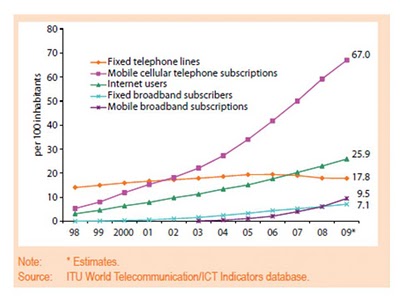
By any measure, recent progress, especially over the past few years, has been quite dramatic: mobile cellular penetration in developing countries has more than doubled since 2005, when it stood at only 23 per cent.
Last year, mobile cellular penetration in developing countries passed the 50 per cent mark, reaching an estimated 57 per 100 inhabitants at the end of 2009. Even though this remains well below the average in developed countries, where penetration exceeds 100 per cent, the rate of progress is remarkable.
Android might be the next big evolution, not that voice and text messaging are propagating. Using Android, devices could be customized for any number of applications that might otherwise be run on a PC, an important development in markets where device cost and access to electricity are issues.
Already, over four billion mobile phones are in use in the world today. The next billion new users, Rotberg says, will be spread out in the developing countries, mainly in Africa and Asia. Android could be important in that regard.
Not since abour 2006 have there been more fixed broadband lines in service in the most-developed broadband markets than emerging countries, and by 2009 a group of about 15 nations, including the BRICs, as well as countries in Southeast Asia, South American and Eastern Europe had surpassed the developed countries in total subscribers.
These days, the 15 emerging countries have the biggest share of broadband lines and the fastest growth rates as well, says Point Topic.
It's worth pondering that for just a moment. In 2000 there were 738 million global mobile subscribers. In 2010, there are 4.3 billion mobile subscribers, and most of those subscribers live in the developing world, according to the International Telecommunications Union.
It took just four years to double the number of global mobility users, from 2000 to 2004, and just another four years to double yet again, from 2004 to 2008. That sort of growth does not happen much in the telecom business, and has not happened before in the developed world.
Broadband growth is likely to assume something of the same pattern, but likely will be driven by mobile, not fixed access. Mobility has proven to be a raging, unexpected success story for people in developed regions. Broadband is about to repeat that feat.
Quietly, without much fanfare, communications really has become a capability available to all the world's people, after many decades of attempts by policymakers and providers to figure out how to do that. In the end, better technology has made all the difference. We don't use wires, we use airwaves. We don't use analog, we use digital. We don't use physical goods; we use electronic goods.
By 2014 just 15 developing nations will account for over 320 million broadband lines, 43 percent of the world total of 740 million broadband lines, by that time.
The fastest-growing group of 15 countries will have broadband growth rates of 14.2 percent annually. Another group of 12 countries, including the United States, Japan, Greece and Taiwan, will see annual growth of about 5.5 percent each year through 2014. Some 13 countries, including Western European nations, Canada, South Korea and Hong Kong, will see 4.6 percent annual growth rates.
All of those statistics are important for one compelling reason. Global subscriber and revenue growth for voice services, mobile services and broadband now has shifted to developing regions of the world.
The HTC Smart will be available this spring across Europe and Asia, selling for a suggested retail price of Php 12,900 (Philippines pesos), or $65 in U.S. currency.
HTC Smart uses the HTC "Sense" user interface, allowing personal customization of each person’s own phone experience. It also provides a quick and easy way to see what friends are up to via various social networks as well as quickly communicating over the phone, through text messaging or email.
HTC Smart uses Qualcomm’s "Brew Mobile Platform," a popular mobile operating system that enables smartphone devices to be offered at more aggressive price points.
Such developments are important because they make smartphone features available to users beyond the advanced regions of the world.
Is it possible that simple tools, such as low-cost mobile phones, can have more positive economic and social impact than our typical large-scale government-to-government and typical development aid efforts? The aid establishment might not like the question, or the answers, but MIT NextLab project staff seem to believe the answer is "yes."
“Traditional aid does little for the very poor,” says Jhonatan Rotberg, founder and director of the NextLab program. “Only a fraction of the donated money trickles down to those who need it most."
"But with a mobile phone, poor people can get ahead," he says.
By any measure, recent progress, especially over the past few years, has been quite dramatic: mobile cellular penetration in developing countries has more than doubled since 2005, when it stood at only 23 per cent.
Last year, mobile cellular penetration in developing countries passed the 50 per cent mark, reaching an estimated 57 per 100 inhabitants at the end of 2009. Even though this remains well below the average in developed countries, where penetration exceeds 100 per cent, the rate of progress is remarkable.
Android might be the next big evolution, not that voice and text messaging are propagating. Using Android, devices could be customized for any number of applications that might otherwise be run on a PC, an important development in markets where device cost and access to electricity are issues.
Already, over four billion mobile phones are in use in the world today. The next billion new users, Rotberg says, will be spread out in the developing countries, mainly in Africa and Asia. Android could be important in that regard.
Not since abour 2006 have there been more fixed broadband lines in service in the most-developed broadband markets than emerging countries, and by 2009 a group of about 15 nations, including the BRICs, as well as countries in Southeast Asia, South American and Eastern Europe had surpassed the developed countries in total subscribers.
These days, the 15 emerging countries have the biggest share of broadband lines and the fastest growth rates as well, says Point Topic.
It's worth pondering that for just a moment. In 2000 there were 738 million global mobile subscribers. In 2010, there are 4.3 billion mobile subscribers, and most of those subscribers live in the developing world, according to the International Telecommunications Union.
It took just four years to double the number of global mobility users, from 2000 to 2004, and just another four years to double yet again, from 2004 to 2008. That sort of growth does not happen much in the telecom business, and has not happened before in the developed world.
Broadband growth is likely to assume something of the same pattern, but likely will be driven by mobile, not fixed access. Mobility has proven to be a raging, unexpected success story for people in developed regions. Broadband is about to repeat that feat.
Quietly, without much fanfare, communications really has become a capability available to all the world's people, after many decades of attempts by policymakers and providers to figure out how to do that. In the end, better technology has made all the difference. We don't use wires, we use airwaves. We don't use analog, we use digital. We don't use physical goods; we use electronic goods.
By 2014 just 15 developing nations will account for over 320 million broadband lines, 43 percent of the world total of 740 million broadband lines, by that time.
The fastest-growing group of 15 countries will have broadband growth rates of 14.2 percent annually. Another group of 12 countries, including the United States, Japan, Greece and Taiwan, will see annual growth of about 5.5 percent each year through 2014. Some 13 countries, including Western European nations, Canada, South Korea and Hong Kong, will see 4.6 percent annual growth rates.
All of those statistics are important for one compelling reason. Global subscriber and revenue growth for voice services, mobile services and broadband now has shifted to developing regions of the world.
Labels:
Android,
HTC,
smart phone
Gary Kim was cited as a global "Power Mobile Influencer" by Forbes, ranked second in the world for coverage of the mobile business, and as a "top 10" telecom analyst. He is a member of Mensa, the international organization for people with IQs in the top two percent.
Apple Gets Ready for 3G iPad Launch
You might think the launch of the 3G version of the Apple iPad, able to use both Wi-Fi and mobile broadband access, will not get the attention the initial launch itself has gotten. Apple will launch the mobile network version today, April 29, 2010.
But it appears every Apple retail location will be closed for one hour, starting at 4 p.m, in order to prepare for the launch of the iPad 3G.
Apple might be expecting lines. It's a non-scientific, nearly random observation, but two Apple iPad owners I know of already plan to give their Wi-Fi-only versions to other family members and buy a 3G-capable unit. There could be lines.
Labels:
Apple,
iPad,
mobile broadband
Gary Kim was cited as a global "Power Mobile Influencer" by Forbes, ranked second in the world for coverage of the mobile business, and as a "top 10" telecom analyst. He is a member of Mensa, the international organization for people with IQs in the top two percent.
Apple Calls the Tune, Again
Apple might not yet have remade the notebook or netbook business, and might not have conclusively proved there is an undiscovered new consumer electronics niche for tablet devices, but it has caused Microsoft to kill its existing slate project, known as "Courier."
Microsoft’s Courier originally was conceived as the tablet of the future, Microsoft’s answer to Apple’s iPad, with two screens. Apple might disagree that the iPad is a "big iPod Touch," but Microsoft apparently has concluded that a two-screen device with a book style form factor is not what the market will want.
Perhaps the bigger deal, perhaps obvious in retrospect, is that although the device would have been "touch" capable, it somehow fails to offer an experience similar to the iPad. Make that one more case of Apple disrupting the conventional wisdom about user experience and user interface. And it apparently hopes to do the same in the mobile advertising businesss.
Apple never likes to play at the low end of any business, so we should not be surprised to see Apple taking that tack as it attempts to show what its iAd network can do on devices such as the iPad, iPhone and iPod Touch.
Apple also is famously "controlling" about the "user experience," so you should not be surprised to hear that Apple is making "initial demands for greater control over advertisers' marketing campaigns."
According to the Wall Street Journal, Apple is looking for placements priced about an order of magnitude (10 times) higher than is typical.
If you recall the demo Apple put together for its iAd announcment, you can understand why: Apple is aiming for content-rich campaigns that may involve branded characters and expensive production.
Apple Inc. aims to charge close to $1 million for ads on its mobile devices this year and perhaps even more--as much as $10 million--to be among the first participants.
Ad executives say they are used to paying between $100,000 and $200,000 for similar mobile deals.
Obviously, Apple is attempting to pull off a couple "hero" campaigns that likely cannot be replicated too widely in the future because most campaigns will not be able to afford the high rates.
One example Apple has been showing advertisers is an ad for Nike's Air Jordan basketball shoe.
When a user is in an application, an animated banner ad appears on the border of the screen, along with an iAd logo. If the user taps on the ad, it expands across the screen, displaying a video, an interactive store locator and exclusive offers at local stores, among other features.
Apple is planning to charge advertisers a penny each time a consumer sees a banner ad, ad executives say. When a user taps on the banner and the ad pops up, Apple will charge $2. Under large ad buys, such as the $1 million package, costs would rack up to reach $1 million with the various views and taps.
Marketers will be able to target ads to groups of users based on consumers' download preferences from its iTunes store, according to ad executives. For instance, a marketer could choose to show its ads to people who have downloaded financial applications or reggaeton music, horror movies or comedy TV shows.
Marketers also will be able to target ads to users in a general location like a city, although they cannot target ads to individual consumers or access personal details.
Apple is seeking high quality ads from big-name marketers for the launch, ad executives say. The ads will go through an approval process, and Apple will build the ads itself during the first couple of months to make sure they work well and attain a certain aesthetic and functionality, ad executives say. Eventually, Apple plans to create a developer kit so that agencies will be able to design and create the ads themselves.
The process is causing tension among some ad directors, who are hesitant to give up control. Welcome to Apple's world.
Microsoft’s Courier originally was conceived as the tablet of the future, Microsoft’s answer to Apple’s iPad, with two screens. Apple might disagree that the iPad is a "big iPod Touch," but Microsoft apparently has concluded that a two-screen device with a book style form factor is not what the market will want.Perhaps the bigger deal, perhaps obvious in retrospect, is that although the device would have been "touch" capable, it somehow fails to offer an experience similar to the iPad. Make that one more case of Apple disrupting the conventional wisdom about user experience and user interface. And it apparently hopes to do the same in the mobile advertising businesss.
Apple never likes to play at the low end of any business, so we should not be surprised to see Apple taking that tack as it attempts to show what its iAd network can do on devices such as the iPad, iPhone and iPod Touch.
Apple also is famously "controlling" about the "user experience," so you should not be surprised to hear that Apple is making "initial demands for greater control over advertisers' marketing campaigns."
According to the Wall Street Journal, Apple is looking for placements priced about an order of magnitude (10 times) higher than is typical.
If you recall the demo Apple put together for its iAd announcment, you can understand why: Apple is aiming for content-rich campaigns that may involve branded characters and expensive production.
Apple Inc. aims to charge close to $1 million for ads on its mobile devices this year and perhaps even more--as much as $10 million--to be among the first participants.
Ad executives say they are used to paying between $100,000 and $200,000 for similar mobile deals.
Obviously, Apple is attempting to pull off a couple "hero" campaigns that likely cannot be replicated too widely in the future because most campaigns will not be able to afford the high rates.
One example Apple has been showing advertisers is an ad for Nike's Air Jordan basketball shoe.
When a user is in an application, an animated banner ad appears on the border of the screen, along with an iAd logo. If the user taps on the ad, it expands across the screen, displaying a video, an interactive store locator and exclusive offers at local stores, among other features.
Apple is planning to charge advertisers a penny each time a consumer sees a banner ad, ad executives say. When a user taps on the banner and the ad pops up, Apple will charge $2. Under large ad buys, such as the $1 million package, costs would rack up to reach $1 million with the various views and taps.
Marketers will be able to target ads to groups of users based on consumers' download preferences from its iTunes store, according to ad executives. For instance, a marketer could choose to show its ads to people who have downloaded financial applications or reggaeton music, horror movies or comedy TV shows.
Marketers also will be able to target ads to users in a general location like a city, although they cannot target ads to individual consumers or access personal details.
Apple is seeking high quality ads from big-name marketers for the launch, ad executives say. The ads will go through an approval process, and Apple will build the ads itself during the first couple of months to make sure they work well and attain a certain aesthetic and functionality, ad executives say. Eventually, Apple plans to create a developer kit so that agencies will be able to design and create the ads themselves.
The process is causing tension among some ad directors, who are hesitant to give up control. Welcome to Apple's world.
Labels:
Apple,
enterprise iPhone,
iAd,
iPad,
mobile advertising
Gary Kim was cited as a global "Power Mobile Influencer" by Forbes, ranked second in the world for coverage of the mobile business, and as a "top 10" telecom analyst. He is a member of Mensa, the international organization for people with IQs in the top two percent.
Thursday, April 29, 2010
About 1/2 of 1 Percent of Time Warner Cable Customers Buy 50 Mbps Service
It's likely fair to keep in mind, as ISPs, regulators and policy advocates ponder future service offerings at speeds of 100 Mbps, or even higher, that few U.S. consumers appear to want to buy service at speeds of 50 Mbps or higher.
Time Warner Cable added 212,000 high-speed Internet subs in the first quarter, with about 1,000 buying the ultra-high-speed Docsis 3.0 services. That represents about one half of one percent of new customers, roughly in line with the few figures that have emerged from other ISPs able to sell 50 Mbps to 100 Mbps access services in Europe or North America.
The number of wideband subscription adds in the first quarter are consistent with recent trends at TWC, the only major US MSO so far that's even been willing to share those numbers. In January, TWC said it added only about 2,000 wideband subs in the fourth quarter of 2009.
Comcast, which has 80 percent of its plant wired up for wideband and intends to finish the job later this year, hasn't disclosed any D3 subscriber figures.
AT&T noted during its first quarter conference call that 59 percent of its customers buy access at speeds of at least 3 Mbps. What that might suggest is that most consumers still do not buy ultra-fast connections, preferring medium-speed connections instead.
Time Warner Cable added 212,000 high-speed Internet subs in the first quarter, with about 1,000 buying the ultra-high-speed Docsis 3.0 services. That represents about one half of one percent of new customers, roughly in line with the few figures that have emerged from other ISPs able to sell 50 Mbps to 100 Mbps access services in Europe or North America.
The number of wideband subscription adds in the first quarter are consistent with recent trends at TWC, the only major US MSO so far that's even been willing to share those numbers. In January, TWC said it added only about 2,000 wideband subs in the fourth quarter of 2009.
Comcast, which has 80 percent of its plant wired up for wideband and intends to finish the job later this year, hasn't disclosed any D3 subscriber figures.
AT&T noted during its first quarter conference call that 59 percent of its customers buy access at speeds of at least 3 Mbps. What that might suggest is that most consumers still do not buy ultra-fast connections, preferring medium-speed connections instead.
Labels:
100 Mbps,
50 Mbps,
DOCSIS,
national broadband plan,
Time Warner Cable
Gary Kim was cited as a global "Power Mobile Influencer" by Forbes, ranked second in the world for coverage of the mobile business, and as a "top 10" telecom analyst. He is a member of Mensa, the international organization for people with IQs in the top two percent.
Subscribe to:
Comments (Atom)
On the Use and Misuse of Principles, Theorems and Concepts
When financial commentators compile lists of "potential black swans," they misunderstand the concept. As explained by Taleb Nasim ...
-
We have all repeatedly seen comparisons of equity value of hyperscale app providers compared to the value of connectivity providers, which s...
-
It really is surprising how often a Pareto distribution--the “80/20 rule--appears in business life, or in life, generally. Basically, the...
-
One recurring issue with forecasts of multi-access edge computing is that it is easier to make predictions about cost than revenue and infra...