Monday, April 4, 2011

EMC Cloud Backup Service Arrives On iPad, iPhone

In one sense, the ability to use cloud-based applications as easily on a smartphone or tablet as on a PC is not that big a deal. Most observers would agree that the movement of apps to mobile devices is on-going and likely an irresistible trend.

Mozy, a cloud-based storage service, now allows mobile apps to run as native applications on smart phones and tablets. Consumer subscribers to the storage service are able to access all their files independently in their "MozyHome" storage holders. For example, users can view documents and open them in other applications, such as a browser.

On another level, though, the app might be the precursor of something much more strategic. First, the move to cloud-based apps accessible on any common computing device means that the user interface and the installation process should be dramatically simpler than before. Installation now means "download from app store" and the user interface is a simple web browser app.

That could ultimately have huge implications for the entire value chain and ecosystem that sells and supports business applications, software and services.

Consider just one implication: the smart phone "brings its own broadband." We are used to the idea that apps can be used over any standard broadband connection. With growing use of tablets and smart phones, business users already might be supplying their own broadband. That isn't to say businesses have less need to buy fixed location broadband; simply to note that a large category of "broadband access" services already have been "sold."

As with many other types of business applications, services and appliances, the "pitch" increasingly is a "replace what you already have" decision, not a "buy something new" decision. Also, mobile "broadband" is a secondary feature of the primary product, which is the smart phone and the apps it supports.

Likely more important is a shift of selling and provisioning context. In the future, buying a business app might be nearly as simple as going to a web store and downloading an app. Some way to simplify uploading of enterprise data also will be required in some cases, of course.

Sunday, April 3, 2011

AT&T Buying T-Mobile Won’t Matter, Says Pinger

The AT&T acquisition of T-Mobile USA won't make a dent in either innovation, competition or consumer welfare, because wireless innovation now lies in all the applications now available "over the top," says Pinger co-founder Joe Sipher.

For instance, my company, Pinger, now moves over a billion text messages every month and millions of minutes of voice calls. And we are only a fraction the size of Skype. There are many more companies like ours out there too. Increasingly, users pay nothing for calls because these new over-the-top services apply internet monetization methodologies to communication services. Advertising based communication services mean no contracts, no calling plans, no overage fees.

The "AOL" Approach to Content Generation

Twenty years ago, large corporations had to deal with a bunch of clearly identified specialized journalists from the mainstream media. Today, a large chunk of the news cycle is controlled by many diverse opinion shapers.

The "AOL" approach to producing content is one example of how much content and news production has changed, for the worse, many would argue. For better or worse, content producers and journalists, as well as those who try to get attention in the media, might as well know what is happening.

Microsoft on Tablets

“The tablet takes cutting-edge PC technology and makes it available whenever you want it…It’s a PC that is virtually without limits — and within five years I predict it will be the most popular form of PC sold in America.”

--Bill Gates in 2001

"...not sure whether tablets "would remain with us or not."

--Craig Mundie, Microsoft Research, 2011

One suspects the latest statements are made only because Microsoft needs more time to ready its own approach and offering.

1/2 of Twitter Users Follow 2 or More People

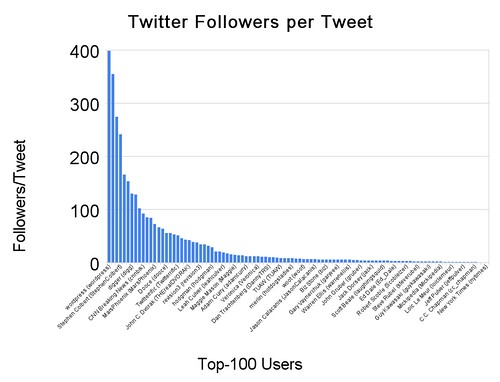
How Many Users Does Twitter REALLY Have?Perhaps the first thing that strikes you, looking at this graph, is its familiarity. As it turns out, when using Twitter, a relatively small number of users actually "follow" many other people. In fact, just about half of Twitter users follow two or more people.  About 10 percent of Twitter users follow 50 people or more, and an infinitesimal number follow more than 500 people.

That's basically the flip side of a graph you might also be familiar with, the number of followers a Twitter user has. As you would expect, it's the same graph: a very small number of Twitter entities get a disproportionately high number of followers.

Both of those graphs would be expected in a Pareto distribution, sometimes popularly known as the "80/20" rule.

Saturday, April 2, 2011

Amazon.com Considering Mobile Payments Service

Amazon.com is considering the introduction of a service that would let consumers pay for goods in brick-and-mortar stores using their mobile phones, according to Bloomberg.

The company’s “Amazon Payments” unit is said to be exploring whether to start a service based on near field communications.

Amazon.com Said to Be Considering Mobile-Payment Service for Smartphones – Bloomberg

Mobile Broadband to Produce Majority of Subscriber Growth to 2014

The number of mobile broadband subscribers passed the number of fixed broadband subscribers, globally, in 2010, says Infonetics Research. A goodly part of the growth now is coming from smart phones, tablets and other devices, leading Infonetics to forecast that 1.5 billion connected devices will be in use by 2014.

As a consequence, fixed broadband will show slower growth as mobile broadband becomes the broadband of choice, on a global basis. That doesn't mean fixed line services will be abandoned, but simply that mobility is a "personal" service, used by people and sensors, where fixed line service is generally to a location. Since there are more people and sensors than homes or offices or factories, the unit growth will tend, over time, to be for mobile devices and sensors.

read more here

Friday, April 1, 2011

SK Telecom Runs Out of Domestic Growth Opportunities

South Korea's SK Telecom Co. is considering a bid for movie-rental chain Blockbuster Inc., which filed for bankruptcy court protection last year, the Wall Street Journal reports. Whether a bid emerges, and whether it is the best use for SK Telecom's cash, is probably debatable, some might think.

But the possible move does indicate a problem that faces many fixed-line and mobile service providers, namely that opportunities for domestic growth are very challenging. To stay within their historic industry areas of competence, service providers are being forced to look to international, out of region markets, or, as this possible idea suggests, businesses outside the original core competency.

Use of Mobile Apps Grows 3% Last Quarter

In February 2011, 69 percent of U.S. mobile subscribers used text messaging on their mobile device. Browsers were used by 38 percent of subscribers (up 3.1 percentage points from the prior quarter), while downloaded applications were used by 36.6 percent of the mobile audience (up 3.2 percentage points from the previous quarter).

Accessing of social networking sites or blogs increased 3.3 percentage points, representing 27 percent of mobile subscribers. Playing games represented 25 percent of the mobile audience, while listening to music represented 17.5 percent.

Mobile Content Usage
3 Month Avg. Ending Feb. 2011 vs. 3 Month Avg. Ending Nov. 2010
Total U.S. Mobile Subscribers Ages 13+
Source: comScore MobiLens
Share (%) of Mobile Subscribers
Nov-10Feb-11Point Change
Total Mobile Subscribers100.0%100.0%N/A
Sent text message to another phone67.1%68.8%1.7
Used browser35.3%38.4%3.1
Used downloaded apps33.4%36.6%3.2
Accessed social networking site or blog23.5%26.8%3.3
Played Games22.6%24.6%2.0
Listened to music on mobile phone15.0%17.5%2.5

It's April Fools Day, So Techsters Will Play Jokes on People, Including Google


Here are some other "pranks" of the day from Googlers:
http://googleblog.blogspot.com/2011/04/gmail-is-moving-fingers-are-fitter.html?utm_source=feedburner&utm_medium=feed&utm_campaign=Feed%3A+blogspot%2FMKuf+%28Official+Google+Blog%29

85% of Smartphone Users Access Mobile Web

There aren't yet any apps, aside from specific "mobile apps" or "social apps," that people access more on a smartphone than on a PC, a survey by Yankee Group has found. But researchers also find that use of smartphones to access web apps of all sorts is growing, and that most popular apps people like to use on their PCs also get used from their smartphones, though at a lower frequency, so far.

GPS and navigation apps likely are one clear exception, likely used virtually exclusively in a mobile context.

Most likely, we will relatively soon find there are some apps that are used primarily from a smartphone or other mobile device, compared to a PC. Mobile payment apps come to mind.
 LR-55441-EX01.jpg

39% of Small Businesses Will Be Buying Cloud Services Within 3 Years

About 39 percent of small and medium-sized businesses recently surveyed by Edge Strategies on behalf of Microsoft say they expect to be using, and paying for, cloud-based services within three years.

Accounting and payroll apps, project management, data storage and customer relationship management are among the top categories of apps respondents expect they will be sourcing from a cloud services provider.

http://www.microsoft.com/Presspass/presskits/commsector/docs/SMBStudy_032011.pdf

Where Will 4G Compete with DSL?

You can get an argument about whether fourth-generation mobile broadband services work well enough to be a viable substitute for a fixed-line connection, and what user requirements are best suited for such potential substitution.

Wireless might or might not work so well for multi-person households, for example, but might be quite adequate for a single-person household, especially when a user does not watch much online video.

Some service providers also will have incentives to try and sell wireless substitutes for fixed-line service anywhere those service providers do not have fixed-network assets.

Long Term Evolution "provides a real opportunity for the first time to give a fixed customer in a home, broadband service — wireless — but broadband service,” says Dick Lynch, Verizon CTO.

Eighty Percent of Consumer Purchases will be Influenced by Social and Mobile Marketing

By 2015, digital strategies, such as social and mobile marketing, will influence at least 80 percent of consumers' discretionary spending,' said Adam Sarner, research director at Gartner. "Marketers still need to shift their traditional campaign management strategy around executing campaigns to a customer and move toward a digital marketing, two-way engagement approach."

Digital agency Morris argues that the shift away from mass marketing thinking into "laser-focused relationship creation" is enabled by all manner of technology that allows products to be customized and personalized, by the end user directly if not at the manufacturing stage.

What AT&T's Potential Purchase of T-Mobile USA Doesn't Change

People love to speculate about what the AT&T purchase of T-Mobile USA means, or could mean. Right now, all such talk is speculation, as the deal cannot clear Federal Communiations Commission and Department of Justice reviews for roughly a year. People eagerly describe the deal as "transformative" or "industry-altering."

So here's a bit of a contrarian view: it will change much less than most people now think. AT&T and Verizon have been the two industry-leading providers since 1995 or so, and each firm has only become more dominant since then. The AT&T acquisition will make AT&T bigger, but nobody can say yet how much bigger, as divestitures will undoubtedly be required to gain regulatory blessing.

Verizon might bulk up a bit more as well, though Verizon's interest in doing so remains unclear. Many will assume the deal, if approved, will reduce the number of leading national wireless providers from four to three. Whether that is stable over the long term is open to question.
Nor is it entirely clear whether consumer benefits, ranging from innovation to prices, would necessarily diminish, in a three-provider or even two-provider environment. The reason is that most innovation now occurs on the handset and application fronts. Nor can we accurately predict what will happen as cable operators and other existing and potential providers ramp up their own services. And though hoped-for spectrum auctions will likely find AT&T and Verizon in leading roles, spectrum auctions in the past have proven capable of shaking up the existing industry in serious ways.

There could well be far less impact, one way or the other, in the immediate wake of a successful AT&T acquisition of T-Mobile USA. In part, that is because the merger approval conditions undoubtedly will prevent AT&T moving in ways that are clearly threatening to continued innovation and competition.

Indirect Monetization of Language Models is Likely

Monetization of most language models might ultimately come down to the ability to earn revenues indirectly, as AI is used to add useful fe...