Saturday, April 30, 2011

OnSwipe: Web Content on Tablets That Behaves Like an App

Up to this point, content intended primarily for consumption on a tablet device would be created for the Apple iPad and use the App Store for distribution to end users. Self-executing apps such as games are ideal for that format. But such apps are less than ideal for content distribution, the founders of OnSwipe argue.

"With HTML5, however, content publishers can have the swipe features, the page movement, the rich graphics and all the other things that apps provide, and still be open and easily portable to other tablets or platforms," says co-founder Jason Baptiste.

OnSwipe gives content publishers the ability to mimic many of the user interface and features that apps provide, but on the open web. That promises a way of authoring that works for web, tablet and small-screen devices.

At first, the company figured it would just license its software platform to publishers who wanted to create a quick app-like experience for the iPad. “But that would just be a services business, not a really big company,” says Baptiste. “Not that that’s bad, but we wanted to do something really big — there’s so much potential there. So we decided to give the software away, and have as many people publish in an infinitely customizable way, and we would build a thread that pulls them all together.”

The idea now, Baptiste says, is to create a kind of networked layer on top of the OnSwipe publishing tools, to turn those tools into more of an ecosystem.


Friday, April 29, 2011

PCs Getting Less Use at Small Businesses

A survey of 2,223 owners and managers at companies with less than 500 employees, most of them with between five and 499 workers, suggests that "PC" use is declining, while other digital devices, including tablets and smartphones are taking up the slack.

Beyond the finding that nine percent of business owners were using iPads (as of November 2010), the study found that 79 percent of small- and midsize-business owners used a desktop computer, down from 83 percent in 2010.

Some 16 percent used a netbook or notebook, down from 21 percent earlier in 2010.  About 60 percent used a laptop, down from 65 percent.

Note the trend: tablets up, desktop PCs, netbooks down, notebooks down.

About 37 percent used a smartphone or other personal digital assistant, up from 27 percent the prior year.

Fully 31 percent were using mobile applications, a category that wasn’t even measured the previous year, on smartphones, cell phones, or tablet computers.

What all of that might mean is that many business and work tasks really do not require much in the way of content creation, beyond replying to emails or social media messages.

read more here

Rabobank’s iPhone App: Take a Picture, Pay a Bill

Rabobank’s iPhone app allows customers to pay bills by taking a picture of the bill.

About 30 percent of Dutch consumers pay their bills by using "acceptgiros," standard yellow payment forms that merchants sent to them together with their bills. These forms are prefilled with all relevant information that is required to make the payment. The customer can pay the bill by simply signing the acceptgiro and dropping it into the letterbox of his bank, or by paying it directly using online banking.

Dutch Rabobank has added a new functionality to its iPhone mobile banking app which it calls "acceptgiroscan." Users of the app can pay bills by simply taking a picture of the acceptgiro with the phone’s built-in camera.

Fiber to the Home in Shanghai

Summary of the Amazon EC2 and Amazon RDS Service Disruption

"The issues affecting EC2 customers last week primarily involved a subset of the Amazon Elastic Block Store (“EBS”) volumes in a single Availability Zone within the US East Region that became unable to service read and write operations," Amazon says.

This caused instances trying to use these affected volumes to also get “stuck” when they attempted to read or write to them. In order to restore these volumes and stabilize the EBS cluster in that Availability Zone, Amazon disabled all control APIs (e.g. Create Volume, Attach Volume, Detach Volume, and Create Snapshot) for EBS in the affected Availability Zone for much of the duration of the event.

For two periods during the first day of the issue, the degraded EBS cluster affected the EBS APIs and caused high error rates and latencies for EBS calls to these APIs across the entire US East Region, Amazon says.

Summary of the Amazon EC2 and Amazon RDS Service Disruption

"The issues affecting EC2 customers last week primarily involved a subset of the Amazon Elastic Block Store (“EBS”) volumes in a single Availability Zone within the US East Region that became unable to service read and write operations," Amazon says.

This caused instances trying to use these affected volumes to also get “stuck” when they attempted to read or write to them. In order to restore these volumes and stabilize the EBS cluster in that Availability Zone, Amazon disabled all control APIs (e.g. Create Volume, Attach Volume, Detach Volume, and Create Snapshot) for EBS in the affected Availability Zone for much of the duration of the event.

For two periods during the first day of the issue, the degraded EBS cluster affected the EBS APIs and caused high error rates and latencies for EBS calls to these APIs across the entire US East Region, Amazon says.

Consumers Feel Smart Phone Obsolescence

When asked, 62 percent of respondents to a Retrevo survey said they currently feel their smart phone already is "out of date," or will be before their service contracts expire. That speaks both to the rapid pace of smart device innovation and the upside for providers of the latest smart phone models.

The solution, some would argue, are shorter contracts, or no contracts. One is reminded of the surveys taken to assess consumer receptivity to advertising. Those surveys virtually always find that people don't really like ads. But they like the idea of paying more for their desired content even less.

That's essentially what the Retrevo survey found as well.

When asked if they would be willing to pay extra for a shorter contract, most responded as you would guess, with a "no." But some would pay as much as $100 extra to get a one-year contract rather than a two-year contract.

Those sorts of questions and answers are instructive, but also hinge on consumer desire, at least in the U.S. market, for high subsidies on their devices. Few consumers really want to pay $400 to $500 for their devices, to get a contract-free service plan. Most put up with contracts so they can buy those devices for $200 to $250.

You can argue all you want about the wisdom of those preferences. Most of the money a consumer spends over the length of the relationship is service fees. The device cost is a relatively small matter in comparison. But consumers have voted with their wallets, and service providers, though not enamored of the operating expense the subsidies represent, do not seem likely to abandon the model, simply because it works.

One also might argue that the subsidies, which encourage users to swap out their devices more frequently, are one reason the U.S. market now is the world leader in terms of application innovation. A user that has invested $500 to $600 in a mobile device is likely to feel obligated to use that device as long as possible.

A user that has invested only $200 to $250 is less likely to be wedded to any particular device, and is likely to feel that investing in another, updated device makes sense.

http://www.retrevo.com/content/blog/2011/04/are-you-prisoner-your-phone-carrier

Cloud Incidents Illustrate Trend

The recent Amazon Web Services outage illustrates a broader computing trend you'll all recognize, in your roles as consumers, small business or enterprise users of technology. And that trend is that, across the board, users are required to take a more-active role in managing their technology. Most people discover they are required to learn more about their computing devices and applications than they actually would prefer, just to use the tools.

Many would note that the lesson from the AWS outage is that the normal advice to build in redundancy and resiliency into an applications or hardware infrastructure applies equally when buying cloud computing services.

"While it is important to maintain pressure on service providers to improve their reliability footprint, the onus of developing or contracting reliable system stays with their clients, and there won’t be any miraculous cloud that provides 100 percent uptime or that does not risk to fail meeting its own SLAs," says Andrea Di Maio, Gartner VP.

FCC to Report "Broadband Gap" Growing?

The Federal Communications Commission (FCC) is expected to argue, in its annual "706" report on U.S. broadband status, that broadband providers are not deploying services in a reasonable and timely way to all Americans.

The report hasn't been officially released yet, but we understand the methodology used to argue that the broadband gap "is widening" will be different from past reports, which have focused more on a lowest common denominator approach. The new report is expected to focus on the higher end of broadband speeds and adoption.

Some suggest the latest version of the study will mirror the conclusions from last year in other respects, which found the speed of broadband deployment unsatisfactory. ” "The FCC concluded in its Sixth Broadband Deployment Report that between 14 and 24 million Americans still lack access to broadband, and the immediate prospects for deployment to them are bleak," the FCC said at the time.

Some might find that an odd way to report the results of survey that found 95 percent of people do have fixed network access. Others might simply note that even the claim of five percent "unable" to get access requires ignoring satellite access which is available to nearly every location. There are likely some locations that cannot get convenient line of sight access to a satellite providing broadband access, but that is a rare situation.

Until 2009, the 706 reports had found adequate and continual progress. The cynical will simply note that broadband has not changed, the political agenda has changed. See http://www.precursorblog.com/content/fcc-706-report-us-broadband-cup-5-empty-netcompetitionorg-press-release.

"This report underscores the need for comprehensive reform of the Universal Service Fund, innovative
approaches to unleashing new spectrum, and removal of barriers to infrastructure investment," the FCC said when unveiling last year's report.

The agency has cited the 2010 findings to justify instances of government intervention, some would say.

PayPal Buys Mobile Payment Enabler

PayPal has acquired Fig Card, which developed a low-cost USB device that plugs into the cash register or point-of-sale terminal and allows merchants to accept mobile payments using a smart phone app.

The solution requires no new hardware on the phones (iPhone, Android, many Blackberry models) and free hardware for the merchants.

Thursday, April 28, 2011

5 Reasons You're Consuming More Mobile Content

Consumers are consuming more mobile content than ever before, but why? For the simplest of reasons. There's more content to watch and there's more widespread mobile broadband, and better mobile broadband. There are more smart phones and tablets to make it convenient. There are simple applications and better user interfaces, allowing users to get users to video fast.

Simply, the barriers to watching video simply have fallen in every way.

Time Warner Cable Looks to Close an Era

Time Warner Cable apparently is looking at converting all its programing to IP, a move that would allow it to serve up video to all sorts of digital devices, eliminating the need for a set-top decoder and opening the door to either over-the-top or captive video on the existing model, but with one infrastructure supporting all forms of access.

There are all sorts of immediate, and some potential, implications. Decoders represent a huge amount of capital investment for a video provider using decoders. Eliminating the decoders would vastly reduce Time Warner Cable capex. That's the immediate benefit from an operations perspective.

From a strategic perspective, the shift to all-IP would open the possibility of over-the-top service, which in an early scenario might allow Time Warner Cable to serve up its video to current customers who also use tablets, PCs and smart phones to watch video.

In a more-disruptive scenario, Time Warner Cable could envision selling video to anybody in the United States, over the top, providing content contracts and municipal regulators allow it.

That could create quite a change in the famously collegial U.S. cable industry, where cable operators simply do not compete with each other.

Search Results Follow Market Share Rules

Many years ago, I learned that there are fairly reliable relationships between market share and profitability. Basically, the rule is that the number-one provider in any market has twice the market share of provider number two, which in turn has twice the share of provider number three. It's a remarkably useful rule of thumb.

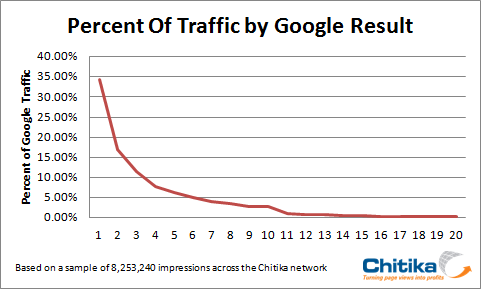
A new examination by Chitika, looking at the value of Google search results, ranked by share, is remarkably consistent with those rules of thumb about market share.

As it turns out, the number-one search result tends to get double the traffic of the number-two result. The Chitika data also shows that search result three has 11.4 percent share, while the number-four result has eight percent share. That's pretty close to what the rule of thumb would suggest.

Traffic by Google Result
If the number one result has 34 percent share, the rule would predict the second result to be 17 percent, which is precisely what Chitika found. The rule also would suggest result three would have 8.5 percent share. In the Chitika data, the third search result has 11 percent share. The fourth result has eight percent share, as the rule suggests would be the pattern.

In search results, as in other markets, share makes a huge difference. The other thing you might recognize is a standard Pareto distribution, sometimes known as a "long tail" or 80/20 rule.

Rules of thumb can be excellent guides to strategy, if a company really wants to lead a market. It's also nice to know that at least some things one learns in school turn out to be correct in real life. 

Google Announces Video Chat for Android 2.3 Devices

Google is launching an update to Android Gingerbread, version 2.3.4, enabling video chat using GTalk on Android smart phones. This is the same functionality offered as part of Honeycomb, version 3.0, and allows any Android phone with the proper version of Gingerbread to conduct a video chat with anyone using a compatible (Honeycomb) Android tablet, their smartphone, or GTalk on their desktop.

RIM: Weaker Guidance, Near Term

Research In Motion has updated its financial guidance and said it expects to sell fewer BlackBerry smartphones than it previously estimated. "RIM now expects fully diluted earnings per share for Q1 to be in the range of $1.30-$1.37, lower than the range of $1.47-$1.55 previously forecasted by RIM on March 24, 2011," RIM said.

"This shortfall is primarily due to shipment volumes of BlackBerry smartphones that are now expected to be at the lower end of the range of 13.5-14.5 million forecasted in March and a shift in the expected mix of devices shipped towards handsets with lower average selling prices," RIM noted.

RIM still expects “strong revenue growth” in the third and fourth quarter thanks to the introduction of new BlackBerry smartphones. The near-term shipments aren't really the issue.

The problem is that with Apple and Android leading the smart phone market, plus the expected revitalization of Microsoft, given its alliance with Nokia, there is precious little room left in the smart phone market for player number four, whomever that might be. Unless you conclude that Microsoft, which now will count Nokia as part of its ecosystem, falls further, RIM is the provider likely to be bumped down into the fourth spot.

Is Private Equity "Good" for the Housing Market?

Even many who support allowing market forces to work might question whether private equity involvement in the U.S. housing market “has bee...