Friday, June 24, 2011

HTC Evo 3D, View 4G Launched at Sprint

The HTC EVO™ 3D and HTC EVO View 4G™ launch today, June 24, 2011, exclusively on the Sprint network.

HTC EVO 3D, America’s first glasses-free 3D phone will cost $199.99 and HTC EVO View 4G, the first 4G-enabled tablet in the United States, will cost $399.99. Both prices exclude applicable taxes, and the devices require a new two-year service agreement or eligible upgrade.

Incidentally, Sprint has added some funny videos and polls on the pages touting the new devices. http://now.sprint.com/alltogethernow/index.php?pid=2&ECID=SEM:Google:C:Sprint:HTC

What’s needed to do payments right

Ubiquity is a primary requirement for a successful payments system, executives at PayPal believe. "A payments service needs to be everywhere to be effective," says Sam Shrauger, VP Global Product and Experience, PayPal. 


That puts PayPal in the camp of would-be and developing mobile payments providers that really must look for ways to create a universally-available service, without the limitations of mobile device operating systems, communications capabilities or input-output methods on the consumer side of the business.

PayPal also would like to avoid forcing the essential merchant partners to invest in upgrades to their point of sale terminals, especially at a time when there are many ways to handle the communications part of the process.

"Very narrow payment offerings," then, are not the approach PayPal will take when it does reveal what it plans to do in the mobile payments space. PayPal does believe that whatever it does, it will have to be compelling enough "to make people change their current behavior."

Others will take the other approach, which is to create "niche" offerings. Starbucks and Square probably are the best examples of that at the moment. Starbucks only cares about what its own consumers do, at Starbucks locations. Square really is optimized to enable non-traditional retail payments in scenarios where the retailer doesn't own, doesn't use, or cannot use a traditional POS terminal.

To really “do payments” right, you’ve got to have more than just technology," says Shrauger. "Above all, any new solution has to deliver something better than what exists today. Not just new and different–better."

PayPal already has introduced retail payments on a limited scale in the United Kingdom, so it already is moving down the track of retail payments at physical locations.

PayPal Doubles Mobile Payments Predictions to $3 billion in 2011

PayPal has raised its forecast for 2011 "Mobile Total Payments Volume" to $3 billion, up from $2 billion just a couple of months ago. It's the third upward revision to the numbers since the first estimate of $1.5 billion at the beginning of the year.

"Mobile payments are growing at a rate we never could have imagined when we started processing them back in 2006," says Laura Chambers, Senior Director, PayPal Mobile.

"We’re now seeing up to $10 million in mobile TPV a day, a big increase from the $6 million we reported in March," says Chambers. "And we currently have eight million customers who are regularly making purchases on their mobile phones, up from a previously reported six million users."

Thursday, June 23, 2011

PayPal Will Look for Scale When it Launches Mobile Payments Platform

PayPal isn’t yet ready to say anything in public about what it might be planning in the mobile payments arena. But it isn't so clear that PayPal will want to wait too long for near field communications to achieve wider deployment before it tries to gain traction in some other way, especially ways that offer immediate scale.

That's the problem these days. Mobile payments ultimately will require huge scale. But few providers are able to demonstrate, today, such scale.

The contrast is Starbucks, which leveraged its existing terminals, existing loyalty programs, customer affinity for the brand and existing prepaid card infrastructure to create a program that creates instant scale for the brand, and doesn't try to create a ubiquitous, generic mobile payments business.

We might hear something in the fall. But there are clear reasons why PayPal is looking at mobile banking, mobile wallet and mobile payments in a general sense, and will emerge as a provider in some capacity.

The angle might build on PayPal’s strength as a trusted payment provider in the online marketplaces, as well as the advantages for international transactions. About half of online transactions use a credit card, while 22 percent use a debit card. But PayPal gets used 23 percent of the time, making PayPal as important an online payment mechanism as debit cards are.

So some of us would not be surprised to see some initiatives that build on the peer-to-peer payments business PayPal already runs. See https://personal.paypal.com/us/cgi-bin/?cmd=_render-content&content_ID=marketing_us/mobile_payments. From PayPal’s point of view, the service gets used both to buy things and send money to people. But retail transactions seem to hold potential that could vault PayPal into an entirely new segment of the payments market.

A new payments startup, Naratte, uses ultrasound to authenticate and transmit payment data. PayPal is reported to have looked at the approach.

The company’s founder, Brett Paulson, also has built a demo app specifically leveraging PayPal’s API that enables contactless “tap and go” transactions on almost any phone on the market today.

The payment technology, called “Zoosh,” establishes a secure link between payment source and merchant by generating a high-pitched sound which is inaudible for the human ear.

“All you need is a speaker and microphone, which you already have on your device,” says Paulson, Naratte’s chief executive and cofounder. “We’ve built everything in software so you just download an app to get a contactless experience.”

Laura Chambers, PayPal’s manager for mobile, also has been quoted in a statement saying that she and PayPal were “very excited about Naratte’s Zoosh technology” after seeing demos. “Zoosh’s approach provides instant scale,” she offered, “which is a major hurdle for most mobile payment technologies.”

Mobile Banking Demand Next 6 Months From New Smart Phone or Tablet Buyers

More than half of smartphone and tablet owners use their devices for some form of mobile banking (distinct from payments or wallet operations), according to a study from Chadwick Martin Bailey and iModerate Research Technologies.

About 21 percent of users view balance information while 17 percent review transactions. Some 13 percent have transferred funds. About 12 percent have viewed their available credit, while 12 percent have paid bills. The survey was not intended to uncover demand for new mobile payment or mobile wallet services, or peer-to-peer payments.

But the survey suggests it is new users, who have never used any mobile banking service, and who will buy a new smart phone or tablet within the next six months will fuel the growth, as many current smart phone or tablet owners already seem to have made up their minds the feature has no value for them.

The study of over 1,400 U.S. consumers also found that 45 percent of U.S. consumers own a smartphone or tablet. Of that group, 52 percent currently conduct some form of mobile banking.

However, the real growth in the mobile banking market will come from those who don’t yet own smartphone or tablet. The study shows 39 percent of those who plan to buy a smartphone or tablet in the next six months are highly likely to use their smartphone or tablet for mobile banking. By contrast, only six percent who already own a smartphone or tablet, but don’t mobile bank say they are highly likely to start in the next six months.
“I think what we’re seeing is that mobile banking among current smartphone owners has plateaued,” says Jim Garrity, vice president of Chadwick Martin Bailey’s Financial Services practice. “For all intents and purposes, those folks have already made a decision about whether or not they want to participate in mobile banking. The real opportunity is in the 14 percent of consumers who are planning to buy a smartphone or tablet in the next six months, because among that group many say they are highly likely to participate in mobile banking.”

The study also found consumers are becoming more comfortable using their smartphones to make purchases as well. According to the survey, 45% of smartphone owners made a purchase with their device over the past year. The majority of those payments are tied to credit cards (49 percent), while 40 percent of those purchases were tied to debit cards and PayPal.

See the full results here.

PCs Still Main Platform for Online Newspaper Reading, SayscomScore

About 90 to 98 percent of online newspaper reading, across countries, still happens on PCs, comScore reports. Between one and seven percent of newspaper reading occurs on mobile phones. Though tablets are heavily used for content consumption, tablets do not yet represent much newspaper reading activity, ranging from nearly zero to less than two percent of total online newspaper reading, says comScore.

Of course, media executives have high hopes for tablets as a device that could spur heavier online readership, especially paid readership.

The iPad is currently the dominant tablet device across all geographies, contributing more than 89 percent of tablet traffic across all markets. The iPad’s contribution to total non-computer device traffic is highest in Canada (33.5 percent). Brazil has the second highest non-computer device share of traffic coming from the iPad at 31.8 percent, although non-computer devices account for less than 1 percent of total traffic in the country. In Singapore, where non-computer devices comprise nearly 6 percent of total traffic, the iPad accounts for 26.2 percent of this traffic.

Newspaper Site Category Traffic by Geography and Device Type
May 2011
Multi-Country Report for Selected Countries
Source: comScore Device Essentials
ComputerMobileTabletOtherNon-Computer Traffic Newspaper Category Index*
UK90.2%7.4%1.9%0.5%184
Singapore91.2%5.8%2.8%0.2%149
Japan93.0%5.2%1.4%0.3%151
U.S.93.3%4.6%1.8%0.3%108
Australia94.6%3.4%1.9%0.2%126
Chile95.4%3.9%0.4%0.3%226
Canada95.5%2.2%1.9%0.4%131
Spain96.3%2.4%1.2%0.1%163
India96.9%2.9%0.2%0.0%94
France97.7%1.1%1.1%0.1%159
Brazil98.1%1.0%0.8%0.1%316
Germany98.1%1.1%0.7%0.1%117
Argentina98.6%1.0%0.3%0.1%124

*Non-Computer Device Traffic Newspaper Category Index = Share of Non-PC Traffic for Newspaper
Category / Share of Non-PC Traffic for Total Internet x 100. Index of 100 indicates average representation.


Mobile Backhaul Among Issues Regulators are Looking At, as Part of AT&T T-Mobile USA Buy

U.S. backhaul markets now are part of the regulatory review of the proposed AT&T purchase of T-Mobile USA. Specifically, the Federal Communications Commission is looking at potential harm to the market for supplying mobile backhaul connections. The FCC six of AT&T's top competitors to answer questions on network coverage, backhaul, pricing and spectrum for its review of AT&T's $39 billion takeover of T-Mobile USA.

The agency sent 37-page letters with a list of nine questions Monday to Verizon Wireless, Sprint Nextel, U.S. Cellular, MetroPCS, Cellular South and Cricket Communications parent Leap Wireless International asking for detailed information about the companies' operations.

Citing a new business arrangement between AT&T and Verizon, Lynn Refer, president and CEO of Telecom Transport Management, a small wireless backhaul provider, says the future of the independent backhaul business may be at risk.

Under the pact, Refer and others in the industry said, the two largest wireless companies have a reciprocal arrangement to provide infrastructure to connect each other’s wireless data traffic. See Rivals' alarm grows over AT&T / Verizon deal - Eliza Krigman and Elizabeth Wasserman - POLITICO.com.

Those sorts of questions never quite go away in the telecom access and wholesale business. Similar concerns have been raised in the past about interconnection agreements between AT&T and Verizon in other instances. Consider the matter of how carriers interconnect with each other, specifically in terms of the business arrangements.

Historically, networks have used two dominant mechanisms. Networks that estimate they will typically exchange equal amounts of traffic will negotiate "settlement-free" peering agreements, where the carriers agree to exchange traffic without payments to the other provider, on the theory that, when traffic exchanged between the networks is roughly equal, there is no reason to conduct detailed billing operations that would result in a net zero effect in any case.

That typically is not the case for networks of unequal size, though. A smaller network, with fewer users, typically will originate much more traffic for the exchanging networks than it ever will terminate on behalf of any other large carrier. In such cases, the larger carriers will negotiate "transit" agreements to account for the unequal traffic flows.

Basically, the smaller networks pays the bigger network for the excess traffic being delivered to the larger network. In a business with huge network effects, that might be expected.

In such cases, smaller networks and backhaul providers always will fear that the two largest U.S. networks, with the largest networks, will use their leverage to raise rates for smaller carriers who need to buy backhaul services from either AT&T or Verizon. Though a conceptually different issue from competitive impact on the broader mobile market because of the AT&T purchase of T-Mobile USA, potential impact on U.S. backhaul rates now has become an issue in the merger approval process.

The concern always exists, in every segment of the market where smaller networks and service providers compete with AT&T and Verizon, of course. But one might argue the "problem" is self correcting Were AT&T and Verizon to raise rates too much, incentives would be created for third party backhaul providers to get into the business.

Some would argue that the backhaul doesn't have as much to do with any actual potential harm, but simply is a way policy advocates can continue to argue for more regulation of special access pricing in general.

Washington lobbyists generally in the pay of smaller carriers and service providers have for years been trying to get the FCC to dictate terms in this market, without success. There are obvious reasons. A small carrier does not have the money to build a significant amount of special access capacity most places it is needed, and must buy from other carriers. A competitive market for access circuits, where rates reflect demand, will tend to benefit those who own the assets, especially where there are not so many other providers.

"Market power" tests never go away. But the success many firms have had in providing competitive backhaul services precisely because an AT&T or Verizon is the only other alternative has generally created opportunity for competitors to jump in and provide options for buyers. Oddly enough, "higher prices" are the magnet to attract new competitors. Lower prices will keep them away. Some might argue that so long as competitors are free to enter markets, neither AT&T nor Verizon will have the ability to harm other providers by maintaining excessively high prices.

In fact, given the general and legitimate concern within the global industry about bandwidth pricing, deals that might lead to marginally higher prices might be exactly what is needed to encourage all providers to invest more in facilities. In a competitive market, high prices fix themselves. Mobile backhaul won't be any different.


By 2016, Mobile Advertising Outlay Will Equal Current Total Online Ad Spending | Press Release | ABI Research

In 2010, not quite $2 billion was spent on mobile advertising. In 2012, according to the latest forecasts from ABI Research, that figure will be more than $7 billion.

And by 2016, the forecasts suggest that about as much money – $24 billion – will be spent on mobile advertising as is currently spent on all online advertising put together.

Do Facebook Fans Read a Brand's Posts?

Large brands, with a million people who have "Liked" a brand site, aren't necessarily reaping outsized results if the metric is attention paid to brand posts, a new study suggests.

The study suggests only about three to five percent of those "Likers" actually read posts put up by the brand on any given day, says PageLever.

Whether that's a good thing or not depends on one's point of view. HubSpot recommends a 0.5 percent feedback rate as a goal. But some fan pages, on sites with several hundred thousand fans, sometimes achieve feedback rates above one percent regularly when they post purposely to get likes and comments.

$31 Billion in Mobile Commerce in 2016

U.S. mobile commerce will  reach $31 billion in sales volume by 2016, growing at a 39 percent compound rate, according to Forrester Research. That will be about But the report seven percent of overall e-commerce sales by 2016 and only one percent of total retail sales.

In 2011,  mobile commerce sales are expected to reach $6 billion.

Read more here.

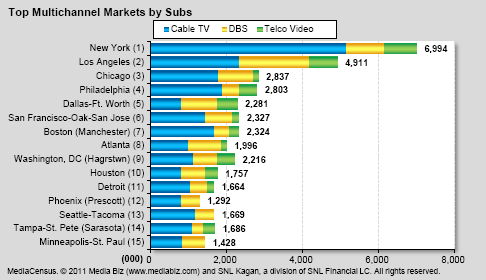
Cable TV Subs Drop in First Quarter 2011, 8% on an Annual Basis

SNL ImageCable subscribers declined as much as eight percent on an annual basis in the top 15 markets in the first quarter of 2011, balanced by strong growth in telco TV and mixed results in DBS subs, SNL Kagan reports.

Overall, cable subscribers dropped from 24.1 million to 23.2 million in the top 15 markets, year over year, about 900,000 on a national basis.

Cable subscriber losses were the greatest in Dallas and Atlanta, markets where telco video subs increased 7.8 percent and 29 percent, respectively. Year-over-year DBS subs dropped 5.1 percent from the first quarter of 2010 in Atlanta, but grew nearly four percent in Washington, D.C., and Houston.

Telco video subs increased nearly 51 percent in Los Angeles.

41% of T-Mobile Retail Locations Could Close After Merger

T-Mobile retail stores are starting to closeOne of the dangers for T-Mobile USA is what happens if the deal is not approved. Not only will T-Mobile USA have lost customers, it might also have lost retail partners and more than a year's worth of marketing effort.

Foursquare Goes National with American Express

Last March, foursquare conducted a test with American Express, allowing users to link their AmEx and foursquare accounts, spend at least $5 at a local merchant in Austin, and get a $5 savings applied directly to your monthly statement.

Now the partnership is going national. Across the whole country, at select merchants, you can now check-in with foursquare, pay with your American Express card, and get big savings on your monthly statement.

There’s no cutting out coupons or showing your phone to the cashier. The savings are automatically credited to your account within a few days. The deal is one way "payments" are being integrated with other activities, ranging from check-ins and offers to advertising and in-store promotion,.

Verizon Open to Featuring Netflix on FiOS TV

Would Verizon feature Netflix on FiOS? Possibly, Verizon says. “The answer is definitely not no,” says Eric Bruno,Verizon FIOS SVP.

“People are going there anyway. If they are going there anyway I would rather have them go to Verizon.” And Bruno says Verizon would be open to doing the same thing with YouTube.

See the video here.

Loopt Aggregates Buyers, Then Finds Sellers

There are several ways to approach the aggregation of "deals" to offer consumers. One can aggregate deals first, then match with consumers who want them. Or you can aggregate demand first, then find retailers to supply the demand. The latter is what Loopt is attempting.

Can a Good End be Produced by a Bad Means?

The U.S. Supreme Court has ruled, in a 6-3 decision, that Louisiana’s new congressional map, which includes districts based on race, is unco...