Saturday, August 27, 2011

Odds of AT&T Getting Regulatory Clearance to Buy T-Mobile USA Now 50-50?

Analyst sentiment that the AT&T purchase of T-Mobile USA will win regulatory clearance have dropped, at least among 32 analysts polled by Stifel Nicolaus & Co. analysts Rebecca Arbogast and David Kaut.

The observers rated their expectation for approval on a scale of 0-to-100 percent, and the average of their answers fell to 49.5 percent in August from 54.7 percent in July, the analysts said.

Eight of those who think approval is unlikely deepened their conviction, and six of those who expect approval expressed less certainty.

Friday, August 26, 2011

Facebook ending Deals product after four-month test

Facebook says it is ending "Facebook Deals," its daily deal business, after four months of testing. It isn't immediately clear what the suspension means. Some had thought, when Facebook Deals was launched, that more-established providers such as Groupon and LivingSocial would be crushed by Facebook Deals. Deals was supposed to crush Groupon, LivingSocial.


In part, that view was driven by some "unusual" features. For starters, Facebook was not going to take any of the retailer revenue. Facebook also was going to integrate "Credits," its virtual currency. Facebook Deals advantages


It isn't clear at all that the end of what Facebook calls a test is the final word in terms of Facebook's involvement in offers and coupons. In fact, some of us would say that the longer-term future probably has offers being integrated more directly with "mobile payments" and "commerce" features and functions. There is plenty of time for Facebook to figure out where it wants to play in those other areas as well.

And when those other elements are clear, Facebook has many options.

Apple Believes in Ecosystems

Salesforce CEO Marc Benioff talks about help from Steve Jobs, Apple CEO. He says that in 2003 Jobs praised Salesforce’s “fantastic enterprise application” and advised him to dream bigger and think about the wider “ecosystem.”

Salesforce took it at face value and built an app store of sorts dubbed "App Exchange." However, they loved the app store term so much that they bought a URL and trademarked it. Benioff says he gave the trademark and URL to Apple.


Apple planned ecosystem all along?

Why are Infographics so Popular These Days?

Why are infographics so popular these days? Joe Chernov, VP of content marketing at Eloqua, notes that infographics are not new.  He says that they are simple, sharable and they have status, meaning there's a thrill of discovery with good ones.

Eloqua found that infographics are driving more traffic to blogs, were tops in driving from complettions, generate more PR than any other corporate news, and went on to correlate to sales.

How Mobile Networks Will Expand Capacity 1,000 Times by 2020

Extrapolations of current growth trends predict that networks need to be prepared to support up to a thousand-fold increase in total mobile broadband traffic by 2020. 

This figure assumes a ten-fold increase in broadband mobile subscribers and up to 100 times higher traffic per user (beyond 1 GBytes per subscriber per day), with smart phones and similar connected devices experiencing the fastest growth.


You might wonder how networks can increase capacity by perhaps 1,000 times between now and 2020 or so. Nokia Siemen thinks it will take a combination of inputs, including 10 times more spectrum, plus an order of magnitude better spectral efficiency (10 times improvement) and then 10 times denser radio networks.

Manhattan's "Silicon Square"

Manhattan's new "Silicon Square" is clustered around Union Square. Good subway connections and restaurants are said to be the reason.

Union Square is "Silicon Square"

Will Apple Put Brakes on Itself?

As the Wall Street Journal reports that Apple has developed a system to deliver video directly to TVs, and is considering whether to launch a subscription service, there's an inkling of how things really will be different at Apple, all protestations to the contrary.

"Even if Mr. Cook (new Apple CEO Tim Cook) is willing to take the kind of risks that Mr. Jobs did, the company's board will likely scrutinize his moves more carefully, said Forrester Research Chief Executive George Colony," the newspaper reports.

"It will be very reasoned and logical, but Apple will not take the leaps that it took when you had Steve in that chair," said Colony.

Some would argue it was precisely such leaps that lead Apple to its dominance of several markets. If the board, or Apple's management, now starts to behave more like other boards and managements, Apple will not be able to make the bold leaps it has in the past, some of us would argue.

It is true that Apple's corporate culture now has been shaped in the image of Steve Jobs. That will be helpful in many ways. What cannot really be replicated, by most accounts, is the force of personality and singular ability to "get his way" that allowed Apple to make bold, risky moves few, if any, other companies would take.

Management skill isn't really the issue. Apple under Tim Cook will be well managed. And, for the moment, the design and marketing teams remain intact. But Apple didn't reach its current position because it was well managed. It creates and dominates new markets precisely because of a creative vision Steve Jobs uniquely seems to exercise among top CEOs.

Successor Faces Tough Job at Apple (subscription required)

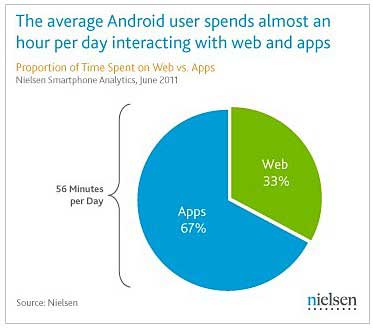
Android Mobile Users Spend 67% of Time with Apps


Android owners in the US spent an average of 56 minutes per day interacting with the Web and apps on their phones in June 2011.

About 67 percent was spent using mobile apps while a third (33 percent) was spent browsing the mobile Web, according to a report from Nielsen.
The "long tail" seems to operate, though. Despite the hundreds of thousands of apps available for the Google Android OS, a very small proportion of apps make up most of the time spent on such devices.

For example, the top 10 Android apps accounted for 43 percent of the total time spent by Android consumers on mobile apps in June.

The top 50 apps accounted for 61% of all time spent using apps. That finding implies that with 250,000+ Android apps available on the market (as of June), the remaining 249,950+ apps are competing for the remaining 39% of the mobile apps pie.

The "long tail" is basically the "Pareto" theorem, which most people popularly know as the 80/20 rule. Simply, 20 percent of causes represent 80 percent of effects.

In an application store, Pareto means that only a handful of applications will be most used. In the case of the Android Market, 61 percent of the app usage comes from two-hundredths of one percent of the available apps. 

Android apps popular, have a long tail

Google Shuts Slide Gaming Business

Failure is never an easy thing for any executive to deal with, or to welcome. It doesn't matter that management consultants routinely urge companies to "try things and fail faster," to get to the winners.

In that vein, Google is shutting Slide, the social-gaming business it bought for about $200 million in 2010. It wouldn't be the first time a Google experiment has failed. Google tries lots of things.

But it takes deep pockets to shut down a line of business purchased within the last 12 months for that much money. Perhaps we ought to be happy there are firms which can spend that much money "trying things," with the ability to shut them down quickly if they don't get traction.

Google's thinking was solid, when the deal was done. As gaming as proven to be so sticky for Facebook, Google was looking for a way to add stickiness to its own social offerings. We all suspect gaming will be coming to Google+ in a bigger way, for that reason.

Thursday, August 25, 2011

Jobs Exit Might Open Some Doors, But When?

Few, if any observers seem to believe Apple's market success will change soon, just because Steve Jobs has stepped away from his CEO role. There are some who think Apple will start to be more vulnerable at some point, though.

"What this will do is clearly embolden the competitors, because a lot of them think they just can't compete with Steve Jobs," said Rob Enderle, principal analyst with the Enderle Group, whose clients include Apple rivals such as Microsoft, Lenovo and Dell.

Some think Apple should start making changes, though. "Now that Jobs has stepped down, however, Apple has a great opportunity," argues PC World. "Rather than maintain its completely closed and locked-down approach to the technologies it makes, the time is right for Apple to open up." Apple needs to "open up?"

That seems to fly in the face of moves by many of Apple's competitors in the other direction, of copying Apple's tight integration of hardware and software. Some say Google's purchase of Motorola is a step in that direction.

"It's all about if Apple at some point makes a significantly bad decision," said Georges Nahon, the CEO at Orange Labs, a division of France Telecom SA. Jobs exit opens door Apple rivals

Some might say any move by Apple to "open up" would count as such a bad decision. 

Internet and Deregulation


There is a curios paradox about the way people think about the Telecommunications Act of 1996. Many people in favor of deregulation and competition would say it failed to bring about enough sustainable competition. In other words, it failed. On the other hand, you'd be very hard pressed to find anybody who actually believes their own communications services are in any way worse than they were before the Telecom Act was passed. In most cases, those same people would have a hard time claiming they are spending more money than they used to, for the same basket of services they bought pre-1996.

It is true that many of us are spending as much, or more, than before 1996, but it also is true we are buying lots more services, using more features and devices than before. The obvious way to reconcile those facts is to say that it was the Internet, and applications built on it, that really have lead to better consumer outcomes, for the most part.

Put another way, things got better, even though the Telecom Act failed, for other reasons. Where the Telecom Act attempted to introduce more competition in voice, the Internet was where the locus of innovation was passing. Even if matters had changed further in the direction of what new contestants would have preferred, would that have changed the fundamental direction we are headed?

The "voice" era was ending in any case, with innovation increasingly driven by broadband access and Internet, mobile and Web applications that rely on broadband.

Internet innovation succeeded, even if Telecom Act did not

Cable Still Leading Telcos in New Broadband Subscriptions


Leichtman Research Group, Inc. says  the eighteen largest cable and telephone providers in the United States, representing about 93 percent of the market, acquired about 350,000 net additional high-speed Internet subscribers in the second quarter of 2011. That represents the second lowest level of net additions LRG has tracked, historically.

The top cable companies accounted for 77 percent of the net broadband additions for the quarter. The largest phone companies added about 80,000 subscribers during the quarter, compared to a net loss of 10,000 subscribers in the second quarter of 2010.

AT&T and Verizon added 628,000 fiber subscribers in the quarter (U-verse and FiOS), while having a net loss of 578,000 DSL subscribers.

The top cable companies added over 270,000 broadband subscribers in the quarter. The top cable broadband providers have a 56 percent share of the overall market, with 8.9 million more subscribers than the top telephone companies, compared to 7.85 million this time a year ago.

Second quarter 2011 broadband additions

After Virginia Earthquake, Here's How Twitter-verse Reacted


Twitter reaction to quake

Steve Jobs, Life and Career in Animation

Mobile Hype Cycle Could be at a Peak: Why Does That Mean?


The 2011 KPMG Mobile Payments Outlook, based on a survey of nearly 1,000 executives primarily in the financial services, technology, telecommunications, and retail industries globally found that 83 percent of the respondents believe that mobile payments will be mainstream within four years (by 2015). In fact, 46 percent believe mobile payments will be mainstream within two years.

But there is room to disagree about the accuracy of those projections. One might argue that forecasts of this sort are notoriously unreliable, with respondents overestimating near term prospects.

Analysts at Gartner, for example, use a model of how expectations for significant new technologies running in a predictable cycle. What the cycle suggests is that expectations nearly always (always, according to the model) run ahead of marketplace acceptance.

What the Gartner hype cycle suggests is that expectations for mobile payments using near field communications are at a point where we can expect five to 10 years to elapse until NFC actually begins to make serious inroads as an adopted mainstream technology. The emphasis probably is important to note: “begins.”

But KPMG analysts take the opposite view, arguing that respondents are too pessimistic. “We believe that exploding smart phone growth and myriad opportunities will grow mobile payments at a much faster rate than our respondents anticipate,” said Gary Matuszak, KPMG Global Chair of the Technology, Communication and Entertainment practice.

“While KPMG believes that these forms of mobile payment will all gain some traction, our view is that mobile wallet is one of the most exciting and promising payment opportunities,” analysts say.

Mobile wallet provides the momentum to move beyond payments to participate in the entire chain of mobile commerce, from consideration and brand awareness to purchase after-sales loyalty and care,” said Tudor Aw, Technology Sector Head, KPMG Europe.
Banks, mobile service providers have key roles in mobile payment

If Gartner analysts are right about the near field communications "hype cycle," we should soon see some public "disillusionment" expressed about near term prospects for NFC. The reason is that Gartner now sees NFC at the "top" of its hype cycle, the point at which overly-optimistic projections face the reality of an extended period of development, before something "useful" actually emerges.

Internet TV, NFC payment and private cloud computing all are at what Garner calls the "Peak of Inflated Expectations," which is always followed by a period where the hype is viewed as outrunning the actual market. That suggests NFC soon will enter a phase where expectations are more measured.

In fact, Gartner now expects it will take five to 10 years before NFC is in widespread and mainstream use. Gartner's latest expectation likewise is that cloud computing and machine-to-machine applications will not be mainstream for another five to 10 years as well. Gartner's 2011 Hype Cycle

The Best Argument for Sustainable Neocloud Role in the AI Ecosystem

Perhaps the “best” argument for a permanent role for neocloud service providers is the relevance of enterprise private cloud inference serv...