Friday, December 2, 2011

Comcast, Time Warner Cable, Bright House Sell Spectrum to Verizon


SpectrumCo, LLC, a joint venture between Comcast Corporation, Time Warner Cable, and Bright House Networks, is selling Verizon Wireless its 122 Advanced Wireless Services spectrum licenses covering 259 million POPs for $3.6 billion. What might be noteworthy is the strategic change of direction. The cable companies purchased the AWS spectrum at least in part as a potential foundation for wireless service.

The sale, and the agreement by the owners to resell Verizon Wireless services instead, suggests the cable operators once again have decided that they could not create independent wireless operations.

Moreover, given the business relationship cable companies have had with Sprint since at least 1994, the move also suggests that the cable operators are breaking with the idea of Sprint as a strategic partner. Since cable companies have been among the potential buyers of Sprint Nextel, the latest moves would seem to indicate no interest in that area.

Cable TV operators have been spending money to get into the wireless business for decades, with little success. In 1994 Sprint, Tele-Communications, Comcast and Cox Cable formed a joint venture to build a nationwide network to provide wireless service.

However in 1998, Sprint assumed control of the business and bought the cable companies' interest in the company.

In 2005 Comcast, Cox, Time Warner and Advance/Newhouse formed a joint venture with Sprint Nextel to provide a quad-play cable TV, high-speed data, landline and wireless service to their customers. But the quad-play idea never panned out and Pivot never grew beyond the initial 33 markets Sprint launched in November 2007.

Sprint said that Pivot was being hindered by provisioning issues. Time Warner later said that demand for Pivot services was "tepid." Pivot users eventually were given the option of switching to Sprint's regular service.

In 2008, Sprint and Clearwire announced that they would combine their WiMAX businesses and create a new company that would include a $3.2 billion investment from Intel, Google, Comcast, Time Warner Cable, Bright House Networks and Trilogy Equity Partners.  Cable wireless history

Recently, Cox Communications decided to shutter its own wireless business as well.

Comcast owns 63.6 percent of SpectrumCo and will receive approximately $2.3 billion from the sale. Time Warner Cable owns 31.2 percent of SpectrumCo and will receive approximately $1.1 billion. Bright House Networks owns 5.3 percent of SpectrumCo and will receive approximately $189 million. Comcast, Time Warner Cable sell spectrum to Verizon

Rogers Exec Calls for 100% Availability of Ethernet Services

Cable companies have a major opportunity to win enterprise business away from telcos, but need to interconnect their networks to provide national coverage and deliver higher-quality customer service, Terry Canning, senior vice president of Canada-based Rogers Business Solutions, says.


"Telcos were built on five-nines, but they stopped there," Canning said. "We have the opportunity to win huge shares of marketplace if we pursue 100. But we're not there yet." MSOs Can Outdo Telcos in Ethernet


The need for 100 percent availability is particularly important as more enterprises move critical applications into the cloud and rely on network connections into the cloud for those applications, he said.

Whether in actual fact any communications service can reach 100-percent availability, and still be profitable, is the issue.

The issue of national interconnects between major local cable companies is a related, but separate, issue. Where cable is disadvantaged, compared to telcos, is in going outside the typical regional footprint of a cable operator to serve national and multinational enterprises, he said. 


Rogers is developing network-to-network interfaces to interconnect with other cable operators, but more work is needed to develop a standard product set across the cable industry. That impediment also illustrates the issues faced by the cable industry. Unlike the telecom industry, which builds every network element and system for interconnection, cable operators traditionally have not needed to do so.

Cable also must overcome its reputation as a "best effort" service provider by delivering higher-quality customer service to its most important customers, Canning said.

YouTube Now More Like TV

YouTube now features a few new changes that make the experience more like TV, especially the "channels" format. Now if Google can someday acquire more "TV" content to fill those channels, we can better a better sense for the actual shifts in user behavior many have been predicting ultimately will happen.


Cable Success in Mid-Market Requires Changes

David Strauss, a cable industry consultant, explains what cable operators in the U.S. market must add to their playbooks as they target mid-sized businesses more aggressively. Cable Expands Its Business Game

Up to this point cable has been most successful in the small business segment (a dozen to 16 phone lines).

Thursday, December 1, 2011

Google Delivery Service Protects Search

You might think a shipping service for online products is directly related to protecting the value of a search business, but that is precisely what Google believes. The problem, in a nutshell, is that Amazon Prime, and perhaps Amazon in general, often becomes the "go to" search engine when people are shopping online.

So Google is in talks with major retailers and shippers to create a service that lets consumers shop for goods on the Web and receive orders within a day for a low fee, all as a way of bolstering the use of Google's search engine for e-commerce activities.

Amazon's growth has surged in recent years with the help of a service called Prime that allows people to receive many items they order from the site in a day or two for a $79 annual fee, analysts say. Google, Retailers in Fast-Delivery Talks

For Google, the issue is that when users bypass Google's search engine and go straight to Amazon, Google's advertising model is threatened.

Revenues from Multiscreen Content Platforms to Top $21 Billion in 2015?

New NPD In-Stat research forecasts that revenues from multi-screen content platforms will top $21 billion in 2015. Asia Pacific will have the most active multi-screen households by 2015, and 273 million households will be using some kind of multi-screen service by 2015.


Precisely what that revenue forecast actually means is an issue, though. As is the case for triple-play services, the precise revenue contribution from each of the constituent parts is an accounting issue. 

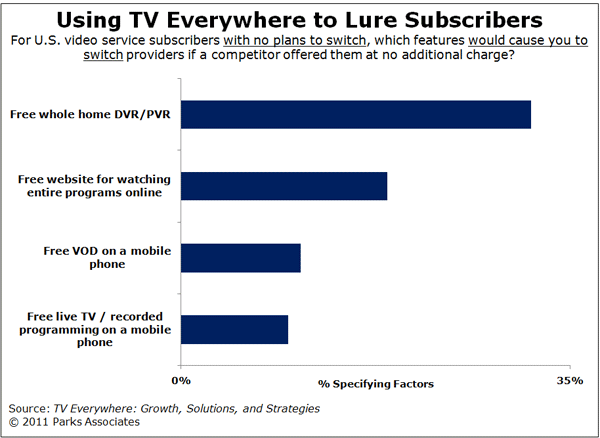
All revenue forecasts for "TV everywhere" or "multi-screen" video entertainment services faces the same issue. When the ability to stream some content to a tablet or smart phone, within a home, is bundled with a cable TV subscription, how does one attribute the revenue? 


If an additional fee is assessed, the issue is clearer, but that might not be the dominant way such services are sold to consumers. 


Multiscreen Content Platforms to Top $21 Billion in 2015

HTC, Sprint Acknowledge Using Carrier IQ Software But Deny Snooping

Sprint and HTC apparently use a diagnostic application called "Carrier IQ" that can record keystrokes and even encrypted search terms on some smart phones.

Sprint and HTC say the software is used for ordinary diagnostic reports needed to help improve the performance of mobile devices and mobile networks. HTC, Sprint Acknowledge Using Carrier IQ Software

Carrier IQ Logs Smart Phone Keystrokes

In November 2011, security researcher Trevor Eckhart announced that he found software made by Carrier IQ that may be logging your every move on your mobile phone. 


Trevor referred to it as a "rootkit", a piece of software that hides itself while utilizing privileged access like watching your every move. Carrier IQ didn't take too kindly to this accusation, and responded aggressively with a cease-and-desist letter, and went on to deny this accusation. However, to further back his accusation, Eckhart released a video that he says shows the software working. 


.

Mobile Commerce Will Grow 73% in 2012


US M-Commerce Sales, 2010-2015 (billions and % change)U.S. mobile commerce sales will reach $6.7 billion this year, a tiny fraction of overall retail sales, but a 91.4 percent increase over 2010. In 2012, sales will rise another 73.1 percent, to $11.6 billion, according to eMarketer.  Growing mobile commerce activity

M-commerce sales include sales of physical goods as well as travel and event tickets purchased via mobile, but exclude digital downloads and usage of mobile phones as a point-of-sale payment mechanism, the way eMarketer analyzes the market.

Also, eMarketer forecasts 37.5 million US consumers ages 14 and up will make at least one purchase on their mobile phone in 2012, up from 26.8 million in 2011.  Overall, 72.8 million mobile users will research or browse items on their phone next year, but not necessarily make a purchase.

US Mobile Buyers, 2010-2015
But mobile commerce, like all other new consumer behaviors, is a habit that takes some time to develop. Over half of consumers would prefer to receive coupons by e-mail and about 30 percent would like them to be delivered using text messaging or instant messaging,  eMarketer also notes.
Mobile Coupons: Growing But Consumers Are Still Afraid

History of U.S. Telco Consolidation

A Tangled Family Tree

Sprint Rescues Clearwire


Sprint has agreed to pay up to $1.6 billion to struggling wholesale wireless provider Clearwire over the next four years, ending the near-term threat that Clearwire could run out of cash to operate its business and possibly enter bankruptcy.

In large part, that is why Clearwire has made interest payments totaling $237 million on its first-priority, second-priority and exchangeable notes which were due Dec. 1, 2011, and which had been in danger of default by Clearwire.

The deal includes possible pre-payments for LTE services and potential equity investments. Sprint has committed to providing additional equity funding to Clearwire in the event of a future Clearwire equity offering. If Clearwire raises new equity between $400 million and $700 million, Sprint will participate in the offering on a pro rata basis up to $347 million, consistent with Sprint’s current voting interest of 49.6 percent on the same terms and conditions as other participating companies. 

The agreements modify prior wholesale pricing agreements and provide Sprint with unlimited access to Clearwire’s WiMAX network. Under the terms of the agreements, Sprint will pay Clearwire a total of $926 million, approximately two thirds of which will be paid in 2012, for unlimited 4G WiMAX retail services during 2012 and 2013, subject to certain conditions.

The agreements also establish long-term usage-based pricing for WiMAX services in 2014 and beyond. Sprint will have access to Clearwire’s WiMAX network through at least 2015.

Sprint plans to continue selling WiMAX devices with two-year contracts through at least 2012 and support those devices through the life of the contract.

In addition, the agreement provides Sprint competitive pricing for re-wholesaling by Sprint of WiMAX services to third parties as well as increased pricing flexibility for Clearwire’s own wholesale business.  

Dan Hesse, Sprint CEO says the deal “provides Sprint improved pricing, allows us to continue to provide WiMAX 4G services to our customers today and to new customers in the future and provides additional LTE capacity to help complement our ‘Network Vision’ strategy and meet our customers’ growing data demands.”  Sprint funds Clearwire

In October, Clearwire reported that it was discussing the possibility of skipping an interest payment on debt it owes. While the WiMax network isn’t the future of Sprint’s Long Term Evolution strategy, it’s essential, at least for the moment, for supporting millions of Sprint 4G customers.

As part of the deal, Clearwire agreed to keep its WiMax network operational until 2015, which will give both companies time to build out their own LTE high-speed network.

The financing from Sprint gives Clearwire $926 million for unlimited network use for 2012 through 2013. The remaining financing is a prepaid fee for Sprint to use Clearwire’s LTE network, which should be available by June 2013.

Some had speculated that Sprint might be better served to let Clearwire go into bankruptcy, then buy the assets. But that approach would not automatically allow Sprint to secure the spectrum Clearwire now uses. The latest infusion of capital gives Sprint a better bridge to its own LTE future, at the very least.

AT&T Mulls Joint Venture With T-Mobile USA as Fallback Position

AT&T and Deutsche Telekom may go for a joint ventureAT&T and Deutsche Telekom, the parent of T-Mobile USA, have discussed an alternative transaction, forming a joint venture that would pool network assets from the two U.S. wireless carriers, as a potential alternative plan if their current acquisition deal falls apart, the Wall Street Journal reports. 


But it isn't clear that the talks are active. "There are currently no talks about a (network sharing) joint venture," Reuters reports. "This would signal that they have given up. This is not the case, we're still betting on victory, not on the second-best solution," Reuters reports a source has said. 

At least in principle, such a move could create a sort of functional separation between AT&T and T-Mobile USA retail operations and the networks on which those services are provided. Such infrastructure sharing deals have grown more common, as mobile service providers agree to share tower sites and radio facilities as a way of reducing capital investment for new networks. AT&T Mulls Joint Venture With T-Mobile


The possible infrastructure joint venture would have a different business driver, namely allowing each firm to better use their shared spectrum and radio network. In such a deal AT&T would not have to worry about antitrust concerns, as the two firms would separately maintain their distinct retail customer bases and operations. 


On the other hand, such a deal could complicate any future efforts by T-Mobile USA to sell itself outright. 

Tablets cannibalizing TV viewing, says Orange

Tablets compete with television viewing, while smart phones complement it, a new study sponsored by service provider Orange suggests. In the United Kingdom, for example, 35 percent of tablet users watch on demand content, 40 percent watch streamed content and 39 percent watch live TV on their devices.


By contrast, the study also found that smartphones are complementing TV consumption. In France, 19 percent of users said they watch more TV as a result of their mobile media usage. Tablets cannibalizing TV viewing, says Orange study 


Word of Mouth Works

Columbia sociologists Lazarsfeld and Katz estimated that word of mouth was seven times more powerful that newspaper or magazine ads in motivating brand-switching as early as 1955.

In 1975, the Roper Organization showed that word of mouth was mentioned as the best source of information about new products and services 67% better than advertising at 53% or editorial content at 47%.

A 2003 Cap Gemini study (cited by AdAge in TV Ads Don't Sell Cars) into the influences on car purchases showed that 71% of the 700 respondents pointed to word of mouth compared to only 15% for television ads. McKinsey estimated that word of mouth drives two thirds of the US economy. Conversation Agent: Permission is an Asset

That's basically why social media work: they are updated, more efficient word of mouth mechanisms.

MasterCard invests in mFoundry

MasterCard has made an investment in mFoundry, the developer of mobile banking, payment and commerce solutions that created the Starbucks mobile payment system. MasterCard also seems to be interested in mFoundry's relationships with hundreds of banking institutions that have created their own branded apps. 


Intel Capital, Fidelity Information Services and Motorola Mobility also are said to be part of the funding round for mFoundry. Previous investors include PayPal and NCR. The list of backers illustrates some of the dimensions of the developing mobile commerce ecosystem, which includes mobile handset, payment clearing network, retailer terminal, mobile wallet and mobile advertising and marketing functions as well.


For the past five years mFoundry has been developing mobile banking applications for banks that typically enable users to check their balances and conduct other financial services from their phone.


Going forward, MasterCard wants to work with mFoundry to enable those applications to make payments at the register using MasterCard’s near-field communication (NFC) technology called "PayPass." MasterCard invests in mFoundry


Yes, Follow the Data. Even if it Does Not Fit Your Agenda

When people argue we need to “follow the science” that should be true in all cases, not only in cases where the data fits one’s political pr...