Wednesday, January 11, 2012

Screen Size Matters, But Mobiles are About Content Consumption

Mobile device screen size should make a difference in user behavior, one reasonably would expect, with lead applications varying with size of screen and input method. "Specifically, larger screen devices seem to fulfill productive needs while smaller screen devices tend to satisfy communication or entertainment needs," say researchers at In-Stat.

That should make sense. But the reported behavior might not always match actual behavior, particularly for tablets. PCs of all types remain a virtual requirement for content creation, while a variety of appliances can be used for content consumption.

Tablets and smaller-screen devices arguably represent a different lead experience, even though PCs, tablets and smart phones all are multi-purpose devices. That is to say, PCs (desktops and notebooks) can be used to consume or create content, but are virtually a requirement for creating content more complex than email or text messages.

Smart phones arguably still are balanced "communication" and "content consumption" devices. And though in surveys people tend to suggest they "work" on tablets, much of that "work" is one form or another of content consumption.

“The majority of tablet owners have a screen size between 9 and 11 inches, a size optimized for sophisticated uses that require a lot of interaction,” says Stephanie Ethier, In-Stat senior analyst. “The top uses for tablets are web browsing, email, and downloading and using applications, which are productivity-based uses. "

Portable media players, which can be virtually identical to tablets except for the smaller-than-5-inch screen, are used primarily to support entertainment-focused uses, like listening to music and watching video,” she says.

My own non-scientific observation is that tablets get used more often for "entertainment" than for work, though the "productivity" argument is used to justify buying them.


Tuesday, January 10, 2012

Google Social Search Will Change SEO, Again

Not everybody will care, but Google's new "social" and "location" and "personal" approach to search is going to have some implications for the way search engine optimization gets done, not least of all because Google+ entries now apparently become part of the ranking algorithm. Google search gets more social

Instead of trying to figure out how to get sites to appear high up in organic search results, businesses will have to figure out how to attract real people to post information about them on Google. Google Search 

Google Wants to Buy T-Mobile USA?


You can expect to hear lots of rumors about "who wants to buy T-Mobile USA" in the coming months, if only because T-Mobile USA parent Deutsche Telekom really needs a "plan B" that allows it to gracefully exit the U.S. market and redeploy capital elsewhere.

In that vein, SNL Kagan says it has been told both Dish Network and Google have submitted formal offers to buy the firm. One never knows whether, in fact, such bids have been made, or how serious such bids might be.  Rumors of that sort get "leaked" all the time as trial balloons, sometimes in hopes of spurring serious thinking on a transaction.

That Dish Network plans to build a Long Term Evolution fourth generation network is not in doubt, and Dish executives have not shied away from saying they will buy or build as makes sense, financially.

A Google bid would be more complicated, given Google's status as primary backer of an open mobile operating system and owner of Motorola Mobility, a handset manufacturer and retailer. But, these days, it is quite hard to avoid all possible channel conflict.

Most people can think of all sorts of reasons why Google would not want to own T-Mobile USA. Operating a service provider business is a lower-margin business than Google is used to, is a difficult business that might slow the rest of Google down, raise new regulatory concerns and also make many of its other businesses a bit harder to run.

On the other hand, most people could probably think up ways it would benefit Google's other mobile-related businesses if Google had a ready made way to create products, define handsets and then get quick adoption in the market on at least one leading network.

It's the sort of thinking one suspects is happening at Amazon, about why it wants to be a supplier of tablet devices, and might well want to get into the smart phone business as well.

Smart phones and tablets both have become important content consumption platforms, and both Amazon and Google are in the content business, in different ways.

But it's just a rumor, at the moment.

Intuit Launches GoPayment Mobile Payments in Canada

Mobile Marketing Intuit Begins Global Push with GoPayment Mobile Payment SolutionIntuit's "GoPayment" dongle system, now is available in Canada. GoPayment is similar to Square, so if you understand what Square does, you also understand GoPayment.

The basic idea is simple, and elegant. Merchants often want to sell products in locations where a cash register and credit card terminal are not available.

In other cases a merchant cannot justify the cost of owning and operating such equipment. GoPayment turns an Apple iPhone, Android phone or a BlackBerry phone into a terminal that can accept debit cards and credit cards.


Google Social Search

Google search keeps getting more social, adding the ability to integrate web content, profiles, personal results and other content, including local content.

Social Search will include Google+ posts, for example plus user personal photos, making any single user's search results highly personal (and private).


Now, typing just the first few letters of a friend’s name brings up a personalized profile prediction in "autocomplete" mode. A results page for a friend will include information from their Google+ profile and relevant web results that may be related to them.


In addition, you’ll find profile autocomplete predictions for various prominent people from Google+, such as high-quality authors from our authorship pilot program.


Once you select that profile, if you’re a signed-in Google+ user, you’ll also see a button to add them to your circles right on your search results page.
Since some of the information you’ll now find in search results, including Google+ posts and private photos, is already secured by SSL encryption on Google+, Google decided that the results page should also have the same level of security and privacy protection.

"Search plus Your World" will become available in mid-January 2012  to people who are signed in and searching on https://www.google.com in English.

"Next Big Thing" Will be Mobile-Related, But Give it a Couple Years

Consumer-Electronics-Global-Overview-Growth-Trends-and-Analysis
Hot new mobile devices have been the big reason people have spent money on mobile services over the last several years, you might argue. For starters, it often is impossible to purchase a device without also buying other products, such as mobile data plans.

You can get a tablet and use Wi-Fi for connectivity, but in the U.S. market, for example, it is virtually impossible to buy a smart phone without an accompanying data plan. The caveat: you can buy a full price, "unlocked" smart phone, not from a service provider. But almost nobody does this.

With the Consumer Electronics Show now in full swing, you will not be able to avoid hearing about the "next big thing," or the "lack of the next big thing" coming out of CES. Sometimes the hype matches an eventual trend, and sometimes it does not, so be circumspect.

Among the devices of recent years to have been the "big thing" at CES are netbooks (up and down), 3D TVs (hasn't taken off), tablets (clear winner). But in decades past, there have been entire shows where nothing even that pronounced really has emerged. Some years, the industry itself looks only to refine an existing trend, because there is, in fact, no "hot" new product category.

To the extent you can say there is a "new category," it would be ultrabooks, the new "thin and light" notebook PCs that are supposed to compete with the Macbook Air. If you think about it, you can probably see the problem here. Most people do not buy the Macbook Air, when they buy a PC.

They mostly buy notebooks, it is true. But the Macbook is at the high end of the market, and most people do not buy products at the high end, in any market. So a reasonable person might argue that although ultrabooks are nice hardware, they will not create a big new market.

If pricing stays high, then few will be sold. If pricing drops, as virtually everybody expects, then ultrabooks will simply become the new form factor for many notebook PCs.

The other problem some might note is that with very few exceptions, hardware doesn't drive the market the way it used to. You can say the Apple iPhone did so, and you can argue the tablet does so. But PCs haven't created sizable new markets for some time. I'm not saying they are less useful, but it is an established category.

The other problem is that as most of a consumer's devices, and virtually all the portable devices, become multiple-purpose devices, more of the value has moved to software and communications. Some 48 percent of the respondents to a survey conducted by CTIA-The Wireless Association and conducted by Qualtrics say their mobiles have become their primary ways of using voice communications.

Also, when asked what they thought was the most important function of their mobile devices, 61 percent said the Internet; 42 percent said text messaging or instant messaging and 40 percent said voice. Smart phones are multi-function devices.

"You've got a computer in your pocket, you've got a computer in your briefcase, you've got a computer on your desk — and pretty soon you're going to have a computer in your TV — all running apps — and they're going to do most of what you want to do," says Selburn. "The problem is: How do you wrap up an app and put it under the tree at Christmas?" CES: No killer app?:

Some 48 percent of the respondents to a survey conducted by CTIA-The Wireless Association and conducted by Qualtrics say their mobiles have become their primary ways of using voice communications.

Also, when asked what they thought was the most important function of their mobile devices, 61 percent said the Internet; 42 percent said text messaging or instant messaging and  40 percent said voice.


It would be fair to note, with regard to CES or device trends in general, that we sometimes hit periods when there is no "hot new category." Tablets were the last clear winner. But that doesn't happen every year. Ultrabooks are interesting. But it is reasonable to ask whether they can create a whole new category, or simply change an existing category in some significant way.

Communications Overload?

Communications overload
Communications overload has gotten to be a more-frequent topic in the last decade, as the types of channels and variety of tools has exploded. That has lead to some thinking on the part of enterprises, for example, about how to limit and manage communications overhead.

Recently, French IT service provider ATOS Origin announced its intention to be e-mail free for communication between employees in three years. CEO Thierry Breton cited the move as a response to the data explosion that has managers spending five to 20 hours a week attending to e-mail and 25 percent of time at work searching browsers and social network sites.

A part of their solution is to replacee-mail with more efficient social community platforms that bracket communications and assemble information by communities of interest. Another? Restrict non-work browsing. Should You Dump E-mail?

Some of us probably are skeptical that anything other than "unplugging" or "ignoring" messages will work. The whole movement of communications in recent years has been towards "ubiquity" in terms of ability to reach people anytime, anywhere, using a variety of modes including social networks, instant messaging, blogs, text messages, voice, email, tweets, video messages and more unified communications software.

Mobile communications, which according to some studies already is the preferred mode of voice communications, and rapidly becoming the main messaging platform and Internet access portal as well, is a key contributor.


DeviceMore this yearMore next year
Mobile33.6%39.1%
E-mail38.4%34.2%
Texting (SMS)30.7%32.2%
Social networks26.5%26.2%
Desktop video12.8%26%
Instant messaging18.6%21.3%
VoiP calling12.1%21.3%
Source: Skype (December 2010)


Monday, January 9, 2012

48% Say Mobile is "Primary" Voice Channel

Some 48 percent of the respondents to a survey conducted by CTIA-The Wireless Association and conducted by Qualtrics say their mobiles have become their primary ways of using voice communications.

Also, when asked what they thought was the most important function of their mobile devices, 61 percent said the Internet; 42 percent said text messaging or instant messaging and  40 percent said voice.

Not only has mobile become the primary voice tool for nearly half of respondents, Internet access and messaging were deemed more important than voice.

The survey of about 1,000 U.S. female mobile users also shows that substantial percentages of respondents likewise rely on mobiles as their primary way of accessing the Internet.

More than 38 percent of the women said their mobile devices were their main access point to the Internet and almost a third (32 percent) said mobile broadband had replaced their traditional Internet service.

Wireless substitution, one might argue, has reached truly significant levels. The survey does not, in and of itself, suggest how fast users might decide they do not use, and do not need, their fixed network voice lines.

The public results did not suggest that those same percentages of respondents have stopped buying landline voice service, only that, of the two forms--wireless and fixed--nearly half have shifted their primary voice activities to mobiles.

Apple's Enterprise "Trojan Horse" Strategy is Working

Steve Jobs famously argued that he'd rather sell to consumers than businesses, because he'd rather sell directly to an end user than a third party. It would appear that Apple's prospects are improving, in part because enterprises are more lenient these days about allowing some employees to use their own tools. Consumer markets more sustainable

But lately Apple has been able to use a "Trojan Horse" strategy, selling products to lead business buyers who have acquired and prefer Apple products in their roles as consumers. Tablets and iPhones are the two best examples.


Millennials Prefer Smaller Companies? Perhaps, But What Does it Mean?

Only seven percent of the Gen-Y generation (some say this is people roughly 18 to 29, other might use a slightly-different age range) works for a Fortune 500 company, according to Millennial Branding.

Some would argue the pattern exists because start-ups better reflect Gen-Y ("Millennial") values.

It is a simple demographic fact that Millennials will represent 75 percent of the workforce by 2025. But some might argue that "culture" and "values" have rather little to do with employment patterns of Millennials.

Since about 1980, enterprises, such as the "Fortune 500" firms, have been employing a smaller number of U.S. workers. Concurrently, there are more and more people working "for themselves," as well.
For example, “owner” is the  fifth most popular Millennial generation job title, according to Millennial Branding.

 Some would say this is because they are an "entrepreneurial" generation. Perhaps there is some truth to that characterization, but one might also note that the numbers and percentages of workers who work for smaller companies, or independently, have been climbing for decades.  Millennials choosing start-ups

So though it is possible that Millennials have a preference for start-ups, it also is possible that this simply is where the jobs are. The entire workforce has shifted since 1980 or so, one might argue.


Mobile Now Drives Enterprise Cloud Adoption

Up to this point, it might have been reasonable to consider the impact of "mobility" on enterprises mostly in relation to remote or distributed work, and separately from other trends, such as "consumerization" or "cloud computing," though all three are related.

Increasingly, though, it is looking as though mobility is now driving cloud adoption. That's new.

When cloud storage provider Box tracks its enterprise sales, it finds there has been a 30-fold increase in the number of enterprise deployments that are mobile-driven.
So while mobile user growth may be up nine times, enterprise activity is producing more revenue growth.

The Box enterprise customer base now includes 82 percent of the Fortune 500, the company says. Mobile drives cloud adoption

That mobile drives enterprise cloud computing adoption should not be surprising. Networked computing has been driving most application trends for some time. Most consumer apps now run in the cloud. And though enterprises can afford to run apps using their own data center infrastructure, it increasingly makes sense to create web interfaces for enterprise apps, whether the facilities are run "in the cloud" or on owned facilities.


Ultrabooks "Versus" Tablets? Sorta

I might be a complete contrarian, but I don't believe notebooks and tablets are "product substitutes." Most people do think about it that way, and there is a clear logic for doing so.

Will people spend incremental cash on a tablet or a PC? Yes. Will tablets displace many PCs in the workplace? Yes. Will tablets displace many PCs in consumer environments? Yes.

Given my agreement with all those propositions, why do I think tablets are, in fact, not replacements for PCs? For the same reason a high-end Lexus is not a product substitute for a SmartCar. It is true that both provide "transportation," but so do skateboards, bicycles, mopeds, motorcycles, buses, airplanes and trains.

My point is that we have had, for decades, a multi-purpose device, the PC, that has gotten more portable, and now mobile form factors over time. There are some instances where some users have considered even a BlackBerry smart phone a functional substitute for a notebook PC.

I know a few people who claim that, on business trips, they compose articles on BlackBerries. I wouldn't. Most people probably wouldn't, but some do. Smart phones as content consumption devices

Still, there will be many more people who routinely use a tablet as a substitute for a PC, some of the time, most of the time, or nearly all the time. But the notion of "substitute" implies, rather directly, than one product provides equivalent satisfactions for some problem or need.

It might be viewed as a technicality or just "semantics," but I'd argue that, for decades, the ways people use PC devices have changed, though our portals have not, quite so much.

If you at the "birth" of the PC, you will discover that a particular application, namely the spreadsheet, lead to rapid adoption of PCs as ways to enable scenario and modeling exercises by accountants and financial personnel. That generally remains the case: it is applications that create the demand for devices.

What some of us might say is that the tablet starkly illustrates the principle that devices get used because people want to use applications. And what tablets illustrate is the massive shift of application consumption from "work" or "content production" to "entertainment" and "content consumption." Content consumption

It's just that, up to this point, we have not made attractive content consumption devices available. To be sure, most tablet users do some amount of content creation on tablets, but it mostly takes the form of answering emails. Most of the other activities are one form or another of content consumption.

It's a matter of latent user behavior being "uncovered," more than the creation of a new product category, though clearly, that also has happened. As it turns out, most of us, most of the time, seem to use connected PCs to consumer content, and little time "creating" it. Ultrabooks vs tablets

The point is that PCs increasingly get used for content creation ("work"). Tablets get used for most of the other things people do on the Internet, which is consume content. 


Tim Tebow's "Immaculate Reception" in Overtime Against Steelers

Some still are skeptical about Tim Tebow's future as a star National Football League player. On the first play of overtime, with a new rule barring "sudden death" victories, Tebow took the first snap and did the only thing a team can do, on offense, to win a game "sudden death" style: score a touchdown.

He's got the problems many say he has. But he's clearly progressing fast. There's something else, though. The whole team plays better when he's on the field. It's a total team effort. It's an intangible, but it seems to be "real."

Sunday, January 8, 2012

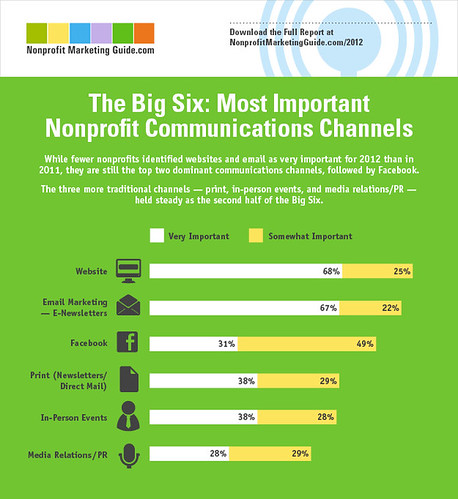
6 Most Important Non-Profit Communication Channels

Half of the top-six marketing and donor communications activities non-profits will use in 2012 require the use of broadband access. The other three partially use broadband access. Non-profit Marketing in 2012

Saturday, January 7, 2012

Cutting the Video Cord Sounds "Good" to Some, But Isn't a Perfect Substitute


Around 80 percent of what most Americans watch on TV can be had for free, some would argue. Some of us would say that is a pretty big and overly-broad generalization. But keep in mind there is an 80-20 rule.

The 20 percent of programming people really cannot get "for free" includes what many would consider the "most valuable" programming.

Also, few people really seem to be willing to live with their video subscriptions, at the moment.

About nine percent of U.S. respondents to a Deloitte  survey say they have stopped buying video entertainment subscriptions from cable, telco or satellite providers, while another 11 percent report they are considering doing so.  Nine percent have cut the video cord

Cable providers lost about 1.77 million subscribers over the past year, similar to 1.76 million lost in 2010, according to Leichtman Research Group. But cable industry losses are virtually directly balanced by subscribers gained by telco and satellite providers.


The implication is fairly clear: video cord cutting remains largely a potential danger, not a current reality.

Telcos added 1.53 million video subscribers in 2011, compared to 1.61 million in 2010. Satellite providers added about 480,000 subscribers in 2011 and 930,000 in 2010. 2011 video market was stable, overall.

One complicating factor, Leichtman notes, is that growth traditionally has come from new housing starts. Since housing construction is down, the opportunity to grow the universe of subscribers is stilted. On the other hand, customer churn generally increases when people are moving. To the extent that people are not moving domiciles as much as they have in the past, that should contribute to lower churn.

What those figures do not shed light on is whether average revenue per accounts is stable, rising or dropping. One might argue that new features such as digital video recorder or HDTV are pushing average revenue up, while a desire to save money could be leading some customers to drop premium channels such as HBO.

Evidence seems to have been mixed in the third quarter of 2011. Comcast's basic video ARPU remained flat $72.7 during the period while broadband ARPU increased 2.2 per cent to $42.6. Telephony ARPU declined 2.4 percent from the previous quarter's $31.9.

DirecTV ARPU increased almost two percent from the previous quarter, reaching $92.20. Third quarter 2011 ARPU

Time Warner Cable had declines across the board in ARPU, with the sole exception of broadband.

DISH saw its ARPU decline two percent from the previous quarter, marking the company's first consecutive quarter ARPU decline since the recession in 2009.

AT&T U-verse and FiOS TV ARPUs continued to grow, however. FiOS monthly ARPU increased two percent from the previous quarter and U-verse's monthly ARPU was up 2.5 percent.

The larger point is that though service provider market share is changing, and average revenue per account is mixed, with no clear pattern, there is, at least according to Leichtman Research, no evidence that video cord cutting is happening on anything more than an insignificant level.  
But it always has been clear that some content is "more valuable" to consumers than others. Cable TV executives used to say that "nobody watches more than seven channels; the problem is that each person watches a different seven."
That is why distributors continue to argue that, for all its problems, a "bundled" approach still makes the most financial sense for consumers and suppliers. Cord cutting still minor

"Lean Back" and "Lean Forward" Differences Might Always Condition VR or Metaverse Adoption

By now, it is hard to argue against the idea that the commercial adoption of “ metaverse ” and “ virtual reality ” for consumer media was in...