Friday, June 1, 2012

Should Mobile Service Providers Embrace Over the Top Voice?

Telecom service providers face big challenges when deciding what to do about over the top applications. In some cases, especially in highly-competitive markets where over the top apps have gained significant share, it will make sense to compete with carrier-owned over the top apps. 


In other cases, OTT will make sense, but as a way of getting customers in out-of-region markets. In other words, a mobile service provider might launch a branded app, but mostly to gain revenue from OTT users who are not already "customers." In that scenario, OTT apps are less a response to in-region competition, and more a growth strategy for out of region.


In other cases, "not competing" might be seen as a safer approach. 


AT&T CEO Randall Stephenson, for example, thinks data-only pricing plans for mobile handsets are "inevitable."  As with "naked DSL (digital subscriber line) plans, AT&T would sell mobile broadband without voice service and then let users choose their own VoIP and messaging providers. 


"I don't think we'll see a big flash cut, but you'll see that propagate into the marketplace," Stephenson said, citing a 24-month time frame for doing so.


AT&T might guess, probably correctly, that such plans will appeal to a segment of the customer base. Keeping a "data only" customer is better than losing the whole account. 


So the "right" response to over the top competition can vary. In some markets, branded OTT apps might be the right tactic, especially when there is perceived upside from out of region sales. In other cases a "go slow" approach might be preferable. 

Amazon Bets Right on Kindle Pricing

Some observers understandably have worried that Amazon faces financial risk by pricing Kindle Fire devices at cost, or slightly below cost. The contrast is provided by Apple, which makes healthy margins (30 percent or so) on its devices.


But Amazon has a different business model. It wants to populate the market with Kindles that drive content sales. Apple creates content capability only to sell devices. 


The early evidence suggests that Amazon made a good bet. Device sales are driving higher content purchases. 


E-Reader Infographic - 600

Verizon Buys Hughes Telematics, a "Real" M2M Business

Verizon Communications is acquing Hughes Telematics, a supplier of automotive location-based services including sensor and telemetry services, vehicle diagnostics, GPS tracking and emissions monitoring system for wireless fleet vehicle management.


A majority owned subsidiary of HTI, Lifecomm, also plans to offer mobile personal emergency response services through a wearable lightweight device with one-touch access to emergency assistance.


The transaction will expand Verizon's capabilities in the automotive and fleet telematics marketplace and accelerate growth in key vertical segments, including emerging machine-to-machine (M2M) services.


This is important for Verizon since machine-to-machine services are expected to be a key growth driver for mobile service providers. Also, M2M services such as these are the "real" M2M revenue sources, though many consider services for  "connected devices" such as tablets to be part of the "M2M" business.


That definition is used by the GSM Association, for example. Some of us consider connected devices and M2M to be separate markets. 


Video Gets Watched on PCs at Work, on Tablets at Home

Tablet video viewing rises on weekday mornings as people prepare for the day and commute to work, then falls off during work hours as PC viewing picks up. 


On weekday evenings, tablet video surges as people watch streaming video to end their day. 


A third of tablet video plays occur between 7pm and 11pm, while only about 17 percent of PC plays take place over that same window. Ooyala says. 


It is only an incipient trend, but a trend, nevertheless: tablets are becoming a prime time vehicle for watching video. 

AT&T Mulls Upgrading Rural Lines Without New Fiber

AT&T has about 15 million lines in rural areas that company management might have preferred to sell, but the company apparently cannot find buyers. So AT&T now is considering a plan to upgrade those lines, Bloomberg reports. 


In a possibly-significant move, AT&T apparently is looking at ways to upgrade the all-copper lines without installing new optical fiber in the transport portions of the access network, using IP Digital Subscriber Line Access Multiplexers. 


Two decades ago, before mobility became the growth engine for the global telecom industry, it might have seemed inevitable that fiber "to where you can make money" was the future. These days, the problem is that the "fiber to where you can make money" equation has changed for the worse. 


If AT&T can figure out how to upgrade all-copper lines using only new DSLAMs, that would be a major innovation, as the business case for U-verse or fiber to the home in its rural areas is beyond challenging. 

“Extreme” Shoppers Use Mobiles Throughout Purchase Process

Among consumers with a smartphone or tablet, 50 percent used a mobile device to compare prices while shopping, 44 percent looked for a coupon, 33 percent  "liked” a retailer on Facebook, and 17 percent bought a product using an app, a new study by GfK shows.

In addition, nearly one-fourth of mobile-enabled shoppers have used brick-and-mortar stores for "showrooming,” checking out a product in person, and then purchasing it online.

Younger adults – ages 18 to 34 – are the primary drivers of these mobile shopping behaviors; these consumers are more than three times as likely to report using a smartphone or tablet for shopping (34 percent compared to 10 percent), compared to those ages 50 to 64.    

Mobile Bandwidth is Different from Untethered Bandwidth

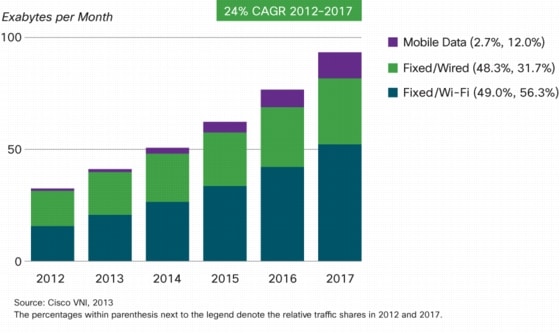
Traffic from wireless devices will exceed traffic from wired devices by 2016, Cisco forecasts. It is a shocking prediction, but has to be put into context.

In 2016, wired devices will account for 39 percent of IP traffic, while Wi-Fi and mobile devices will account for 61 percent of IP traffic. In 2011, wired devices accounted for the majority of IP traffic at 55 percent, Cisco says.

But you have to put those figures into context. Cisco clearly is pointing out the growing role played by untethered (no wired connection) and mobile (a mobile network connection) appliances as generators of bandwidth demand. 

Globally, mobile data traffic will increase 18-fold between 2011 and 2016, Cisco says. Mobile data traffic will grow at a compound annual growth rate (CAGR) of 78 percent between 2011 and 2016, reaching 10.8 exabytes per month by 2016.


Also, global mobile data traffic will grow three times faster than fixed IP traffic from 2011 to 2016
Global mobile data traffic was two percent of total IP traffic in 2011, and will be 10 percent of total IP traffic in 2016.
One of the key observations is the difference between tethered Wi-Fi and mobile access. If 61 percent of all traffic is created by untethered and mobile devices, while 10 percent of demand is driven by mobile devices, then it is fairly obvious that Wi-Fi-based use of the fixed networks could represent half of all bandwidth demand, down about five percent since 
In other words,untethered devices--including mobile devices in Wi-Fi mode--become the key drivers of overall Internet demand.
What remains a bit less clear is how device roles will change as video consumption on untethered and mobile devices begins to underpin total consumption. 

At the end of 2011, 78 percent of IP traffic and 94 percent of consumer Internet traffic originated from PCs.


By 2016, 31 percent of IP traffic and 19 percent of consumer Internet traffic will originate from non-PC devices).
One suspects the portion of traffic created by untethered devices of all sorts will be higher than that in many developed regions. 
As in the case of mobile networks, video devices can have a multiplier effect on traffic
An Internet-enabled high-definition television that draws 30 minutes of content per day from the Internet would generate as much Internet traffic as an entire household today.

Thursday, May 31, 2012

U.S. Cable Operators Get 75% of First Quarter 2012 Broadband Adds

The seventeen largest U.S. cable and telephone providers acquired 1.3 million net additional high-speed Internet subscribers in the first quarter of 2012. 

The top cable companies have more than 45.3 million broadband subscribers, and top telephone companies having over 34.6 million subscribers.

The top cable companies added about 980,000 subscribers, representing 75 percent of the net broadband additions for the quarter, compared to the top telephone companies.

The top cable broadband providers have a 57 percent share of the overall market, with about 10.7 million more subscribers than the top telephone companies, compared to 8.9 million more a year ago

Broadband Internet ProviderSubscribers at End of 1Q 2012Net Adds in 1Q 2012
Cable Companies
Comcast18,582,000439,000
Time Warner^11,136,000227,000
Cox*4,530,00030,000
Charter3,802,000147,000
Cablevision3,007,00042,000
Suddenlink982,60031,200
Mediacom887,00036,000
Cable ONE463,44312,361
Other Major Private Cable Companies**1,941,00016,000
Total Top Cable45,331,043980,561
Telephone Companies
AT&T16,530,000103,000
Verizon8,774,000104,000
CenturyLink5,643,00089,000
Frontier^^1,746,00011,000
Windstream1,363,8008,500
FairPoint318,5104,375
Cincinnati Bell257,200(100)
Total Top Telephone Companies34,632,510319,775
Total Broadband79,963,5531,300,336

Netflix Enables Wi-Fi-Only iOS Mode

Updated player on iPhone
The latest version of the Netflix mobile app for iOS devices allows users to disable mobile network use to watch Netflix content. The new video player for iPad, iPhone, and iPod Touch has a more consistent look and feel across PC and mobile devices.

Netflix also has added an option to its features settings menu so users can choose to allow streaming from Netflix only when connected to a Wi-Fi network.


That feature will help users manage their bandwidth buckets, while also allowing mobile use of the Netflix streaming feature.


People are smart enough to figure out they should watch streaming video when at home, using their fixed network bandwidth.


That is increasingly congruent with user behavior, as more users are watching their tablets and even smart phones during the standard "prime time" video viewing hours.


Will 25% of U.S. and Western Europeans be Paying with NFC by 2017?

Juniper Research projects that more than 25 percent  of U.S. and Western European mobile phone users will use their near field communications-enabled mobile phones to pay for goods in-store by 2017, compared with less than two percent in 2012. 


That might strike some observers as a bit aggressive, given the "glacial" progress Isis and Google Wallet seem to be making with their NFC mobile wallet efforts. And those two initiatives are not the only NFC-based efforts. Nor can anyone be sure other potentially-powerful efforts will not emerge.


Some might argue other marketing-related applications are likely to achieve that sort of usage, though. 


In other markets, Telefonica and consortia of Western European mobile service providers also are trying to get regulatory clearance to launch their own programs. Project Oscar in the United Kingdom, owned by Everything Everywhere, Telefónica UK (O2) and Vodafone UK, is among them.

Consortia in Germany, Sweden, Denmark and Hungary are working on platforms of their own.  In the Netherlands, Travik is seeking approval, while in Scandinavia “4T” is seeking to launch, as well.

In Singapore, the Singapore IDA is spearheading creation of a mobile payments system as well. The French “Cityzi” mobile payments venture likewise was created by mobile service providers, but with key participation by banks and retailers, according to Juniper Research.

Assuming most of those efforts actually launch in 2013, some will assume it is a bit of an optimistic forecast that a quarter of all smart phone users will be using NFC by 2017, a relatively quick three years later.
It is not, perhaps, impossible, but will strike many as unlikely. At least in the U.S. market, there is quite a bit of skepticism about both Isis and Google Wallet, and even some opinion that NFC will not emerge as the most-important enabler of mobile payments.
Mobile payments will reach $171 billion globally in 2012, a 62 percent  increase over last year's total of $105.9 billion, according to research firm Gartner Inc.

That increase corresponds with a 32 percent rise in mobile payment users expected this year. The number of users is expected to hit 212 million users, up from 160.5 million in 2011.

But Web or WAP access is expected to make up 88 percent of mobile payments in the U.S. market as late as 2016, when NFC usage is expected to increase, Gartner believes.

Apple's Supply Chain Becomes a Weapon

LUMIA_TEARThe way that Apple has fostered its relationships with suppliers and manufacturers over the past few years has led to this moment, a time where products like the iPhone, iPad and MacBook Air are not only made using the best materials and manufacturing processes available in the world, they’re also less expensive to make and generate far more profit than competing devices, TNW argues.


That's an important observation. In past decades, one might have argued that Apple makes above-average profits because of its brand. In other words, users paid an "Apple tax" that corresponded to the perceived higher value of an Apple product.


Now, Apple might actually be able to sell at high margin, using the best materials, and set prices at retail that take advantage of a decade-long effort to optimize its supply chain. 


So now Nokia finds it has to price its latest smart phone at $200 less than the iPhone, even when its cost of components is higher than Apple's cost for components, the Wall Street Journal notes

How to Model Broadband Consumption With Few Data Points

“Nearly all communications traffic, including Internet traffic, can be approximated with high accuracy by the log-normal distribution,” says Phoenix Center Chief Economist Dr. George S. Ford. That’s important, as it means we generally can predict overall end user behavior when we actually know only a couple of key data points.

Among the practical implications are estimates of what is likely to happen when  a broadband service provider imposes a monthly usage cap of 250 gigabytes. The log-normal distribution suggests how many customers would hit the limit.

The log-normal distribution also generally allows some estimation of how consumption will vary across the entire customer base, knowing only the consumption of the top one percent, and the consumption of the top 10 percent of users, an analysis by Dr. Ford suggests.

The point is that “averages” (the arithmetic mean) don’t tell an observer very much when any service has an asymmetric distribution, as always seems to be the case for Internet consumption by consumers.

Cisco’s Visual Networking Index reports that the top one percent of users accounted for more than 20 percent  of Internet traffic and that the top 10 percent of users accounted for 60 percent
of traffic.

That means a Pareto distribution, which would ideally show that 20 percent of instances account for 80 percent of the impact would also likely hold.

Ford notes that Comcast’s 250 GByte  per month usage cap on its residential broadband
customers, taken with Comcast’s own statements that 99 percent of its residential customers will not approach that cap suggests that only one percent of Comcast’s residential users consume 250 GBytes per month or more.

Comcast also indicated that its median customer consumes about 8 GBytes to 10 GBytes per month.

The log-normal distribution could well inform many other sorts of policies, such as what amount of consumption a “typical” user requires.

“My approach to approximating usage patterns may be useful for variety of policy issues,” says Ford. “ For example, when addressing universal service for broadband, the level of service that qualifies as ‘broadband’ will have to be parameterized.”

Knowledge of the usage distribution may aid in establishing these service level definitions that can be described as “reasonably comparable to those services provided in urban areas, for example.

Twitter Use Highly Correlated with Smart Phone Use

Who uses Twitter on a cell phoneTwitter usage is highly correlated with the use of mobile technologies, especially smart phones, according to the Pew Internet & American Life Project.


About 20 percent of smart phone users also are Twitter users, with 13 percent using the service on a typical day. 


By contrast, Internet users who own more basic mobile phones are roughly half as likely to use Twitter overall (nine percent do so), and just three percent of these more basic phone owners are “typical day” users.


Indeed, this correlation between Twitter adoption and smart phone ownership may help to explain the recent growth in Twitter usage among young adults. 

Those ages 18 to 24 are not just the fastest growing group when it comes to Twitter adoption over the last year, but also experienced the largest increase in smart phone ownership of any demographic group over the same time period.


Twitter adoption by age

Marketers Think Tablets Will Change How Content is Presented

Red LipstickA survey of 212 global marketers showed that popular belief holds that there will be some big changes in all aspects of content over the next 12 months, from design, to copy, right though to delivery.


Of those interviewed, 45 percent think tablet consumption will have a very high impact on design of content, while 35 percent think it will have high impact, the IDG Connect survey finds. 


Experiences that were once almost exclusively the preserve of the consumer space are suddenly applicable to the business landscape.  Now everything has the potential to become three dimensional.
This trend is already impacting the world of fiction publishing. Take Papercut for example; available through the App Store, this is being billed as an “enhanced reading experience” for iPad and includes three short stories interwoven with animation, interactivity and sound. As readers proceed through the text additional text appears without the need for page turning


Europe Risks Becoming a "Digital Desert"

Alcatel-Lucent Chief Executive Officer Ben Verwaayen said Europe’s phone companies risk turning the region into a “digital desert” by shying away from investing in networks.


Verwaayen says a combination of regulatory barriers and economic crisis are contributing to the problem.


In an interesting twist, given the "warnings" about the United States "falling behind" in some key communications capabilities, be that broadband access, the speed of broadband access, smart phone ownership, messaging or other advanced applications and services. 


But innovation and technology leadership changes over time, whether the issue is consumer behavior, supplier prowess or advanced technology adoption. 


Telecommunications companies in the U.K., Germany, Italy and France have been reluctant to invest as much as their counterparts in the U.S. and Asia in faster mobile-phone and fixed-line networks because of Europe’s sovereign debt crisis and regulatory decisions deemed unfavorable by Verwaayen. As a result, Europe is falling behind, he argues. 

“Five years ago in the U.S., you knew that leaving L.A. meant going into the desert, meanwhile Europe was ahead,” Verwaayen said. “Five years later that has reversed. The creation of value has come back to the U.S.”


Five years ago, U.S. firms had five percent share of the smart phone operating system market. Today, U.S. firms have 64 percent share. 


On the Use and Misuse of Principles, Theorems and Concepts

When financial commentators compile lists of "potential black swans," they misunderstand the concept. As explained by Taleb Nasim ...