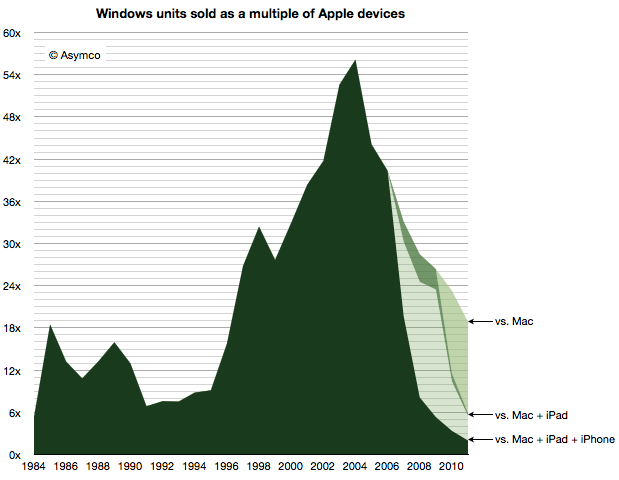
Historically, Windows has sold multiples of Apple devices. But that was when "devices" mean personal computers. These days, tablets and smart phones are seen by many as changing the equation.
By some estimates, the Windows device lead peaked in 2004. So if one counts smart phones, tablets and PCs as the "universe of devices," Apple iOS might reach parity with Windows soon.
Friday, July 6, 2012
Will Apple iOS Platform Match or Eclipse Windows?
Gary Kim was cited as a global "Power Mobile Influencer" by Forbes, ranked second in the world for coverage of the mobile business, and as a "top 10" telecom analyst. He is a member of Mensa, the international organization for people with IQs in the top two percent.
New Bubble Metrics
Five years after the "dot.bomb" or Internet bubble, some would argue, investors already were at it again. Though many had suggested unprofitable technology companies with less than $100 million in revenue would not be able to "go public," that was happening.
By 2005, in other words, what had been "learned" in the aftermath of the Internet bubble were lost. In fact, some would argue matters are worse today, than in 2000 and 2001.
Gary Kim was cited as a global "Power Mobile Influencer" by Forbes, ranked second in the world for coverage of the mobile business, and as a "top 10" telecom analyst. He is a member of Mensa, the international organization for people with IQs in the top two percent.
Thursday, July 5, 2012
One Derecho Wrecks "Availability" Performance for the Whole Year
All it takes to degrade a 99.999 percent availability is a hurricane, derecho or other widespread weather or natural event. That "five nines" standard means annual outages of about five minutes, 26 seconds.
Verizon says it continues to gain ground in restoring services to its wireline customers following the highly destructive June 29, 2012 Mid-Atlantic derecho that caused power outages to about three million homes and business locations, for at least some period of time.
Verizon's wireline repair load currently is running two to three times normal levels. Many customers' voice, Internet and TV services are coming back as commercial power is restored, and Verizon crews are spread across the region to replace poles, re-hang downed lines and repair customers' services. As of July 5, 2012, field forces are responding to 156 downed utility poles and 897 downed copper or fiber cables in the region.
Verizon says it continues to gain ground in restoring services to its wireline customers following the highly destructive June 29, 2012 Mid-Atlantic derecho that caused power outages to about three million homes and business locations, for at least some period of time.
Verizon's wireline repair load currently is running two to three times normal levels. Many customers' voice, Internet and TV services are coming back as commercial power is restored, and Verizon crews are spread across the region to replace poles, re-hang downed lines and repair customers' services. As of July 5, 2012, field forces are responding to 156 downed utility poles and 897 downed copper or fiber cables in the region.
| Uptime | Uptime | Maximum Downtime per Year |
| Six nines | 99.9999% | 31.5 seconds |
| Five nines | 99.999% | 5 minutes 35 seconds |
| Four nines | 99.99% | 52 minutes 33 seconds |
| Three nines | 99.9% | 8 hours 46 minutes |
| Two nines | 99.0% | 87 hours 36 minutes |
| One nine | 90.0% | 36 days 12 hours |
Gary Kim was cited as a global "Power Mobile Influencer" by Forbes, ranked second in the world for coverage of the mobile business, and as a "top 10" telecom analyst. He is a member of Mensa, the international organization for people with IQs in the top two percent.
If Facts Don't Fit the Theory, The Theory Probably is Wrong
Facts sometimes don't fit theories that purport to explain those facts.When that happens, it is likely theory is wrong, in some way.That might appear to be the case for one theory about the strategies any industry has to embrace at any stage of its lifecycle.
Of course, some of you will look at the chart and sense a huge anomaly. The telecom industry is over 150 years old and long ago would have passed beyond the "scale" stage, for example.
One observation might be that the theory "fits" non-regulated industries, but does not fit very well for highly-regulated industries such as utilities. Others might note that airlines, which were deregulated in the 1980s, have had 30 years of mergers already. The theory suggests the entire process of moving through all four stages should take about 25 years.
Note also that the theory claims to apply for any industry that is formed, or is deregulated. Aviation has been a distinct business for much longer than 50 years.
Of course, it is always possible to force the facts to fit by artificially changing the definition of what an industry is. One might argue that "smart phones" represent a different industry that that of feature phones, or voice-only phones, or analog phones.
One might argue the older telecom business using step switches was different from the business using electromechanical switches or digital switches or now IP switches.
But that's probably a case of straining to make the facts fit a theory, rather than acknowledging there is something wrong with the theory.
Of course, some of you will look at the chart and sense a huge anomaly. The telecom industry is over 150 years old and long ago would have passed beyond the "scale" stage, for example.
One observation might be that the theory "fits" non-regulated industries, but does not fit very well for highly-regulated industries such as utilities. Others might note that airlines, which were deregulated in the 1980s, have had 30 years of mergers already. The theory suggests the entire process of moving through all four stages should take about 25 years.
Note also that the theory claims to apply for any industry that is formed, or is deregulated. Aviation has been a distinct business for much longer than 50 years.
Of course, it is always possible to force the facts to fit by artificially changing the definition of what an industry is. One might argue that "smart phones" represent a different industry that that of feature phones, or voice-only phones, or analog phones.
One might argue the older telecom business using step switches was different from the business using electromechanical switches or digital switches or now IP switches.
But that's probably a case of straining to make the facts fit a theory, rather than acknowledging there is something wrong with the theory.
Gary Kim was cited as a global "Power Mobile Influencer" by Forbes, ranked second in the world for coverage of the mobile business, and as a "top 10" telecom analyst. He is a member of Mensa, the international organization for people with IQs in the top two percent.
Best Buy Will Use Mobile Payments Inside New Stores
The heart of a test store near Best Buy's headquarters here is a "Solution Central" help desk, rimmed with chairs and manned by the company's black-tied Geek Squad. It strongly resembles the Genius Bar at Apple's stores.
Best Buy says the new smaller stores are focused less on displaying every conceivable gadget and more on connecting customers with employees who can answer questions or help program equipment.
As part of that change, customers will be able to buy products from just about any Best Buy associate, on the spot, without going to a designated "check out" location, as is the Apple practice as well. That means mobile payments will be the "new normal" at the new Best Buy stores.
Best Buy says the new smaller stores are focused less on displaying every conceivable gadget and more on connecting customers with employees who can answer questions or help program equipment.
As part of that change, customers will be able to buy products from just about any Best Buy associate, on the spot, without going to a designated "check out" location, as is the Apple practice as well. That means mobile payments will be the "new normal" at the new Best Buy stores.
Gary Kim was cited as a global "Power Mobile Influencer" by Forbes, ranked second in the world for coverage of the mobile business, and as a "top 10" telecom analyst. He is a member of Mensa, the international organization for people with IQs in the top two percent.
RIM Earns $4 Billion Annually in Service Provider Fees for Email Services; Carriers Want to Pay Less
Research in Motion executives say the company is "not in a death spiral," but pressure is growing. RIM earns $4.09 billion in annual revenue from mobile service providers who provide RIM device email services to consumers.
But AT&T, for one, wants to pay RIM less for the privilege.The fees account for more than a third of revenue at RIM, according to Bloomberg.
“There’s definitely negotiations going on right now to reduce” the fees, said Sameet Kanade, a technology analyst at Northern Securities.
But AT&T, for one, wants to pay RIM less for the privilege.The fees account for more than a third of revenue at RIM, according to Bloomberg.
“There’s definitely negotiations going on right now to reduce” the fees, said Sameet Kanade, a technology analyst at Northern Securities.
Gary Kim was cited as a global "Power Mobile Influencer" by Forbes, ranked second in the world for coverage of the mobile business, and as a "top 10" telecom analyst. He is a member of Mensa, the international organization for people with IQs in the top two percent.
Samba Mobile Launches Free Mobile Broadband Service in U.K.
Samba Mobile is going to test the notion that an ad-supported mobile broadband service can work. Apple iPad users buy a Samba SIM now for £2.99 plus some "packaging" costs and get free mobile broadband service. Other notebook or desktop PCs will require a Samba dongle.
Samba Mobile will become the latest service provider to try and prove that an ad-supported mobile service can work, though all prior attempts have failed.
Tablet owners need only the Samba Micro-SIM, though the service is only available on Apple iPads at this stage. Laptop and desktop users must purchase a Samba USB-Dongle and the SIM for £25.
Samba Mobile will become the latest service provider to try and prove that an ad-supported mobile service can work, though all prior attempts have failed.
Tablet owners need only the Samba Micro-SIM, though the service is only available on Apple iPads at this stage. Laptop and desktop users must purchase a Samba USB-Dongle and the SIM for £25.
Samba surfing is compatible with Firefox and Google Chrome but members are forbidden from accessing pornography sites as well as material that breaches copyright or is deemed offensive.
The company also says it may install cookies to collect information about your “general internet usage”.
Gary Kim was cited as a global "Power Mobile Influencer" by Forbes, ranked second in the world for coverage of the mobile business, and as a "top 10" telecom analyst. He is a member of Mensa, the international organization for people with IQs in the top two percent.
One Reason Mobile Service Providers Think M2M Has a Future
Those changes will require broadband access, many would argue, creating a new type of customer for mobile service connections.
Gary Kim was cited as a global "Power Mobile Influencer" by Forbes, ranked second in the world for coverage of the mobile business, and as a "top 10" telecom analyst. He is a member of Mensa, the international organization for people with IQs in the top two percent.
Telefónica Sees Huge Upside in M2M, Carrier Billing
Telefónica might be a bit optimistic, but the firm believes it can generate annual revenues of €5 billion (US$6.2 billion) by 2015 from initiatives that leverage the carrier's billing and charging capabilities as well as machine-to-machine services.
Those are important assertions for one principal reason. When a tier-one service provider decides to target its human and financial resources to a new revenue growth initiative, scale matters. In other words, a large telco cannot afford to waste time chasing small revenue opportunities, but has to look for opportunities that make a difference.
The shorthand way you can think about it is that when a service provider earns scores of billions worth of revenue each year, small opportunities do not “move the revenue needle” enough to be worth pursuing. As a very-simple rule of thumb, a tier-one service provider has to look for opportunities that generate at least a billion dollars a year.
Telefónica Digital believes its new global "Direct to Bill" agreements with Facebook , Google , Microsoft Corp. and Research In Motion Ltd. will do so.
Those deals allowTelefónica customers to buy content and services from Facebook, Google, Microsoft and RIM application stores, for example, using their mobile accounts. The charges appear directly on the subscriber phone bills, and do not require use of credit cards.
The operator believes this could prove very popular in Latin America, where, according to Telefónica, "credit card penetration is low and 60 percent of the population do not have bank accounts."
Telefónica also has entered a strategic partnership with service provider Etisalat that extends Telefónica's M2M reach into 17 new countries (in Africa, Asia/Pacific and the Middle East). The two operators plan to "jointly develop business opportunities in Machine-to-Machine (M2M), financial services, cloud computing, eHealth, mobile advertising and over-the-top [OTT] communications."
Those are important assertions for one principal reason. When a tier-one service provider decides to target its human and financial resources to a new revenue growth initiative, scale matters. In other words, a large telco cannot afford to waste time chasing small revenue opportunities, but has to look for opportunities that make a difference.
The shorthand way you can think about it is that when a service provider earns scores of billions worth of revenue each year, small opportunities do not “move the revenue needle” enough to be worth pursuing. As a very-simple rule of thumb, a tier-one service provider has to look for opportunities that generate at least a billion dollars a year.
Telefónica Digital believes its new global "Direct to Bill" agreements with Facebook , Google , Microsoft Corp. and Research In Motion Ltd. will do so.
Those deals allowTelefónica customers to buy content and services from Facebook, Google, Microsoft and RIM application stores, for example, using their mobile accounts. The charges appear directly on the subscriber phone bills, and do not require use of credit cards.
The operator believes this could prove very popular in Latin America, where, according to Telefónica, "credit card penetration is low and 60 percent of the population do not have bank accounts."
Telefónica also has entered a strategic partnership with service provider Etisalat that extends Telefónica's M2M reach into 17 new countries (in Africa, Asia/Pacific and the Middle East). The two operators plan to "jointly develop business opportunities in Machine-to-Machine (M2M), financial services, cloud computing, eHealth, mobile advertising and over-the-top [OTT] communications."
Gary Kim was cited as a global "Power Mobile Influencer" by Forbes, ranked second in the world for coverage of the mobile business, and as a "top 10" telecom analyst. He is a member of Mensa, the international organization for people with IQs in the top two percent.
Wednesday, July 4, 2012
A La Carte Video Would Destroy Most Channels, Study Suggests
If the U.S. government mandated that TV channels be sold individually, only five to 10 traditional TV networks would survive, destroying up to $300 billion of value, endangering some one million jobs and curtailing consumers' video choices, according to an analysis by Needham and Company.
According to Needham's analysis, with unbundling, TV subscription revenue would decline 15 percent to 20 percent and ad revenue would plummet 75 percent. Meanwhile, if content companies delivered content directly to consumers, they would incur customer service costs estimated at $50 per customer per year, or $5 billion nationally.
Gary Kim was cited as a global "Power Mobile Influencer" by Forbes, ranked second in the world for coverage of the mobile business, and as a "top 10" telecom analyst. He is a member of Mensa, the international organization for people with IQs in the top two percent.
Little is 'Trivial' Where Mobile Payments are Concerned
Though some might scoff at the notion that applications, such as contactless payments in transportation or parking, or wallet applications such as “time to refill your prescription” notifications using text messaging that every mobile device can receive, are “trivial,” such applications are important, for a number of reasons, says Diarmuid Mallon, Sybase 365 head of product marketing.
For starters, applications that are not drop-dead simple, widely available and which do not provide “obvious” and immediate value will not be adopted quickly or broadly. Given growing fragmentation in both the mobile payments and mobile wallet spaces, that is an important issue.
But there is a reason apparently trivial applications are important. They often are the places where clear value is provided.
For starters, applications that are not drop-dead simple, widely available and which do not provide “obvious” and immediate value will not be adopted quickly or broadly. Given growing fragmentation in both the mobile payments and mobile wallet spaces, that is an important issue.
But there is a reason apparently trivial applications are important. They often are the places where clear value is provided.
Gary Kim was cited as a global "Power Mobile Influencer" by Forbes, ranked second in the world for coverage of the mobile business, and as a "top 10" telecom analyst. He is a member of Mensa, the international organization for people with IQs in the top two percent.
Can Carrier “App Stores” Beat Apple App Store or Google Play?
Carriers such as AT&T and Verizon may very well get into the app store space to compete with Apple and third-party app stores like Getjar, argues Infonetics Research analyst Shira Levine.
The carriers' differentiation would be the ability to offer Android and browser-based applications in a one-stop-shopping environment. "AT&T learned a valuable lesson with the iPhone," says Levine. "They’re not part of the revenue value chain."
As a result, she says, "[carriers] are envisioning OS-independent app stores, which consumers could access no matter what device you had and even do so across multiple devices."
That’s part of the thinking behind the Wholesale Applications Community. Will it work?
The carriers' differentiation would be the ability to offer Android and browser-based applications in a one-stop-shopping environment. "AT&T learned a valuable lesson with the iPhone," says Levine. "They’re not part of the revenue value chain."
As a result, she says, "[carriers] are envisioning OS-independent app stores, which consumers could access no matter what device you had and even do so across multiple devices."
That’s part of the thinking behind the Wholesale Applications Community. Will it work?
Gary Kim was cited as a global "Power Mobile Influencer" by Forbes, ranked second in the world for coverage of the mobile business, and as a "top 10" telecom analyst. He is a member of Mensa, the international organization for people with IQs in the top two percent.
How Can Mobile Service Providers Compete with Facebook, Apple, Google "Messaging?"
Some would argue that a war over “interpersonal communications,” separate from the earlier messaging formats of email, instant messaging, chat and text messaging, is about to break out among three of the over the top application platforms, namely Google, Facebook and Apple.
For mobile service providers, that poses an issue, namely the future of their text messaging revenue streams, since historically mobile service providers have not make money directly from email or chat.
Facebook’s unified Chat / Messages / Email; Apple’s cross-device iMessage system and Google’s Gmail / GChat / Hangouts are something different, some would argue, as those platforms blend email, messaging chat and even video conferencing.
For mobile service providers, “how to compete” is the issue. A reasonable person might argue that no mobile service provider is fully equipped to compete in the “interpersonal communications” space dominated by those three application providers.
But mobile service providers can compete.
For mobile service providers, that poses an issue, namely the future of their text messaging revenue streams, since historically mobile service providers have not make money directly from email or chat.
Facebook’s unified Chat / Messages / Email; Apple’s cross-device iMessage system and Google’s Gmail / GChat / Hangouts are something different, some would argue, as those platforms blend email, messaging chat and even video conferencing.
For mobile service providers, “how to compete” is the issue. A reasonable person might argue that no mobile service provider is fully equipped to compete in the “interpersonal communications” space dominated by those three application providers.
But mobile service providers can compete.
Gary Kim was cited as a global "Power Mobile Influencer" by Forbes, ranked second in the world for coverage of the mobile business, and as a "top 10" telecom analyst. He is a member of Mensa, the international organization for people with IQs in the top two percent.
Video Audiences are Fragmenting
Men 18 to 34 are now spending more time streaming video than watching live TV, one third visit YouTube multiple times a day, half subscribe to a YouTube channel, and two thirds shared YouTube videos in the past week, according to Generation V, a YouTube study of consumer video trends.
The study also finds that 40 percent of women 25 to 49 have subscribed to a YouTube channel, half shared a video this past week, and one third regularly share online video with their kids or parents.
Those changes in viewership illustrate just one aspect of the range of underlying changes that are needed before over the top online video can seriously challenge traditional TV and subscription video services. There are many.
The study also finds that 40 percent of women 25 to 49 have subscribed to a YouTube channel, half shared a video this past week, and one third regularly share online video with their kids or parents.
Those changes in viewership illustrate just one aspect of the range of underlying changes that are needed before over the top online video can seriously challenge traditional TV and subscription video services. There are many.
Gary Kim was cited as a global "Power Mobile Influencer" by Forbes, ranked second in the world for coverage of the mobile business, and as a "top 10" telecom analyst. He is a member of Mensa, the international organization for people with IQs in the top two percent.
Tuesday, July 3, 2012
Would You Pay $600 for an Apple iPhone?
Leap Wireless and Virgin Mobile are betting that users will pay $500 to $600 for an Apple iPhone, at full retail prices. AT&T thinks they will not do so. It is possible, perhaps likely, that the actual answer will be that some users will do so, but that most will not want to do so.
The answer obviously matters greatly for Leap (Cricket) and Virgin Mobile, as well as for all other mobile service providers that clearly would prefer to reduce the amount of money they tie up in device subsidies.
Leap Wireless has committed to buy nearly $1 billion of iPhones over the next three years that it hopes to sell at a partially subsidized price of at least $400 for the iPhone 4 and $500 for the iPhone 4S.
BTIG Research believes that $200 will continue to be reasonable price point for high-end phones, though. If that proves to be true, Cricket and Virgin Mobile might take a hit to earnings, and mobile service providers will have to figure out some other way to attack the subsidy problem.
The answer obviously matters greatly for Leap (Cricket) and Virgin Mobile, as well as for all other mobile service providers that clearly would prefer to reduce the amount of money they tie up in device subsidies.
Leap Wireless has committed to buy nearly $1 billion of iPhones over the next three years that it hopes to sell at a partially subsidized price of at least $400 for the iPhone 4 and $500 for the iPhone 4S.
BTIG Research believes that $200 will continue to be reasonable price point for high-end phones, though. If that proves to be true, Cricket and Virgin Mobile might take a hit to earnings, and mobile service providers will have to figure out some other way to attack the subsidy problem.
Gary Kim was cited as a global "Power Mobile Influencer" by Forbes, ranked second in the world for coverage of the mobile business, and as a "top 10" telecom analyst. He is a member of Mensa, the international organization for people with IQs in the top two percent.
Subscribe to:
Comments (Atom)
Is Private Equity "Good" for the Housing Market?
Even many who support allowing market forces to work might question whether private equity involvement in the U.S. housing market “has bee...
-
We have all repeatedly seen comparisons of equity value of hyperscale app providers compared to the value of connectivity providers, which s...
-
It really is surprising how often a Pareto distribution--the “80/20 rule--appears in business life, or in life, generally. Basically, the...
-
Financial analysts typically express concern when any firm’s customer base is too concentrated. Consider that, In 2024, CoreWeave’s top two ...