Thursday, August 2, 2012

IP Transit Price Disruption Heating Up?

Prices for wholesale IP transit service normally decline, on a price-per-bit basis, every year. So the mere fact of price-per-bit decreases should not normally constitute a reason for concern. 


The only thing that does raise concern is a rate of price decline that is higher than expected. So it is that TeleGeography says IP transit price declines in most locations accelerated over the last year.


The median monthly lease price for a full GigE port in London dropped 57 percent between the second quarter of  2011 and the second quarter of 2012 to $3.13 per Mbps. The issue is that prices had dropped at a 31 percent rate of decline between 2007 and 2012


In New York, the comparable price dropped 50 percent to $3.50 per Mbps over the past year, and 26 percent compounded annually over the five-year period. 


Just how significant that is cannot yet be determined. A dip during or immediately after the 2008 Great Recession would not have been surprising. A faster drop in prices, given the current recession, might not be unusual, either. And there seems no shortage of new competition in either London or New York markets. 


On the other hand, the trend of IP transit pricing on the highly-competitive routes to London and New York do not seem out of line with long-term trends, either. 


    Median GigE IP Transit Prices in Major Cities, Q2 2007-Q2 2012
IPT_August_2012.png
Source: TeleGeography

Time Warner Cable Now Earns 43% of Revenue From "New" Sources

In its second quarter 2012 earnings report, Time Warner Cable earned about 57 percent of its revenue from legacy sources (video entertainment subscriptions and advertising). The problem, one might argue, is that the 42 percent of revenue earned from "new" sources includes two sources, namely high-speed access and consumer voice, that have, in turn, become "legacy" revenue sources.

The latest "new" source of revenue is voice and data services for business customers. At some point, that source also will become a "legacy" source.

That points up a larger strategic challenge, namely how Time Warner Cable can continue to grow, as all its "new" revenue sources become "legacy" sources that cannot drive significant growth.

Excluding the impact from acquisitions, residential services revenue growth was primarily driven by an increase in high-speed data revenues, partially offset by a decline in video revenues, Time Warner Cable says.

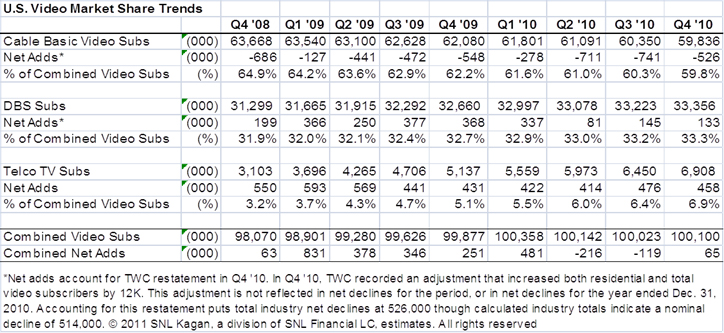
Time Warner Cable lost 169,000 video subscribers during the quarter.

The growth in residential high-speed data revenues was the result of growth in high-speed data subscribers and an increase in average revenues per subscriber (due to both price increases and a greater percentage of subscribers purchasing higher-priced tiers of service), Time Warner Cable says.

Residential video revenues decreased driven by declines in video subscribers and revenues from premium channels and transactional video-on-demand, partially offset by price increases, a greater percentage of subscribers purchasing higher-priced tiers of service and increased revenues from equipment rental charges, Time Warner Cable also reported.

Residential voice revenues remained essentially flat as growth in voice subscribers was offset by a decrease in average revenues per subscriber.

Consider Comcast, the largest U.S. cable TV company. Comcast now relies on its core legacy service, video entertainment revenues, for about 33 percent of total revenue. How Time Warner Cable could get to similar levels now becomes the issue.

Here's Why AT&T is Intentionally Slowing iPhone Sales

undefined Compared to other key competitors, AT&T sells more iPhones. 


Since iPhones impose the greatest subsidy burden, AT&T gains if it sells a mix of devices carrying lighter subsidy costs. 


The cost of such handset subsidies has become a bigger issue globally, as every service provider struggles with the operating cost issues such subsidies represent.


It is no secret that mobile service providers globally want to reduce the amount of money they spend to subsidize smart phones for their customers.

The problem is that the subsidies raise operating costs, and thus affect cash flow.

Of course, it can be argued that such subsidies also provide value, in part by reducing customer churn, as consumers often must sign contracts to qualify for the device subsidies.

Some would argue that although there is a positive churn reduction effect, the amount of reduced churn  is only 27 percent of incremental subsidy cost for AT&T and 45 percent for Verizon.

This means AT&T is actually losing more than $2 billion by providing iPhone subsidies, for example, while Verizon is losing nearly $1 billion. Verizon's "losses" are lower because it has sold fewer iPhones than AT&T. Over time, that gap should close.

Mobile service providers aren’t happy about the cost of device subsidies that cause a drag on earnings. For AT&T, the financial impact of iPhone subsidies is clear. AT&T profit margins had grown for five straight years beginning in 2005, but reversed in 2010, apparently related directly to iPhone 4 demand and subsidies, BTIG argues.

BTIG argues the iPhone subsidies have reduced AT&T margins by at least 10 percent in 2011, for example.

But the trick is how to wean customers off the subsidies without seriously slowing the smart phone adoption rate, since most smart phone customers, given a choice, buy subsidized devices, with a contract, rather than paying full retail price and buying service without a contract.

Up to this point, the decision hasn’t been terribly difficult. A Motorola Mobility Holdings Droid 4 costs $549.99 without a contract and a 16-gigabyte Apple iPhone 4S, which runs only on 3G networks, is $649.99. Verizon Wireless offers both devices for $199.99 with a two-year data plan commitment.

It therefore comes as no surprise that nearly all customers choose to buy a subsidized device.

Up to this point, for example, Verizon has not charged a fee to its subscribers when customers decide to upgrade to a new device. But Verizon in April 2012 announced it would charge a $30 fee when that occurs. For Verizon Wireless, that could add up to $1 billion to Verizon’s annual earnings, and also boost profit margins, BTIG argues.

But that’s not all. Verizon Wireless now will provide incentives for users to pay full retail for their devices, using the bait of “unlimited” mobile data plans. That is likely to cause buyer sticker shock, though.

The new Verizon Wireless plan to end "unlimited" service and move users to capped plans primarily is aimed at matching end user data consumption to usage. But Verizon Wireless also appears to be using the opportunityto wean customers off device subsidies.

Verizon says "when we introduce our new shared data plans, unlimited data will no longer be available to customers when purchasing handsets at discounted pricing," unless of course the customer wants to pay full price for a device.

One might doubt the “full retail phone price, unlimited usage” plan will be chosen by many customers, though.

On the other hand, it is an interesting way of enticing some users to pay full retail for their devices. One wonders what Verizon might think of next, aside from simply raising the prices of devices sold with contracts. 


In the meantime, suppliers such as Virgin Mobile and Cricket Communications should provide an early real-world test of demand, as both those mobile service providers will sell iPhones at full retail.

Smart phones have been very helpful for mobile service providers, boosting average revenue per user by driving mobile broadband subscriptions. But the subsidies generally used to spur sales are bcoming a major drag on earnings, and change is coming. Basically, service providers will have to risk lower sales growth, and less mobile broadband revenue growth, to limit handset subsidies. It might be a Faustian bargain.

In fact, what seems to have happened is that user behavior has changed, with users upgrading those “expensive” smart phones faster than they had generally been upgrading their feature phones, analysts at BTIG say.

As a result, U.S. mobile service providers plan to take steps to reduce handset upgrades as a way of raising operating margins. That is likely to affect sales of Apple iPhones, generally considered the most-expensive device to support.

AT&T, Sprint, Deutsche Telekom, Vodafone, America Movil and Telefonica are among firms planning to take steps that will slow iPhone sales in the coming year.

In the United States, BTIG expects iPhone sales to decline four million sequentially to nine million with the largest impact coming from AT&T, Apple’s largest customer.

In fact, AT&T says it has built its business model for 2012 around the idea that it will sell no more smart phones, overall, than it did in 2011, about 25 million units.

BTIG analysis suggests something quite significant. Despite the importance of smart phone accounts for growth of key broadband revenue, AT&T has decided to essentially cap smart phone sales to preserve its profit margins.

The impact should be clear: fewer iPhones sold by AT&T, and possibly fewer iPhones sold by other mobile services providers. That could lead to market share gains by other smart phone makes and models, or could spur Apple to produce lower-cost iPhones.

What the carriers hope for is the ability to sustain average revenue per user growth, and higher profit margins.


Vodafone's Spanish division is bringing back cut-price smartphones for new customers for a limited time, the firm said on Monday, prompted by a mass client exodus in recent months after scrapping handset subsidies in the recession-hit country, Reuters reports.

The move illustrates the clear danger for any single service provider that attempts to break from established practices that consumers find helpful, such as selling hot new devices at subsidized prices, even if that means consumers need to sign a service contract.

Vodafone says the policy is temporary, and will end September 15, 2012.  

Vodafone and Telefonica, with almost 70 percent market share between them, have suffered huge subscriber losses since they decided to use Spain as a test case for a new business model that cuts subsidies for smartphones.

Vodafone has lost over 600,000 mobile clients since April, when it stopped slashing prices on smartphones, while Telefonica's Movistar lost 572,000 in April and May, according to data from Spain's telecoms regulator.

It remains to be seen whether Vodafone actually will reinstate the "no subsidies" policy after September 15. Given the crushing recession in Spain, Vodafone probably needs to do everything it can to stem the subscriber losses, and boost uptake of smart phone services.

Mobile service providers in Spain lost a quarter of a million clients in May 2012, the fourth consecutive month of subscriber losses, la Comisión del Mercado de las Telecomunicaciones says.

The industry also lost 380,000 customers in April 2012, according to the Spanish telecommunications commission.

Precisely why customers are deserting is the issue. Spain is in what might be called a deep recession, so it is possible customers are dropping their mobile subscriptions to save money.

And it remains true that prepaid service, which offers consumers more control over their spending, continues to gain customers, which might reinforce the notion that economic distress is causing what might be called an unusual negative move in mobile subscriptions.

But some might suspect that the industry's end of subsidies for handsets also has had some negative impact, primarily by shrinking the number of new accounts mobile service providers need to add every month to compensate for departing customers.

BlackBerry to Exit Hardware Business?

Thorsten Heins, chief executive of Research in Motion, says RIM cannot compete in hardware, and is willing to license the BlackBerry 10 operating system to other handset manufacturers.

“We don’t have the economy of scale to compete against the guys who crank out 60 handsets a year," says Heins. "To deliver BB10 we may need to look at licensing it to someone who can do this at a way better cost proposition than I can do it."

Vodafone Spain Brings Back Device Subsidies

Vodafone's Spanish division is bringing back cut-price smartphones for new customers for a limited time, the firm said on Monday, prompted by a mass client exodus in recent months after scrapping handset subsidies in the recession-hit country, Reuters reports. 


The move illustrates the clear danger for any single service provider that attempts to break from established practices that consumers find helpful, such as selling hot new devices at subsidized prices, even if that means consumers need to sign a service contract. 


Vodafone says the policy is temporary, and will end September 15, 2012.  


Vodafone and Telefonica, with almost 70 percent market share between them, have suffered huge subscriber losses since they decided to use Spain as a test case for a new business model that cuts subsidies for smartphones.


Vodafone has lost over 600,000 mobile clients since April, when it stopped slashing prices on smartphones, while Telefonica's Movistar lost 572,000 in April and May, according to data from Spain's telecoms regulator.


It remains to be seen whether Vodafone actually will reinstate the "no subsidies" policy after September 15. Given the crushing recession in Spain, Vodafone probably needs to do everything it can to stem the subscriber losses, and boost uptake of smart phone services.


Mobile service providers have clear motivation to stop subsidizing smart phone sales, as such practices harm operating results. But, as Vodafone has discovered, such practices also can lead to high customer churn or slow smart phone adoption.


Subsidies might just be a necessary evil, from a service provider perspective, where it comes to encouraging adoption of high-end smart phones, with their associated boosts in recurring revenue.  

Small Cells Provide More 3G than 4G Value

Small cells deployed by mobile operators in areas of high traffic actually will provide more value, in the near term, for 3G operations than for 4G operations, Strategy Analytics argues. Small cells also cost significantly less than 3G macro cells for the same coverage area but slightly more than new 4G Long Term Evolution macro cells, says Sue Rudd, Strategy Analytics director.

“This is largely due to the ‘consumer electronics-like' vulnerability of very large numbers of small cell sites that require installation and ongoing maintenance," Rudd says.

"Cost is not the only reason to choose small cells since they offer faster installation for rapid upgrades in throughput” says Phil Kendall,  Strategy Analytics  director. "Estimates vary, but small cells will probably increase throughput by over 200 percent in legacy 3G hot zones, or at the edge of macro cells where data throughput is poor.”

Throughput improvements could reduce the cost per megabit by 30 percent, he argues.

Wednesday, August 1, 2012

AT&T Puts Breaks on Apple iPhone Sales

Regional retail sales managers at AT&T have been instructing store managers to put the brakes on Apple’s iPhone, as company executives had said they would do in 2012, it appears. The issue is device subsidies. It costs AT&T more money to subsidize iPhones than other devices. And those subsidies put pressure on AT&T earnings.


As reported by Boy Genious Report, customers seeking smart phones at AT&T retail stores are being steered away from Apple’s iPhone and towards Android phones or Windows Phone devices such as the Nokia Lumia, BGR says. 


Even when customers come into stores specifically looking for the iPhone 4S or iPhone 4, staffers have been instructed to make an effort to show people Android and Windows Phone devices as well.


In addition, AT&T retail staff in at least some locations are no longer permitted to get iPhones as their company-owned devices, and must instead choose an Android smartphone or a Windows Phone.


One source told BGR that Apple’s iPhone used to make up as much as 80 percent of smart phone sales at stores in his area, but that figure has dropped dramatically to between 50 percent and 60 percent. 

"Payments," As Such Are Not What Consumers Value

“Consumers do not have much interest in payments," says James Le Brocq, managing director at O2 Money. "They want to do things in their everyday lives conveniently: travel to work, buy lunch, buy a gift."
TABLE Wallet wars

New Cloud-Based Google Wallet App Released

Google has released a new, cloud-based version of the Google Wallet app that supports all credit and debit cards from Visa, MasterCard, American Express, and Discover. Now, users can choose to pa with any of those card brands when  shopping in-store or online with Google Wallet.

The new version also allows users to remotely disable their mobile wallet apps. If a Google wallet user loses a phone, they can use the ‘Devices’ section in the online wallet to disable all cards used with the wallet.

When a user disables their wallet on a device, Google Wallet will not authorize any transactions attempted with that device. If the Google Wallet online service can establish a connection to your device, it will remotely reset your mobile wallet, clearing it of card and transaction data.


The Google Wallet app now stores user payment cards on highly secure Google servers, instead of in the secure storage area on your phone. A wallet ID (virtual card number) is stored in the secure storage area of the phone, and this is used to facilitate transactions at the point of sale.

This new approach also speeds up the integration process for banks so they can add their cards to the Wallet app in just a few weeks. Banks that want to help their customers save cards to Google Wallet, including their custom card art, can apply here.

The new Google Wallet app is available now on Google Play.

Olympics Streaming Seems to Hit Netflix Streaming

ISP technology provider Procera Networks reports that Netflix streaming was down a quarter from normal levels in the U.S. Sunday, even though overall streaming video traffic was way up, according to Procera Networks.

Procera Networks notes that Netflix streaming was down 25 percent on July 29, 2012, for example.

Netflix CEO Reed Hastings had suggested this would happen. “This quarter the Olympics are likely to have a negative impact on Netflix viewing and sign-ups,” Reed Hastings has said, in setting third quarter 2012 guidance at one million to 1.8 million domestic net adds.


U.S. Becomes Biggest Global Market for Mobile Internet Advertising in 2012

Spending on mobile Internet advertising in the United States will top all other countries in the world for the first time in 2012, helping drive mobile ad spending worldwide to $6.43 billion in 2012, according to eMarketer.

Until this year, Japan was the world’s largest market for mobile advertising, with spending reaching $1.36 billion in 2011, up from $1.01 billion in 2010, eMarketer also says.

Spending on mobile internet ads in Japan will grow 27.2 percent to $1.74 billion in 2012, versus 35.4 percent growth in 2011, eMarketer reports.

Mobile internet advertising spending in the United States, by comparison, will grow 96.6 percent to $2.29 billion in 2012, up from $1.16 billion last year, according to eMarketer.

North America also will surpass Asia-Pacific in 2013 as the world’s largest regional market for.

Comcast, European Cable Operator Growth Strategies Diverge

Virtually all existing communications and video entertainment businesses are in a time of transition from older revenue patterns to new business models that inevitably will include a mix of products, often sold to different customers than in the past.

Beyond that, it remains unclear what revenue contributions might in the future be made by entirely new lines of business. But Comcast’s second quarter 2012 earnings report suggests the upside potential and downside risks.

Also, the latest Solon Survey of European cable operators illustrates a couple salient points about the near term growth drivers for North American and European cable operators. Wireless appears to be a bigger factor for European cable operators, while Comcast’s approach now suggests content will be a bigger source of revenue for the larger U.S. cable providers.

In the near term, European cable operator growth now comes from broadband access, mobile services and business-to-business services.

The key trends are the importance of mobility and services aimed at business customers, which In the 2009 survey were not firmly embraced by cable operators in Europe.

By 2011, sentiment had changed, with operators across Europe highlighting the importance of
commercial and mobile segments in driving near term revenue growth.

On average, cable operators expect to double the share of revenues generated through mobile offerings, while the revenue contribution from business and wholesale activities is forecast to increase by approximately 33 percent. For a business historically serving the consumer segment, the expansion of services to business and enterprise customers is significant.

By 2014, a typical European cable operator will be earning 12 percent of its revenues from business customers. Some cable operators, though, already earn more than 30 percent of total revenues from B2B services.

European cable operators surveyed expect revenue growth of over five percent per year until 2014 and further EBITDA margin expansion by two percentage points up to 48 percent, on average, to 2014.

In large part, that is due to gains in broadband access revenue, which remains the main source of revenue growth for European cable operators, the report suggests. In fact, Solon attributes broadband access revenue for a rebound in operator average revenue per user, which had been dropping.

Revenue earned by offering or higher access speeds, at an average broadband access ARPU of approximately 20€ per month, is the primary reason ARPU now is stable, the Solon report indicates.

Comcast’s revenue, on the other hand, now has tipped towards content. Comcast video revenues have shrunk to about 52 percent of total Comcast revenue, while other access network services now contribute 48 percent, and are growing.

At some point, Comcast will earn less than half its revenue from its legacy video entertainment business. And that is to focus only on Comcast’s “local access” business.

In fact, including the NBC Universal contributions, it already is true that Comcast earns less than half its total revenue from cable TV distribution. In fact, cable TV video distribution operations now account for only 33 percent of total Comcast revenue.

For anybody who has followed the U.S. video entertainment market for some decades, that U.S. cable operator video penetration is as low as 44 percent of TV homes is a shocking statistic. There was a time when penetration was as high as 70 to 80 percent of homes in some areas.

Competition from satellite and telco competitors is the reason for the sharp reversal.

Some 97 percent of U.S. homes own a TV, and about 90 percent of all U.S. homes buy a subscription TV service.

Telco IPTV penetration on a global basis, measured agains the installed base of worldwide broadband subscribers, reached 15 percent in the first quarter of 2012, representing  67 million subscribers and eight percent of the world’s 812 million video entertainment service subscribers, according to TeleGeography.

North American telcos, led by Verizon and AT&T, have succeeded in selling IPTV service to almost 40 percent of their broadband subscriber base. That is not to say telco TV now reaches 40 percent of homes. That statistic means the tier one telcos are selling video entertainment to 40 percent of their customers who buy broadband access.

Since telcos have almost half of all broadband customers, and since broadband is purchased by about 80 percent of U.S. households, you can roughly estimate that telcos now sell video services to perhaps 20 percent of U.S. households.

But keep in mind that telcos are not able to sell video to many locations, using their fixed networks, for technology reasons. Where they can do so, market share could be in the 30 percent range.

Generally speaking, getting a video customer means taking that customer away from a cable TV or satellite TV provider who already had the customer, as household penetration of subscription TV is over 80 percent. The market, in other words, is saturated.

There are some important implications. You might well argue that 40 percent video penetration of a service provider’s own customer base is “about as good as it is going to be,” when strong cable TV and satellite TV competitors own the rest of the customers, and when taking a customer therefore is tough.

In any market with three dominant and well-heeled contestants, you might expect an ultimate market share distribution that could easily be split three ways, with any single contestant getting 20 percent to 40 percent share.

If telcos have 20 percent share, could that share double? In principle, yes. If telcos get 30 percent share, could share then double again? Probably not, if the other two contestants (satellite and cable) continue to perform at a high level. 


But there is one big change in potential market share structure that long has been speculated, namely a purchase of both U.S. satellite companies by one of the tier-one U.S. telcos. That, in principle, could mean telcos then would have as much as 60 percent share of video service customers.

For the moment, telcos are doing about as well as they can, using only their fixed networks.

IPTV and Pay-TV Penetration Rates, Q1 2012

Source:TeleGeography

Vivotech to Abandon NFC Terminal Business

No new business lead by start-ups ever seems to reach fullness and fruition with some failures. So it is that contactless reader and NFC software vendor Vivotech has become an early casualty of the contactless mobile payment business.

NFC Times reports that the firm plans to cease operations and sell at least some of its assets. Sources say Vivotech is in talks to sell its reader business to PAX Global Technology, owner of Shenzhen, China-based PAX Technology, a maker of point-of-sale terminals. 


Vivotech’s software business, though, might be retained.

Some would argue that Vivotech simply was too early, a common problem when whole new industries are being born.

In part, the problem seems to have been that the original business was built around sales of NFC-capable terminals, but that point-of-sale business has suffered from margin compression.

Software and services used for payments and other features, such as tracking and redeeming mobile offers, now are viewed as adding more value.

Vivotech had shipped nearly one million terminals globally over the past several years.

Triple Digit Increases in Social Media, Video Consumption During Olympics

undefinedSocial media traffic, including Twitter traffic, has grown two orders of magnitude during the London Olumpics, Allot Communications says.  


Twitter peaked at 137 percent of typical use during the opening ceremony and grew to 413 percent by day three of the games.

QQIM, the Chinese instant messaging service, grew over 300 percent by day three of the games.

Instant Messaging increased 182 percent, on average, during the opening ceremony, Allot says.


WhatsApp posted a 430 percent increase during opening ceremony.


Online video peaked at 217 percent during the first official day of competition, growing to 408 percent of typical levels by day three of the London Olympics.  


Facebook traffic posted an 87 percent increase during the first two days of the games and moved up to 162 percent by day three of the Olympics.


YouTube traffic grew 40 percent during the first official day of competition and moved up to 153 percent of typical levels by day three of the games, Allot says.  

Is Google Fiber Planning To Expand Beyond Kansas City?

Though it might seem unlikely, a few observers might think Google Fiber really could be something Google wants to pursue, beyond Kansas City, Kan. and Kansas City, Mo.

So far, only Dow Drukker, senior vice president of CapStone Investments, has been willing to speculate somewhat seriously on the possibility.

“Initial Indications Google Fiber Is Likely Expanding Beyond Kansas City.
"We saw an ad for an Inside Sales position in Mountain View, Calif. for selling Google Fiber to small businesses," he says. The ad said the job would entail building a team to sell a national broadband network, Drukker says.

That indicates, at least to Drukker, that Google likely plans to build a 1-Gbps fiber access network in
additional cities.

Some of us continue to believe that would be a waste of capital on Google's part. More likely is an effort to sell Google capacity on its own backbone network, or an effort to resell local access capacity wholesaled from partners, if anything.

Clear AI Productivity? Remember History: It Will Take Time

History is quite useful for many things. For example, when some argue that AI adoption still lags , that observation, even when accurate, ig...