Thursday, July 11, 2013

What Does Google See in Chromebooks?

Google’s Chromebook initiative initially was derided by many as “too little, too late,” coming at a time when the market was turning to tablets as the growth category in computing devices.

Google obviously did not agree then, and sales results now suggest Google was on to something. Though Chromebooks still represent a small portion of the total U.S. market for laptops and netbooks, Chromebook market share, and apparently growth rate, is increasing.

The devices had about four percent to five percent market share in the first quarter, though that was up from one percent to two percent in 2012, according to Mikako Kitagawa, Gartner analyst.

On the other hand, there is little question that tablets are leading consumer interest in computing devices at the moment. Global PC shipments dropped to 76 million units in the second quarter of 2013, a 10.9 percent decrease from the second quarter of 2012, according to preliminary results by Gartner.

This marks the fifth consecutive quarter of declining shipments, which is the longest duration of decline in the PC market’s history, Gartner says.

“We are seeing the PC market reduction directly tied to the shrinking installed base of PCs, as inexpensive tablets displace the low-end machines used primarily for consumption in mature and developed markets,” said Mikako Kitagawa, Gartner principal analyst.

“In emerging markets, inexpensive tablets have become the first computing device for many people, who at best are deferring the purchase of a PC,” Kitagawa says.

What does Google see in the PC market that others might not? As with Android, Google’s revenue model benefits from increasing the ways Google can steer users to its own apps, devices and operating systems.

Though it might be hard to quantify directly, the more touchpoints Google has, the more places and times it can display ads that underpin its current revenue model. That is the same reason Google has been so proactive in pushing for faster broadband access, lower cost broadband access and ubiquitous access.

In addition to the “always connected” angle, future web apps might act much like launch “native apps” on devices, even when those devices momentarily are not connected.

Chromebook might seem like a distraction. But it is a piece with Google’s support of Android, maps, office suites, YouTube and other apps, devices and operating systems. All of that contributes to creating an ecosystem where the ability to sell ads based on detailed knowledge of people, their behaviors and activities is possible.

Internet Users, Everywhere, are Sophisticated Consumers of Access

People are sophisticated consumers of Internet access services, a global impact study suggests. 

Teenage users in South Africa, for example, use their mobiles and fixed network access in ways that minimize costs, maximize convenience and use the strengths of each method at different times and places.

Among low-income users, free use (such as that in a library) supports resource-intensive content creation or work operations where storage, time, bandwidth and bigger screens are key requirements or at least more conducive to achieving the Internet session goals.

But users avail themselves of their mobiles for Internet access for time-sensitive pursuits, interpersonal communication and low-bandwidth media consumption.

Shared access venues are seen as better for consumption of media and working with large-format documents, while mobile access supports everyday social connections and messaging.


In South Africa, of 8.5 million Internet users in South Africa, 7.9 million accessed the Internet on their phones in 2011, and that 2.48 million of these used only mobile phones for their Internet access.

Also, among a population of 49 million people, ITU estimates suggest there are 725,000 fixed broadband subscriptions, but over 50 million mobile subscriptions.

One possible conclusion is that Internet users, rich or poor, are sophisticated consumers of Internet access services. In developed nations, end users likewise mix use of mobile Internet and fixed network access (Wi-Fi, typically) during the course of a day, in ways that similarly provide value at lower cost.

But it appears cost is not the only dimension upon which consumers are sophisticated.

Internet access speed might be a major reason large number of developing market public access users use shared computing services, even when they also have computers and Internet connections at home, a study suggests.

In other words, people are smart. They use Internet access tools the way they might use other tools, each with a purpose.

In Brazil, home Internet penetration at home among shared venue users was 40 percent, compared with the 24 percent national average. In other words, a significant percentage of people with at-home connections still use shared Internet access centers.

In Chile, 33 percent of public access users had Internet connections at home, as
did about 25 percent of users in Ghana and the Philippines.

Users said “better equipment,” “faster connections,” and availability of “help” were key reasons for using a shared center.

In other words, the Global Impact Study of Public Access to Information & Communication Technologies study suggests users are aware of the benefits of using different access networks and services, in different ways, for different reasons that provide higher value.

Projections of Developing World Internet Adoption are Wrong, as Voice Projections were Wrong


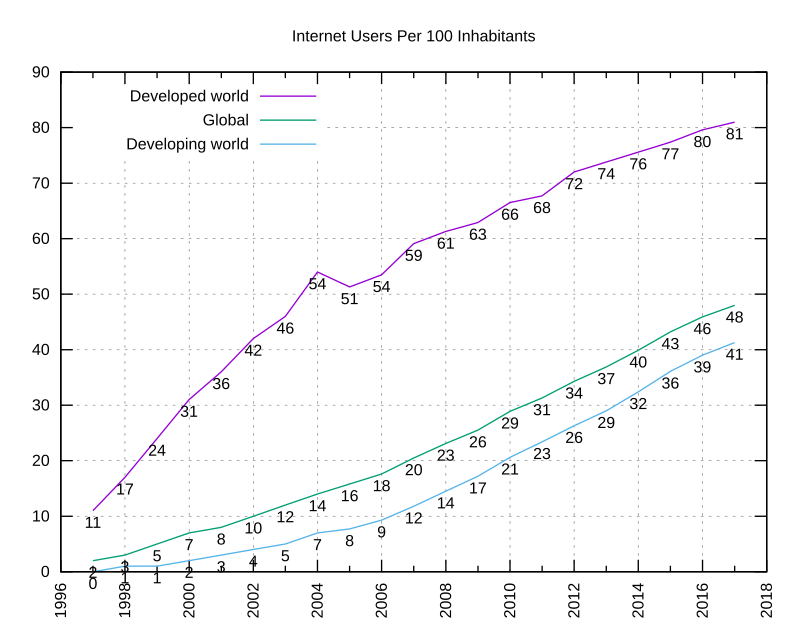
File:Internet users per 100 inhabitants ITU.svgCurrent projections about developing world use of the Internet generally feature a linear growth pattern. That is a rational way of think about it. 

But it also is likely to be wrong. Forecasters looking at use of voice communications in the developing world likewise were linear. 

But those forecasts were quite wrong. Why they were wrong is a story about deregulation, competition, using "capital-rational" networks and changing consumer perception of value. 

Voice communications, provided by mobile networks, became non-linear and exponential over a brief period of not even a decade.

Based on that precedent, one also would predict that Internet adoption in the developed world also will be non-linear. It is hard to predict, as the impact of mobile communications was hard to predict. 

But one clear implication is that the massive adoption wave happened only when service providers switched from expensive fixed networks to more-affordable wireless networks. In fact, from 1997 to 2007, world fixed lines were up relatively slightly. 

As with voice, mobility and wireless are likely to be the foundations for a similar upsurge of Internet access in developing nations. 


BT to Offer 300 Mbps by end of 2013

Sometimes slowly, fixed network access speeds are climbing towards a gigabit standard. 

BT now says it will launch a 300-Mbps service in about 50 exchanges by the end of 2013. Those exchanges already have fiber to home networks in place. 

Existing customers on the fiber to home network will also be able to upgrade to the faster speeds by switching to the £50 "Unlimited" package, which comes without any usage limits and is free from traffic management. 


Are Mobile Broadband and Smart Phone Internet Distinct Market Segments?

Strictly speaking, observers consider the use of dongles as "mobile broadband," while use of smart phones for Internet access is considered something else.

In the U.K. market, for example, about five percent of surveyed respondents say they use mobile networks for Internet access to their PCs. 

About 33 percent say they use their smart phones for Internet access. Of course, many smart phones feature personal hotspot features, making the distinction fuzzy, at best. 

But it always is possible to identify "market segments" that some might say are distinct, and others believe are parts of a single market. Are triple-play services a distinct market from the markets for constituent services?

Is business high-speed access a different market from consumer high-speed access? Is 3G data access a different market from 4G data access?

The answers are more difficult because there always are some customers who use their services as though the choices (mobile broadband or smart phone access versus fixed network access, for example) are in fact clear substitutes.

In other words, some consumers make their own decisions about what products are functional substitutes, and which are not, even when regulators and service providers consider the products separate markets. 

Ofcom, for example, does not consider fixed wireless access a functional substitute for fixed high speed access supplied by either cable companies or over BT's network, since Ofcom is largely concerned with wholesale offers. 

And fixed wireless networks are not especially well suited to wide scale wholesale operations, Ofcom believes. "Deployment of broadband services using fixed wireless access so far has been limited to specific geographic areas or specific circumstances," Ofcom says. 

"In the short term, given the costs involved in providing fixed wireless access and the lower quality of the service, it is unlikely that an increase in the price of wholesale broadband products will lead a substantial number of CPs (communications providers) to switch to fixed wireless access at the wholesale level," Ofcom says. 

The point is that although there are reasons to consider mobile broadband as a distinct product from smart phone Internet access, the boundaries are fuzzy, and likely will become more fuzzy, as personal hotspot capabilities obliterate the differences in capability. 


Wednesday, July 10, 2013

Mobile and Autos are Made for Each Other, But App Providers Will Make Most of the Money


Five years from now, there will be over 60 million connected cars on the road globally, according to estimates from the GSMA.

Car-focused telecom, hardware and software services will drive some 40 billion euros ($51 billion) in annual revenue by 2018, Business Intelligence estimates.

Pandora, for example, is now being used in 2.5 million cars and 100 car models through one of its 23 partnerships with auto brands and eight partnerships with stereo manufacturers.

But some things do not seem to change. As with other ecosystems, ranging from electricity to water to roads, most of the ecosystem revenue is earned by third parties that build their own businesses on top of the infrastructure.

App providers will earn most of the money, a story by now familiar to service providers of all types.

Voice over LTE Getting Traction?

Service providers often face business model issues when transitioning from an older network to a new network, especially when the new networks have to support legacy applications. Consider the case of a telco upgrading its digital subscriber line network to a fiber to home or fiber to neighborhood network.

The business problem often is that capital has to be invested to support applications that offer no incremental value, or little perceived incremental value, over the older network versions. Fiber to the home offers faster speeds than DSL, but many consumers often do not see the need for the higher speeds, initially. Stranded capital results, in other words.

Up to this point, Long Term Evolution support for voice has been a similar case in point. Service providers have been relying on workable 3G voice while using new LTE bandwidth for Internet-based services.

Though there arguably are new features supported by Voice over Long Term Evolution (VoLTE), there have been some technology issues to be overcome. But an equally important issue is that it has not been clear any incremental revenue can be earned by deploying VoLTE.

To be sure, it is simpler, and more elegant, to deliver voice using the same network used for Internet access.

Some also believe VoLTE will offer additional features, compared to legacy forms of mobile voice. What operators are hoping for is that a combination of VoLTE, high definition voice and Rich Communications Suite will create a differentiated voice value proposition.

Also, at some point, supporting voice on LTE networks will allow operators to decommission the 3G networks, freeing up spectrum.

But as a practical matter, lots of mobile service providers have opted to rely on 3G for voice, using 4G primarily for Internet access operations.

"Operators are using another solution called circuit-switched fallback CSFB, and my understanding is that has worked better than operators had dared hope for,” said Mark Newman, chief research officer at Informa Telecoms & Media.

Some argue VoLTE adoption has been slower than anticipated in part because 3G voice still works, and because shifting more data access operations to 4G has the effect of freeing up more bandwidth on the 3G networks as well.

Stéphane Téral, Infonetics Research principal analyst, argues that VoLTE adoption will accelerate now that SK Telecom has shown how well VoLTE works in a national deployment.

Infonetics Research now expects 12 commercial VoLTE networks and eight million VoLTE subscribers by the end of 2013, with about three-quarters of those in Asia Pacific region.

At the same time, any number of observers might say there remains the possibility that over the top mobile voice could have bigger impact.

“While Skype dominates the over-the-top mobile VoIP space, the market is seeing other applications such as Fring, KakaoTalk, Line, Nimbuzz, WeChat and Viber gain in strength,” said  Diane Myers, Infonetics Research principal analyst.

“But the fact remains that most over the top mobile VoIP providers are making very little money per user,” said Myers. “In 2012, the average revenue per user was a meager US$7.13 annually.” That is an unsustainable business model, if not augmented in other ways, she said.

The number of global OTT mobile VoIP subscribers shot up more than 550% in 2012, to over 640 million, and is expected to approach the 1 billion mark in 2013, Infonetics Research estimates.

But Infonetics Research also projects the number of VoLTE subscribers to grow at a 145 percent compound annual growth rate from 2012 to 2017.

U.K. Mobile Ops Get Permission to Refarm 3G Spectrum for 4G

Though it might not have immediate implications, U.K. mobile service providers will be able to “refarm” their 2G and 3G spectrum for Long Term Evolution 4G, without applying for specific permission to do so, under new rules promulgated by regulator Ofcom.

Previously, only EE (and 3, which purchased some spectrum from EE, but has not yet been able to deploy that spectrum) had been given permission to conduct such redeployment operations, though all the major operators won new spectrum in the LTE auctions as well.

Under an Ofcom rule, EE was allowed to repurpose its 1.8GHz GSM frequencies in 2012, allowing EE to launch LTE before its rivals could acquire spectrum and build new networks.

The current 900 MHz and 1800 MHz licenses held by Vodafone and Telefónica
permit the use of 2G and 3G technologies.

The 1800 MHz licences held by EE and 3 now allow use of 4G technologies as well as 2G and 3G.

The new move by Ofcom moves away from the specific licensing rules that specified not only the purposes for which spectrum could be used but also which technologies (air interfaces) could be employed as well.

The new rules are more flexible, and allow carriers to make business choices about how to deploy networks, rather than being restricted to specific network options.

5G Will Quite Different from 4G

Will fifth generation networks be a “network of networks” or “heterogeneous network” rather than a single air interface on the model of 3G or 4G. That would be a big shift.

Traditionally, the difference between one generation of mobile networks and the next has been the air interface protocols. Now Ericsson thinks the key differentiator will be the ability to flexibly operate a virtual network that integrates many different air interfaces, protocols, frequencies and network types.

At least in part, Ericsson takes that view because of some differences between past next generation networks and future networks, namely the differences in speed and spectrum.

In the past, new mobile generations are typically assigned new frequency bands and wider spectral bandwidth per frequency channel (1G up to 30 kHz, 2G up to 200 kHz, 3G up to 5 MHz, and 4G up to 40 MHz).

The problem is that physical availability of spectrum usable for longer-range mobile apps is growing limited. And spectrum means bandwidth. 

At least so far, with the 4G standard calling for peak rates of about 1 Gbps, 5G will have a tough time offering “faster speed” as its distinguishing feature.

That means suppliers will be looking at battery life, coverage and throughput flexibility and the ability to match apps and device requirements in an affordable way.

Some new spectrum will be made available. Spectrum in the 900 MHz, 1800 MHz, 2100 MHz and 2600 MHz bands will be used for new LTE networks and HSPA network capacity upgrades.

LTE deployments using 700 MHz and 800 MHz spectrum will be added as well.

Small cell deployments will play a vital role in high-capacity hotspots, and the spectrum for that could come from the 3500 MHz band, where there is as much as 400 MHz being used for fixed broadband wireless access and satellite services, Nokia Siemens Networks has said.

All of that points up the importance of spectrum sharing and other new methods of creating new bandwidth.

Unlicensed bands such as 5 GHz or 60 GHz will offer additional traffic offload options for best-effort traffic of less critical applications without quality requirements.

The result is that up to 1.5 GHz of spectrum can be made available within this decade, Nokia Siemens Networks believes. At least 1 GHz of that will be traditional exclusive spectrum, while new spectrum-sharing techniques can unlock more spectrum for mobile broadband.

So there are lots of good reasons why Ericsson thinks a 5G network will be quite different from earlier mobile network generations.

In addition to phones and PCs, game controllers, TVs and other devices people use, there will be millions of machine-to-machine devices and sensors also supported by the 5G network. And the point is that no single network is best for all apps and devices.

“The long-term outcome of this trend is what we refer to as 5G: the set of seamlessly integrated radio technologies” that collectively, integrated seamlessly, will represent a fifth generation of wireless networks, Ericsson argues in a white paper.

One huge assumption is that there will be a massive increase in the number of devices that must communicate. In the future, the roughly five billion human-centric connected devices are expected to be surpassed between 10-fold and 100-fold by communicating machines including surveillance cameras, smart-city, smart-home and smart-grid devices, and connected sensors.

So there is a massive scale issue: a transition from five billion devices to 50 billion or perhaps even 500 billion connected devices.

A thousand-fold increase in required bandwidth is the other huge assumption. Beyond 2020, wireless communication systems will have to support more than 1,000 times today’s traffic volume, Ericsson also argues.

But bandwidth requirements will vary. It is possible many M2M apps and devices will not require lots of bandwidth, while consumer apps might require hundreds of megabits and some shared-use locations will require gigabits.

Likewise, latency and reliability requirements will vary as well. So it will make sense to match requirements to network segments and capabilities to match use cases to cost and network requirement parameters.

So 5G might be radically different from earlier generations of mobile networks. First of all, should 5G develop as Ericsson foresees, it will be the first network that actually is a network of networks, not a single air interface. The complexity of such an undertaking also suggests 5G will not arrive in fully-formed fashion as soon as typically is the case for mobile networks, which tend to be replaced about every decade.


Tuesday, July 9, 2013

Orange Expands "Smart Parking" Effort

Orange has teamed up with Streetline, a U.S.-based company that provides smart parking solutions, to develop a set of connected services embedded in the vehicle or dedicated to drivers. 

With 1,300,000 regulated parking places in France, the smart parking market is very promising," said Nathalie Leboucher, Head of the Smart Cities Programme at Orange.

Parks Associates projects that by 2017, 17.6 million consumers will subscribe to embedded connected vehicle services such as General Motors’ OnStar and Chrysler’s UConnect Access.

The international research firm predicts 47 percent of all new vehicles sold in the U.S. will have embedded mobile communications by 2017.


[FR] Orange Business Services and Streetline... by orange_business

"Law of Big Numbers" is a Key Telco Innovation Challenge

Innovation is critical to telco survival, most observers would tend to agree. If key legacy revenues are declining, new revenue sources must be found. Where to look for such new revenues is a key issue, though.

Nor is it easy to find big new revenue sources, in the communications or any other big business, where the law of large numbers is at work. Basically, a firm generating large revenues cannot easily find big new revenue sources that significantly impact total revenue.

After looking at 3,500 new service launches since 2009, Ovum concludes that “many operators miss the big picture, exaggerate the threat from over-the-top (OTT) players, and misunderstand the broader benefits of innovation,” says Emeka Obiodu, Ovum principal analyst.

Some executives might disagree with some of those conclusions. In four years' time, telco text messaging revenue will decline on average by around 40 percent across Europe and the Middle East, according to senior execs surveyed by STL Partners.

Mobile voice isn't that far behind, with a 20 percent decline predicted. That hardly qualifies as “an exaggeration,” one might argue.

Ovum implies that telcos were too selective when choosing partners and overburdened their partners with unrealistic revenue expectations. That is largely a structural problem.

A service provider with $20 billion to $100 billion annual revenues is not helped much by new lines of business that throw off annual revenues less than $500 million to $1 billion. The “unrealistic” revenue expectations largely are driven by the fact that organizations with large revenues cannot “move the revenue needle” with large new revenue streams.

Ovum also emphasizes the importance of prioritizing innovations that exploit the centrality of operators’ networks. Whatever service provider executives might have thought in the past, the advice to look for new services that build on the network and its users seems a generally accepted point of view at the moment.

“No matter how much telcos try to diversify, their primary role will always be as carriers of voice, messaging, and data traffic,” says Obiodu. Doubtless most service provider executives in the telco world would agree. It perhaps is not so clear that cable TV operators or satellite providers necessarily agree so much.

Other studies suggest telcos already have gotten that message. The approach currently pursued by the majority of respondents (64 percent) to an Accenture survey can be defined as renovation, or a more limited, incremental approach based on line extensions.

As one example, AT&T post paid customers are paying a new 61 cent a month “administration fee” that will raise $512 million a year in revenue ($7.32 per year per post paid customer), on a base of roughly 70 million customers.

To be sure, that is what most people would consider a consumer-facing innovation, but does make the point.

The amount of money AT&T makes from that 61-cent charge will be roughly equal, every month, to the amount of gross revenue Verizon Communications fixed network operations makes from all small business customer operations every month.

That is a practical example of the ways large telcos most easily can create new $1 billion annual revenue streams, namely by building off things they already do.

Generating $1 a month in incremental revenue from 70 million customers creates $840 million a year in incremental revenue.

Softbank to Invest $16 Billion at Sprint

Softbank Corp. plans to invest $16 billion in Sprint over the next two years, mostly to support Sprint's Long Term Evolution network, more than doubling the investment Sprint has been making on its own. 

After the two-year surge, spending is expected to stabilize at about $6 billion annually. 

Softbank also believes it can cut $2 billion to $3 billion annually, based on increased purchasing volume for items such as smart phones and base stations.


Whatever else might happen, the SoftBank purchase of Sprint already has vaulted SoftBank into third place globally for mobile revenue.

Saturday, July 6, 2013

"No Good Reason for Smart Phone Profits"

In what has to be one of the most astounding statements ever made by the chief executive officer of a company, about his business, Motorola Mobility CEO Dennis Woodside reportedly has said his company intends to drive down prices for Android devices.

That might not be too big a surprise. Perhaps the more astounding statement is that  "there's no good reason anyone should make huge margins selling smartphones," Woodside said. 

To be sure, price disruption is not unusual in the Internet ecosystem. Many firms have tried to disrupt pricing in a market. But that normally is a strategy employed by attackers, not incumbents. 

Of course, the difference in this case is that Motorola Mobility is fully owned by Google, which has different motivations than the owners of virtually all other handset suppliers. 

Smart phone profits have become a bigger issue recently, as margins seem to be under pressure, with more earnings difficulties  expected. 

The problem is similar to that of tablets, where greater competition is leading to commoditization, with falling profit margins. 


Are Handset Subsidies Good for Consumers?

Are handset subsidies “good” or “bad” for consumers who choose to buy service plans featuring bundled devices? A study by the Organization for Economic Cooperation and Development tries to answer the question.
Perhaps not surprisingly, the answers are nuanced.

In some cases, where one or more operators allow for the possibility of purchasing the smart phone device independently from a bundle, there is a higher total cost for consumers over three years.

For those countries where both bundled and “bring your own device” options exist, such as in France or the United States, the report concludes that the bundled option (with discounted smartphone) was, on average, between $10 and $20 a month more expensive than the BYOD option.

“This is not unexpected,”  a new OECD report shows. When service providers bundle or subsidize a device over time, they essentially are loaning the customer money. The difference in cost over three years essentially represents the cost of credit.

Practices that promote transparency, such as the use of handset purchase by unbundled monthly instalments, can have a positive impact on both consumers and the ecosystem that exists around smartphones, the report suggests.

This report also concludes that, in broad terms, service pricing is only slightly affected by the presence of bundled discounts for popular smart phones.

But the report also notes there are other forms of consumer benefit, irrespective of the possibly higher cost of bundled devices, over three years.

Bundled devices are beneficial, and promote smart phone use, by removing high upfront payments that are a deterrent.

Consumer lock-in is not an issue when regulatory authorities enforce maximum periods for contracts after which customers are entitled to have their handsets “unlocked”, do not permit devices to be locked or ensure there are procedures for early termination of service contracts.

The report does not that there is some evidence that when one mobile service provider provides subsidized devices, and others do not, the non-bundling carriers suffer marketplace damange.

In Spain, Telefonica and Vodafone, the two operators with the largest market share, decided to remove handset subsidies in February 2012 (Cinco Dias, 2012).This action was not followed by Orange (Spain) which gained market share from Telefonica and Vodafone during the first half of that year.

Possibly as a result of this experience Vodafone reintroduced what it described as a short term special offer, which included the price of a handset, at the end of July 2012.

If "the Employee is Part of the Product" Then Boosting Investment in Employee Engagement Can Pay Off

Even if a “leaner” approach to employee staffing might make sense for some firms, at some times, there also is an argument to be made that f...