Friday, September 23, 2016

Will Oligopoly Still be the Outcome, As New Platforms Emerge?

Capital-intensive industries tend to produce oligopoly market structures. Even some industries that are scale-intensive or moderately capital intensive also tend to do so, it seems. Look at Apple’s market share , for example.


So one reasonable question in the global access business is to ask whether technology platform advances can reduce capital investment hurdles enough to break the “oligopoly” market structure.


If so, then a wider new competitors might expect to break into the top ranks. If not, then only big firms can hope to do so.


At the moment, in several markets, it appears the latter thesis will be tested. In India, the entry of Reliance Jio already is rearranging market structure, forcing consolidation. In the U.S. market, Comcast and Charter Communications are getting ready to enter the market. In Myanmar and Singapore,  new competitors are being authorized.


So far, no breakthroughs in platform cost have occurred that could challenge oligopoly structures, though. In other words, the zero sum game continues to prevail, and one contestant’s gains will come at another’s expense.


It is unknown how much new fixed wireless and mobile platforms might change possibilities for non-oligopolistic market structures, on a marketwide basis. But it might be reasonable to suggest that the new platforms will lower provider cost, but not enough to overcome oligopoly assumptions.

That is not to underplay the potential importance of several new platforms, as well as continued advances by hybrid fiber coax networks. Lower platform costs are helpful in increasingly-competitive markets where capital and operating costs must be lowered.

Lower costs are required to serve rural customers as well. But, at least so far, none of the platforms seemed poised to break the background setting that business models assume costs high enough that oligopoly is the outcome.


In addition to devices, oligopoly also seems to prevail in the consumer applications market.


According to comScore, in the United States, the top seven apps, and eight of the top nine apps are owned by Facebook or Google.


Indeed, one might ask whether it is possible for any new apps providers to displace Google and Facebook, either.


Some might argue that stable oligopolies are possible somewhere between two and four providers, with many arguing three strong contestants is the optimal sustainable outcome. That four or more providers exist in many markets is considered by many a “problem” in that regard, generally called the rule of three.


Most big markets eventually take a rather stable shape where a few firms at the top are difficult to dislodge.


Some call that the rule of three or four. Others think telecom markets could be stable, long term, with just three leading providers. The reasons are very simple.


In most cases, an industry structure becomes stable when three firms dominate a market, and when the market share pattern reaches a ratio of approximately 4:2:1.


A stable competitive market never has more than three significant competitors, the largest of which has no more than four times the market share of the smallest, according to the rule of three.


In other words, the market share of each contestant is half that of the next-largest provider, according to Bruce Henderson, founder of the Boston Consulting Group (BCG).


Those ratios also have been seen in a wide variety of industries tracked by the Marketing Science Institute and Profit Impact of Market Strategies (PIMS) database.


Thursday, September 22, 2016

In U.S. and U.K., 10-12% of Internet Users are "Mobile Only"

More than 90 percent of Australians under 50 go online using a mobile phone. That does not mean that “only” do so using a mobile device, only that the behavior is ubiquitous.

As with many other aspects of Internet behavior, older age cohorts use their mobile devices to use Internet apps at a lower rate.

Some 75 percent of all consumers in Australia access the internet using a mobile phone, according to a June 2016 survey by Sensis.

But that figure is because just 61 percent of those ages 50 to 64 do so, and just 33 percent of those ages 65 and up do the same.

For some, the more interesting question is what percentage of people use “only” the mobile device for Internet access.

In earlier 2016, for example, 11.7 percent of U.S. Internet users were going online exclusively using a mobile device mobile device, and do not use personal computers or other devices at all.

In fact, since 2015, according to comScore, there are more “mobile-only” than “desktop only” Internet users.

In the United Kingdom, about 10 percent of Internet users use mobile exclusively to get online, according to Ofcom.


Wednesday, September 21, 2016

Ting Will Face Big Test in Denver, Colo. Suburb

Ting will face an important test of its abiliity to compete against the tier-one providers when it lights a gigabit network in Centennial, Colo., where both CenturyLink and Comcast already offer, or soon will offer, their own gigabit services.

It might be one thing to offer gigabit services in a smaller community where it will not have to face a tier-one provider. It will be something else again to compete against two tier-one providers, each of which already is committing to offer gigabit services.

That will be the case in Centennial, a suburban community in the southern part of the Denver metropolitan area. For that reason, it is a crucial test, not only for Ting, but all other independent gigabit providers.

AT&T DirecTV Now Launch Will Include Zero Rated Bandwidth on the Mobile Network

In the fourth quarter of 2016, AT&T will launch DirecTV Now , an over the top video entertainment product with a heavy mobile or untethered focus, featuring “100-plus premium channels.”

There are a couple angles here. Consider the way AT&T plans to manage bandwidth consumption and pricing, something that, in the mobile realm, has been a challenging barrier.

“And when you buy this content, the data required to stream it on your mobile device is incorporated into the price of the content,” said AT&T CEO Randall Stephenson at an investor conference.

“If you choose to use that in a mobile environment on AT&T your data cost associated with this is incorporated into your content cost,” he said.

There is a precedent for this: broadcast TV, broadcast radio, Sirius XM and cable TV and other linear video services. Or, if you like additional examples, newspapers and magazines that consumers can subscribe to, with delivery cost simply bundled into the price of the subscription.

Media products, in other words, always have featured incorporation of delivery cost into the purchased product price.

Zero rating of delivery cost (no incremental charge, in the above examples), is simply a common media and content product pricing model. Though some insist on casting zero rating as an infraction of network neutrality, it is simply an accepted model for media products.

As some have argued, video entertainment services can be viewed as “managed services,” not “Internet” apps. By definition, managed services are not subject to network neutrality rules.

The other angle is that in zero rating video entertainment, AT&T shows its belief that its mobile network can handle the huge increase in consumed bandwidth. And if the mobile network can handle entertainment video, it can handle all the other conceivable media types.

If the mobile network can handle all the media types, and former bandwidth restrictions are not impediments, then mobile increasingly will be a viable substitute for the fixed network.

AT&T Believes Default Future Architecture is Wireless

Just in case you were wondering whether tier-one service providers such as Verizon and AT&T actually believe they can use fixed wireless and mobile services to compete directly with fixed networks--including optical fiber directly to the premises--consider what AT&T CEO Randall Stephenson recently said at an investor conference.

“Our default or target network architecture in the long run is wireless,” he said. “We think that's where we need to be.”

But what about fiber to the premises? “ Obviously fiber is going to be important for several years,” Stephenson said. Of course that will be the case, in enterprise, backhaul and wholesale settings in particular.

But that is not the key point. AT&T might be wrong, but it actually believes wireless will do the job.

“But as we look out in a world of 5G our target architecture is a wireless architecture,” he said.

Fortune 500 CEOs are a sober lot, not given to flippant remarks when speaking in investor forums. So that is a significant statement.

So that little tidbit is instructive. It will bother some in the ecosystem. Many will doubt the shift to wireless is going to be easy, or even possible. But many of us would not bet against the premise.

There simply is too much development effort, too much new technology, too much new spectrum coming and too clear a need for lower infrastructure and operating costs, for that shift to wireless not to be attempted.

Comcast Might Get 12 Million Mobile Accounts in First Few Years

In the early going, Comcast is likely to snag about three percent market share, or about 12 million accounts. That is based on Comcast getting about 10 percent mobile market share in the areas where it actually operates its fixed networks.

Eventually, Comcast theoretically could get 20 percent share of the whole market, but likely not unless it acquires either T-Mobile US or Sprint.

So here’s the thinking.

In the first quarter of 2016, the leading U.S. mobile providers had about 393 million branded mobile accounts in service, with Verizon having 138 million, AT&T 130.4 million, T-Mobile US 65.5 million and Sprint 58.8 million.

For the sake of argument, if Comcast were to grab about 10 percent share in the first few years, that would represent about 39 million accounts.

Eventually, if Comcast gets 20 percent share, that implies something on the order of 79 million accounts.

There are many contingencies. Comcast says it will first concentrate on selling services to its own customer base. Since Comcast networks pass only about 30 percent of U.S. homes, that essentially limits the addressable market to some fraction of the total U.S.mobile market.

So if Comcast gets 10 percent of mobile customers in its own areas, that might equate to some 12 million accounts. To get to 20 percent share of the whole U.S. market, Comcast almost certainly would have to acquire either Sprint or T-Mobile US.

There are, of course, many unknowns. Some believe it is inevitable that Comcast buys T-Mobile US. Some new entity, with marketing muscle and assets, could enter the market and buy Sprint or T-Mobile US.

Dish Network somehow could find a partner to help it build and operate its own network, complicating the market share possibilities even further.

Some believe Sprint and T-Mobile US will try to merge, again.

You can make your own guesses about which competing mobile service providers will be hurt the most, as Comcast enters the market.

In the second quarter of 2016 Verizon had 35 percent share. AT&T had about 32.5 percent share. T-Mobile US had about 16 percent share, while Sprint had about 15 percent share. All other mobile suppliers collectively had about two percent share.

If Comcast were to take share equally, from all the four leading providers, Verizon would lose the most customers. Few likely believe that will be the case. Assuming Comcast enters the market with a low price positioning, it is likely to compete more with Sprint and T-Mobile US.

AT&T, by virtue of its subscriber mass, and its relatively greater loss of subscribers to T-Mobile US, might also be affected more than Verizon.

U.S. Mobile Operator Subs, Q2 2016 (retail and wholesale)
Carrier
Subscribers (millions)
Net Adds (millions)
Service Revenue
(US$ millions)
Verizon Wireless
142.754
1.285
$16,741
AT&T
131.805
1.361
$14,912
T-Mobile USA
67.384
1.881
$6,888
Sprint
58.446
-0.360
$5,943

Messaging Apps Now are Platforms

BII Why Banked And Unbanked Prepaid Cardholders Use Prepaid Cards
Source: BI Intelligence
Messaging apps now are platforms, meaning they now are proving to be the foundation for creating apps and services on top of them.


Messaging apps now are ways for people to connect with brands, browse merchandise, and watch content, for example.


The combined user base of the top messaging apps is larger than the combined user base of the top four social networks, according to Business Insider.  

WhatsApp, Facebook Messenger, WeChat, and Viber are biggest. But WeChat, KakaoTalk, and LINE arguably have done the best job monetizing their customer bases. 


Chat apps also have higher retention and usage rates than most mobile apps. Also, the majority of their users are young, an extremely important demographic for brands, advertisers and publishers.


Enterprise Employees Downloaded Malware Every 4 Seconds in 2015, Study Finds

source: Check Point
Unknown malware increased nine times while employees downloaded a new unknown malware every four seconds in 2015, according to the Check Point Security Report and SANS 2016 Threat Landscape Study.

In total, there were nearly 12 million new malware variants discovered every month, with more new malware discovered in the past two years than the previous decade, Check Point said.

About 20 percent of employees will inadvertently introduce malware through the mobile or Wi-Fi networks.

Endpoints represent the starting points for most threats, with attackers leveraging email in 75 percent of cases.

Also, 39 percent of endpoint attacks bypassed the network gateway firewalls.

As smartphones and tablets account for 60 percent of digital media time spent, mobile devices now are the way a substantial number of breaches occur.

Tuesday, September 20, 2016

Comcast is Going to Rearrange U.S. Mobile Operator Market Share

As competitive as the U.S. mobile market is, it is going to get worse. Comcast will be getting into the mobile business in 2017, using a “Wi-Fi-first” approach.

Speaking at an investor conference, CEO Brian Roberts said that by mid-2017 Comcast will launch a mobile service using Verizon wholesale services and Comcast’s own network of 15 million public Wi-Fi hotspots.

The only issue is which of the four biggest U.S. mobile firms will be hurt the most. Based only on share changes T-Mobile US has reported, AT&T and Sprint are probably the most exposed.

T-Mobile US says it has added--so far in the quarter--about 753,000 net new branded postpaid phone accounts and 650,000 prepaid net customer accounts in the third quarter 2016. At that rate, T-Mobile US will show growth for the quarter, year over year.

Adding some color, T-Mobile US says it gained more than 250,000 accounts from Verizon Wireless.

T-Mobile US gained about 400,000 accounts from AT&T and nearly 300,000 from Sprint.

If Comcast enters the market with a price-lead strategy--and most believe that is precisely what it will do--Comcast should pose the same “value-price” challenge T-Mobile US already does.

Comcast says it will concentrate first on selling mobile services to its own customers, essentially expanding its triple-play bundle to a quadruple-play bundle.

If Comcast enters the market with a price-lead strategy--and most believe that is precisely what it will do--Comcast should pose the same “value-price” challenge T-Mobile US already does.

In the first quarter of 2016, there were about 393 million mobile accounts in service, with Verizon having 138 million, AT&T 130.4 million, T-Mobile US 65.5 million and Sprint 58.8 million.

For the sake of argument, if Comcast were to grab about 10 percent share in the first couple of years, that would represent about 39 million accounts. Eventually, if Comcast gets 20 percent share, that implies something on the order of 79 million accounts.

You can make your own guesses about which competing mobile service providers will be hurt the most. But in the second quarter of 2016 Verizon had 35 percent share. AT&T had about 32.5 percent share. T-Mobile US had about 16 percent share, while Sprint had about 15 percent share. All other mobile suppliers collectively had about two percent share.

So Comcast initially will spend some time as provider number five. Eventually, Comcast could surpass T-Mobile US and Sprint.

Where Verizon and XO Communications Both Sell Services, at Least 3 Competitors Operate

As part of its acquisition review of XO Communications, Verizon’s studies show that more than 96 percent of buildings in areas where XO and Verizon both operate have at least two fiber competitors in the building, in addition to Verizon and XO.

Also, 98 percent of these buildings have at least one fiber competitor in the building, in addition to Verizon and XO.

Furthermore, 99 percent of these buildings have at a minimum two or more fiber competitors either in the building or within 1,000 meters.  

The data is important because regulatory bodies will take a look at implications for competition in business markets as a result of the acquisition.

XO and Verizon both have fiber in the same building in 664 locations nationwide.

Within Verizon’s fixed network footprint, XO and Verizon both have fiber to the same building in 170 locations.

More than 95 percent (162 out of 170 in-footprint buildings) have two or more other fiber competitors in the building, in addition to Verizon and XO.  

Thus, there will be at least three fiber competitors fiber access competitors in these buildings following the transaction, and in most instances more.

Of the eight remaining buildings, six have at least one other fiber competitor in addition to Verizon and XO, plus at least one other fiber competitor located within 0.1 miles of the building.  

Thus, nearly 99 percent (168 out of 170 in-footprint buildings) will have at least one fiber competitor in the building and at least one other fiber competitor within 0.1 miles.

The remaining two buildings have at least two fiber competitors located within 0.1 miles.    

Out of footprint, XO and Verizon both have fiber in the same building in 494 locations. More than 94 percent (465 out of 494 out-of-footprint buildings) have two or more other fiber competitors in the building, in addition to Verizon and XO.  

Thus, there will be at least three fiber competitors in these buildings following the transaction, and in most instances more, Verizon says.

Again, this analysis does not account for several other communications and cable providers who also likely serve some of these buildings but for whom information is not readily available.

Of the 29 remaining buildings, 17 have at least one other fiber competitor in the building, in addition to Verizon and XO.  

Of these 17 buildings, eight also have at least one other fiber competitor located within 0.1 miles of the building, and another eight have at least one other fiber competitor located within 1,000 meters of the building.  

Thus, 97 percnet (481 out of 494 out-of-footprint buildings) will have at least one fiber competitor in the building and at least one other fiber competitor within 1000 meters.  

The remaining building of these 17 has one competitor in the building.

Of the other 12 buildings, 4 have at least two fiber competitors within 0.1 miles; two have at least one competitor within 0.1 miles and one additional competitor within 1000 meters; and six have two or more competitors within 1000 meters of the building.  

That means that more than 99 percent (493 out of 494 out-of-footprint buildings) have at a minimum two or more fiber competitors either in the building or within 1,000 meters of the buildings.

AT&T Working on New Fixed Wireless Access Platform

source: AT&aT
Add AT&T to the list of big, influential firms now seriously exploring the use of new types of fixed wireless platforms for gigabit communications in the access network.


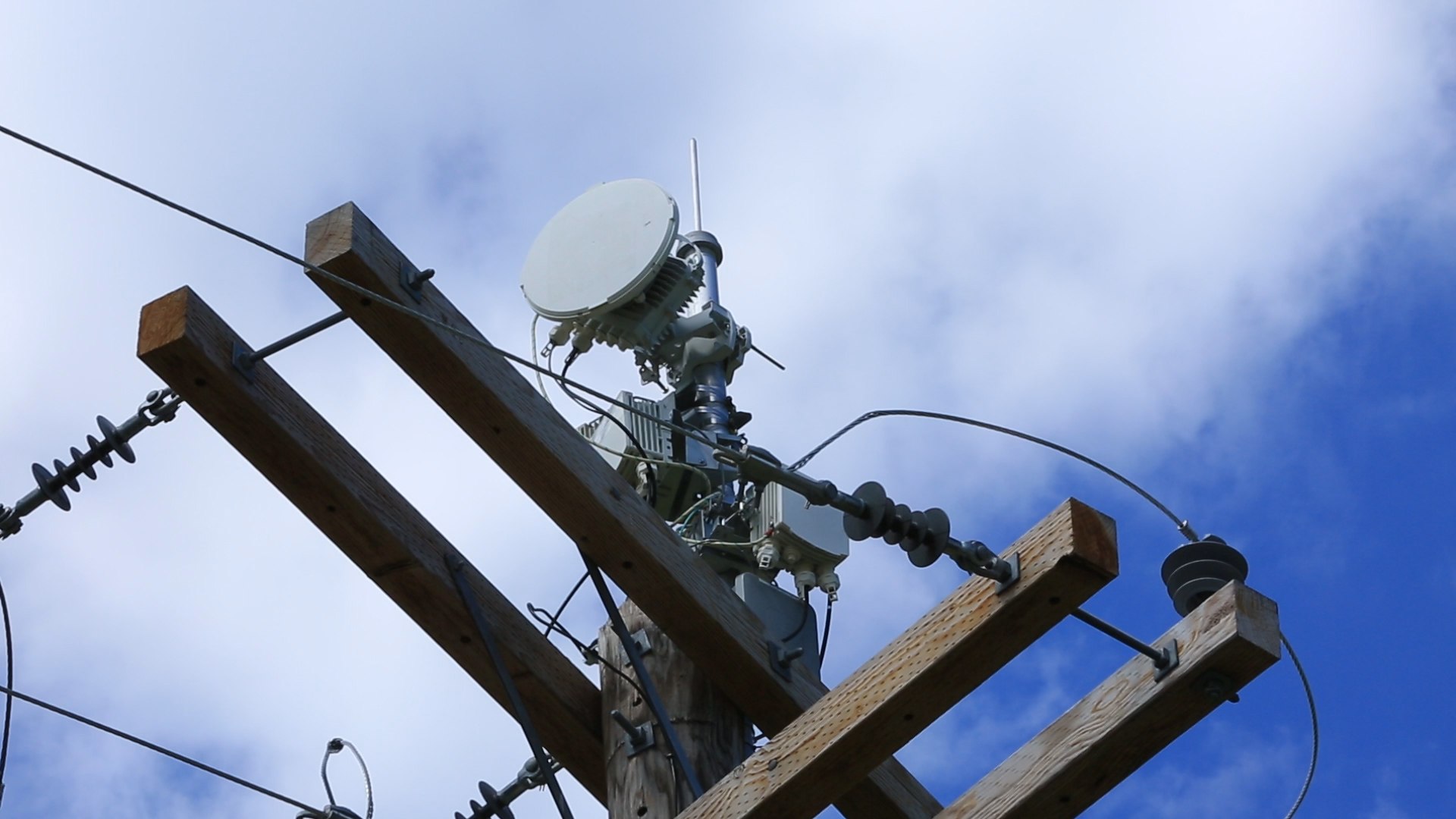
AT&T is working on “AirGig,” a method for combining fixed wireless with power line transmission for communications, without building towers, laying cables or acquiring new spectrum.


All three of those attributes have the potential to dramatically lower the cost of delivering gigabit services in the access network.


AT&T’s Project AirGig has several key advantages”
  • Easier to deploy than fiber
  • Uses license-free spectrum
  • No need to deploy towers, dig trenches or connect cables


At&T expects to conduct field trials in 2017.

Combined with the dominant role of cable TV networks in the access network, and the upgrades to gigabit speeds, serious questions can be asked about whether fiber to the home will continue to be viewed as the “best” way to deliver gigabit Internet access and other services to consumers.


“Project AirGig has tremendous potential to transform internet access globally, well beyond our current broadband footprint and not just in the United States,” said John Donovan, AT&T chief strategy officer.


AT&T says it has more than 100 patents or patent applications supporting this new technology and other access technologies.


source: AT&T
“We’re experimenting with multiple ways to send a modulated radio signal around or near medium-voltage power lines,” said Donovan. “There’s no direct electrical connection to the power line required and it has the potential of multi-gigabit speeds in urban, rural and underserved parts of the world.”


Project AirGig is therefore one more potential platform for Internet access and communications that uses fixed wireless.


As part of Project AirGig, AT&T Labs invented low-cost plastic antennas and devices located along the power line to re-generate millimeter wave (mmWave) signals that can be used for 4G LTE and 5G multi-gigabit mobile and fixed deployments.

“These patent-pending devices can mean low hardware and deployment costs while maintaining the highest signal quality,” said Donovan.


Biggest Competitor for Any Enterprise IT, Communications Sale is Not Other Sellers

source: Gartner
It always is tough to get to “yes” when selling communications or information technology products to enterprises.


“Your real competition is often not your competitors,” says Hank Barnes, Gartner research vice president. The status quo, or inertia, arguably is a bigger problem. The adage “you don’t get fired for buying IBM” illustrates the element of decision-maker or recommender risk when buying new technology and products.


The other problem is the sheer amount of buyer effort required to make a decision. No matter how great the promised benefits of a particular solution, there is cost (time, staff effort, political capital) to buy and use the solution.


And, needless to say, few buyers actually believe the benefits will be as great as the seller promises.


Also, internal teams, departments and business units always are vying for additional resources to help them accomplish their missions. So other projects and spending always are potential rivals for any new spending.


Not only do sales personnel need to convince buyers that a particular solution delivers value, but they also have to convince the relevant decisionmakers that any single project is more important than the others they are considering at the same time, Barnes argues.

So spending money elsewhere, or even doing nothing, always is a potential outcome, no matter the merits of a particular solution, says Barnes.


"Free Speech" Versus the "Free Exercise of Religion?" Maybe "Free Exercise" Versus Criminal Trespass

Some commentators loudly proclaim the January 18, 2026, disruption of a church service at Cities Church in St. Paul, Minnesota is a “test of...