Saturday, November 12, 2011

How Much Will Consumers and Business Pay for Really-Fast Broadband?


As the Federal Communications Commission shifts universal service programs to support broadband access rather than voice, the European Commission pushes for ubiquitous 30-Mbps service across the community, with a further objective of 100-Mbps service for roughly  half of potential consumers by 2020, it is fairly clear that there is widespread support for the idea that faster broadband can have important economic and social benefits.

If Federal Communications Commission Chairman Julius Genachowski gets his way, the FCC will set a goal of 100-Mbps service delivered to 100 milliion American homes by 2020. 100 Mbps or faster is the FCC goal

Genachowski says his preferred approach to a national broadband policy would require ISPs to offer minimum home connection speeds by 2020. The “100 Squared” initiative might in fact be too modest a goal, he suggests.

"We should stretch beyond 100 megabits," he adds. But "availability" is only part of the business equation. Demand is the other part. And at least so far, there isn't much evidence that substantial numbers of businesses or consumers are willing to pay for 50 Mbps, 100 Mbps or potentially 1 Gbps service. 

It might be a different story is the cost of such service were no more than what consumers now pay, but it seems highly doubtful investment can be raised, if that were to be the expected outcome.

Few customers now buy 50-Mbps services where such speeds are available, in large part because the cost is in the triple-digits range. Proponents might argue that the goal is 100 Mbps for not much more money than people now pay for 4 Mbps or 7 Mbps service, but it is hard to envision how even "free" opto-electronices could support such a value-price combination.

In other words, even if all the active elements actually were provided for free, could service providers actually build ubiquitous networks offering 100 Mbps or faster speeds, and price in middle-double digits? So far, the answer appears to be negative.

About 60 percent of the cost of building an FTTH network is construction work, ducts and cables, not to mention cabinets, power supplies and other network elements. Still, in some dense areas, it might be possible to do so, since the construction and cable might amount to about $1200 per home passed. Again, keep in mind we assume totally free opto-electronics.

In suburban areas the business case is marginal, at best, since about $2400 might have to be spent on construction and passive elements.

Since the FCC goal only calls for connecting 100 million homes out of possibly 113 million, we can safely assume the cost of most rural networks of such capacity need not be considered.

Of course, opto-electronics are not "free." But the point is that construction costs, were nothing else an issue, would still be a tough proposition, if the goal is very high speed access at prices most consumers would pay.

American consumers will be paying more for broadband in the future, if for no other reason than that most mobile plans will require it, and those charges will be paid for on a "per-device" basis, not "per home."

What seems improbable is that U.S. consumers are willing to increase overall broadband spending by an order of magnitude (10 times) to have 100 Mbps or faster service on a fixed basis.

One can of course argue from history. Prices for lower-speed broadband services have declined over time, while the prices for the faster tiers have remained stable, but speeds have increased. The issue is how much price compression is possible.

"In order to earn a return for investors, you have to be conscious of what consumers will pay. I don't know this is something consumers will pay for," Piper Jaffray analyst Christopher Larsen says. "It's a nice goal, but it's a little on the over ambitious side."

And in a capital-intensive business such as communication networks, being too early, with too much additional capacity, processing or storage, can be ruinous. One might point to the dramatic bubble in capacity investing, competitive local exchange networks or e-commerce sites around the turn of the century.

Equally to the point is the serious gap that developed between 3G mobile networks, especially in Europe, and the promised new applications that proponents expected would develop.

It has been roughly a decade since European mobile operators placed big spectrum bets on "third generation" mobile broadband, and then largely watched as killer apps failed to emerge, customer use of the new networks remained sluggish, and executives ruefully noted they had overpaid for spectrum.

As operators now gear up for a transition to 4G, we will hear similar talk about new applications the network will enable. The difference is that, a decade after launch, the  "killer app" for 3G turns out to be mobile broadband access.

Right now, 4G is mostly “just” faster access. But 4G looks to be a potential replacement for fixed-line broadband, so maybe, early on, a lead application for 4G will be displacement of fixed-line broadband connections, and not any particular new application.

Some might argue that a lead app for 4G is turning out to be personal Wi-Fi hotspots, for example, another “access” function. A decade from now, we are likely to have discovered that some important new applications, enabled specifically by 4G, have arisen. But it will take some time, if 3G is any predictor.

At some point, the gap can be bridged either by “build it and they will come” improvements in processing, storage or communications that outstrip known demand, or “build it and they will come” applications that might be usable by only a fraction of potential consumers.

Some think the logjam can be broken only by moving faster towards faster networks, to create the right environment for application developers. That tends to be an opinion held by people whose core business interests do not require investing the money.

Service providers are quite a bit more circumspect, and “greed” is not the primary reason for such views. In fact, experience teaches service providers that consumers are quite careful about spending their own money on communication services, devices and features.

One case in point is a study of small-business broadband by Columbia Telecommunications Corporation, which conducted a nationwide survey on behalf of the Small Business Administration.

The really significant finding is that respondents won't pay all that much for 100 Mbps or 1 Gbps connections. Businesses Want 100 Mbps, 1 Gbps, but won't pay

And price resistance is stubborn. Even when the price for such a service is just 10 percent to 20 percent higher, businesses are significantly less likely to switch to a 100-Mbps service from what they currently buy.

As you might guess, if small businesses are hesitant to spend 10 percent to 20 percent more to get 100 Mbps, they are even more hesitant to spend more for an extremely fast Internet connection of 1 Gbps. This is especially true for prices that are 40 percent or more higher than their current prices.

If you asssume the average prices now range between $70 a month to $124 a month, then survey respondents show significant resistance to paying much more than $84 to $149 a month for 100 Mbps service, or $98 to $174 for 1-Gbps service.
This graphic might confuse you. The taller the bars, the less likely the respondent is to take the action indicated. The tallest bar, a score of "5" would mean "highly unlikely" to take the action. SMB broadband demand report

A score of "1," shown by a shorter bar, would indicate strong willingness to take the action.

The point is that small business users aren't willing to spend much more to upgrade from their current level of service to 100-Mbps service.

The most surprising finding is that even the same prices, or prices 10 percent 5to 20 percent lower do not cause small business respondents to become certain of switching. Scores around "3" indicate a "maybe, maybe not" attitude.

No matter what these respondents say about wanting higher speeds, they don't appear to be willing to pay much of anything for it.

People Now Watch Videos Nearly 30 Percent Longer On Tablets Than Desktops | TechCrunch

Viewer engagement by device
It perhaps is counter intuitive, but a new study by Ooyala suggests that people spend more time watching long-form video on their tablets, than on their PCs.


Even more surprising, there is evidence that smart phone users, on the smallest screens, might be watching video at levels approaching PC viewing.


In fact, the Ooyala study already shows that viewer "engagement," defined as the percentage of any bit of content that the user actually watched, is higher on smart phones than on desktop PCs or game consoles, both of which offer the biggest screens.

Granted, the Ooyala report does confirm that, given a choice, most people seem to prefer watching video on the biggest available screen. But what might be surprising is the amount of viewing on the "smallest" screen--the smart phone--so much of the time.

Tablet viewers watch for longer periods of time than viewers of desktops or mobile devices, and tend to watch more of any single bit of video as well.

For each minute watched on a desktop, tablets recorded “1:17 in played content”, which works out to 28 percent longer than the desktop average. People Watch Videos Nearly 30 Percent Longer On Tablets

That tablet viewers are more than twice as likely to finish a video than desktop users might be explained by the fact that much tablet use occurs "on a couch, rather than at a desk," meaning the user is in a more-relaxed setting without the "I'm at work" mindset.
The completion rate for tablet viewers was double what it was for desktop viewing, and is 30 percent higher than that of mobile devices. 


It is just a historical anecdote, but 30 years ago, the best and brightest video executives would have adamantly insisted that people would not watch entertainment video on small screens. But that was a long time ago. Before optical fiber changed fixed networks. Before most people had mobile phones, much less smart phones. Before 3G and 4G. Before digital video and video compression. Before high-definition video. Before the Internet and the Web. 


It's just a reminder that what seems true "now" might not have been true in the past, and might not be true in the future. 

Friday, November 11, 2011

Tablets are Untethered, not Mobile Devices

Ross Rubin, executive director of industry analysis for NPD Group, says the reality is that a lot of tablet usage seems to be at home or in Wi-Fi hotspot areas. tablets are untethered, not mobile


"Consumers are maybe reluctant to pay $15 or $20 a month when they may just need cellular access for a few hours," Rubin says. "Obviously, for some time there's been a lot of discussion about per-person billing versus device-based billing, and the tablet situation has really made that more of a real issue versus a theoretical issue."

In other words, if mobile service providers want to encourage more tablet use on mobile broadband networks, they probably will have to start offering the equivalent of mobile broadband "family plans" now common for voice and text messaging services.

ABI Research reports that less than half of tablets actually ship with a cellular modem, and less than half of those are ever actually activated after shipment.

Mobile Changes Mom Spending Dramatically

Motherhood is a catalyst for sharing, says Michael Fogarty, BabyCenter SVP. It also is a catalyst for content sharing and therefore an opportunity for content marketing on mobiles, in significant part because motherhood seems highly correlated with significant changes in spending. 


Some 62 percent of moms change the brands they buy when they become moms. And 73 percent change their purchase criteria for apparel and beauty products. "For example, the Victoria’s Secret brand goes from relatively high on the list to right down in the basement; it doesn’t even show up," says Fogarty.


E moms blogher and parenting 8 2, jkc
View more presentations from BlogHer


"They’re sharing photos of their kids, of course, but in terms of shopping, they want to share their recommendation about which stroller or diaper brand to buy," says Fogarty. "Anytime you get a coupon for something that’s relevant, especially in terms of the stage you’re at—whether it’s pregnancy or new motherhood—there are thousands of moms out there who would benefit."

"If you’re on a social network, you’re going to share that," Fogarty says. "And increasingly it’s being shared via mobile because it’s so much easier."  Mobile Changes Mom’s Path to the Register


"It’s very clear that moms are using mobile in different ways from the general women’s mobile segment because motherhood instigates mobile usage," says Fogarty. "We learned that 53 percent of moms actually purchased a smartphone as a result of becoming a mom."


"So it’s easy to see why moms are 18 percent more likely to have a smartphone than the general population," he says. "It’s much more than a phone—it’s everything from her calendar, her scheduler, her text messenger, her way to keep up with the nanny, her recipe finder, her GPS."


BlogHer Inc., in partnership with Parenting Magazine, conducted their second annual study of moms and technology in June 2011.  The findings show that moms are more engaged than ever with laptops, the Internet and mobile phones.  In fact, they have become the Chief Technology Officers for their families, overseeing households where children begin interacting with various electronic devices at an extremely early age; in some cases younger than two. Blogher survey


Kindle Fire Disables Some Android APIs

The Amazon Kindle Fire apparently does not support some application program interfaces used by other Android devices, meaning some Android apps won't run on the Kindle Fire. Though most consumers won't care, the "fragmentation" many observers see in the Android ecosystem illustrates the complicated nature of "openness" in software platforms these days.


It appears almost no platform is completely open, or completely closed. Amazon Kindle Fire disables some APIs

Isis Thinks Google Wallet Competition is a Good Thing

Mobile wallet providers
Michael Abbott, the CEO of carrier-backed mobile payments joint venture Isis, has an interesting take on rival Google Wallet: "It's the best thing that could happen."


You might think that an odd thing for one competitor to say about another major competitor. But early in the development of a brand-new industry, it actually can help to have multiple substantial contestants promoting the new market.


That is helpful because it reduces the perceived risk, on the part of potential users and customers. Any company executive that has tried to explain "what we do" in a market with no other providers or competitors will immediately grasp the concept. 

Abbott argues that competition from multiple parties is a good thing, early on, as it generates greater consumer awareness and can convince many other essential providers in the ecosystem to participate. Google Wallet is good for mobile payments


One is reminded that Apple under Steve Jobs did not conduct market research to develop new products, as Jobs' philosophy always was that people could not provide meaningful feedback about products they never have seen. 


That's another aspect of new markets, for new products consumers do not have experience using. Since people may not even be aware of why they need a product, it can be hard to sell such products. Having more contestants in such a market contributes to the overall evangelization process that creates better understanding on the part of users of why they "need" a product. 


U.K. Will Not Reach 30 Mbps Broadband Access Goal by 2020

FTTH Deployment Cost
Rural fiber infrastructure cost
BT Group Director of Strategy and Policy Sean Williams considers the EU target of 30 Mbps to all citizens by 2020 as "not achievable for any country." 


That doesn't mean complete or even substantial failure. In fact, one might argue the opposite. 


BT does seem to believe it will be possible to provide 30 Mbps access to about 90 percent of the U.K. population. 


For the final 10 percent of homes or locations, 2 Mbps might be more reasonable, for all sorts of good reasons related directly to the cost of building communications infrastructure in rural and isolated areas. Some might argue that the cost curve looks very much like the curve that describes the cost of providing health care to people, where most of the cost is incurred late in life. 


Likewise, the cost of building facilities to the last couple of percentage points of locations is very high. That's one reason satellite broadband providers have a business. The core market is about two percent of U.S. households, for example. 


The high cost of reaching the last 10 percent of locations in either the U.K. or U.S. markets always will be a problem, at least when using fixed networks, whether the services are narrowband or broadband . EC broadband target unreachable 


So some might argue that 90-percent coverage of the United Kingdom with 30 Mbps service by 2020 is not in any way "a failure." It is a success. But the problem with all infrastructure goals is that it always is a stretch to reach the last 10 percent of potential customers with networks of any kind.

Thursday, November 10, 2011

Tablet Users Watch 30% More Video

Where it comes to online video consumption, device type matters. And it looks like tablets are shaping viewer behavior in new ways. Tablet users averaged nearly 30 percent more viewing time per play than those who watched on desktops, for instance, and they completed videos at double the desktop rate, according to data from Ooyala. 

Viewer engagement was generally higher on mobile devices than on desktops. Mobile viewers completed 75 percent of a long-form video at a rate of 20 percent, compared to 18 percent for desktops. As a general rule, device type heavily influences viewer engagement. In the third quarter of 2011, tablet viewers were the most engaged, while desktop and laptop viewers were relatively less engaged.

For each desktop viewer who completed a video, for instance, more than two viewers did the same while watching on a tablet. Across all plays, the video completion rate for mobile devices was slightly higher than that for connected TV devices and game consoles, as well.


In fact, the latest data suggests  viewers are turning to their tablets, mobile devices and especially their
connected TV devices and game consoles to watch medium- and long-form videos. You might think mobile users would watch shorter clips, while desktop PC users watch more long-form programming. That doesn't seem to be the case. 


Desktops or laptops are far more likely to be used to watch short clips, the Ooyala data suggests.  Videos shorter than three minutes, for instance, accounted for more than half (52 percent) of the hours of content viewed on desktops.


That same measure is 42 percent for mobile devices, 29 percent for tablets and just six percent for
connected TV devices and game consoles. 


By contrast, longer-form videos represent a bigger share of the hours played on non-desktop devices. Videos 10 minutes or longer accounted for 30 percent of the hours watched on mobile devices, 42 percent on tablets and nearly 75 percent on connected TV devices and game consoles, Ooyala reports. VideoMind Video Index

China Telecom Plans to Offer Wireless Service in U.S. in 20129

If you are going to start a new mobile service provider in the U.S. it helps to have a clear niche, and that is what China Telecom Corp. seems to be thinking. China Telecom says it will start selling a wireless service to U.S. consumers under its own brand early next year, seeking to sign up Chinese-Americans, students and tourists who travel often between the two countries.


China’s biggest fixed-line provider will offer users of the service handsets with two lines, one that will work in the United States and another in China, says Donald Tan, president of China Telecom Americas.

Smart phones Now the "Lead Offer"

Lead offers vary by segment, in the U.S. or any other communications market. For competitive local exchange carriers, the lead offer long has been a bundle of business broadband access and business voice.


Consumer fixed-line providers have been leading with the triple play of consumer video, voice and broadband access. 


Wireless providers might arguably be leading with a device, not so much services. Basically, the "smart phone" now is the lead offer for a wireless provider, with data access, voice and texting becoming features. 


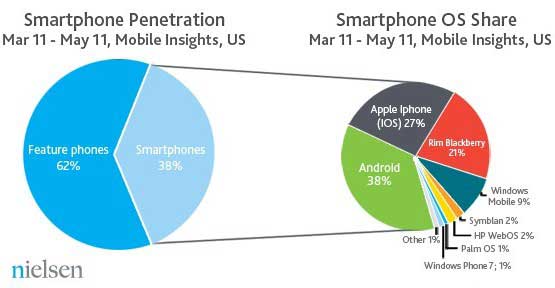
More than one-half (55 percent) of US consumers who purchased a new handset in the three-month period ended May 2011 bought a smartphone instead of a feature phone, up from the 34 percent who did so during the same period one year earlier, according to a survey from Nielsen.


Overall, 38 percent of U.S. consumers owned a smartphone as of May 2011, and 62% owned a feature phone. Smart phones as lead offer

T-Mobile USA Reports Third Quarter Subscriber Gains

Mobile share will shift, based on mergers
T-Mobile USA reported third quarter 2011 service revenues of $4.67 billion, slightly down from $4.71 billion in the third quarter of 2010, but net customer additions of 126,000 in the third quarter of 2011, a 176,000 improvement from net customer losses in the second quarter of 2011 of 50,000 and slightly down from 137,000 net customer additions in the third quarter of 2010. T-Mobile Gains Subs

Given the distractions of the still-unsettled acquisition of the company by AT&T, that is a reasonable performance. T-Mobile USA attributed the gains to its smart phone offers, value pricing, a wider selection of 4G devices and the 4G network itself.

T-Mobile USA served 33.7 million customers at the end of third quarter of 2011, compared to 33.6 million customers at the end of second quarter 2011 and 33.8 million customers at the end of third quarter 2010. 


The gains came from prepaid customer additions of  312,000 in the third quarter of 2011, an improvement from 231,000 net prepaid customer additions in the second quarter of 2011, and 190,000 net prepaid customer additions in the third quarter of 2010.

Post-paid contract customer losses, including connected devices were 186,000 in the third quarter of 2011, an improvement from 281,000 net contract customer losses in the second quarter of 2011. Net contract customer losses were 54,000 in the third quarter of 2010.


Those results point up one key element of T-Mobile USA positioning in the broader mobile market. With AT&T and Verizon Wireless claiming leadership of the "premium" positions, and several firms including Leap Wireless and MetroPCS claiming the "value" positions, both T-Mobile USA and Sprint must fight to figure out where they fit. 


In a sense, both T-Mobile USA and Sprint are being squeezed from the top and the bottom, in terms of their segments in the market. 


The End of SEO as We Know It: Mobile is the Reason

Lots of observers note that traditional search is changing with the advent of social networks, mobile apps and other ways for people to find things without engaging with a traditional search engine application. Some would say that Apple's Siri voice recognition app is just the latest example of that trend.


That has implications for content marketers as well, a least in terms of how much time and effort to spend to search engine optimization, for example. 


In the future, it is argued, people often will bypass search altogether. Ask Siri to "find the closest Italian restaurant" and the result is based on your current location and data from Yelp. 


Clawing your SEO way to the top spot on Google for "Philadelphia Italian restaurant" won't matter.


At the very least, the importance of presence on local content sites will grow. As a result, savvy small businesses that don't rely on e-commerce will spend even more time optimizing listings on Foursquare, Yelp, Facebook Places.


Yelp recommendations are currently embedded in Siri responses, so Yelp optimization matters more than SEO, some will argue. Siri: This Is the End of SEO as We Know It | Inc.com

The choices brands make might also change, to favor recommendation sites that are affiliated with certain app environments such as Siri. 


Africa Now the World’s Second Largest Mobile Market

Africa is now the world’s second largest mobile market by connections after Asia, and the fastest growing mobile market in the world, according to the GSMA. Mobile penetration reached 649 million connections in the fourth quarter of 2011 (having first exceeded 50 per cent mobile penetration in 2010).

Over the past five years, the number of subscribers across Africa has grown by almost 20 per cent each year and will reach more than 735 million by the end of 2012. Africa Now the World’s Second Largest Mobile Market

Some 96 percent of subscriptions are pre-paid. By 2015, next-generation LTE networks are predicted to reach 500,000 connections in Kenya, 1.1 million connections in Nigeria and 2.5 million connections in South Africa.

War Between Flash and HTML5 is Over: HTML5 Has Won

The debate over whether supporting the Adobe Flash plug-in on mobile devices is a better way to support content apps, instead of using HTML5, seems to be over. Adobe is abandoning its work on Flash for mobile.


"Our future work with Flash on mobile devices will be focused on enabling Flash developers to package native apps with Adobe AIR for all the major app stores. We will no longer adapt Flash Player for mobile devices to new browser, OS version or device configurations," Adobe says. Flash, HTML5 war is over


Instead, the company will refocus its efforts on mobile apps and desktop content, and “aggressively contribute to HTML5.” It’s not just that HTML5 is a great opportunity for Adobe. There are some very basic reasons why the company changed course on its mobile Flash.


In particular, Flash suffers a performance hit as video resolution grows. 

Will Cloud Lead to Use of Fewer Applications?

Could a widespread shift to cloud computing actually reduce the number of applications used by enterprises or consumers? In an enterprise context, at least, that might happen.

Over time, many companies’ IT landscapes have become cluttered with obsolete IT systems and applications that no longer deliver full value to the business, but still are used. In survey of IT executives conducted by Capgemini, 85 percent of respondents said their application portfolios were in need of rationalization.

A shift to cloud delivery would logically help solve those sorts of problems, as it would be easier to buy and use only the apps an enterprise really needs, today, instead of what those enterprises thought they needed in the past. Applications in a cloud environment

In principle, cloud-delivered apps for consumers might be created and managed in the same way, as it is relatively easy to update and change apps without lots of grief on the part of end users. Since latency can be a key issue for many cloud-delivered apps, there is an advantage for app providers that optimize cloud apps for latency performance, and that should often include stripping out bloat.

What Role for Mobile Video?

According to Yankee Group researchers, 34 percent of respondents who watch video on their mobile phone at least once a week say they watch user-generated videos. 


That isn't to say they wouldn't watch professionally-produced video as well, but those options are not generally easily available. 


These videos from sites like YouTube or Facebook are by far the most popular content. YouTube just recently announced it is receiving 200 million mobile views of its videos daily, a 300 percent increase from last year. The next most popular, TV show clips, are cited by just 20 percent of respondents. 


So how big a business could mobile video, in the form of a channel for the sorts of programs people now watch on cable, telco or satellite systems, get to be? Content providers ultimately will have to decide how much to support streamed or multicast video for mobile consumption. 


The current hope is that revenue from the existing linear business (cable, satellite and telco TV) will continue to grow steadily, while incremental and significant new revenues can be earned from over-the-top delivery as well. Whether consumers will accept that state of affairs is a growing issue. 


The whole assumption behind "TV Everywhere" efforts is that consumers get mobile access as part of their fixed-network video service. But if subscription costs keep rising four to seven percent a year, there is just some point at which consumers will be unable to afford the fixed-network product, much less pay more for mobile access.


The probable future disruption of the video business might not be caused so much by the availability of new delivery channels and devices as by a consumer revolt over high prices. So how could mobile video work in a future environment where willingness to pay hits a wall?


Fundamentally, providers would have to adjust either the "value" part of the equation or the "price" part, or both. If consumers can get "what they really want," while paying no more than what they already pay, we could see a significant shift to "on demand only" delivery modes. 


Mobile might then become a significant channel for subscribers with high needs to watch professionally-created programming, including sports and news, where they are. Those are the two "real time" genres with an "event" character. Movies can be watched on a highly time-shifted basis. Sports and news really are better when consumed "live and in real time."


Mobile is arguably the best platform for that, in terms of immediacy, if not "screen size" parts of the experience. 


Wednesday, November 9, 2011

U.S. Broadband Adoption Up to 68%

Some 68 percent of American households used broadband Internet in 2010, up from 64 percent in 2009. Only three percent of households relied on dial-up access to the Internet in 2010, down from five percent in 2009, according to the National Telecommunications and Information Administration. Another nine percent of households had people who accessed the Internet only outside of the home.

So is that a good thing, or not so good? It depends on how you look at the data. The main reasons respondents cited for not having Internet access at home were a lack of interest or need (47 percent). 


In other words, about half of households that do not buy or use broadband access services do not have interest in using the Internet, or have no need to do so. About 24 percent of respondents who do not buy broadband say it is too expensive. 


And 15 percent of households do not own computers. Individuals without broadband service at home relied on locations such as public libraries (20 percent) or other people’s houses (12 percent) to go online.


All told, approximately 80 percent of American households had at least one Internet user, whether inside or outside the home and regardless of technology type used to access the Internet.


Cable modems and DSL were the leading broadband technologies for home Internet adoption, with 32 percent and 23 percent of households, respectively, using these services. Broadband Adoption Rises

Ofcom Warns of "Low Interest" in Super Fast Broadband

Ofcom chief Ed Richards has warned that cash-strapped U.K. consumers lack enough incentive from access providers to upgrade to "superfast" broadband packages. In other words, "prices are too high."


"For superfast broadband, subscriber numbers are still low, perhaps because the nearest thing we have found to a ‘killer app’ so far is the demands of the multi-user household," Richards said. "The fact that we cannot identify specific ‘killer apps’ beyond bandwidth hungry teenagers is in some ways beside the point." Ofcom boss warns of low interest in 'superfast' broadband

That argument illustrates an important, and sometimes overlooked, aspect of national broadband plans. Some supporters of faster broadband think the "problem" is availability. But there is a mounting amount of evidence that "availability" is not the problem.

For whatever reason, including compelling applications or prices, where super fast broadband is available, and a workable definition is access at 50 Mbps or 100 Mbps at the moment, demand has tended to be low, even in some markets, such as Singapore, where prices are low, by global standards.


Time Warner Cable in early 2010 had about nine million high-speed access customers. It had about 20,000 customers for its fastest DOCSIS 3.0 service, which depending on configuration can support speeds up to about 43 Mbps per 6 MHz channel in the downstream direction, or more, if more bandwidth is made available.


All that means is that few customers are willing to pay $100 a month or more to get really-fast broadband access running at speeds of about 50 Mbps maximum. Low demand for 50 Mbps?


Fiber access does not sell itself, BT has found. As it begins to market its new fiber-based access services, BT has found that consumer demand for 40 Mbps Internet access is less robust than some had anticipated.

"Cardiff has been given a head start by Openreach but some fiber-enabled parts of the city are proving to be a bit slow out of the blocks to take up the opportunities fibre presents," said Richard Hall,BT Openreach NGA Deployment Director for Wales. BT UK Frustrated by Lack of Superfast FTTC Broadband Uptake

"With the notable exception of Whitchurch, residents are proving slow to take advantage of the technology on their doorstep and so we are working with the local council to raise awareness and drive demand," he said.

In the U.S. market, service providers have not fared much better with sales of 50 Mbps or faster services, which largely remain products bought by business customers. Another typical U.S. market issue also could be a factor. Customers in these areas already can buy fast service from Virgin Media.


Telecom Service Provider Revenue to Hit $2.17 Trillion in 2015

Global Telecom Service Provider Revenue Forecast
In the 10 years from 2005 to 2015, telecom service provider revenue has shown and will continue to show year-over-year growth every year except in 2009, according to Infonetics.


Following a 4.1 percent increase in 2010 over 2009, telecom service provider revenue will grow 7.6 percent in 2011, to $1.86 trillion. Infonetics revenue forecast


Telecom carrier revenue is forecast by Infonetics to grow to $2.17 trillion in 2015, driven by mobile broadband. Keep in mind that those are global figures and that growth will vary from region to region.


Is it possible that U.S. service provider revenue could double in just the next five years? Insight Research Corp. thinks so. The firm reports that predicts that, between 2011 and 2016,, North American carrier revenue will  rise from $287 billion to $662 billion, representing 11 percent compound annual revenue growth.

That rapid growth, on a compound basis, would lead to a doubling of industry revenue in five years. That doesn't mean providers in every segment will benefit equally. But a forecast that large would have to assume that most of the growth would have to occur at the largest firms, which represent 80 percent of total industry revenue.
The smaller providers cannot reasonably contribute enough aggregate revenue to tip the needle at such a large scale, even with even-higher rates of growth than 11 percent, compounded.

Global carrier revenue is expected to achieve a nine percent compound annual growth rate  from 2011 to 2016, growing to a total of $5.13 trillion, according to Insight Research Corp.

The forecast explicitly assumes that North American service providers successfully will grow new revenues at a rate fast enough to compensate for weakening voice revenues, for example.
See Insight Research findings here 

Tuesday, November 8, 2011

How Far Can Sports Programming Costs Escalate?

Sports cost per channel 2008
The major sports networks combined pay about $3.1 billion a year for the rights to the 16-game National Football League season, up 35 percent from their last deal. Although the NFL's contracts with CBS, Fox, NBC and ESPN still have two years to run, the league would like to have new deals wrapped up by the end of this season, in February. 


Sports programming costs matter greatly for leagues, sports networks, video distributors, consumers and the future of online video. 


The biggest question is how much further sports programming costs can rise, since those costs are passed along almost directly to end users, who are starting to show resistance to the annual price hikes on video service. 


The three broadcast networks could end up joining ESPN in paying 10-digit dollar figures per season in their next contracts. Testing the limits of rising sports programming rights fees - Los Angeles Times:
Video costs keep climbing


"It's not for the faint of heart," said Fox Sports Chairman David Hill when asked about the next round of NFL negotiations.


Already, ESPN and the regional sports channels are the most expensive basic cable channels on the dial — often costing distributors such as DirecTV Inc. and Comcast Corp. three times more than what they pay for news or entertainment networks such as USA, TNT and Discovery. Distributors worry that continuing to pass along sports costs to their customers could drive more away.

U.S. Productivity is Rising, but AI Doesn't Seem the Reason

U.S. productivity has been rising for several years, but artificial intelligence is probably not the reason, at least, not yet.  According t...