Sunday, January 22, 2012

Are Device Subsidies Bad for Consumers?

Some would argue that mobile device subsidies, which require end user contracts, represent unfair competition in a market where some larger providers can afford to make the offers, while others cannot. Those subsidies are substantial. In some cases, the subsidy can run as high as $500 on some devices.

Others would argue that contracts and subsidies also are anti-competitive to the extent that use of contracts hinders consumer choice, as the contracts lock users into relationships with specific carriers.

Others would argue that device subsidies are one reason so many consumers can afford to buy and use advanced smart phones that often cost as much, if not more than a PC.

In fact, some would argue that the net present value is better, for a consumer, when choosing not to sign a contract. Yell now if you know any consumer that ever has conducted an NPV exercise before buying a device or service.

One can argue that consumers essentially are “dumb” when they choose to buy subsidized phones and sign contracts. Others would argue the behavior not only is quite rational, but provides more value.

The argument for not buying a subsidized device that comes with a contract is that there is a risk of having to pay an early termination fee, or that the recurring fees of a contract plan are higher than otherwise would be the case.

Those assumptions do not generally apply, would might argue. Not every consumer ever pays an early termination fee. Perhaps few do. For a consumer that never pays an ETF, it is not part of the value equation at all.

Nor is it the case that a month-to-month recurring fee is lower than would be the case under contract. As often as not, it will cost just the the same, either way, and could cost more, in the non-contract case.

Consumers do have the choice to buy a prepaid plan that will offer lower recurring fees. But they generally will lose access to the full range of handsets, and will have to pay the full retail price for their handsets. Figuring out the actual NPV of such deals is complex. Users pay more cash up front, but lower recurring fees

So one major variable is the cost of the device and the length of time that device is used. That generally means a tougher business case for a younger consumer than an older consumer, as younger users break or lose their phones more often than older consumers do, and younger consumers are more apt to buy a new phone for fashion or application reasons unrelated to whether the device still works.

That said, in cases where a consumer has to pay an early termination fee early in a contract (the fee is pro-rated), an argument can be made that the NPV would have been better if the contract had not been signed.

Contracts, some argue, also are “unfair” to consumers, which might not be the same thing as a less-favorable NPV. The reason is that the actual value of a handset subsidy is rarely clear to a consumer.

The device “retail” price, which is typically compared to the subsidized price, might or might not capture the actual value of the discount, since a consumer doesn’t know what a particular service provider actually paid for the devices.

The same objection can be made about early termination fees that might be likened, when imposed, to a consumer making a loan to the service provider. Some would argue that the pro-rated ETF fees are levied at rates above the simple amortization rate of the ETF over the two-year contract term.

In other words, if a consumer has to pay even the pro-rated ETF, a simple amortization rate might imply reducing the rate about $14 a month for each additional month of service. Instead, service providers reduce the rate about $10 a month for each month of contract service. That $4 a month “excess” is essentially an “interest” payment, some would argue.

Likewise, the handset subsidy might be likened to a  is a loan that is repaid over the life of the subscriber contract.


Are subsidies loans? Some might argue a handset subsidy is a loan made to a consumer that is repaid over the length of the contract term. The logic there is that the ETF should reflect the actual value of the handset subsidy.

“If the actual cash subsidy is equal to or less than the initial ETF, then the way in which ETFs are administered today produces punitive results for subscribers who terminate their subscriber contracts early,” argues Dave Selzer , JSI Capital analyst.

Some of us would argue that, in most cases, the device subsidies, with contracts, actually are positive for end users, service providers and device innovation. That is not to ignore the growing cost to service providers of providing the subsidies, the potential ETF exposure for consumers or potential danger to device suppliers if the subsidies were to go away.

The simple argument is that device subsidies allow consumers to buy advanced devices they would otherwise not be able to afford, or not want to buy. Service providers sell more data services when they sell the subsidized smart phones and reduce churn. Device manufacturers have larger markets, since consumers replace their phones at a higher rate than they would if the subsidies were not available.

All application providers win because device replacement is the primary way new app behaviors are stimulated.

Nevertheless, the subsidies cause cash flow drag for service providers, and seem to be a growing burden, in that regard.

On the other hand, subsidies and contracts do minimize churn and do support average revenue per user. Those effects are important for public companies.

Would carriers offer the subsidies without some assurance they could earn back the cost of the subsidies over time? Would carriers rather sell devices at twice current prices, or higher? Would they prefer to raise rates? You can make your own guesses in that regard.

That is not to say different packaging is inconceivable. If you assume the subsidy represents $300 to $400 of real costs to a carrier, it might be possible to offer a plan with full-price device purchase, with free service for a period of time or perhaps lower recurring prices.

The details might vary, but a revenue-neutral solution could be imagined. The downside is that predictability of revenue would decrease, since consumers could desert, without financial harm, at any point after the promotion ended

The potential changes in how service providers compete, in a regime where there are no device subsidies, is likewise unclear. All service providers prefer device exclusivity when they can afford to pay for it. That might not change.

But higher device prices would encourage more buyers to shift to prepaid plans that are far less lucrative for service providers. Fewer might buy advanced devices. So innovation would slow. That isn’t helpful for anybody in the ecosystem, as it is the promise of new services and applications that could allow service providers to keep growing revenues as demand for basic voice and messaging declines.

Device subsidies are an issue that contracts address. Contracts smooth out revenue, raise average revenue per user and reduce churn. Whether there is a way to preserve those advantages some other way is an interesting question.

So far, the largest mobile service providers, who live mostly on the strength of postpaid accounts, have been unwilling to rock the boat by switching to some packaging method that does away with the subsidies.

Whether they ought to do so also is a key question. Many business models are built on subsidizing one element of service to make money elsewhere. Amazon seems to be subsidizing devices to sell content, while Apple subsidizes content to sell devices.

Mobile service providers subsidize devices to sell recurring service. In principle, mobile service providers could offer inducements other than cheaper hardware, ranging from free domestic calling or messaging to lower recurring prices.

Whether the value of those inducements to consumers is higher than "cheaper devices" is hard to determine. Also, any other inducement would involve a revenue exposure of some size. Right now, messaging is the service with the highest profit margin and voice is the product with highest revenue contribution, though matters will change over time.

Whether prices and packaging for recurring services matter as much as cheaper phones is the issue. Also, there is no question but that devices increasingly are the value that provides the greatest demand "pull" in markets where "everybody" buys mobile service.

Nobody really "loves" their service provider, much less the ability to communicate, as much as they love their devices. Price is never unimportant. But price differentiation can only go so far, one might argue, as key competitors in each market segment pay close attention to competitor prices and offers.

Are Phone Subsidies a Bad Idea for Service Providers?

Handset subsidies largely are responsible for rapidly increasing smart phone penetration. On the other hand, the subsidies put pressure on service provider profit margins. Assume a service provider subsidies a device at about 50 percent of its actual cost, in exchange for a two-year service contract.

A device that costs the service provider $400 might be sold for $200, with the subsidy value recouped over the life of the service contract.

One might say handset subsidies are a necessary evil, allowing service providers to more easily acquire new customers, reduce churn and increase sales of smart phone data plans.

Typically, smart phone users commit to new multi-year-term contracts and generate average revenue per unit nearly twice that of voice-only consumers.

But handset prices are a major issue for consumers, in China and elsewhere.


But there is a price: the subsidies are a real cost of acquiring customers and reduce both cash flow and operating margins.

“In Canada, operators are seeing the benefits of higher sales and upgrade volumes largely wiped out by the impact of discounted handset pricing,” says Joss Gillet, Wireless Intelligence senior analyst.

The acquisition cost handset subsidies represent is in the range of $350 to $400 per new subscriber in Canada, and about the same amount in the U.S. market.

Nevertheless, Canadian operators value these costs as positive investments since they help to acquire and retain higher ARPU, lower-churning customers on longer-term contracts.

In markets that are saturated, there now are pressures to reduce subsidies. But nobody really can predict what will happen if service providers do so. One has to think (economics suggests higher prices for any product people want will lead to lower demand; while lower prices lead to higher consumption) much-higher handset prices will reduce purchases of new handsets.

At the very least, that will reduce the rate of innovation in devices, as users will refresh their devices at a slower rate, and it is device innovation that drives change in the mobile business.

Lower subsidies also will drive consumers to buy less-expensive devices, as well. On the other hand, at least some might argue that service providers should “double down” by extending contracts and refresh cycles, essentially gaining longer contract terms at the price of more-rapid refresh rates.

Some might say the solution is simply to provide more prepaid options for consumers. Such plans require that users buy their phones at full retail prices. But that also means there is no need for an operator subsidy.

But service providers also differentiate postpaid service from prepaid by the selection of devices. Typically, the hot new devices only are available on postpaid plans, in part to encourage purchase of the higher-margin postpaid plans.

If for no other reason than the differences in average revenue per user and profit margin, it seems unlikely service providers will want to shift too far in the direction of greater sales of prepaid plans.

Another tactic, namely making less costly phones available, will likely be preferred. But some of that potential also depends on supplier ability to create attractive devices at lower cost, as well as user willingness to buy those devices.

So far, no service provider has been willing to take the risk of selling even the most highly desired Apple iPhone without a subsidy. Whether a workable solution can be found--allowing service providers to reduce subsidies without losing customers--remains to be seen.

Some might say the consumer net present value actually is higher when users do not buy on contract, the logic being the early termination charge that could apply. But consumers do not perform an NPV calculations when shopping for a new phone or new service provider.

Also, one might argue that the potential payment of an early termination fee is about the same as the incremental cost of a full-price phone, so that in most cases there is not much difference between buying a subsidized phone under contract, and paying full price for the device to avoid the contract.

Each consumer has to make their own evaluations, but the evidence so far suggests buyers prefer the subsidies, even if they don't like the contracts. It's a bit like attitudes and behavior in the video entertainment business.

People always tell researchers they don't like advertising. But if you ask whether they would prefer to get free or highly-discounted content they want, in exchange for ad exposure, they vote for ad exposure.

Service providers would prefer not to have to provide subsidies. Consumers would prefer not to have contracts. But consumers clearly prefer less-expensive prices for their devices. In a business where the enabler of service--the phone--costs more than a PC, subsidies probably are necessary.

Saturday, January 21, 2012

Google’s Mobile Ad Revenues $7 Per Smart Phone

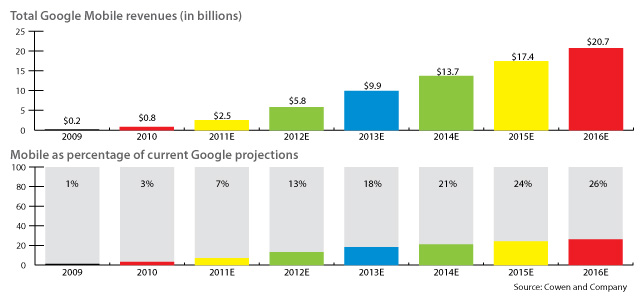
google-mobileCowen Group equity analyst Jim Friedland estimates that Google is generating $7 per year from each smart phone and tablet now used by mobile consumers globally. 


That figure includes both search and display advertising in mobile apps on both Android and iOS (iPhones and iPads). 


Active smart mobile devices worldwide reached 509 million in 2011, and are projected by Friedland to reach 914 million in 2012.


Based on that figure, Google’s mobile ad revenues could more than double from an estimated $2.5 billion in 2011 to $5.8 billion in 2012. 


As a percentage of Google’s total revenues, Friedland estimates that mobile grew from three percent in 2010 to seven percent in 2011 and will almost double again to 13 percent in 2012. 


By 2016, he expects mobile to be a $20 billion business for Google, and represent 26 percent of its total revenues. Google’s mobile ad revenue $5.8 Billion in 2012?


That suggests the magnitude of the challenge facing mobile service providers who generally consider mobile advertising one of a small handful of growth opportunities lucrative enough to contribute significant incremental revenue once mobile broadband the current growth driver, starts to saturate. 


If any mobile operator were to do as well as Google now does, that would work out to about $1.17 a month of incremental revenue per smart phone user, per month, at a $14 annual run rate. Consider that current revenues for voice, texting and data can run $75 per user, per month. 


Of course, the problem is that some current revenue contributors, especially voice and messaging, slowly are declining. And some observers think capital investments and operating costs actually could go negative, in many markets across Europe, North America and the Asia-Pacific region as early as 2015. 


Mobile advertising, mobile payments or machine-to-machine services, as well as cloud computing and other initiatives simply will not contribute significant revenues over the next five to 10 years, during which mobile service providers will have to rely on mobile broadband to fuel revenue growth.


Though not every mobile service provider will face such issues, many mobile executives will be facing huge profitability challenges between now and 2016, according to Juniper Research, which forecasts that mobile service providers face potential capital investment and operating costs that actually exceed revenues by about 2014, Juniper Research says. 

Separately, analysts at Analysys Mason concluded that carriers in many regions around the world face the risk of an "end to profit" in 2015 if not before.

A study carried out by mobileSquared surveyed 31 global mobile operators and found that one third of operators already see traffic and revenue decline, while 75 percent of are worried about losing revenues to mobile application providers.

The research confirmed that over-the-top apps already are affecting traffic and revenues. Some 32 percent of respondents thought operator traffic from messaging, voice and video calling would decline between 11 percent and 20 percent over the next five to 10 years. About 20 percent of respondents estimated revenue would fall 31 percent to 40 percent over the next five to 10-year period.
The problem, according to Juniper Research, is that profit margins are running between 15 percent and 20 percent, which means many service providers are at about break even.

By 2015, costs will exceed revenues slightly, and fall below capital and operating expense by about 2016.

Separately, analysts at Tellabs also predict that revenue could fall below costs "within four years."

The Analysys study assumes a continuation of current cost and revenue trends, especially the current pricing of bandwidth. The findings also suggest the immediate need mobile service providers have for changes in retail packaging and pricing to keep revenues above cost. 


In the near term, increasing data revenue per subscriber is about the only way mobile service providers will avoid a dangerous turn towards sustained financial losses. 

Algorithms Now Drive Advertising

Measured by dollars or by impressions, greater than 50 percent of online advertising is bought using "algorithms" that purport to demonstrate return on investment. 


In the future, some believe, 90 percent of all digital ad impressions, and more than 75 percent of digital ad dollars, will be bought and sold using such algorithmic methods. Content still matters, but algorithms drive buys

For better or worse, media and advertising are driven by the numbers. One has to hope that many intangibles can be quantified accurately and with relevance. There is no way to stop the drive for algorithmic buying. Online, print shifts


Strong Ties, Weak Ties in Facebook

tieznew study commissioned by Facebook suggests that the social network sometimes is an "echo chamber," but not always. 


The study of sharing habits of approximately 283 million Facebook users shows that much, perhaps most, sharing activity and influence is with "friends. That should come as no surprise, since that is the way Facebook is structured. 


The issue is the extent to which shared items affect people with whom any single user has only "weak ties," including people you do not know, as well as with people you know well, such as good friends, co-workers and family. 


Researchers looked at the extent to which strong and weak ties affect the likelihood that "novel" or unexpected new information is received from other people with whom any user has "strong ties," compared to "weak ties."

How Big Will M2M Market Be, Near Term?

Verizon Wireless and Encore Networks today announced the availability of Machine-to-Machine (M2M) solutions, with particular emphasis on enabling wireless capabilities for utility apps that traditionally have run over voice lines.


To be sure, M2M revenues are in an earlier stage of development than mobile broadband, which will account for most mobile service provider revenue growth over the near term.


The two companies will offer Encore's entire “Bandit”  line of enterprise routers, including devices that enable data transmission using the Verizon Wireless mobile network.


Many legacy applications could benefit, including automated teller machines, point-of-sale terminals, elevators, vending machines, kiosks and healthcare devices.


Power distribution sub-stations, refineries and transportation fleets are other expected application scenarios.


M2M is among a handful of potentially-important new mobile applications believed to be big enough, in terms of revenue, to sustain mobile service provider growth as voice and messaging revenues decline, and after mobile broadband uptake has saturated. Global M2M market in Euros

Groupon Move Hints at Mobile Commerce Ambitions

Mertado, a venue for shopping (social e-commerce), is being acquired by Groupon, the daily deals company. The move represents an expansion of Groupon's activities in the e-commerce space. 


Groupon Goods , for example, already has been selling physical products directly to end users, rather than simply offering other merchants a way to stimulate walk-in traffic at retail locations.


Mertado TV, which uses video content to sell products, is one capability Groupon seems to value. Mertado becomes Groupon

Friday, January 20, 2012

Will Mobile Revenues Fall Below Costs Between 2014 and 2016?

Though not every mobile service provider will face such issues, many mobile executives will be facing huge profitability challenges between now and 2016, according to Juniper Research, which forecasts that mobile service providers face potential capital investment and operating costs that actually exceed revenues by about 2014, Juniper Research says. 


Separately, analysts at Analysys Mason concluded that carriers in many regions around the world face the risk of an "end to profit" in 2015 if not before.

A study carried out by mobileSquared surveyed 31 global mobile operators and found that one third of operators already see traffic and revenue decline, while 75 percent of are worried about losing revenues to mobile application providers.


The research confirmed that over-the-top apps already are affecting traffic and revenues. Some 32 percent of respondents thought operator traffic from messaging, voice and video calling would decline between 11 percent and 20 percent over the next five to 10 years. About 20 percent of respondents estimated revenue would fall 31 percent to 40 percent over the next five to 10-year period. 


My own framework calls for a decline of as much as 50 percent in the legacy lines of service over 10 years, based on price trends in long distance. 

The problem, according to Juniper Research, is that profit margins are running between 15 percent and 20 percent, which means many service providers are at about break even.

By 2015, costs will exceed revenues slightly, and fall below capital and operating expense by about 2016.


Separately, analysts at Tellabs also predict that revenue could fall below costs "within four years."

The Analysys study assumes a continuation of current cost and revenue trends, especially the current pricing of bandwidth. The findings also suggest the immediate need mobile service providers have for changes in retail packaging and pricing to keep revenues above cost. 

Coming Top 10 Uses for Mobiles

You don't have to be a believer or supporter of "mobile payments" to guess that, at some point, mobile devices will be used for many "commerce" applications that turn a "communications" device into a "transaction" device.

In 2011, Gartner analysts predicted worldwide mobile payment users would surpass 141.1 million, a 38.2 percent increase from 2010, when mobile payment users reached 102.1 million.
Worldwide mobile payment volume was forecasted to total $86.1 billion, up 75.9 percent from 2010 volume of $48.9 billion. Gartner forecast

Money transfers and prepaid top-ups clearly drove transaction volumes in developing markets. These are seen as the "killer apps" in developing markets, where people value the convenience of sending money to relatives and topping up mobile accounts. This is most obvious in Eastern Europe, the Middle East and Africa, where these two services were expected to account for 54 percent and 32 percent of all transactions in 2011, Gartner said.

It might take until 2014 before retail mobile payments really becomes a mass market behavior in developed markets, though.

The top mobile apps, though, will show the growing importance of commerce and payment-related mobile apps, whether in 2012, as Gartner originally projected in 2009, or by 2014, which seems a more reasonable scenario at this point.


The top 10 consumer mobile applications in 2012 were projected to include money transfer, mobile payment and mobile advertising. 


via

PayPal to Expand Home Depot Retail Payments Test

PayPal is expanding its test of PayPal retail payments with Home Depot from the limited "friends and family" test it has been conducting, to about 50 Home Depot locations in the San Francisco Bay Area. PayPal expands Home Depot test 


Up to this point, the pilot customers (said to be PayPal employees, only)  have been able to pay for items using their PayPal account at Home Depot’s point of sale systems. 


They can either use a pin code on their mobile phone or a  PayPal credit card that can be swiped.


PayPal has been agnostic about actual transaction technologies, so the test is probably more oriented towards assessing end user demand and preferences, more than the particular payment technology.


The logical approach, no matter which technology is chosen, is to link an existing PayPal account with the mobile device. 

In-App or On-Site Commerce is the Ultimate Goal for Many Business Sites

Many observers would argue that the ultimate goal for providers of business and consumer voice services is to make voice and communications a feature of virtually every business application, and most consumer applications.


In the same way, many of us would argue that the ultimate goal for many business apps and sites is the ability to "sell things" directly from the site, which implies a payment mechanism.


Payment processing arguably is a lot easier when it is integrated with any application, rather than an external function. That is why the notion of "in-app" order and payment processing is so important. 


Card.io has created a new version of its software development kit that adds the payment feature to any mobile app.

Any app developer can download the SDK, integrate with their app (iOS or Android), and start accepting payments. There's no merchant account, and payments are deposited directly into a bank account or PayPal account. There are no monthly fees or setup fees, and app providers pay card.io only when a customer conducts a transaction.

The fee is 3.5 percent of the transaction amount, plus 30 cents.


The new feature means any app can accept credit card payments. The card.io feature could be used by any app to allow users to split the tab at lunch, pay a friend back for gas on that road trip, or make a craigslist purchase. Card.io introduces full payment system

Mobile a Work in Progress for "Prestige" Brands

Prestige fashion brands have been inconsistent in their adoption of mobile commerce and other mobile features, a study sponsored by L2 Research has found. That mobile remains a work in progress should not be surprising.

Mobile commerce and marketing encompasses a wide range of processes, channels and business objectives and functions. At this early stage, it might be unusual indeed if retailer programs and end user behavior were to produce an upheaval in terms of customer behavior or business results.

About 66 percent of prestige brands maintain a mobile-optimized site, and about 33 percent of these mobile development efforts do not yet support commerce.

Fewer than 20 percent of brands have created unique app content for the iPad and other tablets, a fact some will say is a missed opportunity as these devices register high usage among affluent consumers.

About 16 percent of brands have yet to develop a mobile-optimized site or mobile site, the study finds.

The study also suggests that mobile searches disproportionately are conducted by users with a higher than average propensity to buy luxury products, the study suggests.

This observation underscores the urgency to adapt search engine optimization, email marketing, and other digital efforts for mobile platforms, the study suggests.


As a product class, tablet devices have proven a boon to m-commerce. Tablet shoppers demonstrate a conversion rate of four to five percent compared with three percent on a PC.

Even when compared directly to smart phones, 25 percent of “dual owners” surveyed by Ipsos demonstrate a preference to purchase on sites while using a tablet.

Although 37 percent of all prestige brands have a presence on both the iPhone and iPad, only 16 percent have created a unique experience for iPad users rather than simply replicating the same app across both devices. Given the dramatic difference in screen sizes, that will not continue to be the case, one might argue.

“Location” also is the defining and unique smart phone capability. But we are early in the process of adapting marketing and commerce to user location in real time.

Only five percent of Americans use geo-local apps (check in services, for example) at least once a month, but these active users represent a high-value demographic. They skew younger, register higher income, and are twice as likely to share product information.

Also, 14 percent of global monthly Google searches for prestige brands originate from mobile devices, which is significant given that non-computer devices account for less than seven percent of traffic in the U .S. and less than five percent of traffic in France, Germany, Italy, Spain, and U.K. markets.

Mobile efforts often also are marketing or commerce “silos,” isolated from other marketing channels. Only 28 percent of the brands in the Index are developing mobile apps promote them on their main sites. But 82 percent of the brands link to their Facebook pages and 66 percent to their Twitter accounts.

Nor are older communication channels unimportant, compared to the newer tools. During the second half of 2011, mobile email open rates increased 34 percent, with consumers opening 23 percent of all emails on their mobile devices.

About 78 percent of the surveyed prestige brands engage in email marketing, only 24 percent have links to mobile-optimized versions of their email content, and 55 percent opt to provide
links to plain HTML versions.


New Mobile Payment Firms Will Not Displace Banks Easily

Some genuinely believe that banks are in danger of serious displacement by mobile payment and mobile banking competitors. It will be harder than many believe. Banking executives will respond; many already are doing so. 


Beyond that, it is difficult to dislodge "trusted providers" in just about any business you can think of. Observers have been predicting the imminent demise of traditional TV distributors or creators for a decade or more. It has failed to materialize, if the measurement is revenue, rather than viewing hours.


Many veterans of the U.S. competitive local exchange carrier business will agree that upending the leading suppliers in the telecom business has proven to be devilishly hard. Some would argue it has proven difficult for all contenders except the cable companies, at least in the consumer market. 


There arguably has been more success in the business customer segments. 


In the emerging mobile payments and mobile wallet businesses, even players as large as Google and Isis (AT&T, Verizon Wireless and T-Mobile USA) are working with banks, rather than trying to displace them. 


PayPal and Square are more directly threats to banks in the ecosystem, but only to a certain extent. 

Banks will be harder to dislodge than many believe.

Don't be Surprised if Google 1 -Gbps Network Gets Low Buy Rates


There is some uncertainty about the construction time table for Google's 1-Gbps fiber access network being built in Kansas City, Kan. and Kansas City, Mo.


That is a relatively trivial issue, though. The bigger issue is whether any significant number of users actually will buy the service.


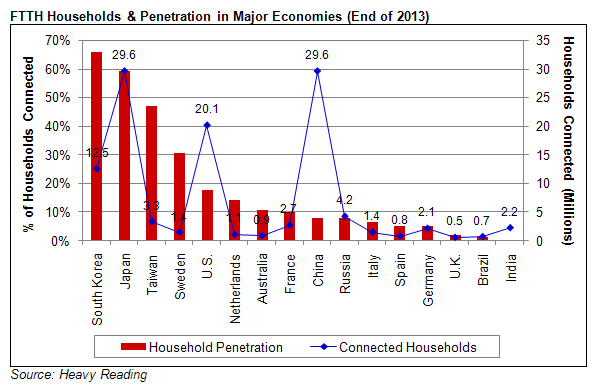
With a small handful of exceptions, fiber to home uptake globally seems relatively restrained, suggesting that, for most consumers, what they can buy on the older networks provides a value-price relationship that is good enough. 


Under Google's deal with the Kansas City Board of Public Utilities, the municipal power and water provider that owns the utility poles, the company has the option of attaching fiber either in the space reserved for telecommunications for the standard pole-attachment fee or in the electrical supply space for free (although the latter is costlier because it requires more highly skilled technicians). Kansas City Fiber on Track 


Google and officials in Kansas City, Kan., said Google remains on schedule to go live for the first customers for Google's 1-Gbps network in the first half of 2012.


The Kansas City Star has reported that negotiations over pole attachment rates have slowed the build. Those of you familiar with fixed network construction projects will not be surprised by that report.


Disagreement about rates and conditions for pole attachments are an old, and possibly recurring, issue when new providers want to build new communication networks.
The bigger issue will come when Google actually unveils its prices and products. Some will note that other fiber to home services, in the United States and elsewhere, have not universally been met with high consumer demand.

In Germany, for example, FTTH take rates are just 0.4 percent, though one million homes are able to buy the service. Low take rates

Will Enterprise "Consumerization" Be More than a Device Issue?

Enterprise workers have been bringing their "consumer" tools and apps into the workplace for some time. Enterprises have started to respond by approving use of such devices, such as Apple products in the phone, PC and now tablet areas. 


Longer term, the issue is how much other movement will be seen in the applications area. Skype is among the best current examples of a consumer tool that is widely used within enterprises. So is LinkedIn. Also, Facebook and other social networks now are being adapted for enterprise purposes. 


For the moment, devices seem to be at the forefront, though.


via

Google Fourth Quarter Results Disappoint

[GOOGAD]Google reported revenues of $10.58 billion for the quarter ended December 31, 2011, an increase of 25 percent compared to the fourth quarter of 2010, and a record for Google.

Though a revenue record, investors were expecting more, primarily on the earnings front, putting pressure on Google's equity price. Google Results

Some think investors are worried about the growing regulatory scrutiny Google is facing, or the implications of its ownership of Motorola Mobility.

But most executives would probably love to have such problems. Consider Google's share of display advertising, which probably will pass Yahoo early in 2012.


Long criticized as being a revenue one trick pony, Google's display ad business now amounts to about 10 percent of total revenues, which continue to be lead by search advertising. 


Remarkably Consistent Smart Phone Video Consumption in France, UK, US Markets

It will come as no surprise to just about anyone that people who own smart phones watch video on those devices. What is interesting, in this bit of survey research, is the consistency of the behavior in different markets. As it turns out, the percentage of respondents to a Yankee Group survey who say they watch video at least once a week on their smart phones is precisely 42 percent each, in France, the United Kingdom and the United States. 


As you also would guess, feature phone users watch far less video. 

Thursday, January 19, 2012

AT&T Price Hike Illustrates Trend

Beginning March 1,2012, AT&T's base rate for "measured phone service" in California will rise $3 a month to $15.37 from $12.37, — a 25 percent increase. The charge for additional local calls will be three cents per minute. Separately, AT&T's flat-rate charge for unlimited local calls will increase $1.05, to $21 a month. Some think the rates are not justified. Granted, it's always hard to determine whether retail rates are "fair" or not. But the rates do illustrate one often-forgotten and fundamental change in AT&T's cost structure.

As more and more customers abandon landline service for mobile service or rival providers, a fundamental issue is that a smaller customer base means fixed overhead costs of the network must necessarily be shared by a smaller number of customers. line loss


That means higher costs for the remaining customers, and the process will not stop as customers continue to shift their communications spending to other providers or other types of service.


Capital intensive networks are susceptible to changes in demand. In Denver, where we live in an arid climate and are highly susceptible to drought, residents continually are exhorted to use less water. We have done so. The result is higher rates. Why? Because the water utility's fixed expenses have to be covered, even in the face of lower usage (what we were asked to do), which lowers Denver Water's revenue. 


Predictions about Mobile Web Experiences Will Be Wrong


Union Square Ventures Partner Andy Weissman argues that, up to this point, most observers have assumed that mobile versions of PC experiences would be be similar to the bigger screen experiences, with relatively similar take rates, use cases and business opportunities.

He now suggests that we might have been wrong, and have been applying old rules in a new context, where the predictive value of the older assumptions isn’t as accurate. One might therefore guess that lots of unexpected change will occur as the smart phone experience begins to mature into a very distinct medium.

Reading, social networking, payments, learning, location services, medicine and media are some of the areas where expectations of end user behavior, value and revenue creation could be different than expected.

Think back to Netscape (if you are old enough) when it first was introduced in 1994, or even 1995 and 1996.  What were the then-current experiences Netscape enabled? Keep in mind this was before Amazon, eBay and Google, before e-commerce, before web mail, before Netflix, iTunes.

Who would have predicted then, the way the web has developed? Much the same is likely to happen with mobile web and smart phone-enabled experiences.

Unpredictable mobile impact

Will the 2026 World Cup Create Any Long-Term Economic Benefit for Host Nations?

World Cup long-term economic effects will be negligible, economists at Goldman Sachs say. That might seem unlikely, given the 2026 FIFA Wor...