Tuesday, February 14, 2012

PayPal Taking Different Tack than Isis, Google

Up to this point, the potential attraction of mobile payments for retailers has been the promise of lower transaction fees for accepting credit card payments. Debit card fees might less a concern these days, but the point is that the most direct value for an upstart payment system is that it costs the retailer less to support.

Up to this point, that has not generally been the case. New mobile payment systems have offered costs higher, or equivalent, in most cases, and only now are some suppliers, mostly smaller firms, offering lower fees.

Some think PayPal might be the first large new provider to try the "lower fees" route. PayPal might actually subsidize its new payment system, allowing retailers to process PayPal transactions at lower costs than has been the case for credit card transactions, for example.

If PayPal can grab a two percent share of checkout at physical stores that would create a $70 billion business, according to eBay Chief Executive John Donahoe. PayPal to attack transaction fees?

That attack on the level of payments transaction fees is not restricted to PayPal. Some other would-be mobile payments providers do offer clear transaction processing fee advantages to retailers. But PayPal has the brand name and heft to create critical mass in the business, something that will be hard for smaller providers to equal.

By hoping to build on its online transaction fee business in the offline world, PayPal is taking quite a different tack than Google or Isis, both of which now are focusing only on revenue streams outside the transaction fee orbit.

FCC Effectively Ends LightSquared Business

The Federal Communications Commission will “indefinitely suspend” the company’s license to use its satellite spetrum to build a new Long Term Evolution fourth generation mobile network because it would interfere with GPS systems operating on neighboring radio bands.

That essentially means the $3 billion gamble to re-purpose satellite spectrum to build a terrestrial Long Term Evolution network is lost. 

Though there is an appeals process, the odds of reversing the decision are minimal, most observers likely would guess.
The FCC decision came after the National Telecommunications and Information Administration concluded there was no feasible way for LightSquared to avoid interfering with the GPS frequencies and services.

An advisory group to NTIA in January 2012 had released the results of extensive testing it said showed that LightSquared “would cause harmful interference to many GPS receivers,” and further testing would not be fruitful. 

At the time that report was issued, there were indications the NTIA tests would confirm the findings.
Investor Philip Falcone has been working since at least 2005 to gain authority to build the network. Among the ramifications for AT&T and Verizon Wireless are the elimination of a potentially troublesome wholesale provider of LTE services. 

Dozens of firms that had planned to launch LTE services now will have to find some other wholesale supplier, or abandon their own business plans. Sprint had planned to provide facilities to LightSquared, and would have gained additional use of LTE spectrum.

Sprint now will lose some amount of revenue from LightSquared. Clearwire and Sprint might be winners, depending on how fast they can ge their own LTE networks up and operating. 

Also, Dish Network might ultimately hope to displace some of the market role LightSquared hoped to create, though Dish up to this point has emphasized its intention to create a retail operation of its own if Dish Network's petition to the FCC, also asking for rights to re-purpose satellite spectrum to create an LTE mobile network. 

The death knell came in the form of a letter sent by the National Telecommunications and Information Administration to the Federal Communications Commission (FCC), which declared the interference to be unavoidable.

"Based on NTIA's independent evaluation of the testing and analysis performed over the last several months, we conclude that LightSquared's proposed mobile broadband network will impact GPS services and that there is no practical way to mitigate the potential interference at this time," the letter said.

In principle, an appeal is possible, but most observers would doubt such an appeal would be successful. The testing conducted so far, which LightSquared has objected to, has shown significant levels of interference to GPS receivers.

As a rule, in such matters, the new applicant has the burden of proof where it comes to avoiding interference with other licensed users of spectrum that already are in operation. That would seem to be the case here.

LTE Apple iPads Coming


AT&T and Verizon Wireless apparently are going to have the right to sell the Apple iPad in a version that supports fourth generation networks those firms operate, the Wall Street Journal reports.  Verizon, AT&T to Sell 4G iPads

The 4G iPad would use the Long Term Evolution networks both AT&T and Verizon Wireless are building, and would presumably stimulate sales of more device broadband plans.

It isn’t immediately clear whether Sprint can get its LTE network built fast enough to qualify for the devices, and T-Mobile USA would seem to be totally out of consideration, since it does not have any concrete plans to build an LTE network. 

More to the point, both AT&T and Verizon Wireless would have clear business reasons for convincing Apple to restrict that LTE version of the iPad to just the two largest U.S. carriers, for some period of time, much as Apple gave AT&T a period of exclusivity on the Apple iPhone.

The decision highlights the clear importance devices now have assumed in the mobile service ecosystem.

Goldman Sachs figures tablet data consumption is increasing by 30 percent per year and by 2020 will account for 17 percent of all mobile data demand.

“We expect global tablet sales to grow over 300 percent through 2012,” Goldman’s analysts say. “Our forecast implies a 42 percent compound annual growth rate from 2010 to 2020 in network-activated tablet subscribers (tablets that actually subscribe to a wireless data plan) with monthly data usage assumed to grow at the rate of 30 percent per year from 1.5 GBytes month to over 20 GBytes per month in 2020,” Goldman analysts say.

Growing use of tablets, and families now paying for many mobile broadband subscriptions, are one reason both Verizon Wireless and At&T are getting ready to introduce new “family data plans” that allow consumers and devices registered to a single account to share a single bucket of data usage.

How Big a Deal is Pinterest?


Pinterest, a social media site launched in March 2010, was getting about 40 times more visitors in December 2011 than it did in June 2011. 

But will the explosive growth continue, and will Pinterest be useful to corporate content marketers?  Vitrue CEO Reggie Bradford thinks the answer to the first question cannot be known yet, but the answer to the second question is a definite “yes.”

Is Pinterest valuable to large brands?
Bradford: Essentially, any brand that can tell its story or feature its products visually stands to benefit.  They’d be capitalizing on what has made Pinterest so compelling and fueled its spectacular growth: a focus on eye-catching imagery.  Pinterest essentially brings “scrapbooking” to the Internet, sans scissors and glue.  So marketers who are able to leverage great visual content can weave their boards into a cohesive social experience within their existing Facebook and social community. But, of course, some brands translate better to a “visual bulletin board” social experience than others. Retailers that already let people visually express themselves should be leveraging Pinterest—think clothing, shoes and jewelry. Brands in the DIY and home improvement space can benefit as many users share favorite room designs, remodeling ideas, paints, furniture, etc. Or cooking or food brands can leverage images and recipes for users to pin and share.  The Wall Street Journal is using Pinterest for Fashion Week. The thought behind it is the WSJ is already covering fashion and the event—which both are inherently visually—so why not leverage Pinterest to perhaps reach a wider audience.

Pinterest content can be surfaced on Facebook Tabs, which is great for creating an integrated and cohesive social experience. But marketers should remember over 40% of Facebook users are accessing it viamobile devices, so brands will want a tech platform with mobile optimization so that Pinterest material looks as great as it was intended. And these stats will only increase. Our own research shows incredible growth with mobile access. (Can provide our recent mobile-social user engagement data, if interested).

Pinterest users seem to have distinct interests.  How do you explain why that pattern has developed?
Bradford: Sure.  We’re seeing an overall trend from social communities being organized around friends and connections to being organized around interests.  Pinterest taps into this by allowing users to create custom “boards” – think virtual bulletin boards -- to feature something specific, let’s say crock pot recipes, which allows others to discover it based on their own interest in that subject.  This bodes very well for its use by brand marketers.  If you’re a coat store, would you rather attract people who are specifically looking at coats or try to make friends with everybody in the hopes that a good percentage of them want a new coat?  Interest-driven social media creates a very different dynamic. And Pinterest’s use of visuals, and simplicity of its use, have attracted users and is increasingly become a time-consuming digital activity.

How might a brand approach the issue of using Pinterest, as compared to Facebook, for example?

Bradford: Whether or not to embrace, or how fast to embrace, an additional social network is a decision every brand has to make for itself, based on its social goals and strategies.  And, again, some brands translate more naturally for Pinterest. However, the beauty of social is that brands can experiment inexpensively, even free, with these new platforms as they come along to see if they bring anything unique that especially addresses their aims.  Facebook is clearly dominant on the social network scene and has, along with Twitter, become foundational for social campaigns.  But brands should stay aware of newcomers, especially when you can incorporate what’s “cool” about those newcomers into Facebook via tabs so you can integrate and get the best of both.

What limitations or advantages does Pinterest have as a venue for brands engaging with potential customers?
Bradford: Many brands have invested a lot of time and effort building their Facebook fans and Twitter followers, and more recently Google+.  The thought of tackling another network can be daunting.  That’s not Pinterest’s fault.  But without a comprehensive platform to streamline the management of multiple streams (Pintrest’s API is not yet accessible), internal resources become an issue.  Secondly, the “Pin It” button works well for consumers, but was not designed for marketers.  It’s missing features that allows for analytics tracking (platforms can help here along with the API).  Lastly, still images are great, but do have their limitations. Unless users click through to the source site, a brand’s ability to communicate everything they want to is limited.  You also have to watch for link rot where the source image is moved or removed, thus generating a broken link that stands out like a sore thumb in such a visually driven environment.

As for advantages, judging from a Shareaholic report which indicates Pinterest is already generating more referral traffic to sites than YouTube, Reddit, Google+, and LinkedIn combined, you’d have to be living in a cave not to see that benefit.  Images are powerful, and not only are users clicking once, they’re clicking twice to continue through to the picture’s source page.  Another advantage is segmenting, which Facebook marketers were already experiencing with Open Graph Objects.  Brands can segment to boards they’ve divided up by season, theme or merchandise type.  Finally, there’s the size of Pinterest’s audience…12 million monthly unique visitors and crossing the 10 million mark faster than any previous independent site.  That has to be attractive to any marketer.

Again, only time will tell if Pinterest has staying power. The road of technology is littered with once-hot platforms and products. But Pinterest does have potential… and brands should experiment to see where it fits into their overall social goals and communities.

18-Fold Growth of Mobile Data Next 5 Years


According to the latest Cisco Visual Networking Index, worldwide mobile data traffic will increase 18-fold over the next five years, reaching 10.8 exabytes per month, an annual run rate of 130 exabytes, by 2016. The monthly 130 exabytes is equivalent to consumption of:
  • 33 billion DVDs.
  • 4.3 quadrillion MP3 files (music/audio).
  • 813 quadrillion short message service (SMS) text messages.
The number of mobile Internet connected devices will exceed the number of people on earth (2016 world population estimate of 7.3 billion; source: United Nations) in 2016.

Cisco also anticipates that global mobile data traffic will outgrow global fixed data traffic by three times in the 2011 to 2016 period. 


This mobile data traffic increase represents a compound annual growth rate of 78 percent.

Mobile cloud traffic will grow 28-fold from 2011 to 2016, a CAGR of 95 percent.

Cisco also forecasts that there will be more than 10 billion mobile Internet-connected devices in 2016, including machine-to-machine (M2M) modules, exceeding the world's projected population at that time of 7.3 billion.

Tablet traffic levels will grow 62-fold from 2011 to 2016, the highest growth rate of any device category tracked in the forecast, generating about an exabyte a month of traffic.

Mobile video, which will comprise 71 percent of all mobile data traffic by 2016.

By 2016, there will be more than eight billion handheld or personal mobile-ready devices and nearly two billion machine-to-machine connections, such as GPS systems in cars, asset tracking systems in shipping and manufacturing sectors and medical applications for making patient records more readily available.

In 2011, 11 percent, or 72 petabytes, per month of total mobile data traffic was offloaded from mobile networks to Wi-Fi networks.. By 2016, 22 percent, or 3.1 exabytes, per month of total mobile data traffic will be offloaded.

Tablet Business Apps are Almost Trivial


New NPD In-Stat research suggests that the most common business uses of tablets are email and calendar management, note taking, and presentations. About 77 percent report that email also is a common workplace use.

All of those might seem relatively trivial applications that can be conducted on smart phones or notebook PCs as well.

“Email is by far the most dominant tablet application for business users,” says Frank Dickson, NPD In-Stat researcher. In addition to email, customer relationship management and IT network intelligence are listed as “most important”  uses.

None of those “facts” is deterring people from buying tablets. JP Morgan analysts now forecast worldwide tablet shipments will reach 99.3 million in 2012, a 55 percent jump over 2011. In 2013 tablet sales will eclipse the 100 million mark, jumping to 132.6 million, JP Morgan also predicts.

That is not to say current apps are destined to be the lead apps at some point in the future. It is conceivable that tablets could emerge as platforms for new behaviors and apps beyond today’s application set.

What there is no doubt about is that tablets have captured consumer affection.

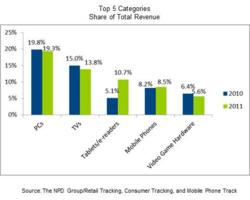
PCs and TVs still represent the two largest categories of U.S. consumer technology hardware and consumables sold in 2011. But tablets and and mobile phones are the third and fourth largest product categories, by revenue.

Revenue from products was about $144 billion according to The NPD Group. PCs represented the most revenue with nearly $28 billion in sales, accounting for almost 20 percent of sales.

Tablets and e-readers were the clear growth categories in 2011, nearly doubling sales to $15 billion in 2011.

And it appears that consumers are shifting spending from other categories toward the top-five categories.

“U.S. hardware sales growth is becoming harder and harder to achieve at the broad industry level,” said Stephen Baker, Vice President of Industry Analysis at NPD. “Sales outside of the top five categories fell by eight percent in 2011 as consumers shifted spending from older technologies to a narrow range of products.”

Apple was the leading consumer electronics brand for the second year in a row. Among the top five brands Apple was the only one to experience a sales increase, posting a 36 percent rise over 2010.

Sales through online, direct mail, and TV shopping channels jumped seven percent and accounted for 24 percent of all sales, up from 22 percent in 2010.

Sales through these non-retail channels captured 25 percent of industry revenue in the fourth quarter of 2011.

Vodadone Mulls Billion Dollar Acquisition Substantially Driven by Backhaul Benefits


Vodafone reportedly is considering a £700 million (U.S.$1.1 billion) bid for C&W Worldwide, a supplier of long haul and local business communications, which was spun off from parent firm Cable & Wireless Communications in March 2010.

You might wonder why a wireless service provider would want to buy a “landline services” provider. The key is that C&W Worldwide is a provider of enterprise services, not consumer services.

C&W Worldwide, in principle, would help Vodafone reduce its mobile backhaul costs, in part by limiting the amount of leased access Vodafone has to buy.

The global portion of C&W Worldwide also would help Vodafone better compete for multinational enterprise customer business.

“At the right price, this makes sense for Vodafone,” said Declan Lonergan, research VP who has studied Vodafone's options"

A billion dollars is a lot to spend for backhaul savings, but that seems the immediate and most tangible value of the proposed acquisition. The potential advantages for sales to global enterprises is much more speculative.

70 Million Small and Femtocells to be Shipped by 2017

Mobile service providers will deploy as many as 70 million consumer femtocells and network "small cells" by 2017, United Kingdom-based Mobile Experts predicts. 70 Million Small Cells by 2017

Most of those deployments will be of consumer femtocells. ABI Research estimates four million carrier pico base stations will be shipped each year by 2015. 

Mobile Experts also sees a ramp up of investment in wireless backhaul for the carrier small cells until about 2013, with relatively steady spending levels between 2013 and 2016. Most of those connections will have to be wireless, for cost reasons.

Whichever technology is used to backhaul small cells, it has to be cheap, "it has to be massively cheap," said Andy Sutton, Everything Everywhere principal architect, access transport. "We have a financial envelope for small cells and it's challenging."

Cost is so important because small cells will have relatively low usage compared to a macrocell and there will be lots of sites to support. Compared with macrocells, small cells will cover distance of about 50 square meters or 538 square feet. That's an area about 23 feet by 23 feet.

One way to look at matters is that this is an area smaller than the range of a consumer's home Wi-Fi router.


Monday, February 13, 2012

"Mobile First" Will Lead to Contextual Apps

By 2016, smart phones and tablets will be used by a billion global consumers. The clear implication, Forrester Research says, is that "mobile is the manifestation of a much broader shift to new systems of engagement."

According to the report,there will be 257 million smart phones and 126 million tablets in the U.S. market alone.

Of those worldwide billion mobile devices, Apple, Google and Microsoft will control some 90 percent of the market with their respective platforms. Business users will factor heavily into these numbers, with some 350M employees using smart phones.

Screen Shot 2012 02 13 at 9.39.46 AM 520x635 Forrester: 1B smartphone and tablet users by 2016, with Apple, Google and Microsoft powering 90%

These systems of engagement help firms empower their customers, partners, and employees with context-aware apps and smart products.

That is one good reason so many firms are going mobile first in terms of their development of new products and applications.

"Mobile first" will fuel profitable growth with stickier offerings and mobile self-service, Forrester argues.

European Commission clears Motorola deal

google-euDon Harrison, Google VP and deputy general counsel says the European Commission has approved Google's acquisition of Motorola Mobility. Similar clearance will be necessary in the United States before the deal can close on a final basis. European Commission clears Motorola deal

The United States Department of Justice also has to give its approval, but there have not been signs DoJ is opposed.


"Social" and "Unified Communications" are Complements or Substitutes

There's a reason one hears more talk these days about whether social media or social communications are "substitutes" for "unified communications."

As it turns out, many business users see social media as complementary to unified communications, though in some cases, social tools are used as a substitute.

In the consumer world, social media hubs such as Facebook and Google+ are taking on the role of the personal communicator, social networker, entertainment curator, search engine and directory.
But voice, messaging and video are becoming parts of overall app functionality.

In the business market, there are similar trends. In most cases, social media and collaboration tools are viewed as a natural part of unified communications and are formally deploying it as part of a UC roll-out.

  LR-58508-EX01.jpg

How Well Will Industry Handle Huge Product Transitions?

Whatever else you might say about the global telecom business, there is no shortage of understanding that fundamental changes are happening and that huge challenges must be overcome.

Rapidly evolving mobile Web technologies have introduced a period of hyper-competition in the mobile sector, analysts at Deloitte say. As a result, new entrants are chipping away at incumbent advantages and profits.

The Deloitte study also suggests the mobile power structure is changing. According to 49 percent of our respondents (70 percent of which are from network carriers), Web companies, rather than network carriers or handset makers will dominate the mobile business in five years.

Moreover, 89 percent believe the role of carriers will be limited to providing access services. That is a major finding. No matter what executives might hope, nearly nine out of 10 respondents think "access," essentially "dumb pipe," will remain the role for ISPs.

The very-largest tier-one service providers arguably will have other options. But smaller firms might be entirely

Also, 87 percent believe that carriers must make the transition from the walled gardens of the past to new organizational models built around open development ecosystems to sustain competitiveness.

Some 31 percent of respondents employed by network carriers think changes in open access regulations will accelerate the commoditization of carriers and 90 percent of the same group believe the traditional carrier “closed garden” business model is quickly becoming a strategic relic.

Consumers Shifting Spending to Tablets, E-Readers?


PCs and TVs still represent the two largest categories of U.S. consumer technology hardware and consumables sold in 2011.
But tablets and and mobile phones are the third and fourth largest product categories, by revenue.

Revenue from products was about $144 billion according to The NPD Group.
PCs represented the most revenue with nearly $28 billion in sales, accounting for almost 20 percent of sales.

Tablets and e-readers were the clear growth categories in 2011, nearly doubling sales to $15 billion in 2011.

And it appears that consumers are shifting spending from other categories toward the top-five categories.

“U.S. hardware sales growth is becoming harder and harder to achieve at the broad industry level,” said Stephen Baker, Vice President of Industry Analysis at NPD. “Sales outside of the top five categories fell by eight percent in 2011 as consumers shifted spending from older technologies to a narrow range of products.”

Apple was the leading consumer electronics brand for the second year in a row. Among the top five brands Apple was the only one to experience a sales increase, posting a 36 percent rise over 2010.
Sales through online, direct mail, and TV shopping channels jumped seven percent and accounted for 24 percent of all sales, up from 22 percent in 2010.
Sales through these non-retail channels captured 25 percent of industry revenue in the fourth quarter of 2011.

Some Forms of Smart Phone Commerce Were Nearly Ubiquitous Last Christmas, Holiday Shopping Season

Smart phones took center stage in the consumer shopping experience during the fourth quarter of 2011, according to NPD Group. Both websites and apps got serious use during the most-recent Christmas and holiday shopping season. 

In December alone, the proportion of U.S. Android smart phone users engaged in shopping websites rose nine percent from November, to almost 80 percent of smart phone users accessing shopping related websites on their devices.

Shopping apps also played an important part of the overall shopping experience, rising five percentage points in December to 59 percent usage.

It would be fair to say that, up to this point, people have been using mobiles for research and sharing with friends. There arguably was less comparison shopping, but that sort of behavior is growing, by all accounts.

Still, such surveys probably overestimate the direct activity related to products users are shopping for, from inside retail locations. And it is applications and behavior on the part of users just before they go to a retail location, and what they do while inside a retail location, that probably has the greatest potential impact on retail sales, for better or worse.

So far, though mobile shopping activities are growing, much of the activity is not too dissimilar from the shopping apps and behavior we have become familiar with on PCs. The big potential changes are how smart phone based commerce behaviors happen while consumers actually are inside stores, shopping.


Source: NPD Connected Intelligence SmartMeter


PayPal Deemphasizing NFC at Point of Sale

PayPal is conducting a major test of ways to integrate PayPal into standard Home Depot point of sale systems. But PayPal continues to believe that near field communications is "too early" in its life cycle to be useful, at least at the moment.

In fact, eBay CEO John Donohue has quipped that "near field communications" stands for "not for commerce." It therefore is not surprising that PayPal appears to be discontinuing, its efforts to supportpmobile payments at the Point of sale using NFC.

PayPal doesn't seem to see enough merchant interest, at least not enough where PayPal is concerned. So far, it appears there is greater retailer interest in adding PayPal payment methods in ways that do not even require use of a mobile device. Merchants bigger on PayPal than NFC


Millennial Males Seem to Like Mobile Ads More than Millennial Women


Among Millennials (some would say that includes people 18 to 29, others would put the range as something more like 18 to 35 or so) men were significantly more likely than women to recall having seen a mobile ad on their mobile phone.

Some 69 percent of Millennial men reported recalling having seen an ad on their mobile devices. 

Less than half of women the same age remembered seeing mobile advertisements. Overall, 59 percent  of smart phone owners of any age or gender reported seeing mobile ads, according to InsightExpress.

US Mobile Phone Owners Ages 18-29 Who Have Seen Mobile Ads, by Gender, Jan 2012 (% of total)


Among women ages 18 to 29, just 12 percent said they liked mobile ads at least somewhat, while a plurality were ambivalent. But fully 40 percent of men report actively enjoying mobile advertising, including 20 percent who said they liked it “very much.” 

On average, across all smart phone owners, a quarter liked mobile ads at least somewhat. It isn't clear what the findings indicate. It could be that more attention has been paid to the creative elements for ads aimed at men, or that it is easier to create such elements for advertising aimed at men. 

There could be "respondent bias" of some sort. It is possible that people think they recall specific ads, when they actually do not. It is possible the Millennial women respondents were simply more honest. 

Perhaps the most important finding is that advertising is an enjoyable form of content at all. It appears advertisers are producing more entertaining content. 

Attitude Toward Mobile Ads According to US Mobile Phone Owners Ages 18-29, by Gender, Jan 2012 (% of total)

Sunday, February 12, 2012

LTE Drives Global Network Equipment Spending

Mobile Communications Factory Revenue
Equipment purchased to support mobile networks will reach $398 billion in 2012, up 17 percent from $340.8 billion in 2011, according to an IHS iSuppli.

A substantial portion of the spending is for fourth generation networks, especially based on use of Long Term Evolution. 


Although growth this year is down somewhat from the 32 percent growth rate of 2011, the market is expected to grow at  double-digit rates until about 2015. 

MEF Launches Mobile Backhaul Initiative

The Metro Ethernet Forum has launched a “Mobile Backhaul Initiative for 4G/LTE,” aiming to create standards for backhaul that could provide a potential 25 percent backhaul savings for mobile operators.

The initiative seems to build on support for multiple classes of service (Multi-CoS) contained in the MEF 23.1 Multi-CoS Implementation Agreement.

“Mobile Operators all agree that the industry’s single biggest challenge and operating cost is in delivering the bandwidth needed for 4G/LTE backhaul” says MEF President, Nan Chen.

The “Mobile Backhaul Initiative” will feature an integrated suite consisting of the MEF 22.1 Mobile Backhaul implementation agreement, MEF 23.1 Multi-CoS implementation agreement, and a technical business paper clarifying the urgency and justification of migrating to Multi-CoS.

The program focuses on providing technical guidance on best practices and a new paper on packet-based frequency synchronization as well.

Why Data Consumption Forecasts So Often are Wrong

Bandwidth planning has become a tricky business since data traffic completely displaced voice as the driver of consumption. Not only is demand more variable and uncertain, growth is more dynamic, by an order of magnitude or two.

That raises an obvious question for mobile service providers: how much bandwidth do they need to be ready to supply to customers? The question might be easier to answer if demand were not if end user demand was predictable, but demand is not predictable. Sometimes growth is "only" 40 percent a year; sometimes it is higher.

Some might say, for example, that over the past year, AT&T has revised its own forecasts of bandwidth consumption in significant ways.

In a March 2011 presentation AT&T projected that data volumes would grow by eight to 10 times between the end of 2010 and the end of 2015.

That forecast appears to be based on an expectation that volumes would roughly double in 2011 and then increase by a further 65 percent in 2012.

Consider this 2008 forecast, which presents a not-unusual rate of growth in potential speeds, which has a direct bearing on consumption, since faster speeds tend to be associated with higher consumption.

Keep in mind that access speeds are different from consumed gigabytes. But the former drives the latter. And nobody currently predicts anything but a continual shift to higher potential access speeds on fixed and mobile networks.

Instead, AT&T now seems to be seeing 40 percent annual growth. Now, 40 percent annual growth is significant. It means bandwidth consumption doubles about every two to three years.  But annual bandwidth growth of 50 percent a year would be well within historical ranges, on an aggregate basis, in terms of long-haul bandwidth consumption. But policies and end user behavior can change the demand curve.

The most-recent AT&T forecast would mean that data volumes would increase by five to six times by 2015. Whether that means existing spectrum, and newer methods for handling traffic using that spectrum, are sufficient to handle future growth is debatable. Some might argue additional spectrum is not required.

Others might say the possible growth of between 500 percent and 1,000 percent, in just four years, is challenging enough that additional spectrum is likely to be needed, especially if the higher range of growth turns out to be the case.

Network planners might point out that supplying additional bandwidth takes prodigious amounts of capital and significant time.

Some might speculate that AT&T’s forecasts about data growth have changed because supplier policies and end user behavior have changed.

Perhaps users have become quite sophisticated about offloading their data usage to Wi-Fi, as service providers have been urging them to do.

Or, perhaps the heaviest users, with "prodding" from the carriers, are modifying their own behavior. Why it is so hard to make accurate bandwidth forecasts

Some observers would not be sanguine about moderating rates of bandwidth consumption. It is true that carriers can provide incentives and dis-incentives for consumption. But it also is the case that video consumption keeps growing, and it is video that drives bandwidth demand.


Use a Smart Phone as a Desktop PC?

A sufficiently motivated researcher can, in fact, use a smart phone as a desktop PC. The results might be "sort of" reasonable.

But such experiments simply point out that behavior is, and ought to be, different on devices with different form factors, user interfaces, screen sizes and software loads.

To use an analogy, in the history of media, we always tend to begin using a new medium on the pattern of the older medium. So, when "stage" was the dominant mass performance medium, and the movie business began, what did movies look like?

The experience was pretty much the same as a live performance, only captured on film. In fact, the new medium arguably was less rich, as an experience, since the "audio track" was missing.

In the realm of devices, we likely have a tendency to envision "how to use" a new category of devices  through the prism of older devices we already are familiar with, as well.

The point is not so much that some common experiences (using email or messaging) will be common to most or all of the platforms. Beyond that, we will eventually discover that each device category creates a distinctive "highest and best use," despite the common features.


Will the 2026 World Cup Create Any Long-Term Economic Benefit for Host Nations?

World Cup long-term economic effects will be negligible, economists at Goldman Sachs say. That might seem unlikely, given the 2026 FIFA Wor...