Friday, April 13, 2012

"Post-PC" Era Doesn't Slow PC Sales, Data Shows

Global tablet sales to end users are forecast to total 118.9 million units in 2012, a 98 percent increase from 2011 sales of 60 million units, according to researchers at Gartner. At the same time, it appears that traditional PC sales also have grown. .

PC shipments worldwide, expected to grow 4.4 percent in 2012, will grow 10 percent in 2013, according to Gartner. That is a bit of a surprise, with all the attention now focused on tablet sales.

In the first quarter of 2012, PC shipments climbed nearly two percent to 89 million units, thogh analysts had predicted a 1.2 percent drop. Those figures might suggest that tablets and PCs now are distinct products in the marketplace. Though substitution will occur in some cases, much as smart phones displace PCs in some cases, all the products will develop specific niches in the computing appliance market, one might argue.

Apple's iOS continues to be the dominant media tablet operating system, as it is projected to account for 61.4 percent of worldwide media tablet sales to end users in 2012, with Android-powered units representing about 32 percent of sales, Gartner says. By 2016, some 369 million tablets will be sold, Gartner estimates.

By way of contrast, IDC predicts that PC shipments will climb from 353.3 million to more than 500 million in 2016. However, the bulk of the growth will come from "emerging markets" not "mature markets", and from portable PCs rather than desktops, IDC forecasts.

In fact, IDC predicts that shipments of portable PCs in "emerging markets" will almost double from 110.0 million in 2011 to 214.7 million in 2016.

One might therefore infer that tablets will represent about 25 percent of “PC” sales in 2012. By 2016, one might argue, tablets will represent 42 percent of “PC” sales.

"Despite PC vendors and phone manufacturers wanting a piece of the pie and launching themselves into the media tablet market, so far, we have seen very limited success outside of Apple with its iPad," said Carolina Milanesi, research vice president at Gartner.

"As vendors struggled to compete on price and differentiate enough on either the hardware or ecosystem, inventories were built and only 60 million units actually reached the hands of consumers across the world. The situation has not improved in early 2012, when the arrival of the new iPad has reset the benchmark for the product to beat."

   Global Tablet Sales  to End Users (Thousands of Units)

OS
2011
2012
2013
2016
iOS
39,998
72,988
99,553
169,652
Android
17,292
37,878
61,684
137,657
Microsoft
0
4,863
14,547
43,648
QNX
807
2,643
6,036
17,836
Other Operating Systems
1,919
510
637
464
Total Market
60,017
118,883
182,457
369,258
Source: Gartner (April 2012)

Thursday, April 12, 2012

Verizon, Time Warner Cross sell in Kansas City, Cincinnati and Columbus, Ohio and Raleigh, N.C.

Verizon Wireless and Time Warner Cable are offering financial inducements to new or existing customers of either company in Kansas City, Cincinnati and Columbus, Ohio and Raleigh, N.C. Both firms are selling video, mobile, Internet and TV services offered by either firm.

But the deals seem to be aimed as much at encouraging existing customers to buy additional products from each of the companies, as the offers are aimed new customers.

Either firm earns a commission if it sells the other company's products. But the structure of the deals also encourages purchasing of incremental services by any current customer.

The initial markets are, as one would expect, places where Verizon does not compete with the cable operators for fixed network services.

For Better or Worse, People Want to Use Their Own Devices at Work

Nearly 60 percent of employees surveyed by iGR say they use their own smart phones, tablets or PCs for work, at work, with the full support of their employers. iGR defines a small or medium business as having 10 to 499 employees.

Enterprises are seeing the same trend, according to Juniper Research.

Why "Over the Top" Mobile Voice Isn't Growing as Fast as it Could

Mobile VoIP provided by over the top providers are as big a revenue threat as over the top services are for fixed network providers. But some would argue that adoption of mobile over the top voice faces headwinds for a reason shared by other apps on mobile phones, namely the drain on batteries.

Softphones aren’t making inroads onto smartphones or the desktop because the former lacks battery life and the latter take too long to start up, according to Jamie Romanin, ShoreTel regional director for Australasia.

Battery life now appears to be a constraint for VoIP clients as it already is for users who avoid using other smart phone features to save their batteries.

But those same behaviors might well help mobile service providers provide another element of value for using carrier-provided voice services.

"Headwinds" for U.S. Mobile Service Providers

Mobile data services have for the better part of a decade been the clear near-term driver of revenue growth for mobile service providers, roughly driven by smart phone adoption. So, oddly enough, we now see carriers making tough decisions about how fast they actually can grow those smart phone businesses.

A key issue in recent years has been the practice of subsidizing the retail price of smart phones to spur adoption. But operators seem to be rebelling at the idea of continuing to do so at current levels. In some cases that might mean new fees when upgrading to a new smart phone.

In other cases, carriers will try to convince customers to buy devices that are easier to subsidize. Some will even try to stabilize smart phone adoption rates, adding new accounts, but not as many as might be added if carriers conducted more aggressive marketing.

Those steps will help carriers protect their dropping profit margins, but at the risk of slower smart phone adoption.

"Over the longer term, we believe the wireless industry faces the twin headwinds of 100 percent penetration and, eventually, decelerating smartphone additions as the base reaches saturation," Jefferies' analysts wrote. "Voice revenues are already in decline. We believe a material drop off in the growth rate of data revenues from slowing smartphone adoption, particularly in 2H12, is a growing risk," Jefferies says.

Mobile and Broadband Spending by Consumers Will Grow 18% in 2012

Overall U.S. communications and media spending by consumers, marketers and institutions is expected to reach $1.4 trillion by 2015, giving it a compound annual growth rate of 5.7 percent, according to a new forecast from the private equity firm Veronis Suhler Stevenson. That’s substantially faster than GDP, which has a projected CAGR of 4.4 percent over that period, the report suggests.

The fastest growth by far is in consumer Internet and mobile services, expected to grow 18 percent in 2012.

What Would a "Revolutionary" Apple TV Experience Include?

It's hard to say what Steve Jobs actually mean by “I finally cracked it” when referring to the issue of television experience and appliances, the latter being extremely important for Apple, whose business is selling appliances that disrupt and dramatically improve end user experience.

The answer to the question also is important to the rest of the video entertainment ecosystem as well, as entertainment television could represent the next big growth opportunity not only for Apple, but a huge risk of ecosystem change for nearly every part of the TV business ecosystem.

Was Jobs referring to some new software and navigation method only? Did he mean some new relationship with the content producing part of the ecosystem? Or did he mean some change in TV design and hardware, or some combination of all of those elements?

BTIG Research believes that “cracking” television would entail tying together computer, mobile devices and the living room TV, along with its cloud-based storage system (iCloud). 


Some might argue integrating online and video TV subscription services, to unify the content experience, would be part of the experience. Some might argue that is an interesting first step, but only a half step.


The big awaiting revolution is creation of a "fun and easy to use" experience that allows consumers to watch what they want, when they want it, program by program, without having to buy whole channels they never watch, and do not want. 

Smart Phone Subsidies: Changes Coming

A broad debate has been growing among mobile service providers about the financial impact of high smart phone subsidies on profit margins, and that concern now seems to be headed in the direction of lower subsidies. That could have important ramifications for device suppliers and customers as well as service providers.

For service providers, the effort is to maintain profit margins that have in many cases been hammered by the cost of the subsidies. But the new policies also should slow iPhone sales, and should boost sales of other devices. Consumers will slow the rate of device upgrades and will face higher prices.

The impact on application and device innovation is less clear, but could lead to some slowing of device upgrades, with uncertain but clearly negative impact on new applications that depend on device features and capabilities.

Up to this point, for example, Verizon has not charged a fee to its subscribers when customers decide to upgrade to a new device. But Verizon now will institute a $30 fee when that occurs. For Verizon Wireless, that could add up to $1 billion to Verizon’s annual earnings, and also boost profit margins, BTIG argues.

Smart phones have been very helpful for mobile service providers, boosting average revenue per user by driving mobile broadband subscriptions. But the subsidies generally used to spur sales are bcoming a major drag on earnings, and change is coming. Basically, service providers will have to risk lower sales growth, and less mobile broadband revenue growth, to limit handset subsidies. It might be a Faustian bargain.

In fact, what seems to have happened is that user behavior has changed, with users upgrading those “expensive” smart phones faster than they had generally been upgrading their feature phones, analysts at BTIG say.

As a result, U.S. mobile service providers plan to take steps to reduce handset upgrades as a way of raising operating margins. That is likely to affect sales of Apple iPhones, generally considered the most-expensive device to support.

AT&T, Sprint, Deutsche Telekom, Vodafone, America Movil and Telefonica are among firms planning to take steps that will slow iPhone sales in the coming year.

In the United States, BTIG expects iPhone sales to decline four million sequentially to nine million with the largest impact coming from AT&T, Apple’s largest customer.

In 2011, AT&T represented 17 percent of iPhone sales for the year and 19 percent in the fourth quarter of 2011.  Apple iPhones represent fully 37 percent of AT&T’s post-paid subscriber base and 47 percent of post-paid service revenue, BTIG says.

BTIG estimates 65 percent of AT&T’s post-paid customers either own an iPhone or are in a family plan with at least one iPhone user.  

For AT&T, the financial impact of iPhone subsidies is clear. AT&T profit margins had grown for five straight years beginning in 2005, but reversed in 2010, apparently related directly to iPhone 4 demand and subsidies, BTIG argues.

In January of 2011, AT&T tightened its upgrade policy and eliminated the popular one-year upgrade offers for iPhone owners. BTIG argues the iPhone subsidies have reduced AT&T margins by at least 10 percent in 2011.

So unless AT&T tightens its upgrade policies, company earnings per share would drop. In fact, AT&T says it has built its business model for 2012 around the idea that it will sell no more smart phones, overall, than it did in 2011, about 25 million units.

BTIG analysis suggests something quite significant. Despite the importance of smart phone accounts for growth of key broadband revenue, AT&T has decided to essentially cap smart phone sales to preserve its profit margins.

The impact should be clear: fewer iPhones sold by AT&T, and possibly fewer iPhones sold by other mobile services providers. That could lead to market share gains by other smart phone makes and models, or could spur Apple to produce lower-cost iPhones.

What the carriers hope for is the ability to sustain average revenue per user growth, and higher profit margins.


source: Yankee Group and CNet

Are Tablets "Naturally" Mobile Products?

During 2011, some 33 percent of all tablets sold globally had the ability to use mobile broadband networks natively, according to ABI Research. According to Chetan Sharma, only about 10 percent of all tablets in use actually used mobile broadband networks.

That illustrates both the tablet upside and challenges for mobile service providers. Mobile phones have little value without a service. Tablets likewise have little value without Internet connectivity, but can use any Wi-Fi connection to do so.

In other words, tablets are more naturally suited devices for mobile broadband services than desktop PCs, perhaps only slightly less well suited for mobile broadband than notebook PCs, but not "naturally connected" devices such as mobile phones. U.S. mobile data generated $67 billion in mobile data revenues in 2011, accounting for 39 percent of the overall revenues. For 2012, Sharma expects mobile data revenues in the U.S. market will reach $80 billion.

That is one reason retail mobile stores always sell phones, sometimes feature tablets, but never try to sell PCs, though some have tried to bundle notebooks and mobile broadband services.

That might change, marginally, once more service providers decide to sell mobile broadband plans the way that fixed network providers sell their broadband connections. Essentially, fixed broadband with local Wi-Fi  inherently supports multiple devices on a single account.

Tablets won't become more interesting for mobile service providers until the equivalent "family data plans" are available.

Apple iPhone Share Growing, in Some Demographics?

It just makes sense that if a particular product is a run-away leader in market share, that buying intentions might match that share. Also, it often happens that market share dominance leads over time, to even more dominance.

Rivals to Apple know what happened in the MP3 player market. Many suppliers in the tablet market would be forgiven a fear that Apple is doing in the tablet market what it did in the MP3 market.

The smart phone market arguably has been more competitive, but a new survey by ChangeWave Research suggests Apple could be increasing its share of market, at least among the typically technology-sophisticated ChangeWave audience.

56  of survey respondents say they plan on getting an iPhone, Samsung next in lineThe latest ChangeWave Research survey of 4, 413 respondents suggests 56 percent of those who plan on replacing their phones in the next three months plan to get an iPhone. In a highly-fragmented market, that is a big number.

That might not be reflective of overall market trends, as other studies tend to show gradual market share gains by many rival Android models, with a dip in Apple's market share.

BlackBerry's woes also are clear from the survey. Where BlackBerry once had smart phone market share in the 30-percent to 40-percent range, it now has declined to two-percent to three-percent ranges.


Intuit acquires AisleBuyer: "Showrooming" Antidote?

Intuit has acquired AisleBuyer, which has a mobile application that allows merchants to support e-commerce operations by mobile phone.

Using AisleBuyer, users scan a product’s bar code in a store, see reviews and ratings, as well as pay for a product with a credit card, on the spot. The notion is that  Intuit's small business payment business benefits from extending merchant retail capabilities further in an online commerce direction.

The deal illustrates a key trend in recent months, namely a bigger emphasis in the mobile payments space on "commerce" than crosses the traditional in-store retailing and e-commerce sides of the retailing business.

In other words, retailers seem to be thinking in new ways about "brick and mortar" and online retail. Where it might once have been more common for store-based retailers to see online as the competition, thereby stifling their own online operations, many retailers seem to have shifted their thinking.

Now an online retailing effort is seen as competition with Amazon and other online outlets, not competition with the retailer's own online store. At the same time, there is a new understanding that "showrooming," where potential buyers check out online prices and delivery while in stores looking at merchandise, is a new problem to be solved.

Nobody can tell yet hot successful brick and mortar retailers will be at fending off showrooming, or how the balance between online and physical retailing will change in the future. The Intuit acquisition clearly is a bet on a future that has smaller retailers engaging in both online and traditional retail operations, supporting online shopping both in-store and at all other times.

Wednesday, April 11, 2012

Why Video Subscription Fees Are "So High"

Licensing fees paid by cable, satellite and telco distributors to program suppliers increased 8.2 percent in 2011 to around $33.5 billion, and likely will grow eight percent for each of the next several years going forward, surpassing $39 billion by 2013, according to Nomura Equity Research.
Just ffour media conglomerates account for 75 percent of this fees, with the Walt Disney Company representing 24 percent of all licensing fees, principally because of ESPN.

Notable: Disney distributes ESPN, which has far and away the highest carriage fees in the business, generating about $4.69 in licensing fees per subscriber, per month, the study shows.
Time Warner, which owns  HBO, TNT, TBS and CNN, represents 21 percent of affiliate fees; Comcast, owner of Bravo and the USA Network, accounts for 16 percent; and News Corp. represents 14 percent of fees.

Re-transmission fees paid to broadcast network affiliate stations totaled nearly $400 million in 2011 and should reach $750 million in 2012, as well.


Obviously, all those fees get passed along to consumers, as Paidcontent notes.

Why "Interactive TV" is Dead

Tablets are displacing PCs and smart phones as the “couch computer” of choice, according to Forrester Research. But even before tablets began to assume that role, it already was clear that "interactivity" with TV was an experience using the Internet. 


One might argue that answers the question about prospects for "interactive TV." Simply, users have voted for "interaction" with TV content using the Internet, mobile devices, Web and apps. There are therefore vastly limited opportunities to build "interaction" into TV content that do not lean on mobile devices, tablets and PCs as the vehicles for interaction. 


Some 85 percent of US tablet owners use their tablets while watching TV, and according to Nielsen, 30 percent of total tablet time is spent while watching TV. 


 Tablets also turn TV into a “dumb” device, Forrester argues.


About 18 percent of respondents surveyed by Forrester say they connect their tablets to their TVs. So much for "smart TVs."


Some 32 percent of tablet owners say they won’t buy a small (less than 24”) TV in the future, apparently because the tablet itself now displaces the small TV.


Consumers are using tablets as personal TVs where they had none before, such as in the kitchen, bathroom, and airports, for example.


The larger point is that "interactive TV" already has become a mass market activity, just not in the way its proponents originally had expected. 

How 4G is like 1G

In one crucial respect, fourth-generation mobile networks using Long Term Evolution represent a return to the global situation for first-generation mobile networks. Though global mobile networks were never completely identical, since multiple frequencies always have been used, LTE is the first generation of networks since the first to offer better prospects for global roaming.


In the second and third generations of technology, there were clear "islands" based on distinct air interfaces. LTE will unify the air interface to a greater extent than has been possible for some time, for example. Time division and frequency division interfaces still will exist, as well as a number of different global frequency bands. 


The main groups of frequencies will include:


700 MHz (US Digital Dividend, various bands) 170 devices
800 MHz (EU Digital Dividend, Band 20) 72 devices
1800 MHz (Band 3) 75 devices
2600 MHz (Band 7) 94 devices
800/1800/2600 MHz 57 devices
AWS (Band 4) 72 devices


But there are "backwards compatibility issues" of some magnitude, though. Some 217 existing  LTE devices also must operate on either HSPA, HSPA or 42 Mbps DC-HSPA networks. Also, 91 LTE devices support 42 Mbps HSPA technology, the Global Mobile Suppliers Association says. 


Some 108 LTE devices support EV-DO networks, as well. 

How Much Can be Done to Improve User Experience for Fixed Network Broadband Users?

Under current Federal Communications Commission rules, fixed network broadband providers cannot prioritize packets, even if such optimization would be beneficial for users of some applications, including any real-time services. That especially is true for users of online video, videoconferencing, voice and gaming, as well as business applications such as remote database access.


But an analysis of data aggregated from 45 U.S. rural communications service providers suggests that rural users behave in ways similar to urban users. There is no significant rural-urban divide in terms of how users behave.

Video streaming was the dominant broadband-enabled application among eight applications studied by Calix. Video streaming accounted for 67 percent of down stream Internet traffic and 13 percent of upstream traffic in the studied networks.

In terms of upstream traffic, business services generated the most, accounting for 53 percent of all upstream traffic.

As other reports consistently show, a small percentage of very-heavy users account for a disproportionate amount of usage. About five  percent of users account for 50 percent of Internet traffic, the Calix report found.

Many would argue that service providers use distinctive usage cases to create customized service packages, at least to the extent current Federal Communications Commission rules allow.

Video and real-time services arguably offer the most-logical opportunities for retail packaging and network management, consistent with existing FCC rules. “A package that targets a superior video streaming experience may offer the service provider the opportunity for an up-sell, and the subscriber with a better experience,” Calix argues.

But what cannot be done, at least on fixed networks, under FCC rules, is to offer a service that prioritizes video bits for such users, as useful as that would be, from an end-user perspective. Nor is it clear that service providers can create “carve outs” for heavy video entertainment users that allow consumption without affecting a usage cap. 


Mobile service providers have more leeway, at least for the moment, to create packages tailored to game users, users of video entertainment or possibly other users of real-time business services.
Report data was drawn from actual Internet traffic monitored in U.S. service provider networks from the fourth quarter (October through December) of 2011.

To download the report,click here

50 GBytes Consumer Per Person, in 5 Years

"In five years a consumer is moving toward a 50 Gigabyte per month usage level," says Leap CEO  Doug Hutcheson. That doesn't mean all, or most of that usage will occur over a wireless network, though.


That figure represents aggregate usage across all networks, using fixed, wireless and public or third-party Wi-Fi access. By way of comparison, AT&T estimated in 2011 that a typical household consumed about 18 Gbytes a month. 


Analysts at  iGR research suggest that by 2016 U.S. end users will, on average, consume about 2.6 GB of mobile data per month. 

If correct, that would imply wireless consumption would be about five percent of total bandwidth consumed by a "typical" user. 


Tuesday, April 10, 2012

Global Consumers' Distrust Advertising, Trust Word of Mouth

Some 92 percent of consumers around the world say they trust earned media, such as word-of-mouth and recommendations from friends and family, above all other forms of advertising, an increase of 18 percent since 2007, according to a new study from Nielsen. 


You might say such attitudes account for the greater interest in earned media (stories in mass media)  and owned media (sometimes called "brand publishing"). 


Online consumer reviews are the second most trusted form of advertising with 70 percent of global consumers surveyed online indicating they trust this platform, an increase of 15 percent in four years, Nielsen says


Nielsen’s survey of more than 28,000 Internet respondents in 56 countries shows that 47 percent of consumers around the world say they trust paid television, magazine and newspaper ads, confidence declined by 24 percent, 20 percent and 25 percent respectively since 2009. 


Still, the majority of advertising dollars are spent on traditional or paid media, such as television. In 2011, overall global ad spend saw a seven percent increase over 2010, according to Nielsen.

Amazon Appstore Gets In-App Purchasing

The Amazon Appstore has added in-app purchasing APIs, allowing developers to offer digital content and subscriptions, in-game currency, expansion packs, upgrades, and magazine issues for purchase within apps, Amazon says


In-app purchasing has become a primary way developers make money on their apps, and Amazon needs to keep pace with Apple and Google, which also support in-app purchases. 


Amazon Smart Phone on the Way?

Topeka Capital Markets analyst Brian White thinks Amazon will start selling its own phone later in 2012, and that it could prove to be “more sophisticated than many smart phones on the market,” Forbes reports.


The logical approach would be to optimize the device for content consumption, especially Amazon-provided content, the way the BlackBerry was optimized to support email. 


He adds that “longer term” it might also make sense for the company to make a move into the television business, as well. 


Apple's move into the smart phone business might have seemed dangerous at the time, but at least Apple always has been a manufacturer of computing devices, and a smart phone is a computing device that handles voice communications. 


Google's move into mobility was less logical, it can be argued, except as a key platform for mobile advertising, and is the mirror opposite of Apple's strategy, which is to merchandise content to sell devices. Google wants to "give away" or merchandise mobile software and phones to sell advertising.


Amazon's move into the e-reader and tablet businesses was a similar "make devices to grow the market for our content" strategy. A smart phone would make sense for similar reasons, as smart phones have become major content consumption platforms. 

Many Emerging Market Social Networks are Indigenous

Around half of the world’s top ten mobile social networks don’t have developed countries as their home bases, Tomi Ahonen says. 


97% Growth of Mobile Payments, Through 2015?

Global mobile payment transactions are expected to grow 97 percent per year, over the next three years, reaching a value of £591 billion by 2015, according to a report by KPMG
That forecast is based, in part, on KPMG’s view that near field communications will be adopted at significant rates, both by consumers and retailers.

But KPMG still believes other methods will have wider use. “Today, premium text messaging dominates mobile payments, but by tomorrow contactless and cloud-based services will dominate, with an expected market share for contactless of 37 percent by 2015," says David Hodgkinson, senior manager in KPMG's customer and channel consulting team.


"TV's Still Going to Look a Lot Like TV Five Years from Now"

Bismarck Lepe, Ooyala president of products, apparently does not believe the television medium will be all that different in five years, especially as related to the way television is produced, namely that TV is about storytelling. Whether the business will change is a separate question. 


TV still is primarily "storytelling," he arguesand lots of observers would say all the "interactive features" once touted for television have failed to take hold for several reasons, among them the key insight that storytelling is not necessarily "improved" by allowing viewers or listeners to change plot lines, for example. 


A couple of decades ago, there was much more interest in interactive television features that might allow such changes, as well as more advertising and multimedia features. But those efforts failed


Even arguably "less ambitious" efforts to create standards for interactive TV ads likewise have failed


As it turns out, at least so far, television remains a "lean back" consuming experience. Consumers do not, at least not yet, have much interest in "lean forward" television, a stark contrast with much use of the Web or video gaming, for example.


That's one reason why many believe the big changes to come might not be about the television format (linear storytelling), but more about the way television is purchased, packaged or delivered, the big change being a shift to online delivery using the Internet. 

What is less clear are the business models and retail packaging of video content. There will gradually be additional ways to consume video paid for as part of a subscription, typically on PCs, tablets or smart phones, though the geographic coverage might well be restricted (within the home, in some cases). But that capability will be a feature of a video subscription, not an alternative.

New payment methods, on the other hand, might play a bigger role, some argue. But that doesn't change the fundamental nature of the experience, the way the product is designed, or necessarily the delivery channel. 

Verizon Ends "Naked DSL" Sales

Verizon Communications in early May 2012 will stop offering "naked DSL," (high-speed Internet without landline phone service). Starting May 6, 2012, new customers won't be able to sign up for DSL without also getting a wired voice service, which adds about $5 to the monthly bill before taxes.


That change, in itself, might not be a huge deal. Only about 10 percent of Verizon's DSL subscribers use the stand-alone service, Verizon says. So the overwhelming percentage (90 percent)  of Verizon customers already buy broadband with voice service.


True, the change will affect packaging for all new broadband access customers, as well as customers making changes to their existing broadband service, such as migrating to higher speeds. Over time, that should shrink the percentage and number of naked DSL customers. 


You might ask " what's the point?


The incremental revenue shift would appear to be relatively slight.


The larger point, though, is the huge importance legacy voice revenue holds for Verizon, and other incumbent telcos.


Circuit-switched voice will in 2012 represent fully $132 billion in fixed network revenues for U.S. telcos, the Telecommunications Industry Association estimates.


Total fixed network revenue will be about $176 billion.


So circuit-switched voice will represent 75 percent of total fixed network revenue. In any business, the best results often are obtained when executives focus on the few activities that deliver the biggest returns.


Voice drives 75 percent of current revenue, even if slowly declining. So anything Verizon can do to protect that specific revenue stream affects total results more than any other single revenue source.

Social Sharing as Helpful as Google Search in Shopping

A new study suggests social sharing of information and opinions about products on Facebook is both a mainstream activity and a significant influence on shopping behavior. The study, conducted by Sociable Labs, found that 62 percent of online shoppers have read product-related comments from their friends on Facebook. 


Helpfulness Chart resized 600The top value to shoppers in reading social sharing is that it “helps them discover a product they might want to buy, the study suggests


About 75 percent of shoppers who read social sharing comments have clicked on the product link in their friends’ Facebook posts, taking them to the product page on a retailer’s website. Some 53 percent of the shoppers who have clicked through to the retailer’s site have made a purchase, the study found. 


A core reason for these actions is that shoppers see social sharing as one of the most helpful tools for finding the right product to buy, the study suggests. 


Some might say a key finding is that Google search and Facebook comments by friends are far and away the "most helpful" sources of information by respondents, rated about twice as helpful as advertising. 


Too Early to Say Much about New iPad Behavior

On the opening day, the iPad represented 0.52 percent of total iPad network traffic. That figure peaked at 2.28 percent on day three, and then declined to 1.92 percent of traffic by day six. In contrast, the iPad and iPad 2 each had 45 percent or more of total iPad traffic, Jumptap says in its latest MobileSTAT Report. 

But it's too early to conclude much of anything about either iPad traffic or users. Still, observers will be watching for any signs of new user behaviors, especially any related to the higher-definition Retina display, which could have important ramifications for online and mobile video, as well as mobile and Wi-Fi network usage. 


A slight dip in iPad 2 traffic immediately after the new iPad was released might indicate that many early buyers of the new iPad also own iPad 2 devices. The suggestion is that they started using the new iPad and so were not using their iPad 2 tablets. 


Monday, April 9, 2012

North American FTTH: Good and Bad News

The number of North American households connected directly into optical fiber networks grew by 13 percent over the past year, indicating that telecommunications companies of all sizes are continuing to upgrade to next-generation fiber to the home technologies, according to the Fiber to the Home Council


The Council 900,000 households across the United States, Canada, Mexico and the Caribbean were upgraded to FTTH service since April 2011, as the total number of North American homes subscribing to all-fiber connections topped eight million. FTTH is now being offered to 19.3 million homes on the continent, the Council says. 


In the United States and Canada there are about 161 million fixed network access lines, so FTTH represents less than 12 percent of potential lines in service, and less than five percent of subscribers. 

Legacy Revenue Still Drives Business Results in Global Industry

The most-obvious take away from the latest data on global telecommunications published by the Telecommunications Industry Association is the dominance and importance of wireless services. Globally, about 63 percent of all revenue, from all sources, is driven by wireless.


About 25 percent of total revenue is produced by fixed line voice services. Fixed network broadband produces about 10 percent of total revenue. IPTV is about one percent of total revenue.


What might strike you about the latest report is the non-existent discussion of the impact of over the top VoIP services. One reason might be that over the top VoIP actually doesn’t generate much revenue, one way or the other, for an incumbent service provider or an over-the-top app provider.


In 2010, operators made on average only $13.21 per user per year from mobile VoIP services. In other words, VoIP turns out not to be such a great product for incumbent service providers. That isn't true for all fixed network providers, though. 


U.S. cable operators have found that voice services using VoIP technology have been a major revenue contributor, in fact the fastest-growing new revenue source, in recent years. Growth in consumer voice has leveled off, though, so attention now will switch to business voice customers. 

Legacy revenue still drives the business, one might easily conclude. 

Telecom Conventional Wisdom Often is Wrong

 In the global telecom business, conventional wisdom” sometimes is quite wrong. SIP trunking, hosted IP telephony and VoIP provide examples. The conventional wisdom is that SIP trunking saves end users money, that hosted IP telephony is a bigger business than Centrex was, or that VoIP is a business tier-one telcos “need” to aggressively pursue. But all three might be “wrong.”


The point is that business strategy and activities have to be based on correct assumptions, and that many common assumptions are incorrect. Consider the conventional wisdom that SIP trunks save businesses money when used to support IP telephony traffic. But there now are arguments that this might not always be true.


Depending on whose research you look at, the penetration rate of SIP trunking in the US is somewhere between five percent and 30 percent of all trunk lines. Zeus Kerravala estimates penetration is right around five percent in the United States, with Europe being about half of that and adoption being almost non existent in Asia at the moment.


The reason, some would argue, is that SIP trunking does not always save enterprises money, especially if the traffic mix changes to video telephony, or when enterprises own lots of distributed phone systems that are not fully depreciated. 

Smart Phone Penetration 56% in 2013?

US Smartphone Users and Penetration, 2010-2016If current trends continue to hold,  the number of U.S. consumers with a smart phone will more than double from 93.1 million at the end of 2011 to 192.4 million by 2016, when 58.5 percent of the total U.S. population will have a smart phone, eMarketer projects


One obvious caveat is that current adoption trends are driven by heavily-subsidized smart phones. Logic suggests an end to such subsidies would drastically reduce the smart phone adoption rate.


A more likely development is reduced subsidies for high-end phones, with a shift of end user demand to the more-subsidized smart phones, which undoubtedly would  not be the high-end devices. 


New iPad Drives 10% of all iPad Traffic

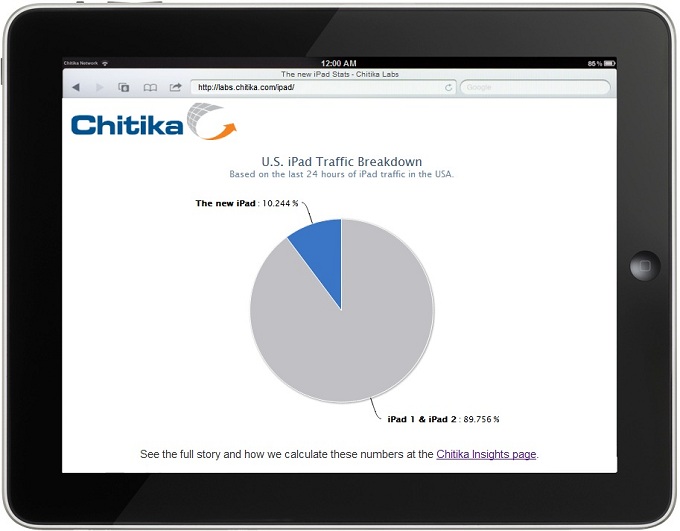
After about three weeks, the new Apple iPad apparently was driving 10 percent of all iPad traffic, Chitika reports


That might imply one of two things, either that after less than three weeks the new iPad has gotten about 10 percent share of the iPad market, or that users of the new iPad are using bandwidth at a higher rate than owners of the older models. 


Most people would instinctively guess it is the latter, not the former, which accounts for the bandwidth intensity. 

The Lumia 900 Becomes Amazon’s Best Selling Phone

Even though the Nokia Lumia 900 just launched a day ago, the phone quickly skyrocketed to the top of  Amazon’s best sellers list.  The Lumia 900 appears at the moment to be the best-selling device sold by Amazon


Part of the instant popularity likely comes from Amazon’s price of $50 with a two-year service plan. That’s $50 less than AT&T’s price and $150 less than the previously most popular phone from Amazon, the Droid RAZR MAXX.


AT&T to Spend More Heavily on Lumia than iPhone Launch

AT&T appears to be gambling that it can achieve market advantage by offering the Nokia Lumia 900 for the period in which AT&T has an exclusive.


AT&T reportedly is going to spend as $150 million to help launch Nokia's Windows Phone Lumia 900, more than it spent to launch the iPhone. Is it a gamble? Some would say so. Microsoft's operating system does not register much more than three percent market share in the U.S. market,  though many expect the tie-up with Nokia might make a difference.


But the Lumia might have key market share and operating cost implications. It might require less spending on AT&T's part in the form of device subsidies. Also, Nokia and Microsoft have limited enough market share that the possibility of upside arguably is far greater than the downside. 


We will see. Consumers will be weighing a lower retail price for the device with the different user interface, as compared either with the Apple iPhone or Android devices. 


Device exclusivity, for a time, remains a key carrier objective. But it remains to be seen whether any future devices, other than the original iPhone, will ever have the length of time where exclusivity holds. Nor is it clear any devices since the iPhone have had similar perceived value. 


AT&T loses

Even Libraries Face Mobile Ecosystem Conflict

The 2012 State of America’s Libraries study illustrates the widespread nature of potential disturbances in the mobile, tablet and application ecosystems between ecosystem participants. 


Over 67 percent of U.S. libraries now offer downloadable e-books and 28 percent lend out e-readers “and other mobile devices” to patrons, but “when Random House increased its e-book prices by 100 percent to 200 percent” the “dialogue between the publishing and library communities concerning ebooks…moved to a front burner,” the report says. 


The report also notes that four of the big-six publishers offer no e-books to libraries at all. “No one is quite sure where the ebook–library relationship is going,” the report says.


Penguin, for example ,no longer provide e-books or digital audiobooks to libraries. 


In November 2011 when Penguin stopped offering new e-books to libraries, it also stopped offering e-books to library patrons using Kindles.


A few days later Penguin restored Kindle access, but also noted, “Penguin informed suppliers to libraries that it expected them to abide by existing agreements to offer older digital titles to libraries only if those files were held behind the firewalls of the suppliers.” 

Who would doubt that Penguin business interests with Amazon have much to do with that decision?


Such conflict is par for the course in virtually all business ecosystems affected by mobility. And that increasingly seems to include retail commerce, online commerce, banking, payments, online and mobile advertising, communications, music, video, movies, books and other printed media products. 


Changes in "who" makes money, "how" therefore now affect many products, processes and services that touch any consumer or business in the ordinary conduct of life, in other words.

Consumers Love Google, Even if Some Pundits Possibly Don't

Google and Apple are highly regarded by consumers, even if some pundits and technologists sometimes discount Google, a new ABC News/Washington Post poll indicates.


About 82 percent of Americans express a favorable opinion of Google overall, while 53 percent have a “strongly” favorable opinion.


About 74 percent of respondents view Apple favorably.  

What Impact Will Declining Smart Phone Subsidies Have on Penetration, Innovation?

It is a fundamental economics insight that when suppliers raise the price of any product, demand drops.


So it takes no particular insight to predict that if mobile service providers start reducing the subsidies they now offer to spur smart phone adoption, adoption rates will fall. And there is growing opinion that smart phone subsidies in the U.S. market are about to become less generous. 


Analyst Walter Piecyk of BTIG, in fact, already has cut his earnings projections for Apple, on the assumption that lower subsidies will lead directly to lower sales of Apple iPhones. The same will be true for suppliers of other devices that also are subsidized less.


 The subsidies can't last, he argues, in part because the ever-growing cost of the devices is putting a strain on operating revenue. 

In addition to fewer sales of smart phones, any abandonment of subsidies would slow replacement rates and arguably slow the rate of innovation for any application or feature that requires new handset functionality.


Any such change also would provide benefits for providers of lower-cost smart phones, as well. On the other hand, an end to subsidies would likely also mean an end to multi-year contracts, which would tend to increase customer churn. 


Hand set subsidies are a double-edged sword, in other words. As much as service providers would like not to provide the subsidies, there are negatives to be faced, including higher churn, slower smart phone adoption and a shift of sales toward less-expensive models. 

Global LTE: by 2016, Growth Will be in Asia-Pacific Region

Though the United States has dominated the Long Term Evolution market so far, other regions are poised to boom over the next five years, according to Signals and Systems Telecom


According to Signals and Systems Telecom, the Western Europe and Asia Pacific Regions will see the highest growth rates during the next five years.


Why There is No Need for "Interactive TV"

An overwhelming number of respondents surveyed by Nielsen suggests the reason why "interactive TV" not only has failed, but likely has little future. 


Connected device owners in the United States, United Kingdom, Germany and Italy overwhelming use their smart phones and tablets devices for interactions and multitasking while watching television.


In the United States, 88 percent of tablet owners and 86 percent of smart phone owners said they used their device while watching TV at least once during a 30-day period, according to Nielsen.


For 45 percent of tablet-owning Americans, using their device while watching TV was a daily event, with 26 percent noting simultaneous TV and tablet use several times a day. U.S. smartphone owners showed similar dual usage of TV with their phones, with 41 percent saying their use their phone at least once a day while tuned in.


simultaneous-tablet

Microsoft Buys 800 Patents from AOL, Issue is Why

Mircrosoft is buying 800 patents from AOL, covering online communications, browsers, search engines, multimedia, network routing, security and voice. The obvious question is "why," and less "why now?" 


The "why now" is simply that AOL was going to sell the patents to somebody, and Microsoft concluded that is was a reasonable way to spend about a billion dollars. The "why" isn't so clear, yet. 


One would have to assume Microsoft expects to be in some businesses, or to have a bigger role in some businesses, where such patents will ward off attacks based on patent infringement. In other cases firms also use patent portfolios to gain cross licensing of patents from other competitors. 


The point is that Microsoft would not be spending about a billion dollars without expecting some business use of the patents. 


The deal also includes Microsoft licensing of about 300 additional patents from AOL. Those presumably include patents related to advertising, search, content management, social networking and mapping. 


AOL has a license to use technologies covered by the 800 patents sold to Microsoft, as well. About 140 of the patents relate to online communications, with the majority of these patents focused on instant messaging and email technology.  These patents cover many features that are now standard in online chat, mobile messaging, and social in-network messaging applications.
  
For example, AOL has  patents covering contact list management, status indicators and visibility settings, group messaging, the use of avatars and icons associated with chat profiles, as well as interoperability technology between various online messaging platforms. 


Regarding email technology, AOL has a number of patents related to spam filtering, group message opt-in systems, and unified messaging (i.e., conversion of email to text and audio).  AOL has also patented technologies for cross-language communications, both via email and online messaging. AOL owns 81 patents related to browser technologies and user interfaces. 


   AOL sells more than 800 patents to Microsoft in $1 billion+ cash deal

Sunday, April 8, 2012

"Why" an iPad "Nano?"

There are several questions that have to be answered, from Apple's perspective, about why it would want to release a smaller iPad, such as the rumored eight-inch device. 


Even if there is a perceived market,  there are some technology questions, such as battery life, or the ability to support Retina display. Perhaps the biggest issue is whether Apple believes there is a substantial incremental opportunity, though. 


The precedent is the iPod, of course. For all rival suppliers, it will matter greatly whether the tablet market develops on the iPod or iPhone model. If the former, Apple "owns" and "defines" the market. In the latter case, there is room for other suppliers. 


For everybody but Apple, the issue is whether competing with Apple is actually feasible, not in the sense of ability to produce and sell a tablet, but whether any other supplier will be able to displace Apple in the "tablet" market in terms of mind share or market share. 


Today, Apple has about 78 percent market share in the MP3 market. 

Mergers, Joint Ventures or Investments as Routes to Controlling AI Model Costs

Just how artificial intelligence model providers might improve their economics is a key business model issue.  A shift to inference operatio...