Monday, July 29, 2013

Can Google Become a Force in Enterprise Computing?

Though Microsoft long has had a huge presence in business and enterprise computing environments, Apple, which traditionally has eschewed designing for business users, nevertheless has gained traction in enterprise computing environments. The big issue for Google is whether the Android ecosystem can become a significant provider in enterprise environments as well.

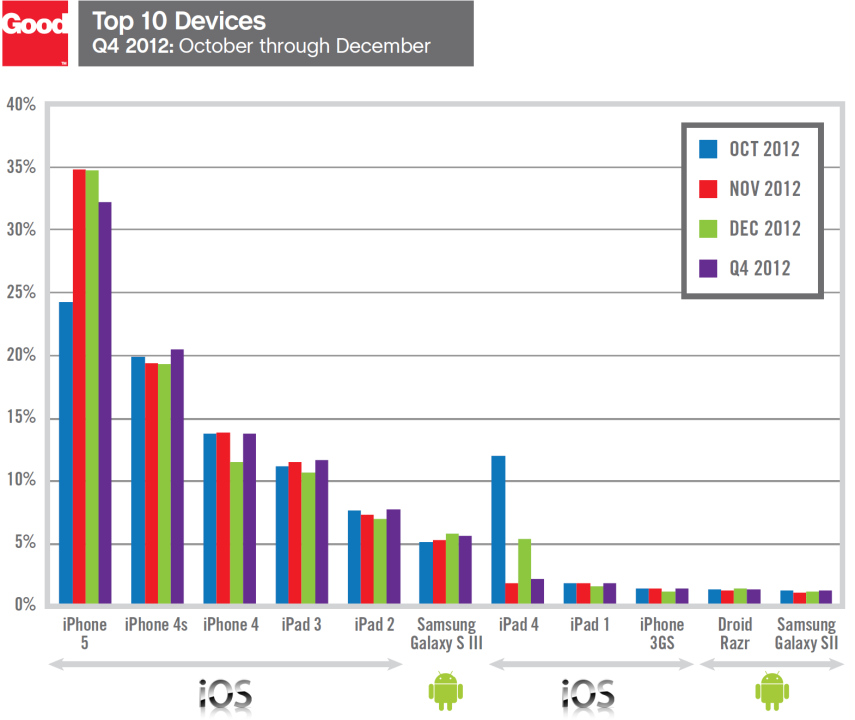
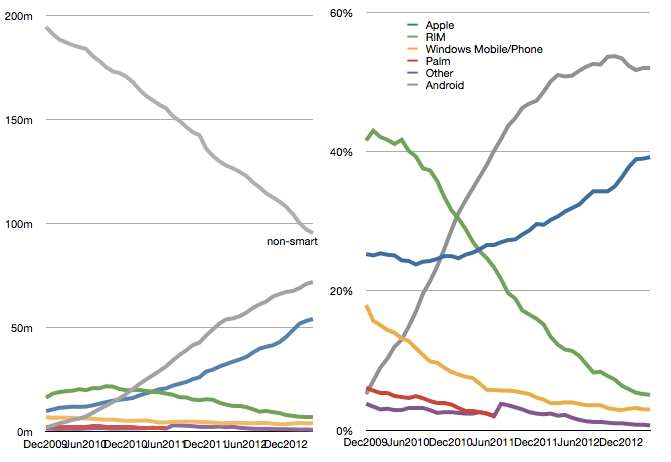
By most accounts, Apple is making the most gains in business user environments. A fourth quarter 2012 analysis by Good Technology shows the strides Apple has made in corporate environments.

Looking at new smart phone and tablet activations, Apple devices show the greatest share. Good Technology’s report showed a clear preference for iOS devices, which accounted for 77 percent of all activations and captured eight of the top ten spots on the most popular device list.

But Android activations accounted for 22.7 percent of all activations for the quarter, which were primarily driven by Android tablets.  Windows Phone devices came in a distant third for the quarter, capturing just 0.5 percent of overall activations, Good Technology says.

That has some bearing on a larger question, namely whether Google is making inroads into the enterprise space, something it is attacking on an array of fronts, ranging from cloud computing infrastructure to productivity suites to devices and applications.

Consider one formerly overlooked approach, namely Chromebooks. Few would claim Google yet has gained significant traction for its Chromebooks in the personal computer market, much less enterprise environments. But some think that could change.

Infrastructure and operations professionals with responsibility for end user computing and device portfolios should look to Chromebooks in the enterprise environment, says J. P. Gownder, Forrester Research VP and principal analyst.

That is the recommendation even if Chromebooks cannot or will not displace most Windows PCs, Macs, and tablets used within enterprises. But for companies that are willing to segment their workforces (offering Chromebooks to specific classes of workers in a mixed environment with PCs and tablets), or adopting Gmail or  Google Apps, or who are deploying the devices in a customer-facing (think kiosk) scenario, Chromebooks are “definitely worth investigating,” says Gownder.

Chromebooks offer the prospect of radically reducing the amount of time IT staff spends “keeping the lights on” for devices, Gownder says. Chromebooks might also in many cases get enterprises out of much of the overhead of supporting notebooks.
“I want to get out of the laptop business,” one CIO told Gownder. Chromebooks offer high uptime, low service costs, and scalable deployment of new web-based applications and content, Gownder says.

A move to corporate Gmail remains pretty much a prerequisite to the adoption of Chromebooks, Gownder also notes, however.

Some might argue Chromebooks are a tool for enterprise collaboration. One CIO told Gownder that workers at his company started to use Google Drive and other collaboration tools “organically and automatically” after the adoption of Gmail. So Chromebooks are a p[altform for collaboration.

“t’s time to take the Google enterprise proposition seriously,” Gownder says.
This


Android is making gains in the overall market, to be sure. And since enteprise computing these days increasingly is affected by consumer computing, that will matter. 
460 Million M2M Connections by 2018?

Mobile machine to machine (M2M) connections are set to reach over 450 million by 2018, according to ABI Research. That likely will be important for mobile service providers anxious to drive revenue and connection growth once sales to people saturates.

Other analysts have M2M forecasts in the same general range. Juniper Research, for example, a year ago forecast 400 million M2M connections in service by about 2017.

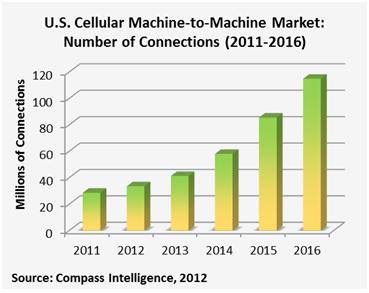
In the United States, The mobile M2M market will reach 114.7 million connections by 2016 with a compound annual growth rate of over 36 percent.

The largest business-to-business vertical market (most of the revenue likely will be B2B, some would argue) is the transportation vertical, with over 40 percent market share.

By 2015 more than 40 percent of M2M connections in the United States could be running on 3G, 3.5G or 4G networks. That also suggests that much of the demand for M2M connections will not rely much bandwidth, as 60 percent of M2M connections will use 2G networks.


Europe dragged down worldwide connection growth in 2011 and 2012, but connection growth will accelerate to a CAGR of 26 percent through 2018, ABI Research forecasts.

M2M average revenue per user connection ARPUs frequently are much lower than for human communications accounts, and ABI Research says competition is putting even more pressure on ARPU.

As do other analysts, ABI Research notes the importance of relatively bandwidth-limited 2G network connections.  Some 70 percent of mobile M2M connections were on 2G networks in 2012, ABI Research estimates.

ABI Research also suggests that the cost of M2M transponders is one reason for the heavier reliance on 2G networks, even though it also is true many M2M apps do not require lots of bandwidth.

In fact, the firm argues 3G transponders are more than twice as expensive as 2G transponders, while 4G transponders are six times more expensive than 2G versions.

As with many other communication services, much of the potential revenue will be earned by providers of apps and services other than the basic connections.

How Much Will Connected Car Business be Worth to ISPs?

Broadband mobile connectivity is about to become default in vehicles, adding a new computing environment beyond office, home, and on-the-go,” writes Forrester Principal Analyst Charles Golvin in a new report on connected cars.

The GSM Association predicts that by 2018, global revenues from the connected car business will include €24.5 billion from in-vehicle services, such as traffic information and and web-based entertainment, up from €9.3 billion in 2012).

Hardware sales might amount to about €6.9 billion, up from €1.2 billion in 2012).

An additional €4.5 billion will be generated by the delivery of telematics services, such as customer relationship management, (up from €1.8 billion in 2012), while €4.1 billion will be earned by mobile service providers in the form of access and mobile data, up from €814 million in 2012.

The GSMA suggests almost 36 million new cars will be shipped globally with embedded telematics (BMW ConnectedDrive and GM Onstar, for example) by 2018, about 31 percent of the total number of cars shipped in that year, up from 5.4 million in 2012.

Others think the volume will wind up being bigger for what might be called “over the top” uses of driver smart phones and other devices. The GSMA forecasts that almost 21 million of the cars sold in 2018 will be fitted with smart phone integration systems (18 percent of total cars sold). In 2012, 1.9 million cars shipped with smart phone integration solutions, such as Ford Applink or Toyota Entune.

These systems typically enable the driver or passengers to view apps running on the driver’s smart phone on a screen in the car and, in some cases, to interact with these apps using vehicle controls.

The connected vehicle is now emerging as a unique computing environment, distinct from the office, home, and on-the-go environments, Forrester argues.

One need not even agree that automobile communications is that sort of new development to recognize why mobile service providers are interested in auto-based communications.

There is universal agreement that global markets for mobile services sold to people is becoming, or has already become, saturated. Machine to machine communications therefore emerges as the next big source of connection and revenue growth.

It isn’t so clear how much various parts of the ecosystem will benefit, but there are logical candidates.

Carmakers see ability to create new recurring revenue streams from emergency calling and automatic accident notifications, entertainment like Pandora and information services like Google search.

Mobile operators see new recurring service revenues. Application developers likewise see new opportunities to sell apps and services.

Another Internet Bubble?

If you have lived through one or two asset class bubbles, any sign that any market you care about is experiencing superheated growth of asset prices will make you quite queasy. This Statista chart should have a cautionary effect. 

2013_07_29_Stocks

Saturday, July 27, 2013

Samsung Sells 1/3 pf all Smart Phones Globally in 2Q 2013

The global mobile phone market grew six percent year over year in the second quarter of 2013, according to International Data Corporation.

And though Samsung and Apple have lead the smart phone market, sales of lower-cost devices represent much of the sales volume. In that area, Alcatel and Huawei had high double- and triple-digit growth rates in the second quarter for their Android-based offerings shipped to high-growth countries such as China and India.

In the second quarter of 2013, these vendors from outside the “top five suppliers” accounted for 44.8 percent of the overall shipment volume, up from 42.2 percent in the same quarter one year ago, IDC estimates.

"Though Samsung and Apple are the dominant players, the market is as fragmented as ever,” said Kevin Restivo, IDC senior research analyst.

Another Way of Looking at Communications Industry Disruption

If you ponder a list of 25 consumer-facing experiences made marginalized or made obsolete over the last few decades, you will notice how many touch the communications and content consumption businesses directly. In other cases, the communications business is affected indirectly. And make no mistake, being made “obsolete” is a disruption.

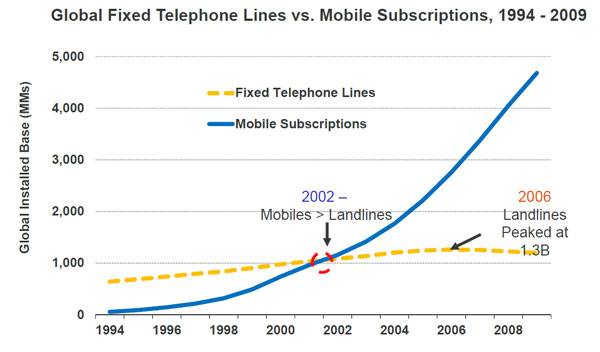
Start with landline phones. It is true that landline phone use has not really been made obsolete; nor has it actually disappeared. Still, in most markets, mobile accounts outnumber fixed voice lines by a substantial margin, 3:1 or better. In virtually all developed communications markets, use of fixed voice lines is declining.

Even in markets traditionally higher “unserved” in terms of widespread voice communications, mobile has revolutionized communications.

One corollary, given that almost everybody has a mobile, is that demand for public pay phones has diminished as well.

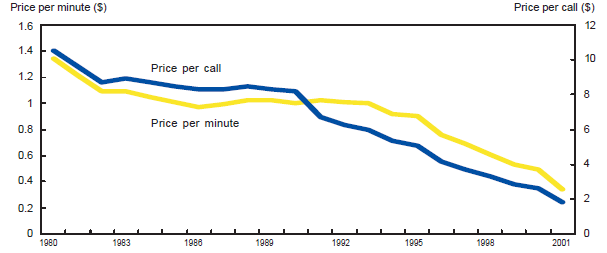
Also, at least within domestic markets, long distance charges are not a relevant concept. In international calling markets, VoIP services have made global calling generally affordable, as this look at Canadian long distance price trends shows.


These days, people do not call 411 for information, they look it up on their smart phones. LIkewise, that has affected the ways use phone books, directories and encyclopedias. Use of paper maps likewise has diminished, because it increasingly is unnecessary to rely on anything other than a smart phone for such purposes.

For the same reason, sales and use of stand-alone GPS devices has declined. One might also point to alarm clocks as a device made often unnecessary because the phone provides the same function.

The finding and publishing of most forms of information also has shifted to Internet delivery, often enhanced by location information. Consider newspaper classified ads.

That change in “search” is part of a shift to computer-enabled information processes, including storage. And in the storage area, floppy disks and compact discs (and increasingly, hard disks) have been replaced by cloud storage or solid state memory. Likewise, videocassette recorders and facsimile machines no longer are widely used.

Add the process of manually “backing up your data,” which is something cloud storage automates.

Paid-for email accounts, film developing, dial-up Internet access, video rental stores and record stores are other examples of consumer retail behavior and revenue streams that have largely disappeared as well.

The point is how much the communications business, content consumption and now computing businesses have been disrupted, and are being disrupted by Internet technology, and how relatively rapidly those changes have happened.

Friday, July 26, 2013

3/4 of All U.S. Access Lines Now are Mobile

As recently as 2004, there were just about as many fixed network voice lines in service as mobile lines. By 2012, mobile lines had grown to represent about 75 percent of all lines in service.

Mobile lines about doubled between 2004 and 2012, while fixed lines dropped about 50 percent. 


Are ISPs Overselling the Value of Higher Speeds?

In the communications connectivity business, mobile or fixed, “more bandwidth” is an unchallenged good. And, to be sure, higher speeds have ...