Wednesday, August 19, 2015

Telecom Provider Failure Now is a Possibility

Nothing is less controversial than the assertion that the telecom business is changing in fundamental ways. Much more controversial are the implications of the changes.

Most controversial of all are predictions that failure now is a possibility.

It is not controversial to argue that “the old telco business model is breaking up,” as Dan Bieler, Forrester Research principal analyst, says. In many ways, the legacy business models are challenged because all the legacy revenue streams are under pressure, and many clearly are declining. Those which are not declining face margin pressure.

It would be reasonable to argue that “telcos are at a crossroads.” Nor would it be unusual to argue that fundamentally different new strategies and roles in the ecosystem will be adopted.

Generally speaking, observers believe the fundamental choices revolve around the roles of
“transmission” (“pipe”) and “services” (apps). One choice is to become a low-cost provider of transport and access services, fundamentally eschewing apps.

In other words, one path forward is to embrace the wholesale model, and deemphasize or abandon the retail role.

Some might feel uncomfortable about that choice, but it is the full embrace of the “dumb pipe connectivity” model.

The tougher path, one might argue, is the full transition to a new model built on some combination of IP ecosystems apps and functions. That is harder to describe or achieve, as it requires creating a major new role in the IP ecosystem beyond connectivity services.

Fundamentally, that embrace of the retailer role could include either a new distributor role (like cable TV, where the access provider bundles apps) or an app creator role.

Perhaps obviously, the bundler or distributor role will be easier than the “app creator” role, which essentially requires that a telco become a Facebook or Google. Most agree that will be difficult.

More feasible is to become a Netflix, bundling OTT content or apps created by others.

What also is new is the possibility of complete failure: going out of business.

That would have been unthinkable in the monopoly era. Communications was--and remains--a vital form of infrastructure. There being no other possible providers, the sanctioned monopoly providers could not be allowed to fail.

That no longer is true. Failure is possible, and replacement providers generally are available. That means, in the coming era, the possibility of business failure by virtually any former monopoly services provider.

That possibility will become a reality, Bieler argues. “At this stage, I see few reasons to be optimistic about the prospects for most telcos to recover the ground they’ve lost to other players in the emerging digital ecosystems.”

Bieler cites a few of the shifts that have lessened service provider value.

Consumers care more about apps and devices than connectivity.  than ever. “Consumers care more about which handset and apps they use than which connectivity provider they have,” he says.

That is a simple function of the shift to Internet Protocol, which specifically, and by design, separates app from access. The protocol itself shifts value to “over the top” applications that can be used on any access platform.

That shift opens the way to third party creation of important apps, without the permission of the access and transport suppliers that once owned and controlled the few important consumer apps (voice, mobile voice, messaging, entertainment video) and some of the important business customer apps.

In fact, the future of the consumer segment business might follow the earlier evolution of the business segment, where apps (information technology) largely is supplied by the software providers, while telcos and other service providers mostly supply the transmission function.

That explains the potential importance of the shift to cloud computing, as it provides one new way for traditional telcos to acquire new value. If all computing shifts to the cloud, then not only is role of connectivity heightened, but the physical layer revenue models extend to data centers that become the functional equivalent of the legacy central and tandem switching centers.

In the enterprise segment, which has become more strategic for any number of communications service providers, telcos are not necessarily the top choice where it comes to supplying voice, data or managed services, Bieler points out.

“Business and IT users trust systems integrators and independent solution specialists more than telcos with a wide spectrum of voice, data, and managed services,” he says.

Bieler also says “regulators undermine telcos from adopting new connectivity business models.”

That will be seen as controversial in some quarters, though not likely in the telecom industry.

“As part of the net neutrality debate regulatory bodies oppose various telcos’ attempts to explore commercial relationships with content and service providers regarding the delivery of content via prioritized connectivity,” Bieler says. “At the same time, regulators refrain from applying the same regulation for over-the-top communication services as for telcos.”

One doesn’t have to agree with the notion that OTT apps and services should be regulated as legacy services are. One can argue that service provider apps should have the same freedom as OTT apps, instead.

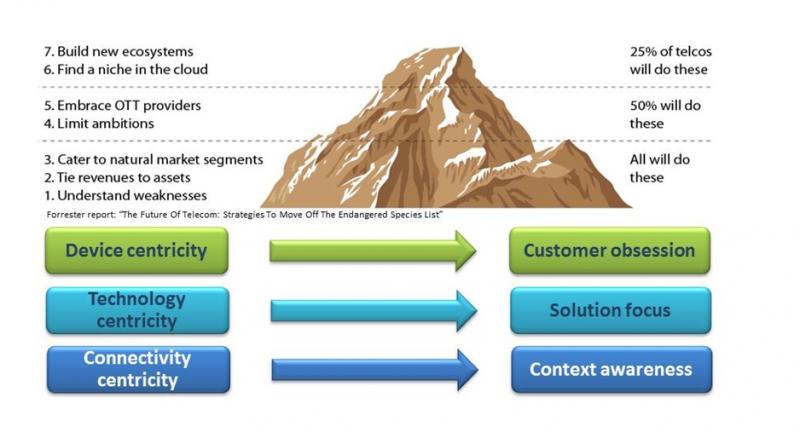
Advice is easy to give: do a better job with customer service, move faster, partner with OTT providers, embrace wholesale, cut costs, innovate faster. Those are among the common bits of advice typically offered.

In the end, connectivity likely will remain the most valuable cash-generating asset, Bieler argues.

There is one simple reason: the protocol stack specifically creates a role for the physical layer, and telcos traditionally have had that role. The one function where telcos and other service providers have core competencies is the physical layer, the actual means of connecting users and app owners.

One need not insist that the only way forward is a wholesale-type role to insist that the physical layer is the one layer of the protocol stack where access and transport providers have unique functions and core competencies.

Bieler’s fundamental view of options is not unusual. Some telcos will transform in significant ways, adopting new roles in the cloud and IP infrastructure. Most will shift to an accommodation with OTT supply of apps, likely moving more to a wholesale revenue model.

That’s the “glass half full” view. The “glass half empty” view is that some legacy operators will simply fail to make the transition, and will go out of business. Failure is a real possibility, because alternative suppliers are available.


Tuesday, August 18, 2015

For Google, the Network is the Computer

For Google, the network really is the computer. “Ten years ago, we realized that we could not purchase, at any price, a datacenter network that could meet the combination of our scale and speed requirements,” said  Amin Vahdat, Google Fellow. “So, we set out to build our own datacenter network hardware and software infrastructure.”

That network now essentially allows Google to treat all computing resources within a single data center as one giant computer. “This means that each of 100,000 servers can communicate with one another in an arbitrary pattern at 10Gbps,” he said.

The architecture also tries to manage all the resources, everywhere on the network, as part of a single computing fabric.

“Our latest-generation Jupiter network has improved capacity by more than 100x relative to our first generation network, delivering more than 1 petabit/sec of total bisection bandwidth,” said Vahdat.

Google released four papers that details various aspects of its networking architecture, including its reliance on software defined networks.

Video Rate Increases are Nearing a Potential Death Spiral

Annual increases in linear video subscription prices are routine. Virtually every year, video distributors raise rates, citing higher programming contract costs.

For many decades, that worked. The problem now is that consumers are showing resistance to buying the product. That creates a different dynamic.

Increasingly, higher prices drive more customers away, raising the overhead to be borne by fewer remaining customers. That is, in microcosm, the whole problem with dwindling customers for every traditional product sold on fixed networks.

There are, every year it seems, fewer customers to carry all of the overhead of the whole business. Sooner or later, unchecked, that becomes a death spiral.

The video subscription business, for most small providers, is nearing such a danger point.

WideOpenWest  programming costs for the first quarter were up sequentially by 9.8 percent on a per basic subscriber standpoint, the company said. On a year-over-year basis, programming costs climbed 15.2 percent over the first quarter of 2014 on a per customer basis, for example.

The interesting conundrum shaping up is that, as economics would suggest, buyers respond to price hikes by buying less. So, one might argue, every price hike drives incrementally more subscribers to disconnect.

Up to a point, suppliers will behave rationally by hiking prices, to maintain gross revenue in the face of unit declines. That works so long as key competitors also raise their prices, and so long as viable substitute products do not arise.

The former might well be the case. The latter almost certainly will not be the case.

The difficulties arguably are highest for small distributors. WideOpenWest, for example,  “saw an overall decline in subscribers and RGUs” in the first quarter of 2015.

Total customers were down about 9,900, while total revenue generating units were down about 54,000. Some 28,000 of those losses came from subscription video units.

WideOpenWest video average revenue per user increased 15 percent year over year, for example. Prices up, subscribers down, just shy of covering the increased programming costs.

For most--if not all small linear video providers--profit margin is the issue. That has been true even for the largest telcos, such as Verizon and AT&T. That is one reason--not the only reason--why AT&T acquired DirecTV.  

On top of that, most small telcos have a tough time eking out a profit under the best of circumstances.

The point is that the strategy of raising video subscription prices already is becoming counterproductive.

80/20 Rule for Fixed Networks?

CenturyLink, Frontier Communications, Windstream and Lumos Networks are examples of former rural telcos that have transformed themselves into companies that make most of their money from business customers.

In the case of Lumos Networks, the strategy was to spin out the former competitive local exchange carrier assets from Ntelos, the independent telco. After that transaction, Ntelos  itself was acquired by Shentel, another Virginia-based independent telco.

Headquartered in Waynesboro, Va., Lumos provides products and services over a 5,800 route-mile network in six states, including Virginia, West Virginia, Pennsylvania, Maryland, Kentucky and Ohio.

In large part, incumbent telcos have repositioned by creating their own out of region competitive local exchange carrier operations, or acquiring other CLECs.

Over the long term, the unsettled issue is the sustainability of traditional telco operations serving both consumers and business customers, in region.

In many ways, the dilemma is the Pareto principle, commonly known as the “80/20 rule,” where 80 percent of results come from 20 percent of actions or operations. In the case of incumbent telcos, the issue is that the access network serving consumers often is necessary to create the economies of scale to support services aimed at business customers.

In much the same way that undersea carriers serve both retail and wholesale segments of the business, fixed network operators might find that serving consumers is required to attain the scale to support the more-profitable operations supporting business customers.

That might be as true for Verizon and AT&T as well as smaller telcos. The ability to support  small cell backhaul networks covering wide areas,  for example, often depends on dense fixed networks that piggyback on residential service assets.  

Android Smartphone Launches for $87, Reaching 1/3 of Africa's Population

Many initiatives now are underway to bring Internet access to billions of users in developing countries, fast, ranging from new access platforms to less-costly smartphones.

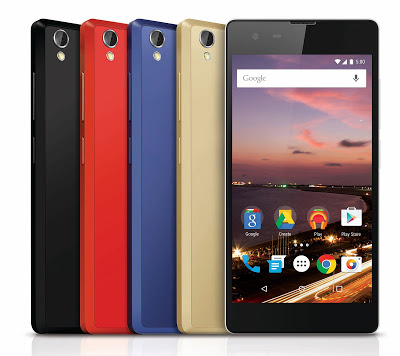
Infinix is selling its first Android One smartphone, the HOT 2, in Nigeria, at a recommended retail price of N17,500 (US$87).

It’s also available to purchase online from distributor Jumia in Egypt, Ghana, Ivory Coast, Kenya, and Morocco. That makes the device available to about a third of Africa’s total population.

Android One, Google’s low-cost version of the Android operating system, is designed to allow manufacturing of low-cost smartphones.

The Infinix HOT 2 phone features a quad-core MediaTek processor, dual SIM slots, front and rear-facing cameras, a FM radio tuner, and 16GB internal memory (expandable).


The Infinix HOT 2 runs the latest version of pure Android (Lollipop 5.1), which provides up to two times better battery performance. The device also automatically gets upgraded to the next version of Android.

Separately, Google is releasing a new offline feature within the YouTube app later in 2015 that allows people to watch offline. That feature is important in areas where there is limited or intermittent Internet connectivity.

Once taken offline, videos can be played back without an Internet connection for up to 48 hours.

Monday, August 17, 2015

Biggest U.S. Linear Video Subscriber Loss in History in 2Q 2015

source: Wall Street Journal
There now is a steady drip of news and metrics indicating that the linear video business is reaching some sort of inflection point. The latest numbers show double-digit declines in viewership at a number of the leading linear video networks in the month of July 2015.

USA Network and History declined 14 percent each, but A&E dropped 36 percent.

Those figures were made public just days after another report showed the linear video business had its biggest-ever subscriber decline, in a single quarter.

The industry lost more than 600,000 video subscribers, its biggest quarterly drop ever, SNL Kagan said.


Sprint Moves Toward Phone Leasing, Not Sale

Sprint seems to be moving in device strategy direction that is different from all three of the of the other largest mobile service providers in the U.S. market. Sprint unveiled a new device program for iPhone customers that dispenses entirely with the “ownership” model and instead substitutes a “lease your phone” approach.

The “iPhone Forever” program offers new and upgrade eligible Sprint customers the lease of an iPhone for $22 per month.

Any customer on the plan can return their current model iPhone and get the latest model.  

“They bring their iPhone, upgrade on the spot and away they go,” Sprint says. The iPhone Forever plan presently offers a 16GB iPhone 6 model at Sprint branded retail stores, Sprint.com, 1-800-Sprint-1, Best Buy and Target.

T-Mobile US had abandoned contracts two years ago. AT&T has kept the option, though AT&T is encouraging customers to move to its installment plans.

Verizon Wireless, meanwhile, has decided to get out of the contract business as well, replacing contracts with the ability to buy a phone on an installment plan .

Through Dec. 31, 2015, customers on any other carrier or existing Sprint customers who are upgrade eligible and turn-in any smartphone will get a promotional rate of just $15 per month on a new iPhone. When they upgrade to the latest iPhone after Dec. 31, their monthly lease rate returns to current lease pricing, $22 per month.

The point, though, is that Sprint might further shift in the direction of leasing phones, not selling them.

Access Network Limitations are Not the Performance Gate, Anymore

In the communications connectivity business, mobile or fixed, “more bandwidth” is an unchallenged good. And, to be sure, higher speeds have ...