Friday, August 28, 2015

Sprint Offers Free Year of Mobile Service to DirecTV Customers

Sprint thinks AT&T’s ability to bundle DirecTV with mobile service is a serious customer acquisition threat. So much so that Sprint is offering DirecTV customers a free year of Sprint mobile service.

The free year of service offer starts Friday, Aug. 28, and runs through Sept. 30, 2015,

DirecTV customers switching to Sprint--or existing Sprint customers--can take advantage of the promotion.

The offer for existing Sprint customers is available to customers adding a new line of service through Sprint Lease, iPhone Forever, Sprint Easy Pay1, or paying full retail price for a smartphone.

The free year of service includes unlimited talk, text and 2GB of data per line (up to five lines), while the devices are used on the Sprint network.

Customers are responsible for the one-time $36 activation fee and monthly taxes and surcharges.

For new customers, Sprint will pay off existing phone and contracts, up to $300 per line.

After the promotional period, customers will pay standard rates.

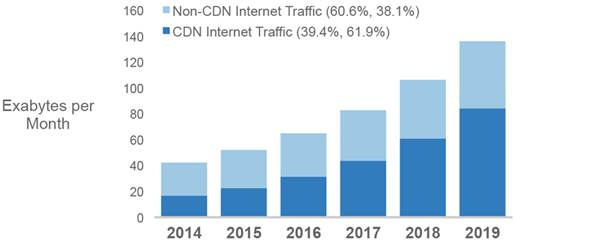
CDN Market Growing 26% Annually

The CDN market is estimated to grow from $3.7 billion in 2014 to $12.2 billion by 2019, at a Compound Annual Growth Rate (CAGR) of 26.3 percent from 2014 to 2019, according to Marketsandmarkets.

In terms of regions, NA is expected to be the biggest market in terms of revenue contribution while Asia Pacific (APAC) is expected to experience increased market traction with high CAGRs, http://www.marketsandmarkets.com/PressReleases/cdn.asp

Other forecasts have called for annual growth between 16 percent and 25 percent.

According to Cisco, CDN traffic will represent about half of all Internet traffic in 2017, and a majority of traffic after that.

Much of that traffic will flow within specific metro areas, not across the long haul networks, as more content and app providers cache content locally.

CDN Traffic Growth

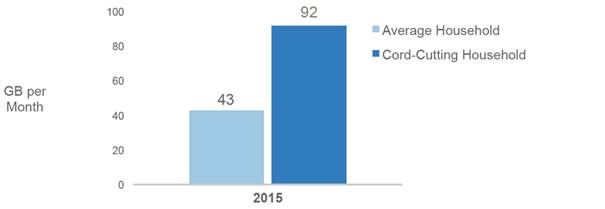
Demand clearly is going to keep growing. On average, households using linear TV generate much less traffic than a household that relies on Internet video.

A cord-cutting household will consume 92 GB per month in 2015, compared to 43 GB per month for a linear TV or average household. That is the difference between linear delivery using multicast (broadcast) delivery compared to on-demand unicast delivery.

Global Cord Cutting Generates Double the Traffic

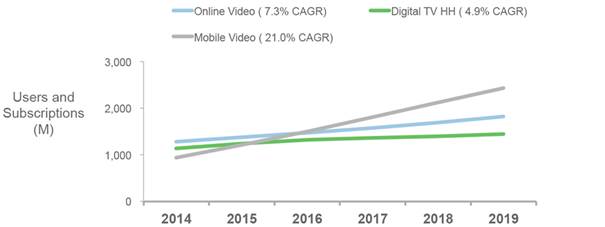
That is driven in significant part by the growth of mobile video consumption. which is growing much faster than either digital TV (cable, IPTV, satellite) or online video, in terms of number of accounts.

This trend is more pronounced in regions such as North America and Western Europe, where the penetration of digital TV already is high.

Also, in emerging regions mobile video growth rates are even higher, as these regions are skipping over fixed connectivity. It therefore is not hard to envision continued strong growth of the CDN market.

Up to this point, the CDN market has been a niche within the connectivity services market. As it grows, it will become more attractive to a wider range of transport suppliers.
Global Online and Mobile Video Growing Faster Than Digital TV

Thursday, August 27, 2015

If Video Goes Mobile, Pricing Plans Will Really Have to Change

Executives at Comcast, Verizon and Dish Network are not dumb. They know there is a high likelihood of disruption of the linear video subscription business. Precisely what form any new model takes remains a matter of some speculation.


At a high level, there are three fundamentally different visions. There is the model of HBO or Netflix, where “channels” are not the foundation, programs are.


Then there is the Sling TV and other similar coming models where channels still are a building block, but the bundle is stripped down to perhaps 20 or 30 channels.


Finally, there is the completely unbundled model where single channels “go direct” to end users.


There likely is room for some forms of all three models, though it is highly probable not all three models will be of equal importance, in terms of revenue or subscribers.


The odds of a “going direct” (over the top) model are less robust, for the simple reason that the business model is the toughest. Going direct requires a huge new investment in marketing, billing and customer support that traditionally no networks possess.


One of the attractions of the traditional bundle, or even the new OTT bundles, is that the content provider can rely on the distributor for the heavy lifting in terms of marketing and support, while avoiding the issues associated with retail billing relationships.


So consider a few of the reasons Apple might eventually be a significant provider.
Apple has a customer base of nearly 90 million iPhone users just in the U.S. market.


The whole linear video business serves about 95 million households.


Apple also is among the market participants that would benefit the most from a major shift to smartphone-centric viewing. That might have seemed a foolhardy notion two decades ago. It is anything but foolish these days, at least as a potentially huge new model.


What remains unclear is what mix of “channels” and “programs” various contestants will emphasize. So far, Netflix is the leading practitioner of the “programs” model, while Sling TV is an example of the “channels” model.


Some of us would bet those are the leading future models. The “direct to consumer” approach, unbundled, might be a factor, but faces huge challenges, mostly around the business model.

Most content owners likely would agree the bundled model--either whole channels or programs--is most feasible, financially.

One unresolved issue, should the mobile model gain big traction, is how distributors will handle the capacity demands, and how they will price bandwidth. The wholesale cost for a firm such as Netflix is one thing; Internet access sold direct to end users is quite another matter.

Retail mobile Internet access costs vary, but might represent retail end user charges of between $7 per gigabyte and $15 per gigabyte. The per-gigabyte cost of a fixed network connection is more statistical, and depends on how much data a given account consumes in a single billing period. But fixed network costs in U.S. markets can be as low as a dollar a gigabyte or even less.

If video entertainment goes "mobile" to any significant degree, video bandwidth is going to be an issue, since no mobile operator likely can sell bandwidth at $1 a gigabyte or less. The obvious solution is to encourage or even require consumption only on Wi-Fi connections.

To a far greater degree than will be the case for OTT video consumed on fixed networks, mobile consumption is going to be a huge issue for ISPs.



Cricket Move Part of AT&T's Latin America Strategy

There is one easy way to describe the difference in business strategy conducted by AT&T and that chosen by Verizon Wireless. AT&T already is committed to expansion in Latin America, while Verizon remains focused on the U.S. market.

One example: Cricket Wireless, an AT&T value brand, is expanding international service  to nine new countries from the United States.

And that arguably is a relatively small part of the strategy. The most direct evidence are the acquisitions of Nextel Mexico and Iusacell, which make AT&T a direct competitor in the Mexico mobile business, and represent the first “outside the United States” expansion in nearly a decade.

The DirecTV acquisition also delivered AT&T a significant position in Latin America video entertainment, though some think additional expansion in the video area is less likely than investments in mobile assets.

Under the new Cricket plan, U.S. callers can reach Dominican Republic, Colombia, Costa Rica,El Salvador, Honduras, Guatemala, Jamaica, Haiti, or Nicaragua by adding the country of their choice to Cricket's Smart ($50) and Pro ($60) monthly plans.  

For an additional $10 - $15 per month, the add-ons give consumers a range of mobile-to-mobile and landline calling minutes (depending on the country) plus unlimited text, picture, and video messaging (MMS).

Local Firms Eager to Join Myanmar's 4th Mobile Operator Business

As you might expect, there is no shortage of local firms in Myanmar eager to participate in the creation of a fourth mobile service provider in a country that until recently had very low mobile adoption rates, and which is seeing rapid growth.

Some 17  local firms have applied to join a consortium that would operate Myanmar's fourth mobile phone network, said Chit Wai, deputy permanent secretary at the Ministry of Communication and Information Technology.

The firms selected to participate will be announced in September, with a mobile license running 15 years to be awarded to the consortium.

There is no limit on the number of local firms that can joining the consortium, which will include a foreign partner.

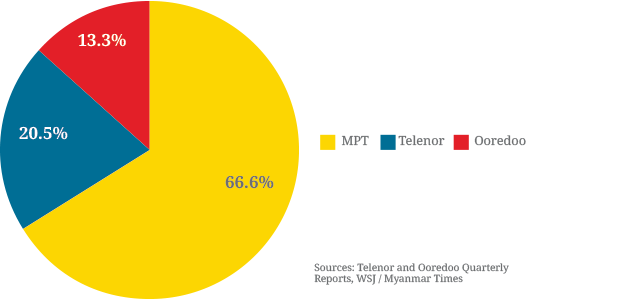
Currently, Norway's Telenor and Qatar's Ooredoo offer mobile service in Myanmar. A third telecom license is held by MPT, a joint venture between the telecoms ministry and Japan's KDDI.


Wednesday, August 26, 2015

Smartphone Sales Slow, But Focus Shifts to India

No market, the saying goes, grows to the sky. At some point, every market saturates, as most of the potential buyers actually have done so. That is starting to be the case for smartphone sales globally, even if pockets of potential growth remain.

Smartphone shipments are expected to grow 10.4 percent in 2015 to 1.44 billion units, according to International Data Corporation (IDC).

That forecast is revised lower from an earlier forecast of This is lower than IDC's previous forecast of 11.3 percent year-over-year growth in 2015.

IDC expects a noticeable slowdown in smartphone shipments in 2015 as China growth moderates.

As the largest market for smartphones--32 percent of all new smartphone shipments in 2014--China remains important even if its growth has begun to slow.

Shipments are forecast to grow just 1.2 percent year over year in 2015, which is down from 19.7 percent in 2014.

China will remain the largest market for smartphone volumes through 2019.

However, its share of the overall market is expected to drop to 23.1 percentin 2019 as high-growth markets like India continue to expand.

More than 26.5 million smartphones were shipped to India in the second quarter of 2015, up 44 per cent from 18.4 million units for the same period last year.

wwsmartphone.png


Worldwide Smartphone Forecast (units in millions)
Android
1,164.3
81.1%
9.9%
1,541.9
81.1%
5.0%
7.8%
iOS
223.7
15.6%
16.1%
269.6
14.2%
3.3%
7.0%
Windows Phone
36.9
2.6%
5.8%
67.8
3.6%
12.8%
14.2%
Others
11.5
0.8%
-15.5%
23.0
1.2%
8.6%
11.0%
TOTAL
1,436.5
100.0%
10.4%
1,902.3
100.0%
5.1%
7.9%

Source: IDC Worldwide Quarterly Mobile Phone Tracker

International Internet Capacity Grows 31% in 2015

Worldwide international Internet capacity growth rates are slowing, a rather familiar pattern in the international capacity business.

Growth rates were about 41 percent in 2011, and 31 percent in 2015. In part, the law of large numbers is at work: it is harder to maintain high growth rates as the installed base gets larger.

Backbone operators deployed 43 Tbps of new capacity in the past year, according to TeleGeography.

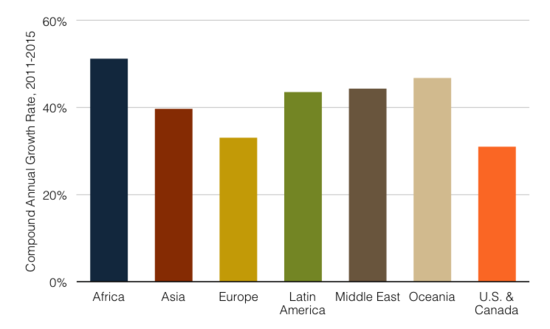
African Internet bandwidth grew 41 percent between 2014 and 2015, and 51 percent compounded annually over the last five years, to reach 2.9 Tbps.

Oceania saw the second fastest growth rate of 47 percent per year between 2011 and 2015 to reach 2.1 Tbps, and capacity in Latin America and the Middle East grew 44 percent per year to 20.6 Tbps and 8.4 Tbps, respectively, TeleGeography says.

While international Internet capacity in each of these regions has doubled every two years over the period, growth in Europe and the U.S. and Canada was far slower, at 33 percent compounded annually.

region-bw_normal.png
2011-2015 International Bandwidth Growth Rates
Source: TeleGeography

Physically-Embodied AI Market is an Order of Magnitude Bigger than Informational AI

Most of the time I actively use artificial intelligence for some sort of cognitive, content or informational task. But that’s only one way A...