Tuesday, August 27, 2013

Will End of Moore's Law Impair ISP Ability to Rapidly Grow Bandwidth?

Theoretical physicist Michio Kaku believes Moore's Law has about 10 years of life left before ever-shrinking transistor sizes smack up against limitations imposed by the laws of thermodynamics and quantum physics.

Signs of the coming end are already here, according to AMD. AMD Chief Product Architect John Gustafson believes AMD’s difficulties in transitioning from 28-nanometer chips to 20-nanometer silicon shows we’ve reached the beginning of the end.

"You can see how Moore's Law is slowing down," Gustafson said. "We've been waiting for that transition from 28nm to 20nm to happen and it's taking longer than Moore's Law would have predicted.”

The coming limits mean processing power will not double every 18 months, Broadcom believes.
Some say we will postpone hitting the wall by tweaking architecture. Others think a non-silicon approach might shift us to a new curve.

Maybe it will be proteins or other molecules or something else that provides the physical basis for a new wave of computing advances.

Some think chip manufacturing economics will be a bigger problem. At some point, it might not make financial sense to produce a faster processor or denser memory, because buyers will not pay what that latest group of devices would cost, at retail.

Whether an end to Moore’s Law will have dire consequences for access and transport providers is not clear. Much of the cost of communications infrastructure comes from construction, not the cost of processing and storage.

90% of Republic Wireless Traffic Moves Over Wi-Fi

Almost 90 percent of mobile service provider Republic Wireless data traffic goes over Wi-Fi, leaving 11.5 percent traveling over Sprint’s 3G network. 

That does not mean a mobile service provider can provide service using only Wi-Fi, only that most of the consumed bandwidth can be shifted to Wi-Fi and stay off the mobile network.

About 50 percent of Republic Wireless customers appear to be able to use Wi-Fi for 93 percent of their total data consumption, Republic Wireless says.  

    Cellular Data Usage Across Republic Wireless Members
DataSkew.png

Cox Communications Offers Wi-Fi Hotspot Access

Cox Communications says its customers with its Preferred, Premier or Ultimate High Speed Internet service now have access to the nation's "largest Wi-Fi network,"  with public hotspots strategically located in high-traffic areas such as restaurants, malls, sports arenas, parks and beaches in cities like Washington D.C., Boston, Richmond, Philadelphia and San Francisco.

Some would argue that Wi-Fi hotspots have become the preferred way U.S. cable operators attain relevance in the untethered access business, even if they do not directly own full mobile networks.

To be sure, enabling such public hotspot access also creates additional value for the high speed access services cable operators have relied on for revenue growth.

But today’s proliferating tablet and smart phone installed bases, all enabled for Wi-Fi access, create potential new revenue models for any number of ISPs. Though creating direct revenue models remains a challenge, ownership of extensive public Wi-Fi hotspot networks creates at least a potential business for mobile and untethered device data offload, even when a cable company does not own the actual direct revenue relationship with the mobile customer.

The issue, as always, is to create a viable revenue model for a public Wi-Fi hotspot business. Some of the benefits are indirect and valuable, even when not creating a direct revenue model. Lower churn, higher customer retention and higher retail rates for one ISP service compared to another are some typical value drivers for an ISP.

And some think it also increasingly will be possible to create Wi-Fi-dominant untethered access models, especially as Internet access becomes a dominant underpinning for Internet application businesses.

For cable companies, extending the range of any future video business beyond the home could provide a direct or important indirect value driver.


Why U.S. Cable and Telcos are Chasing Home Automation and Home Security

There are a couple of reasons why telcos and cable companies in the U.S. market are putting sales effort and development effort into the home automation and security businesses. First, such businesses, while perhaps not of so much interest in a pre-Internet era, and in an era where other revenue opportunities simply were vastly larger, have become more important as legacy revenue sources have begun to wither.

As a line extension using the core features of telco and cable access networks, home automation and security offer a logical way to add more application value to an access network.

Also, the change in access from narrowband to broadband mean some new features, especially the use of cameras, now are possible.

At the same time, the availability of tablets and smart phones might dramatically affect the ease of use, as well as value of home automation and home security systems.

At the same time, the better technology now available to support alarm systems, surveillance systems, intercom systems, access control and energy management services are key changes on the supply side of the business.

Simply, broadband access, Internet Protocol and easy to use mobile and untethered devices increase capabilities and ease of use in new ways.

Security, as such, is becoming a huge market worldwide, as well.

And the U.S. market is among the most lucrative globally. In terms of revenue generation as of 2011, North America held the highest share of revenue, at about 56 percent, followed by Asia-Pacific at 28 percent, according to Marketsandmarkets.com.

Among the various end-products used for home security solutions (electronic locks, sensors, alarms, cameras, panic buttons), cameras are observed to be the most potential product market with a market share of approximately 27 percent as of 2011.

By definition, camera security requires a broadband connection. Revenues for suppliers of security systems, energy management systems are estimated to grow between 25 percent and 31 percent annually between 2012 to 2017, Marketsandmarkets has estimated.

The global home security solutions market is expected to grow from $20.64 billion in 2011 to $34.46 billion in 2017 at a compound annual growth rate  of 9.1 percent from 2012 to 2017.

Africa Might be Among the Best Places for Fast Internet Access Growth

“Emerging markets” enjoyed quite a run in the equities markets over the last decade, but have sputtered of late over concern about the legitimate impact of U.S. interest rate policies. It is too early to say whether the big emerging markets equity run is over, or only taking a pause.

What seems clear, though, is that growth prospects in Africa now are higher than has been the case over much of the last couple of decades. In fact, growth prospects, and therefore prospects for broadband access and any other Internet-related business, have grown, according to Gartner analyst Richard Gordon.

Gordon provides as evidence the growth of inquiries from Gartner clients, which are up significantly over 2012 levels, he points out.


“Most African countries are growing at seven percent to nine percent” rates, he notes.

So despite the likelihood that interest in investing in emerging markets will face a key test over the next couple of years, Gordon suggests Africa might well be a bright spot.

That should be true for providers of Internet access as well.

Google Names Top U.S. "eCities"

Google has ranked communities in all 50 U.S. States for “eCity” awards that “recognize the digital capitals of each state,” Google says. “These cities’ businesses are using the web to find new customers, connect with existing customers and fuel their local economies.”

The research methodology used AdWords data, combined with the base of small businesses in an area, to develop an online index of Internet intensity among small businesses in each community.

"Net Neutrality" Will Kill the Teleconm Business

If you are the sort of person who enjoys deep thinking about the future of the telecom business, it always makes sense to listen to Martin Geddes. Here's a new presentation he's worked up. The formal topic was how to deal with over the top apps.

As has been the case recently, Martin's thinking about access as a trading space figure prominently into the analysis of what's wrong, and how to fix it. 

What I also found significant was Martin's thinking about what others might call value-based pricing. And that means "network neutrality," such as policies that forbid offering consumers class of service or quality of service mechanisms, will doom access providers to an unprofitable future. 


Monday, August 26, 2013

20% of U.S. Residents "Can't Get" Broadband, or "Don't Want to Buy It?"

"One in five Americans still don’t have broadband," a story headline says. Read the story. The writer does not say "one in five Americans cannot get broadband." The writer correctly says that one in five choose not to buy fixed network broadband. 

There's a difference--an important difference--between being unable to buy a product because it is not available, and not wanting to buy the product when it is available. 

The headline can easily be construed as arguing "people can't buy it, because it isn't available," which is an "access to broadband" problem.

If people choose not to buy broadband, those represent a different set of problems, ranging from indifference to lack of funds to lack of knowledge about how to benefit from the Internet or having some other means for getting access that makes more sense, in terms of value and price.

Very often, the people who write stories are not the people who write headlines. And, sometimes, headline writers appear to have missed the actual point a writer intended. 

One sees this often when people talk about, or write about, broadband access. Not being able to buy is one problem. Being able to buy, and choosing not to, is a different problem. 

In some cases, it is not even a "problem." At one home location for example, I voluntarily choose to use two mobile 4G connections instead of a fixed connection. There is no access problem. I could buy either a fast cable or a fast fiber-backed telco access service. I simply choose not to, because I have another solution that works.

Mobile Revenue: Voice 21%. Where's the Rest?

Mobile analyst Chetan Sharma has been looking at the next waves of mobile service provider revenues for some time, using the phrase "the fourth wave."

At present, perhaps 55 percent of revenue was contributed by voice services. Recently, data access has contributed 17 percent, and the over-the-top and digital services a mere three percent.

Over the next 10 years, Sharma expects those percentages to change dramatically. Mobile digital services other than access might grow to 30 percent of total revenue, while voice will represent less than 21 percent.

If mobile digital services are the single biggest category at 30 percent, the implication is that mobile Internet access will represent less than 30 percent of total revenue. 

One assumes that means about 49 percent of revenue will come from messaging revenues, mobile Internet access and handset revenues. 

The bad news is that it appears ecosystem participants other than mobile service providers will be positioned to earn much of the gross revenue from which mobile service providers collectively earn 30 percent. 

If you look at the way machine-to-machine, connected car, mobile payments, mobile banking and mobile commerce initiatives split revenue between app providers, merchants, clearinghouses and others, you might see the problem. 

To earn their 30 percent, mobile service providers will have to work with many other firms generating substantially bigger gross revenues. That assumption is based on the likelihood that telcos will supply some key enabling features to third parties who largely will operate the new mobile digital services. 

Wi-Fi is Valuable for a Service Provider, Just Hard to Quantify

The funny thing about the Wi-Fi "market" is the somewhat unusual size of hardware supplier and end user revenue magnitudes. 

In some ways, the Wi-Fi end user market is somewhat like the end user toaster market. 

Money is spent buying toasters. Electricity is consumed using toasters. 

But there is not much of a direct toaster usage revenue stream.

The Wi-Fi markets are similar, since the sales we can easily quantify are akin to "annual toaster sales," while usage is non-paid.

Of course, the value of Wi-Fi routers and network gear has a value far exceeding the value of network elements and routers sold. It just is hard to quantify, since nearly all Wi-Fi usage has no incremental cost of usage. 

By IDC's reckoning, the equipment supplier market is more than $4 billion annually. 

The market for Wi-Fi capable handsets is larger, at perhaps $30 billion to $40 billion annually. But neither of those sets of figures represents the value of Wi-Fi to application or Internet service providers. People don't buy Wi-Fi-capable handsets for the Wi-Fi, but for the full bundle of values a smart phone represents. 

Consulting firm Infonetics projects that dual-mode Wi-Fi handsets (required for some approaches to FMC) represent a market of approximately 591 million handsets in 2008-2010, growing from 119.5 to 288 million handsets (forecast as of July 2007).

For service providers, most of the benefits of Wi-Fi offload are indirect, coming in the form of reduced customer churn, increased customer satisfaction, some revenue lift and significant avoided capital cost.

Some have tried to model a direct revenue effect.

According to Cisco, a mobile service provider can offload data and voice traffic to the Wi-Fi network, freeing up possibly scarce spectrum and thereby avoiding some amount of network investment. 
If up to 50 percent of calls made on mobile devices are made on the business premises or at home, shifting those calls to Wi-Fi frees up spectrum for use by other customers and applications. 
Assume, for example, that you have an average per-family revenue of US$80 per month, and three phones sharing a pool of 700 minutes. 

With a dual-mode fee of $30 per home location, permitting free calls over Wi-Fi and assuming a reduction in minutes per plan of $20 per month (because at-home calls are now free over the Wi-Fi/broadband haul), the net increase in revenue per family is $10 or $2.50 per person (family plan of $80 + FMC family fee of $30 adjusted for the smaller 500 minutes program, which subtracts $20), Cisco argues.

Assume that 66 percent of total cellular minutes move to the free Wi-Fi calling technology and that the mobile service provider has freed up 231 minutes per month (66 percent x 50 percent x 700 minutes).

Not only has the service provider gained $10 per family per month in revenue, it also has  freed up enough spectrum to support approximately $42 worth of spectrum per month (assuming the new family also adopts the FMC solution).

This new capacity could translate into a $470 million opportunity over a million households.
For the consumer, the free "at home minutes" plus data access via Wi-Fi increase the value of the mobile dual-mode phone (which has Wi-Fi and cellular capability) even from service providers without 3G networks. And both consumers and businesses like putting a cap on total costs.

Informa U.K. researchers suggest a market for Wi-Fi offload services of between US$13 billion and US$37 billion by 2011, depending upon assumptions about the aggressiveness with which FMC services are promoted.

FMC's forecast number of subscribers reaches between 35 and 112 million consumers by that date. The enterprise forecast varies from 10-14 million subscribers by 2011. In other words, 20-27 percent of the revenue will be enterprise-based and enterprises will spend more on FMC per capita.

You can make your own judgments about whether selling Wi-Fi access will be a big deal or not. In the U.S market, Wi-Fi access simply comes as a feature with smart phones, so there is not direct revenue beyond some apportioned share of the basic data plan a smart phone user must pay.
Some us would be more comfortable with a non-direct revenue model lead by lower churn, higher customer satisfaction, capital investment savings and avoided demand on mobile network resources. 

The point is that it is easier to quantify the value of Wi-Fi network gear, routers and some contribution to value when Wi-Fi capability is built into a smart phone, than to quantify the value Wi-Fi represents for a mobile service provider. 

Broadband Now IS Internet Access

Granted, there still are many places where broadband access is expensive, hard to get or even unavailable. Still, in many markets, broadband simply IS Internet access. In the United States, for example, 70 of homes with Internet access buy fixed network broadband service. Just three percent of homes buy fixed network dial-up access services. 

Quantifying the growing role of mobile broadband access is harder. For starters, mobile data access is widely consumed. Some 46 percent of U.S. residents have both a home broadband connection and a smart phone. 

About 24 percent of residents have a home broadband connection, but not a smart phone and some 10 percent have a smart phone, but not a home broadband connection. 

So some might say 10 percent of U.S. homes are relying on mobile access as their exclusive at-home form of Internet access. 
The remaining 20 percent of people have neither a home broadband connection nor a smart phone. 
Since 10 percent of U.S. residents do not have a broadband connection at home but own a smart phone, that implies 32 percent of non-broadband users use a smart phone, and presumably therefore mobile data, according to the Pew Internet and American Life Project.
Since 70 percent have traditional broadband, that means that 80 percent of U.S. residents have either a broadband connection, a smart phone, or both. You can make your own estimate of whether a 3G connection qualifies as broadband. 
In several years, when most people are using 4G, it might be more accurate to say that 80 percent of U.S. residents use broadband, if they use the Internet.
Broadband vs. Dial-up adoption, over time

Telefonica, America Movil Both Covet the German Market: Both Will Get Stakes

Telefonica is trying to acquire Royal KPN NV ’s German mobile business, and of course requires KPN's approval. But that also means Telefonica has to win the backing of KPN's biggest investor, America Movil, which owns 29 percent of KPN. 

The potential complication has been that most observers believe America Movil wants a position in the German market. So an exit, by way of sale of the KPN E-Plus business, would be a set back.

But a new deal proposed by Telefonica apparently now has been accepted by America Movil and KPN.

Telefonica has agreed to give KPN a bigger stake in the combined operations of E-Plus and Telefonica Deutschland. Under the modified deal, KPN have 20.5 percent ownership of the new company, up from the 17.6 percent originally proposed stake.

As always, regulatory approvals are needed, so the deal could still change, or fall apart. If the deal is approved, though, Telefonica, KPN and America Movil would continue to have an equity stake in the German mobile market. 

Among the noteworthy implications is the face that arch rivals Telefonica and America Movil will cooperate in the German market, though competing fiercely in Latin America. 


The Difference Between 2000 and 2013

At least so far, no firm that has dominated one era of computing technology has had similar leadership in the following era. This comparison has to be seen in context, given the huge run up in equity values during the "dot com" years. 

The best illustration is the drop in equity value of AOL, which mostly reflects a drastic change in market valuation, not the underlying fundamentals of the business. 

Still, the equity valuation of Apple, Google and Facebook in 2013 tells you something about perceptions of leadership a decade after the peak of the Internet bubble in 2001. 

image

Will LTE Displace Public Wi-Fi?

Does Long Term Evolution change user behavior? And if so, does behavior change in ways that help mobile service providers make more money? Also, could the substantial use of public Wi-Fi lessen as users shift Internet access back to the mobile network?

A study by U.K. service provider  EE suggests some behavioral changes are happening. Basically, the faster 4G speeds seem to encourage people to use the mobile network more, and public Wi-Fi networks less, for access.

To the extent that use of 4G involves a price premium for identical usage cap plans, service provider revenue is, by definition, higher on 4G, compared to 3G.

What is not yet clear is the potential creation of important new revenue-generating  apps.

It does appear that 4G users on EE’s network are using both public Wi-Fi hotspots and home broadband services less. In April 2013 about 27 percent of respondents surveyed said they did not use public Wi-Fi, or were using it less.

By the end of July 2013, about 43 percent of respondents indicated they were using public Wi-Fi less.

Likewise, where in April 2013 about 21 percent of respondents indicated they were using their home broadband (fixed connection) less, by the end of July 2013 23 percent of the 4G users reported using the fixed connection less.


Those trends--less use of public Wi-Fi and less use of at-home fixed connections--could have implications for average revenue, beyond any price premium paid for a 4G plan, compared to a 3G plan.

As users find their 4G connections more useful, they might start using more data on the mobile network, compared to public Wi-Fi and fixed broadband. That could encourage users to buy larger usage plans, which would generate more revenue for mobile service providers.

At the very least, that could mean heavier reliance on mobile broadband access, compared to Wi-Fi access. At a larger level, there could be implications for mobile broadband substitution of fixed network access.

A pattern of lower usage is one indicator of possible customer churn.

The study also shows people are sharing videos and pictures over 4G, leading to network upload traffic overtaking download traffic at key events. Think of the example of people at a sports event or big concert. This is another example of “faster speed” changing behavior.

Also, the study suggests 33 percent of 4G users stream more video over 4G than
they did using 3G, with BBC iPlayer, Netflix and Sky Go the favourite TV services.

On the other hand, people  are  using some apps less. The study shows a drop in music and app downloading and streaming, for example. Where in April about 15 percent reported music or app downloading or streaming, just 11 percent did at the end of July 2013.


What isn’t completely clear yet are behavior patterns on smart phones and tablets.
Though people seem to browse the web on 4G phones as much as they do on a fixed connection, streaming patterns on tablets diverge from fixed network behavior.

In other words, iPhones get used all day, while tablet usage rises to a peak in the evening. “The pattern of 4G is generally more variable than 3G,” EE reports. “We also see bigger relative peaks on the commute home and in the evening, largely because of streaming activity.”

“4G is being used at peak times for data-intensive activity, such as streaming, social media activity and apps that makes the most of 4G speeds, EE says.


Though most of the attention will be paid to ways traffic shifts between Wi-Fi and mobile networks, use of tablets also is an issue. Since many tablet users routinely rely on Wi-Fi only as their access method, any greater use of mobile network access will translate into revenue for mobile service providers.

It will come as no surprise that the notebook or desktop computer is used most heavily on an at-home fixed broadband network. But tablet use of at-home roughly mirrors PC usage patterns. 

Saturday, August 24, 2013

Licensed Wi-Fi?

Amazon reportedly has tested spectrum that could support either mobile or untethered network access, using Globalstar spectrum originally licensed for satellite applications, but which Globalstar now has asked to reposition as the foundation for a terrestrial network featuring Long Term Evolution for mobile services.

But Globalstar also is interested in a different concept for at least some of its spectrum. Terrestrial Low Power Service is a proposed new 802.11 based service that enables a privately managed extension to the 2.4 GHz 802.11 band and is compatible with the existing 802.11 ecosystem of devices.

Basically, TLPS would add a new licensed Wi-Fi channel of 22 MHz that is adjacent to the existing Wi-Fi spectrum in the 2.4 GHz frequencies. At least in principle, that means Globalstar could offer a managed, quality-assured version of Wi-Fi that most likely would not provide mobility service, but could support in-home, in-building and public Wi-Fi service.

Though still using a traditional licensed spectrum approach, TLPS leverages the ecosystem of adjacent unlicensed Wi-Fi spectrum devices. In principle, a firmware change would allow any Wi-Fi device to use the licensed TLPS spectrum, plus all the unlicensed Wi-Fi spectrum.

That still represents a licensed spectrum approach, but in a new way, leveraging the installed base and popularity of unlicensed Wi-Fi devices and usage scenarios.

The TLPS approach is one new example of a larger trend, namely the blending of application and business cases for services that use both licensed and unlicensed spectrum. One clear example is the way Wi-Fi now gets used to offload perhaps an overwhelming majority of mobile data traffic from the mobile to the fixed network.

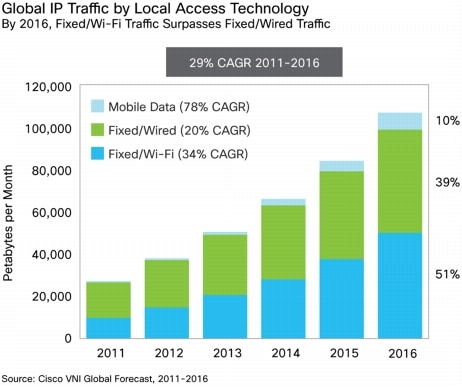
Some studies suggest that 80 percent of data used on mobile devices is consumed using Wi‑Fi connections to fixed networks, OECD says.

In fact, the potential value of TLPS is precisely that it would allow firmware-upgraded devices to use a managed-quality version of Wi-Fi with perhaps three times the range of traditional Wi-Fi, with quality of service assurances in some cases.

Traditional licensed service providers, such as mobile operators, might not be too keen on greater availability of unlicensed spectrum, though additional shared spectrum generally is viewed positively.

But experience has shown that even when unlicensed spectrum operations appear to be competitive with services based on licensed spectrum, such unlicensed operations actually are complementary to licensed access.

The ability to offload traffic to Wi-Fi means mobile operators can save on capital investment that would be necessary if 100 percent of traffic were carried on the mobile network.

As regulators and policy makers ponder the additional licensing of new spectrum, using both shared and unlicensed approaches, the natural tendency to oppose issuance of new unlicensed spectrum might need to be examined.

As Wi-Fi already has shown, unlicensed local distribution, and perhaps even unlicensed access, can be highly complementary to operations using licensed spectrum.

On the Use and Misuse of Principles, Theorems and Concepts

When financial commentators compile lists of "potential black swans," they misunderstand the concept. As explained by Taleb Nasim ...