Monday, April 25, 2011

KPN to Introduce New IM, Skype, Video Plans

One can argue that mobile pricing plans which charge separately for certain applications such as Skype, instant messaging or streaming video would be "consumer surly" by definition. But Netherlands regulators appear to believe that such "per application" charges could be consumer friendly, in particular if they lead to consumer ability to construct customized service packages that correspond to their unique usage patterns and preferences.

KPN has announced plans to charge mobile phone users separate fees for using VoIP services like Skype, instant messaging programs, and streaming video, but specific new rate plans haven't yet been announced. The way it might work is that consumers would buy those sorts of services on plans, just as they now buy voice or text messaging buckets or plans. See http://translate.google.com/translate?js=n&prev=_t&hl=en&ie=UTF-8&layout=2&eotf=1&sl=nl&tl=en&u=http%3A%2F%2Fwww.telegraaf.nl%2Fdigitaal%2F9600864%2F__Extra_heffingen_datadiensten_KPN__.html%3Fsn%3Ddigitaal
.
Dutch regulator OPTA has already said publicly that it's fine with the move, so long as KPN is transparent about how it charges. In fact, an OPTA spokesperson said she would "cheer such a development," since it provides more choice for consumers to put together a subscription package that meets their needs.


Will Netflix Add Family Plans?

Netflix will introduce additional streaming plans later this year that will offer the ability to stream to multiple devices simultaneously, GigaOm suggests. The offering could look like a mobile phone family plan, with an option to add additional accounts at a lower price point.

“One option would be to allow an account to add additional concurrent streams (using the analogy of our DVD business, it would be like choosing a higher-priced plan that allows a subscriber to have more DVDs at home)," Netflix states. "Or it could be that there is a price point that would encourage multiple accounts in one household."

The change potentially is important, as it is a step in the direction of "service for people," rather than "service to a location." That also was the difference between mobile and fixed-line adoption. People bought one phone line per home, but each person has a mobile device.

Netflix might be looking a shift towards "personal" consumption rather than "household" consumption. The "personal consumption" market is much bigger than the "household subscription" market.

Businesses Up Tablet, Notebook, E-Reader Spending 30%

Business spending on 3G and 4G devices such as tablets, notebooks, and e-readers was up nearly 30 percent in 2010, compared to 2009.

“A key take away from the research is that the non-handset spending increase trend seems to be universal across all sizes of business,” says Greg Potter, research analyst.  “There are some slight variations in some of the vertical segments but, they too, share a robust 2010 and have a very healthy five-year forecast.”

Enterprise spending makes up over 62 percent of business spending on non-handset data services, spending over $1.9 billion in 2010.

Enterprise (1,000 to 4,999 employees) will increase spending in 2011 by 19.5 percent in the professional services vertical. Small office and home office spending will surpass $275 billion by 2014, In-Stat projects.

The healthcare and social services vertical represents the largest share of spending, over $400 million in 2010.

"Apps as Games" Pointers

There is at the moment heightened interest in building apps that act like games. There are a few good guidelines when attempting to build "game-like" apps.

First and foremost, the apps have to be fun. If it isn't fun, it isn't a game. If it doesn't entertain, it isn't a game. Some apps try to create a game-like feel by awarding points to app users, but that's inadequate, in many cases.

Gaming has to take advantage of the unique aspects of the technology platform. If an app is entirely web-based, it should be socially-connected, interactive, persistent, and take advantage of the comparatively larger screens (and often higher-powered graphics) offered by desktops, laptops, and tablet computers.

If an app is mobile, it should take advantage of location-based services, video and audio recording capabilities of smartphones, the ability to send messages to people no matter where they are, the ability to integrate the telephone, and maybe even how the accelerometer can be used to measure behavior or integrate with the game experience.

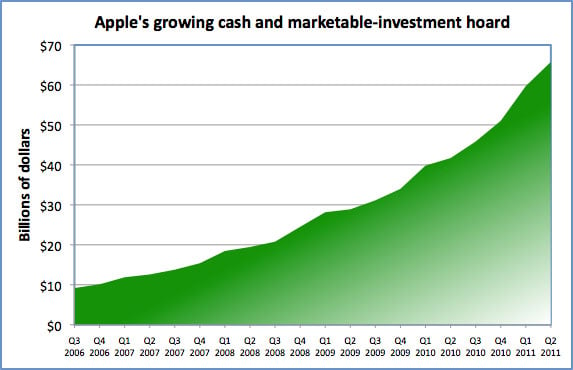
Apple has $66 Billion in Cash, and Growing

Apple's growing cash and marketable-securities hoardApple's $66 billion in cash is a nice problem to have.

From time to time investors clamor for Apple to "do something" with the cash, but Apple invariably responds that it simply wants to make sure it has the ability to make big moves if it has to, or wants to.

So far, Apple hasn't ever made a big acquisition, though.

How SmugMug survived the Amazon Outage

SmugMug, a photo-sharing site, says four simple things allowed it to survive the recent Amazon Web Services outage, despite its reliance on Amazon and cloud computing infrastructure. Geographical dispersion is the first principle. SmugMug uses "multiple Availability Zones." When there is a problem at one of the three centers, service continues from the other sites. The company also "designed for failure," assuming there would be a major outage at some point, requiring backup systems and components.

SmugMug does not use "Elastic Block Storage," which failed during the recent outage. SmugMug also does not rely completely on cloud computing. "The exact types of data that would have potentially been disabled by the EBS meltdown don’t actually live at AWS at all; it all still lives in our own datacenters," says company CEO Don MacAskill.

The advice is obvious. When using cloud computing facilities, an organization requires the same level of redundancy as when using facilities on the premises, or in an owned data center.

Email Remains a Top Mobile Activity

While just over a quarter (28 percent) of non-smartphone users said they check their email "constantly" throughout the day, nearly half (45 percent) of smartphone users do so, according to ExactTarget.

In fact, checking email is a more common mobile web activity than visiting Facebook (23 percent) or Twitter (five percent) among smartphone users.

Overall, the home PC remains the top location from which consumers constantly check email (24 percent) with 63 percent using it to check email daily. Meanwhile, 16 percent of email users overall constantly check email from a work or school computer (22 percent daily).

Eleven percent of email users check constantly from a mobile phone (15 percent daily) but the numbers are minimal for iPad/tablet users with two percent constantly checking and three percent checking daily.

Sunday, April 24, 2011

Google Gets into Social Shopping

Google gets into the social shopping space with Groupon and LivingSocial.

Half of U.S. Adults Shop Using Mobiles

Netflix Supplemental Now, But "All Will Change"

Liberty Media clearly sees Netflix as a supplemental channel to cable TV, satellite and telco TV distributors, but doesn't think that always will be the case. "Cable players pay us $1 billion and more a year," says Liberty Chief Executive Greg Maffei. Netflix is not in that league as a revenue generator.

"When you look at Netflix, the customers come in two categories," says Maffei. "It’s either the consumer who would never be a premium subscriber or cable subscriber at all."

"The second kind of consumer is the price-sensitive viewers who have cable but like the ease of over-the-top options at the right price," says Maffei.

But "all of this will change," Maffei notes.

"Designing for Failure"

The recent outages for some Amazon Web Services customers illustrates the "design for failure" model of cloud computing, some argue. Under the "design for failure" model, combinations of software and management tools take responsibility for application availability. The actual infrastructure availability is entirely irrelevant to your application availability and 100-percent uptime should be achievable even when a cloud provider has a massive, data-center-wide outage.

Most cloud providers follow some variant of the "design for failure" model. A handful of providers, however, follow the traditional model in which the underlying infrastructure takes ultimate responsibility for availability. It doesn't matter how dumb your application is, the infrastructure will provide the redundancy necessary to keep it running in the face of failure. The clouds that tend to follow this model are vCloud-based clouds that leverage the capabilities of VMware to provide this level of infrastructural support.

The downside of the "design for failure" model is that you must "design for failure" up front.

Saturday, April 23, 2011

Google Readies Behavioral Ads in Mobile Apps

Google is preparing to offer behaviorally targeted ads across its network of iOS and Android applications, as well as the ability to more accurately track conversions from handsets running on those platforms.

Individual mobile handsets possess unique ID numbers, or 'device identifiers,' to which Google plans on tying users' in-app behavior for the benefit of advertisers. To date, the company has refrained from making use of device IDs for ad purposes, perhaps owing to privacy concerns, but numerous competing firms already make use of the practice.

Telefonica Illustrates Mobile Communications Carrier Challenges and Trends

A recent presentation by César Alierta, Telefónica chairman and CEO, illustrates the significant issues even the relatively-robust mobile phone business faces these days. Consider organic revenue growth, the rate at which a tier-one carrier is able to grow revenues on its existing customer base and lines of business, without making an acquisition.

Telefónica grew at an organic rate of about 2.5 percent in 2010, as did Vodafone. AT&T grew revenues organically by a bit below one percent.

And those were the fortunate companies. France Telecom saw negative organic growth of about 1.25 percent. Deutsche Telekom saw two percent negative organic growth in 2010. BT saw negative three percent organic revenue growth that same year. Telecom Italia saw organic revenue shrink about 3.8 percent.

Users Likely are Downloading More Mobile Apps Than They Think

Consumers often incorrectly estimate their habits and behaviors. Yankee Group researchers say consumers report downloading about two apps a month. But tracking software installed on a test group by Yankee Group researchers revealed that respondents actually downloaded an order of magnitude more applications for their smartphones than the consumers reported by recollection.

Android owners download an average of more than 20 apps per month, while BlackBerry owners download only two. That is a finding consistent with other surveys. This behavior may be explained by the variety of apps available, Yankee Group researchers say: Android app stores offer more than 130,000 apps, while RIM’s App World offers only 23,000.

Consumers remove an average of 11 apps each month. In fact, the tracking software shows consumers remove 73 percent of the apps they download.

Here's a Concrete Marketing Question Mobile Payments Could Help Answer

That "women control 80 percent or more of consumer spending" is a commonplace bit of marketing rules of thumb that researchers now say might not be true.

In a survey conducted last year of nearly 4,000 Americans 16 and older by Futures Co., a London consulting firm, 37 percent of women said they have primary responsibility for shopping decisions in their household, while 85 percent said they have primary or shared responsibility. The respective figures for men were similar: 31 percent claimed primary responsibility while 84 percent said it was shared.

That's one issue mobile payments capability probably could help answer more definitively. It might never be possible to precisely identify how "responsibility, participation or influence" actually operate. But it should be possible to "prove" who actually made a purchase, with greater accuracy, once mobile payments become popular.

Sure, there are tons of privacy issues to be settled before personalized data can be gathered and analyzed. In principle, however, an actual purchase will be a quantifiable bit of data quite a lot more accurate than a survey respondent's guess about what percentage of the time "influence" or "decision making"occurs.

Recent surveys tend to show, as often happens, that claimed buying influence is more than 100 percent. That's the logical outcome of fuzzy consumer estimations. But transaction data is "hard" evidence, untainted by errors of recollection or opinion.

Is Private Equity "Good" for the Housing Market?

Even many who support allowing market forces to work might question whether private equity involvement in the U.S. housing market “has bee...