Friday, April 29, 2011

Cloud Incidents Illustrate Trend

The recent Amazon Web Services outage illustrates a broader computing trend you'll all recognize, in your roles as consumers, small business or enterprise users of technology. And that trend is that, across the board, users are required to take a more-active role in managing their technology. Most people discover they are required to learn more about their computing devices and applications than they actually would prefer, just to use the tools.

Many would note that the lesson from the AWS outage is that the normal advice to build in redundancy and resiliency into an applications or hardware infrastructure applies equally when buying cloud computing services.

"While it is important to maintain pressure on service providers to improve their reliability footprint, the onus of developing or contracting reliable system stays with their clients, and there won’t be any miraculous cloud that provides 100 percent uptime or that does not risk to fail meeting its own SLAs," says Andrea Di Maio, Gartner VP.

FCC to Report "Broadband Gap" Growing?

The Federal Communications Commission (FCC) is expected to argue, in its annual "706" report on U.S. broadband status, that broadband providers are not deploying services in a reasonable and timely way to all Americans.

The report hasn't been officially released yet, but we understand the methodology used to argue that the broadband gap "is widening" will be different from past reports, which have focused more on a lowest common denominator approach. The new report is expected to focus on the higher end of broadband speeds and adoption.

Some suggest the latest version of the study will mirror the conclusions from last year in other respects, which found the speed of broadband deployment unsatisfactory. ” "The FCC concluded in its Sixth Broadband Deployment Report that between 14 and 24 million Americans still lack access to broadband, and the immediate prospects for deployment to them are bleak," the FCC said at the time.

Some might find that an odd way to report the results of survey that found 95 percent of people do have fixed network access. Others might simply note that even the claim of five percent "unable" to get access requires ignoring satellite access which is available to nearly every location. There are likely some locations that cannot get convenient line of sight access to a satellite providing broadband access, but that is a rare situation.

Until 2009, the 706 reports had found adequate and continual progress. The cynical will simply note that broadband has not changed, the political agenda has changed. See http://www.precursorblog.com/content/fcc-706-report-us-broadband-cup-5-empty-netcompetitionorg-press-release.

"This report underscores the need for comprehensive reform of the Universal Service Fund, innovative
approaches to unleashing new spectrum, and removal of barriers to infrastructure investment," the FCC said when unveiling last year's report.

The agency has cited the 2010 findings to justify instances of government intervention, some would say.

PayPal Buys Mobile Payment Enabler

PayPal has acquired Fig Card, which developed a low-cost USB device that plugs into the cash register or point-of-sale terminal and allows merchants to accept mobile payments using a smart phone app.

The solution requires no new hardware on the phones (iPhone, Android, many Blackberry models) and free hardware for the merchants.

Thursday, April 28, 2011

5 Reasons You're Consuming More Mobile Content

Consumers are consuming more mobile content than ever before, but why? For the simplest of reasons. There's more content to watch and there's more widespread mobile broadband, and better mobile broadband. There are more smart phones and tablets to make it convenient. There are simple applications and better user interfaces, allowing users to get users to video fast.

Simply, the barriers to watching video simply have fallen in every way.

Time Warner Cable Looks to Close an Era

Time Warner Cable apparently is looking at converting all its programing to IP, a move that would allow it to serve up video to all sorts of digital devices, eliminating the need for a set-top decoder and opening the door to either over-the-top or captive video on the existing model, but with one infrastructure supporting all forms of access.

There are all sorts of immediate, and some potential, implications. Decoders represent a huge amount of capital investment for a video provider using decoders. Eliminating the decoders would vastly reduce Time Warner Cable capex. That's the immediate benefit from an operations perspective.

From a strategic perspective, the shift to all-IP would open the possibility of over-the-top service, which in an early scenario might allow Time Warner Cable to serve up its video to current customers who also use tablets, PCs and smart phones to watch video.

In a more-disruptive scenario, Time Warner Cable could envision selling video to anybody in the United States, over the top, providing content contracts and municipal regulators allow it.

That could create quite a change in the famously collegial U.S. cable industry, where cable operators simply do not compete with each other.

Search Results Follow Market Share Rules

Many years ago, I learned that there are fairly reliable relationships between market share and profitability. Basically, the rule is that the number-one provider in any market has twice the market share of provider number two, which in turn has twice the share of provider number three. It's a remarkably useful rule of thumb.

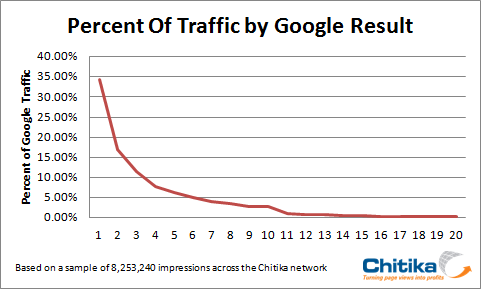
A new examination by Chitika, looking at the value of Google search results, ranked by share, is remarkably consistent with those rules of thumb about market share.

As it turns out, the number-one search result tends to get double the traffic of the number-two result. The Chitika data also shows that search result three has 11.4 percent share, while the number-four result has eight percent share. That's pretty close to what the rule of thumb would suggest.

Traffic by Google Result
If the number one result has 34 percent share, the rule would predict the second result to be 17 percent, which is precisely what Chitika found. The rule also would suggest result three would have 8.5 percent share. In the Chitika data, the third search result has 11 percent share. The fourth result has eight percent share, as the rule suggests would be the pattern.

In search results, as in other markets, share makes a huge difference. The other thing you might recognize is a standard Pareto distribution, sometimes known as a "long tail" or 80/20 rule.

Rules of thumb can be excellent guides to strategy, if a company really wants to lead a market. It's also nice to know that at least some things one learns in school turn out to be correct in real life. 

Google Announces Video Chat for Android 2.3 Devices

Google is launching an update to Android Gingerbread, version 2.3.4, enabling video chat using GTalk on Android smart phones. This is the same functionality offered as part of Honeycomb, version 3.0, and allows any Android phone with the proper version of Gingerbread to conduct a video chat with anyone using a compatible (Honeycomb) Android tablet, their smartphone, or GTalk on their desktop.

RIM: Weaker Guidance, Near Term

Research In Motion has updated its financial guidance and said it expects to sell fewer BlackBerry smartphones than it previously estimated. "RIM now expects fully diluted earnings per share for Q1 to be in the range of $1.30-$1.37, lower than the range of $1.47-$1.55 previously forecasted by RIM on March 24, 2011," RIM said.

"This shortfall is primarily due to shipment volumes of BlackBerry smartphones that are now expected to be at the lower end of the range of 13.5-14.5 million forecasted in March and a shift in the expected mix of devices shipped towards handsets with lower average selling prices," RIM noted.

RIM still expects “strong revenue growth” in the third and fourth quarter thanks to the introduction of new BlackBerry smartphones. The near-term shipments aren't really the issue.

The problem is that with Apple and Android leading the smart phone market, plus the expected revitalization of Microsoft, given its alliance with Nokia, there is precious little room left in the smart phone market for player number four, whomever that might be. Unless you conclude that Microsoft, which now will count Nokia as part of its ecosystem, falls further, RIM is the provider likely to be bumped down into the fourth spot.

Mobile Content Ecosystem to Shift?

Mobile operators in emerging markets need to make urgent adjustments to content strategies if they are to adapt to rapid shifts in the market, according to Ovum analysts.

While mobile service providers currently are the dominant force in the emerging markets mobile content space, this is set to change due to strong competition from new platforms such as application stores.

“Unless telcos make rapid changes to their strategy and execution, their dominance is set to be challenged,' says Angel Dobardziev, Ovum analyst.

Some might argue that no matter what telcos do, that will happen anyway, given that the leading application stores are operated by device manufacturers such as Apple, independent providers such as GetJar or operating system providers such as Google.

“We have found that once a consumer has bought a data access plan, they begin to move away from telco services,' says Dobardziev. 'This will ultimately reduce the role of mobile operators to little more than providers of bandwidth.”

Some might argue that Dobardziev already has answered the original question.

Dilbert Isn't Fiction; Neither is This

LG G-Slate: Walt Mossberg Still Prefers iPad 2

"I’ve been testing the (LG produced) G-Slate, and in my view, it performs pretty well overall—about as well as the first Honeycomb tablet, the Xoom. But it isn’t nearly as good a choice as the iPad 2," says technology reviewer Walt Mossberg.

"Of its three big differentiators, the only clear winner is the 4G cellular capability, which is much speedier than cellular data on the iPad, or on any other Honeycomb tablet I know of," says Mossberg.

"The 3-D feature, which requires the use of 1950s-style colored glasses, seems like a parlor trick to me," Mossberg adds. "And the in-between size, while potentially attractive for one-handed use, is undercut by the fact that, somehow, despite being smaller, the G-Slate is actually a bit heavier than the iPad 2, and a third thicker."


As has been the case recently for other tablet devices, the Apple iPad in its Wi-Fi-only, 16-gigabyte version costs just $499. If you buy the G-Slate without a phone contract, it costs $750. The comparable iPad 2, with the same 32 gigabytes of memory offered by the G-Slate, both Wi-Fi and cellular connectivity, plus its bigger screen, is $729.

Aside from price, the relatively undeveloped state of the apps available for Android devices is an issue, though that is a problem that corrects itself over time, as was the case for the Android Market for smart phones.

Cable's Future Network Will be Flatter

Mobile Shopping Search Grows 181% in U.K.

In the first quarter of 2011, total retail search volumes grew by 29 percent compared with the first quarter of 2010, the British Retail Consortium reports, while mobile retail search traffic grew by 181 percent over the same period.

Mobile searches accounted for 11 percent of total retail searches in the first quarter of 2011, the BRC says.

Retail searches grew fastest for multi-channel retailers, usually those using physical stores and the internet, with search growth of 42 percent, year over year. Searches for online-only retailers grew 19 percent, year over year.

The number of overseas consumers searching for U.K. retailers grew by 27 percent in the first quarter of 2011, year over year, while the number of UK consumers searching for overseas retailers grew by 21 percent in the first quarter of 2011, year over year.
same period a year earlier.

Android Market Eclipses Apple App Store for Free Apps

The Google Android Market eclipsed the Apple App Store for iPhone in terms of free applications and now has 134,342 free applications, while the Apple App Store iPhone has 121,845 free applications, Distimo reports.

If all application stores maintain their current growth pace, approximately five months from now Google Android Market will be the largest store in terms of number of applications followed by the Apple App Store for iPhone and iPad, Windows Phone 7 Marketplace, BlackBerry App World and Nokia Ovi Store.

The rise of Windows Phone 7 and the relative decline of BlackBerry and Nokia as leaders in the smartphone category might have something to do with the state of the respective app stores. Some observers would say that the Microsoft deal with Nokia, which has Nokia essentially abandoning Symbian for Windows Phone 7, will vault Microsoft into position number three in the smart phone OS market, eclipsing RIM.

Looking at history, one would be hard pressed to imagine why RIM would remain a force, or perhaps even viable, in a market so dominated by the iPhone and Android, with Microsoft claiming the third spot, in terms of share. There is not much precedent for a viable "number four or five" provider in the mobile OS ecosystem. So as shocking as the assertion might be, it appears RIM's best days, even its existence as an independent company, are at grave risk.

The Windows Phone 7 Marketplace will also be larger than the Nokia Ovi Store and BlackBerry App World prior to the Windows Phone 7 Marketplace being available for even a full year, Distimo says.
One year after launching the iPad, Apple will be confronted with its first serious competition as both BlackBerry and Google enter the emerging tablet market.

Apple has already seized momentum and grown the App Store for iPad in the first year to 75,755 applications developed by 21,975 publishers. Daily downloads in the "Top 100 Overall" paid and free applications for iPad combined exceed 500,000, while the daily revenue in the Top 100 paid is approximately $400,000 excluding in-app purchases.

http://www.distimo.com/publications/

Wednesday, April 27, 2011

Studios Split on Selling Content to YouTube

Hollywood’s major studios do not always march in lockstep over key industry issues. It appears they are divided over licensing of content to YouTube for its new movie on demand service.

Fox and Paramount have said they will “not move forward with any deal at this time." Disney hasn't said anything final, one way or the other, while Warner Bros., Sony and Universal have just concluded deals to license content to YouTube for rental.

Executives at the hold-out studios reportedly are not opposed to a deal, but want more assurance from Google that it will take a harder line on piracy, specifically linking to pirate sites in Google searches or selling advertising on such sites.

But it seems likely all the studios ultimately will want to work with YouTube. Its 130 million potential buyers represent a huge audience, and are especially interesting demographically. YouTube viewers skew younger, and probably are the sorts of viewers unaccustomed to buying video and might be only lukewarm about the theater experience.

In the online video business, it often is the content owners who dictate the pace of movement, even when other partners are willing.

Clear AI Productivity? Remember History: It Will Take Time

History is quite useful for many things. For example, when some argue that AI adoption still lags , that observation, even when accurate, ig...