Monday, October 10, 2011

Why Thought Leadership Matters

"Thought leadership" really is important in the business-to-business buying process, says consultant Chris Koch. When we asked buyers how important good ideas are to the buying decision, 58 percent of executive-level buyers (people buying more than $500,000 worth of IT services in a single transaction) say that it is important or critical for making it onto the short list of providers. 


More than half of your buyers say that if you can’t demonstrate that you have good ideas for solving their business problems, they won’t buy from you. That's why "thought leadership" is important. 


When asked whether a provider with a good idea means a prospect is more likely to buy from that supplier, 30 percent of respondents said "yes." Of that 30 percent, 54 percent said they’d consider sole sourcing the project.  Buyers look for "ideas" first


The other important element is that information technology buyers rank "peer" advice and experience right at the top of all buying influences. Research, in other words, inherently is social. You draw your own conclusions about what that means for use of social media. 


In addition to talking with peers, buyers also rank talking to analysts and advisors as the second most important source of information. Information gathered from web searches ranks third in importance when IT buyers are conducting their research. IT buyers do their own research

23 Questions from Google on "Quality" Rankings

Without disclosing anything about its algorithms, here are 23 questions Google suggests content creators think about when creating content that Google's algorithms will tend to rank favorably. 


The questions are analogous to what Google's algorithms try to do when assessing the "quality" of a page or an article.


"Our advice for publishers continues to be to focus on delivering the best possible user experience on your websites and not to focus too much on what they think are Google’s current ranking algorithms or signals," Google says . "Some publishers have fixated on our prior Panda algorithm change, but Panda was just one of roughly 500 search improvements we expect to roll out to search this year."

"In fact, since we launched Panda, we've rolled out over a dozen additional tweaks to our ranking algorithms, and some sites have incorrectly assumed that changes in their rankings were related to Panda. Search is a complicated and evolving art and science, so rather than focusing on specific algorithmic tweaks, we encourage you to focus on delivering the best possible experience for users."

ISPs add low-cost broadband access

Internet access provides including Comcast and CenturyLink now are offering lower-cost access to broadband for lower-income households that buy fixed-line broadband access at lower rates than higher-income households. The services generally offer access at about 1.5 Mbps for $9.95 per month to qualifying households. Low-cost broadband access: How do MSOs compare?

The obvious business logic is that it makes sense to convert a non-customer into a customer by offering products optimized for those non-customers. Having a customer relationship is always better than not having one, even if the gross revenue is not so great.

Netflix Reverses Course on Qwikster

Netflix has decided to reverse course on its plan to separate the "DVD by mail" business from its streaming business. "It is clear that for many of our members two websites would make things more difficult, so we are going to keep Netflix as one place to go for streaming and DVDs," Netflix now says. 


Netflix says it is keeping the new price structure, though. Still, users who want both DVD content and streamed content will not have to navigate two websites, or pay two different bills. 


The reversal is the most-recent demonstration of the power of social mechanisms that let consumers voice their opinions, as Netflix was bombarded with negative reviews when the plan was announced. 

Sunday, October 9, 2011

An Additional Star on Yelp Can Boost Restaurant Revenues 5% to 9%

Reviews at the popular crowd-sourcing site Yelp.com are having a significant effect on the restaurant business, according to a study of more than 3,500 Seattle restaurants from 2003 through October 2009. But there is an interesting caveat: the effect does not seem to be seen for chains that already have spent considerable effort to create a well-defined "brand."

In other words, Yelp doesn't work for chain restaurants that already have spent heavily on branding. Chain restaurants in that category seem to be unaffected by changes in their Yelp ratings. If you were wondering whether content marketing can be an alternative to advertising, there is your answer.


Using data provided by the Seattle Department of Revenue, the study by Harvard Business School Professor Michael Luca found that a one-star increase in Yelp's five-star rating scale was associated with a quarter-to-quarter revenue rise of five percent to nine percent.

Luca combined Yelp reviews with revenues for every restaurant that operated in Seattle, Wash. at any point between 2003 and 2009. This suggests that consumer reviews present a new way of learning in the Internet age, and are fast becoming a substitute for traditional forms of reputation. Reviews affect revenue


Online consumer review websites provide more information to consumers than was previously thought to be cost effective, in large part because Yelp relies on user-generated content.


Consumer reviews also provide a substitute for more traditional forms of marketing, the study suggests. The study also suggests that other forms of reputation management, such as chain affiliation, may become less influential as websites like Yelp continue to gain traction. That means the value of a franchise might be less than it once was, for example.


Consumers rely on simple metrics such as the average rating and the number of reviews, and are more trusting of reviews that are written by "elite" reviewers. Yelp changes restaurant revenue

Saturday, October 8, 2011

Mobile Ads $2.5 Billion in 2014

Mobile advertising spend is projected to reach $2.5 billion by 2014, according to Informa Telecoms. 


That still is but a fraction of online advertising, though. Analysts at Deutsche Bank say they are "highly optimistic" on the prospects for mobile advertising in 2011, and expect it to become a billion dollar segment (up from $400 million to $500 million in 2010). 


 Of course, that is a relatively small amount, compared to the U.S. online advertising market, which will represent $28.5 billion in 2011 spending


Revenue growth in 2010 was 14 percent, with a likely increase of 11 percent in 2011. Also, online advertising in total will represent only about 12 percent of total U.S. ad spending.

Citi and América Móvil in mobile banking venture

Citigroup and América Móvil have announced a $50m joint venture to offer mobile banking services to millions of people throughout Latin America, starting with Mexico. 

The alliance between the biggest providers of financial and telecommunications services in Latin America, dubbed "Transfer," will allow customers to use basic mobile telephones to set up bank accounts, transfer money, withdraw cash from automatic teller machines, make purchases in stores, receive payments and pay bills.


Google's Patent Search Likely is Not Finished

An analysis of more than 1,000 patents that Google bought from IBM offers a glimpse inside the search giant's increasingly frantic efforts to protect its Android mobile operating system against legal attacks from competitors.

IPVision, which makes patent-analyzing software, says that the 1,029 patents that Google bought from IBM in July contain little that the company could use to either attack its competitors or defend its own products.

Bundles of patents covering computing—especially mobile computing—technology have become a hot property in recent months. Apple, Nokia, Microsoft, and others have used them to extract money from competitors, or even to block those competitors' products from being sold. This year, Apple successfully prevented the sale of some Samsung devices in much of Europe, while Microsoft has used patents to extract millions of dollars in licensing fees, from companies including Samsung and HTC, for using Google's "free" Android operating system.

Mobile Payments Will Take 10 Years to Reach 50% of U.S. Households

Optimists might think mobile payments will be a significant business in as little as two to four years. 


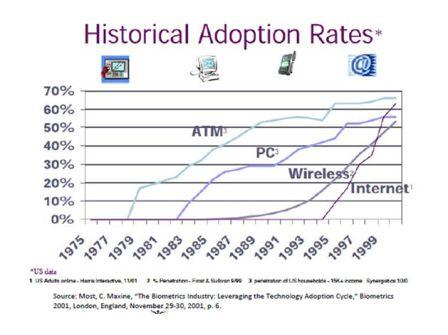
Some might argue from history that it will take a decade or so for mobile payments to be adopted by a significant number of users. By "significant" we might say half of households using mobile payments. KPMG survey


History suggests why that might be so. After 20 years, the percentage of U.S. households using automatic bill paying is still only about 50 percent. Likewise, after 20 years, use of debit cards by U.S. households is only about 50 percent. 


It took about a decade for use of automated teller machines to reach usage by about half of U.S. households. 


The takeaway is that payments innovation tends to be a rather deliberate process, with adoption processes that take between 10 years to 20 years to reach 50 percent of consumer households.


Friday, October 7, 2011

Sprint: No more Clearwire devices after 2012

Sprint Nextel Corp. says it will stop selling phones and other devices compatible with Clearwire Corp.'s network at the end of 2012, as it switches customers to its own Long Term Evolution network. The irony is that Sprint owns a majority of Clearwire. Still, the latest Sprint news might help clarify the Sprint relationship with the wholesaler.

What Clearwire has to decide is whether it can afford to switch to LTE itself at the same time it cannot seem to finance its national network build. One would have to say it is starting to look as though Clearwire cannot survive as an independent entity. Its biggest wholesale customer is going to stop referring customers to Clearwire. Sprint, by indicating it will no longer sell WiMAX devices, also is signaling that customers will in the future be served by Sprint's own network. That means even the customers Clearwire now gets from Sprint are going to start to decline.

Facebook on a Mobile Without a Data Plan

Gemalto is offering feature phone users a way to use Facebook on their mobiles without buying a data plan. The service is not free. Instead, customers are charged a subscription of $1 for a day, $3 for a week, $9 for a month,  for unlimited access to "Facebook for SIM."

Open Range Goes Bankrupt

Open Range Communications has declared bankruptcy. Open Range received about $267 million in loan from the U.S. Department of Agriculture’s Rural Development Utilities Program as part of the "broadband stimulus" program.

Open Range had hoped to create a broadband wireless Internet provider whose primary focus was hundreds of un-served and underserved communities across America. Open Range intends to serve over 500 communities, making its services available to approximately six million people in Arkansas, Alabama, California, Colorado, Delaware, Florida, Georgia, Illinois, Indiana, Ohio, Pennsylvania, Nebraska, Nevada, New Jersey, New York, South Carolina and Wisconsin.

You might recall that back in 2009, the federal government was pitching "investment in broadband" as a "jobs" program. If you talk to suppliers eligible to supply gear to broadband stimulus recipients, you will find that precious little of the money has actually been disbursed. That is not to say no money has moved, but not very much.

As the "stimulus" was supposed to help with the Great Recession of 2008, and since most of the money hasn't been allocated, you can assume there was nothing at all "shovel ready" about the program. That's one traditional objection to most short term federal spending that is supposed to be counter cyclical. By the time the money actually hits the economy, the economy already has begun to improve. In other words, as they say in the legal profession, "justice delayed is justice denied."

In the fiscal realm, counter-cyclical spending that is delayed also has no effect ameliorating the impact of a recession, because the recession is over before the money can do any good. To add insult to injury, you get a major broadband stimulus recipient going out of business.

Sprint to Launch LTE in Former CDMA Spectrum

Sprint executives now are explaining how they will launch Long Term Evolution services on the Sprint network, using the 1900 MHz spectrum.

If the implications are not clear, it means Sprint has decided to start using the LTE air interface in the same spectrum it presently uses to support its 3G CDMA network.

That means a complete upgrade to LTE across the entire Sprint footprint, cannibalizing CDMA spectrum.

Some had thought Sprint would use the 800-MHz spectrum freed up by the shut down of the iDEN network, or perhaps spectrum made available by Clearwire. It appears Sprint simply has decided it cannot wait, and is going to start pulling 3G spectrum off line as it adds LTE services in the same frequencies.

Sprint executives expect that by the end of 2013, 275 million potential users (PoPs) will be covered by the LTE network, including 100 percent of the area where Sprint's 4G WiMAX services now exist.

The move is highly significant, as it means Sprint is going to move fairly quickly to upgrade CDMA users to LTE.

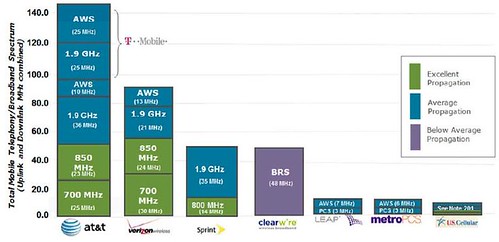
Sprint to use CDMA bands for LTE

Social Media Can Drive 20% to 40% Higher Spending

A recent survey of more than 3,000 consumers by Bain & Company found that customers who engage with companies over social media spend 20 percent to 40 percent more money with those companies than other customers. They also demonstrate a deeper emotional commitment to the companies, granting them an average 33 points higher Net Promoter score, a common measure of customer loyalty.
putting-social-media-to-work-figure-01.jpg

Up to this point, a disproportionate share of those results appear to have been reaped the big early adopters.

The gap between the early adopters and those waiting to take the plunge has actually widened. While the average billion-dollar company spends $750,000 a year on social media, according to Bain & Company analysis, some early adopters such as Dell, Wal-Mart, Starbucks, JetBlue and American Express invest significantly more. In some instances, the investment is tens of millions of dollars.

Bain argues that social media can create value at virtually every stage of the sales funnel, from awareness to retention.

putting-social-media-to-work-figure-02.jpg

OSI is a Business Model


The Open Systems Interconnection model (OSI model) is the foundation for the way all software gets written these days. But the OSI model also is, in many ways, a way of describing the current communications business ecosystem as well.

The OSI model idea structurally separates seven functions, with "application" at layer seven and physical layer at layer one. That should strike you as describing the relationship  between  "over the top" applications of every sort and the network used to deliver the app.

As applied to any business using a software-heavy product, that means there can be a separation of facilities, entities using facilities to create "communication" or "content" services, and application creators. The form will follow the function, you might say. 

For software developers, service providers and consumers and users, the advantages of using the OSI model are numerous. OSI Model 

Features and apps can be created or changed without requiring modification of other parts of the complete communications "stack." In other words, a user can switch from one supplier of a word processing or instant messaging app to another without "changing networks." 

If a user wants to switch from Microsoft Office to Google Docs, that doesn't mean a PC or network access provider also has to be changed. 

A user can switch from one device to another without disrupting use of desired apps. Twitter should work on any brand of smart phone, or any brand of tablet or PC. 

At one level, everybody in the ecosystem wins. Because there is a compartmentalization of functions, changing one app for another, or a wireless network for a fixed network connection, should not disrupt use of an application. 

It's harder in practice than it is in theory. It still isn't easy to start a session of some type on a single device, then seamlessly transition to a different network and another device, without disrupting the session.

Some of you will quip here that it isn't always easy to sustain a single session, on a single network, using a single device, either. That's also true, but is not a defect of OSI! 

However, in principle, and over time, in practice, a user should be able to start a session of some sort (voice or video or Web app) and then maintain the session even when switching from one network to another, from fixed to mobile, for example. 

But there also are clear business implications. Though in the past networks got built to support one major application, these days networks are simply built to support any type of application, whether that is voice, video, Web sessions, text, documents, photos, music or any other types of digital information.

These days, it is technologically possible, and increasingly will be possible in business terms, to deliver anything, to anybody, on any device, in fairly elegant way at times, in reasonable ways at other times. That has serious business implications.

It means that firms "not in my business" can get into your business. Competitors increasingly do not need to "own and control" all the assets used at every level of the OSI software stack, including the physical layer assets. 

By the same token, think of collaboration using voice, messaging and web assets as an application. Webex is one example, but so are phone calls. A layer seven app can be run over any compliant network. You might note that bandwidth on every network is not yet consistently sufficient to support a collaboration app in such a way. That is true, but also changing. It won't be a problem much longer. 

And whether it is yet widely understood, or not, sooner or later app providers whose major products include entertainment video, voice, hosted PBX, videoconferencing and messaging will want to deliver those applications over the top. That also has implications.

In the legacy world, physical layer access was a matter of geography. A supplier needed permission from a government authority to operate a network, to support an application. Cable operators needed municipal permission to build a network to sell television. Telcos needed certificates of convenience and necessity. 

Cloud computing and OSI, plus widespread and universal broadband, changes much of that older model. A company that might also be a telco or cable company or ISP, might or might not "own" physical assets when creating and then delivering applications. 

A  product of the Open Systems Interconnection effort at the International Organization for Standardization, the OSI model is a way of allowing developers to create software in an abstracted way, without having to know all the details of other parts of how a particular network works. 

It also is an analogy for the way the communications and entertainment business already is starting to change. "Over the top" is not just something "other companies" do. It is something layer one asset owners also are starting to do. The only question, over time, is when over the top gets embraced more widely as "my" business strategy, not just "the other guy's strategy."

Has AI Use Reached an Inflection Point, or Not?

As always, we might well disagree about the latest statistics on AI usage. The proportion of U.S. employees who report using artificial inte...