Tuesday, February 16, 2016

India, Indonesia, Vietnam, Thailand are Places to Watch for App Growth

For many in the app industry, India is the key market to watch in 2016. “Not only does India have the brightest economic outlook of the BRIC markets, but smartphone adoption is progressing rapidly with plenty of runway to grow,” argues App Annie.

“Some of the biggest app success stories can be found in India’s sensational mobile commerce growth, resulting in considerable investment for leading companies such as Flipkart and Snapdeal,” App Annie says.

Indonesia also say 40 percent growth in app downloads in 2015. In Indonesia, the sustained increase in mobile transactions fuelled incredible growth for marketplaces such as Tokopedia and Bukalapak in 2015.

Download growth rose as high as 60 percent, year over year, in Vietnam.

“Vietnam was the standout emerging market in 2015,” says App Annie.


While game downloads and revenue tend to be an early indicator of a booming app economy in most emerging markets, the gaming sector was notably robust in Vietnam in 2015.

Mobile games represent nearly 50 percent share of downloads on both Google Play and iOS in 2015.

In the local market, social, entertainment and games publisher VNG’s card and casino games ZingPlay - Tiến lên and ZingPlay Tá Lả proved popular. VNG also offers the most-downloaded messaging app in Vietnam,  Zalo.

In Thailand, messaging app LINE is a leader.  In 2015, the LINE app led combined iOS and Google Play revenue in Thailand. Facebook also maintained a huge presence in social networking in Thailand.

Photo apps also remain a key part of Thailand’s app economy. The photography category trailed only tools in Google Play downloads--outside of games--and grew 25 percent  year over year.

Nine Operators Form App and Service Alliance Reaching 1 Billion Customers

Nine telecom companies have created a “Partnering Operator Alliance” that aims to promote new apps and services for a billion mobile and fixed network customers in more than 80 countries.

Current members of the alliance include BT, Deutsche Telekom, Reliance Jio Infocomm, Millicom, MTS, Orange, Rogers, TeliaSonera and TIM.

The Alliance hopes to promote all relevant product categories within an operator’s business, mobile as well as fixed, B2C as well as B2B. The Alliance will be expanding to additional operators soon.

The Alliance focuses on exchanging best practices on how to bring partner propositions to the market, on joint efforts in partner scouting and will also exchange knowledge about upcoming trends and services amongst the group.

Already, the Alliance has established relationships with 30 innovative partner businesses including AirBnB, Celltick, Disconnect, Idoomoo, Magisto, Mojio and Spotify.

The alliance is an open network of like-minded operators worldwide with complementary geographic footprints.

Poor Customer Satisfaction Does Not Always Lead to Churn Behavior

For whatever reason, another survey of consumers shows that Internet service providers and linear TV providers are among the lowest-ranking entities, in terms of perceptions of customer service.

Mobile service providers, airlines and rental car agencies also rank relatively low, a finding other studies also tend to confirm.

But those perceptions are not always directly related to customer churn  rates, even when consumers say they are quick to change suppliers when customer service is deemed inadequate or faulty.

Despite the fact that mobile service providers tend to rank relatively low in satisfaction surveys, churn rates in the U.S. market, for example, are relatively low, at least for some of the leading providers. For AT&T and Verizon, for example, churn rates are lower than one percent a month, a rate many would consider quite low for a consumer service.

Higher churn rates obviously lead to lower customer relationship durations.

Surprisingly, then, AT&T and Verizon mobile churn rates are quite low, compared to some other consumer products, but quite similar to churn rates for many common products.

Sprint and T-Mobile US have higher churn rates, if now approaching the lower rates seen by AT&T and Verizon.

U.S. credit card companies typically have annual customer churn rates of around 20 percent, a monthly rate of about 1.7 percent.

European cellular carriers experience annual churn of between 20 percent and 38 percent, between 1.7 percent and three percent a month.


Even when they say they will switch suppliers within a day or week of a poor customer service experience, that obviously is not how consumers act. They obviously do not act as they say.

Costs of switching likely provide one explanation. While the costs of switching fixed services providers might be relatively low, it is not frictionless, as consumers frequently have to pay install charges, equipment rental or other upfront charges.

For smartphone account owners, especially those which are multi-user or multi-device accounts, switching costs are substantial, including a need, in many cases, to replace multiple smartphones, each representing $600 or more in costs.

That is one reason why mobile service providers now frequently offer payments of up to $650 when consumers switch suppliers. In many cases, even a $650 subsidy does not cover the cost of buying new devices and terminating device payment plans.

For many consumers, there might also be a belief that switching to another provider will not, in fact, lead to better experiences, as all the suppliers--or most--within a category are deemed to be roughly equivalent.

To some degree, the fact that legacy U.S. mobile air interface standards are bifurcated might have something to do with the churn rates. To some degree, half the market uses GSM, while half the market has used CDMA. Switching across air interfaces necessarily entails scrapping the existing devices and buying new ones.

The bottom line is that, at least for mobile services, relatively low satisfaction does not lead to the churn rates one might expect. That is at least partly because switching costs are substantial.

The latest survey tends to confirm that behavior.


Industrial Internet of Things Market Growing 7% Annually

The global industrial internet of things (IIoT) market is set to grow faster than seven percent, on a compound annual growth rate basis, to 2020, according to Technavio.

Asia Pacific (Asia) will be the biggest market for IIoT, according to Technavio.
The IIoT market in Asia was valued at close to US$38 billion in 2015 and is expected to reach over US$54 billion in 2020.

Though most would expect China, Korea and Japan to be leading growth markets, India also is predicted to be a driver of much growth.

The global IIoT market will drive US$132 billion in revenue by 2020.

Mobile, Fixed, Other Markets Face New Disruptions

Movement into adjacencies always is a key competitive issue within any ecosystem, as it turns former customers into competitors. That happens with chipsets, applications, access, transport, advertising and other support services.

Also, the most-dangerous competitors are those from “outside” the traditional domain. Skype,, Amazon, Alibaba, Netflix, Google Fiber, cable TV entry into voice and business services, XBox, PayPal, M-Pesa, Amazon Web Services and iTunes are among the obvious examples.

Some now think a big further move in the e-commerce business will happen, as logistics functions perhaps are internalized by the likes of Alibaba and Amazon.

No ecosystem now seems safe from movement into adjacencies. In the U.S. mobile market, entry by Comcast and other cable TV operators will be an important example. In the high speed access, growing presence of Google Fiber and other third party Internet service providers is going to challenge prevailing notions of how many providers are sustainable, long term, in the fixed network business.

We once widely believed the answer was “one.” Over the last couple of decades, the number has become “two.” What Google Fiber and others pose is a new question. In some markets, is the viable number actually “three?”

That would represent a major business model challenge for the incumbent suppliers, as any major change in market structure always entails.

In addition to the urgency of creating new revenue sources, operating costs have to be taken down even more than had seemed possible in the past.

Liberty Global, Vodafone Combine Operations in Netherlands

Liberty Global and Vodafone will merge their operating businesses in the Netherlands to form a 50:50 joint venture creating a national communications provider in the Netherlands with video, broadband, mobile and business segment service capabilities.

The business will operate under both the Vodafone and Ziggo brands and will have over 15 million revenue generating units, of which 5.3 million are mobile, 4.2 million are video, 3.2 million are high-speed broadband and 2.6 million are fixed-line telephony.

The new venture will allow the partners to measure customer demand for quadruple-play packages combining fixed network video, high speed access and voice with mobile service, all as part of a single offer.

Compared to European operators, U.S. service providers have been much less convinced that most consumers want to buy all four services from a single provider.

Among other things, marketing challenges are an issue, since mobile service tends to be available nationwide, while the fixed services sold by any single provider are available, if at all, to less than a third of all U.S. homes. That complicates national advertising and marketing operations.

But U.S. cable TV operators are likely to test that assumption, as they tend to market locally, meaning national offers are not a practical issue.

Also, many tier-one European service providers do already operate nationally, for both fixed and mobile services. U.S. regulations are not likely to change, in that regard, in one respect. Though mobile operators can lawfully sell their services nationwide, regulatory authorities still have acted to keep any single provider’s installed base below about 33 percent.

source: Strategy Analytics

Monday, February 15, 2016

Eagles, Jackson Browne Tribute to Glenn Frey

Eagles and Jackson Browne tribute to Glenn Frey, a founding member of the Eagles who passed away recently.


Singapore to Test "Three or Four" Market Structure

With the caveat that it is unnatural to expect market leaders to welcome new competition, even less to welcome fierce competition, Singapore Telecom says it is concerned that issuing a fourth mobile license for Singapore will damage supplier sustainability over the long term.

The reason is obvious: the new provider is expected to spark a “lower price” battle that will damage service provider gross revenues and profit margins.

Would-be licensee MyRepublic says it will focus on innovation, not price competition.

Few observers likely believe that will initially prove to be the case. Most attacks by upstart mobile carriers globally have involved “innovation” around price, even if other elements, such as a reliance on Wi-Fi access, device bundling, contracts or zero rating sometimes also are introduced.

There is yet no consensus on “ideal” mobile market structures that encourage rapid innovation and yet also produce enough revenue and profit that all the suppliers can exist on an on-going basis. Some believe the “best” number is three; others believe “four” is the optimal number.

Those beliefs are unlikely to be changed much as we move towards 5G, which will mix and match access methods in new ways that blur the differences between fixed and mobile operators.

As always, how one defines a particular market is key. Over time, various “mixes” of virtualized mobile access and retail packages will increase the number of potential competitors able to enter and compete in “mobile” markets.

Though the ultimate sustainable market might still entail a small number of share leaders, a larger number of smaller sustainable competitors might be conceivable. And, for shorter periods of time, a larger number of leading contestants might also exist, until market pressures force a few from the market.

In the U.S. fixed network market, as well as a growing number of European markets, there is a parallel development. Where it once was believed only a single operator was viable, it now is seen that, in some markets, at least two providers can sustain themselves.

The latest issue is whether, in some markets, the number might actually be “three.”

Sunday, February 14, 2016

Maybe "More Moore" is No Longer the Issue

Perhaps the progress of Moore's Law, based on silicon technology, does end at some point rather near in time.

Perhaps no replacement substrates  (germanium, for example) can be commercially developed. Perhaps no replacement architectures  (optical, biological or quantum) can be commercialized soon, either.

Even in such a dire situation, how much will it matter? It is hard to say. Much computing these days takes place in huge data centers, where heat and energy consumption arguably are bigger problems than processor speed or the cost of memory.

Likewise, end user device preferences arguably are more centered on battery life, weight, device size and aesthetics than raw processing power.

We might be at a point where adapting processing to match the key apps actually will become more important (low power consumption already has become key).

And since today’s smartphones already process as fast as supercomputers used to, it is not clear how much “more value” faster processors provide. That has been true for quite some time in the personal computer space, for example.

Faster connections arguably improve experience and capability more than processor speed or locally-resident memory.

Some of us would still bet on human ingenuity to reignite another round of Moore’s Law advances, though. Still, the fact remains: raw processing speed is no longer the chief constraint on application or device value. Instead, it is human creativity which now is the gate.

Saturday, February 13, 2016

App Partnerships Might Not Move ISP Revenue Needle

Most valuable and useful apps are no longer created internally by service or device providers, a fact with huge business implications.

Devices and Internet access, for example, are most valuable when people derive high usefulness from a huge multitude of apps and services. But few ecosystem participants are able to directly create and then control the value of their apps.

But that is not to say every part of the ecosystem benefits directly and incrementally from each incremental addition of most apps. Instead, it is the broad alignment of the whole ecosystem that creates the most value for each participant.

It would be accurate to say that a huge app ecosystem is what makes Apple and Android devices and Internet access services so valuable.

At the same time, revenue upside largely is indirect, with the clear exceptions of Google Play, iTunes and the Apple App Store, which get a 30-percent cut of app sales revenue (apps,  advertising and in-app transactions).

In that regard, at least some fixed network service providers in the United Kingdom believe business deals with Netflix have had positive financial impact, even if the impact remains relatively slight. “Netflix plays at least some--likely small--role as an upsell driver for some operators, whose customers can only access the app via their most advanced set-top boxes,” said Ted Hall, Research Director at IHS Technology.

Virgin Media and BT TV, for example, are paid when consumers activate Netflix subscriptions from the operator set-tops.

As you also would expect, other service providers remain wary, in large part because of concern that Netflix will reduce demand for premium movie packages and video-on-demand (VoD) offerings.

As always, the potential benefit from app provider partnerships hinges in part on service provider strategy, in part to partnership terms and in part on the perceived end user perception of value.

IHS analysts believe the number of service providers agreeing to partner with Netflix will grow beyond the 25 linear video providers who already work with Netflix.

“Many of the operators working with Netflix have seen customer satisfaction ratings improve under the partnerships, which have helped foster positive operational performances,” said Ted Hall, Research Director at IHS Technology.

Distributor partners typically receive a share of the ongoing subscription fees for customers that sign up using the operator’s set-top box. Generally, that means Netflix functions as one more premium service, or a substitute for operator video on demand services.

The downside of cannibalization is balanced by the upside of some incremental revenue. Strategically, working with Netflix might help linear video suppliers retain their “one stop shop” positioning.

That should become increasingly important as new competitors such as Apple TV, Google’s Chromecast and Amazon Fire Stick become more popular, and essentially themselves bundle over the top content sources. Indeed, in the U.S. market, Amazon already sells subscriptions to services such as Showtime and other traditional linear video premium services.

There likely is yet room for matters to change, in ways that do not benefit the linear video suppliers.

Recall that similar thinking once prevailed among telcos facing competition from Voice over IP services. Then, as with Netflix, the issue was whether to partner, create an owned alternative, or simply ignore the challenge.

That third option sounds silly, but experience has tended to suggest that partnering helps only marginally, while creating owned alternatives is not viable. Strategic indifference is not so dumb.

There might be little an incumbent can do but try and harvest legacy revenues as long as possible.

The other obvious implication is that it increasingly is hard for any single app partnership to "move the revenue needle" for any ISP.

Friday, February 12, 2016

CenturyLink to Test Metered Internet Access Plans

As do some leading cable TV operators, CenturyLink will test metered data plans in the second half of 2016. Such moves are contentious in some quarters, though an argument can be made that metered usage actually is a useful practice.

Few “for fee” products actually are sold on an “unlimited use” basis, with a flat fee, although usage of most Internet apps tends to occur on an “unlimited usage, no fee” basis.

For-fee products typically sold on an unlimited use, flat-fee basis typically are those for which incrementally-higher usage does not incur direct additional costs. Linear TV subscriptions provide one obvious example.

In other instances, even where historical practice has featured "unlimited" usage, such as mobile Internet access, there are quantifiable costs to supply incrementally-higher consumption, at peak hours. 

Though it often is missed, all communication networks are sized for peak usage, even if most networks are "underused" most of the time. So it is true that most networks have spare capacity most hours of the day.

None of that is relevant for network sizing. All networks are sized to handle the expected peak load, on any given day.

But most for-fee products do have substantial incremental costs for higher consumption, ranging from retail consumer products to taxi cab rides to electricity, natural gas, drinking water or bridge or expressway tolls.

Consumer Internet access is harder to classify, as it is harder to understand direct incremental costs for higher consumption created by unlimited usage policies. Nor is retail price directly proportional to wholesale cost.

But indirect costs (capital investments, energy consumption, interconnection costs) to support rapidly-growing consumption are substantial, at a time when revenue is flat or declining, overall.

CenturyLink anticipates slightly-lower operating revenues and core revenues in full-year 2016 compared to full-year 2015, for example. Operating cash flow also is expected to decline from full-year 2015, primarily driven by the continued decline in legacy and low-bandwidth data services revenues.

Beyond all that, unlimited consumption often has undesirable social impact. The whole point of carbon reduction is to “use less.” When consumers pay no extra costs to consume more, they tend to consume more.


Telco Execs Understand Their Problems; Solutions are the Issue

Decades ago, it would not have been unusual to hear skeptics argue that “telcos don’t get it,” when evaluating the magnitude of transformations that might be required for success in an Internet era.
One rarely hears such sentiments any longer. Rarely, if ever, can a telecom executive be found who does not recognize the need for transformation, and the need for partners to make that transition.
That should not be surprising. It has been nearly three decades since global telcos actually developed their core technology and core products "in house," for a variety of reasons. 
With the growth of the Internet, use of Internet Protocol for virtually all networks, the decoupling of apps from access and digital transformation of most retail and commercial processes, no telco actually has the ability to develop "in house." Nor is there time or money to do so 
Rarely, if ever, will any executive actually claim that core apps will be developed “in house.” And that applies as much to rearchitecting organizational processes and systems as to customer-facing app creation.
A recent survey conducted by IDC on behalf of Amdocs simply confirms those themes. Fully 64 percent of respondents believe that the communications industry will not be able to change fast enough, and will be outpaced by other industries, in making key shifts.
When asked broadly about “digital strategy,” 46 percent of service providers say they do not have a strategy in place.
One might question what “digital strategy” actually means, to each respondent, but it would be fair to say the concept refers more to “how” firms operate, as well as “what” products they create and sell.
But there seems near-universal agreement that partners are necessary. In general, IT services vendors are ranked as the most valuable partners for the execution of digital transformation projects, ahead of specialist digital consultants (second) and systems integrators (fourth).
Network equipment vendors and strategy consultants came in a distant eighth and ninth place, respectively.
The study surveyed decision makers at 81 service providers operating in Asia Pacific (26 percent), Europe (25 percent), Latin America (23 percent) and North America (26 percent). Nearly half of the respondents (46 percent) hold C-level roles.

When Private Equity Gets Involved, There Usually is a Problem

Private equity investors over the past couple of decades have mostly tended to get involved in ownership of telecom companies primarily during the Internet investment boom of the late 1990s, and generally in roles similar to that of venture capital.
Occasionally, private equity gets involved only in smaller or moderate-size telecom deals where there is distress of some sort. That has been the case for Portugal Telecom and Hawaiian Telcom.  
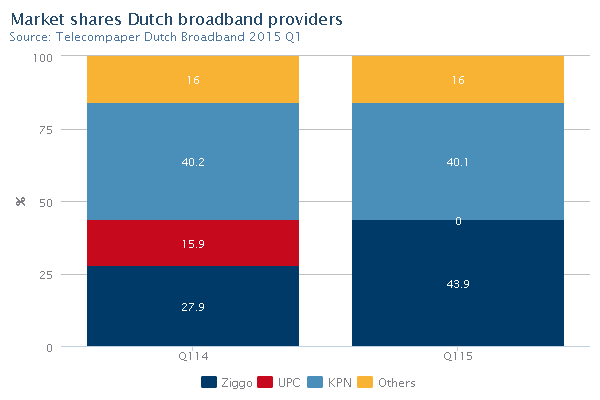
U.S. private equity firms Warburg Pincus and Apollo now are evaluating a bid to buy Deutsche Telekom’s T-Mobile Netherlands division, valuing the deal at more than 3 billion euros ($3.4 billion).
The lack of service provider bidders points to the nature of the issues. The Netherlands is a highly-competitive market with little room for growth, and which is consolidating.
One issue is that the Netherlands mobile market is saturated, with growth shifting to Internet access, especially as provided by triple-play providers lead by cable operator Ziggo and KPN, with cable operators gradually assuming a bigger role.
KPN had about 50 percent of the mobile market in 2010, while Vodafone and T-Mobile each had
All markets in Western Europe, Ovum predicts, will see year-on-year revenue declines by 2019.
Western Europe will see a compound annual growth rates of -1.7 percent between 2013 and 2019.
All 17 Western European markets will see revenue decline over the next five years.

Thursday, February 11, 2016

Casa Shows 4.5 Gbps Down, 400 Mbps Up, on Way to 70 Gbps?

Casa Systems demonstrated DOCSIS 3.1 with upstream speeds of more than 400 Mbps. Casa Systems is now one of the first suppliers of DOCSIS 3.1 to show multi-Mbps upstream traffic. Previously, Casa Systems had shown support of 4.5 Gbps in the downstream direction.
Although perhaps not originally envisioned, the cable TV hybrid fiber coax network has shown extraordinary ability to support hundreds of megabits to gigabit Internet access speeds using software upgrades, without requiring a fiber-to-premises upgrade.
That capability has allowed U.S. Internet service provider Comcast, now the biggest supplier in that market, to double the capacity of its network every 18 months.
In other words, Comcast has  increased capacity precisely at the rate one would expect if access bandwidth operated according to Moore’s Law.
U.S. telcos have generally not been able to increase speed at such rates. That, in large part, might account for Comcast’s leadership of the Internet access market.
That said, across the whole market, access bandwidth has grown at rates very close to what one would expect if Internet access were governed by Moore’s Law.
source: Arris

"Lean Back" and "Lean Forward" Differences Might Always Condition VR or Metaverse Adoption

By now, it is hard to argue against the idea that the commercial adoption of “ metaverse ” and “ virtual reality ” for consumer media was in...