Thursday, August 25, 2011

U.S., Global Executives Disagree About Leadership in Mobile Payments


U.S executives and other global executives seem to disagree in some significant ways about the likely early winners in mobile payments.

Two groups of financial institutions are the current front-runners, say respondents surveyed as part of the 2011 KPMG Mobile Payments Outlook. That survey of nearly 1,000 executives primarily in the financial services, technology, telecommunications, and retail industries globally found that 83 percent of the respondents believe that mobile payments will be mainstream within four years (by 2015). In fact, 46 percent believe mobile payments will be mainstream within two years.

That is true both for U.S. and global executives. Banks, which scored the highest in level of importance in the value chain, and credit card companies (processing networks) will have the most important roles, according to business leaders globally.

But there the views diverge. Global executives placed telecommunications companies third, ahead of online payment leaders such as PayPal, Boku and Obopay, major application providers(Google, Facebook, Amazon), retailers and technology companies.

Among U.S. respondents, the application giants (such as Google, Facebook, Amazon), placed third, followed by specialist online payment players (PayPal, Boku and Obopay) and only then telecommunications companies, which were rated of equal importance, retailers and technology companies.

In other words, after Visa and MasterCard, and card-issuing banks, U.S. executives believe application providers such as Google will lead. Firms such as PayPal are seen as on a par with mobile service providers in likelihood to lead the market.

One can speculate about that difference of perspective, but it might be that U.S. contestants have a keener appreciation of the strengths the application giants and online payment players can bring to bear in the U.S. market, compared to most markets internationally, including developing nations and regions, where mobile service providers already have emerged as key players, working with the banks.

To reiterate, globally, executives tend to believe the banks and mobile service providers are most important. In the United States, respondents believe it is the banks and applications providers who are most important. That’s a significant difference in perspective.

But there also are several distinct market segments, and leadership in each segment is viewed differently. The KPMG survey respondents, globally, see online payment systems emerging early, as a mass market segment, in part because they already has done so.

Likewise, mobile banking as an early segment to emerge, again because there already has been substantial progress on this front. NFC-based payments are seen as taking longer to develop, as well as widespread carrier billing and the “mobile wallet.”

In regard to carrier billing, respondents probably are referring to widespread use of mobile phone bills as a payment mechanism, not the capability, which has been in place for quite some time.

Search Google Maps by Voice

Google's voice search algorithms are remarkably good, if you have used Google voice search on your Android. Now voice can be used for Google Map queries, from PCs running the Chrome browser.

If you’re using a Chrome web browser in the U.S. (English only for now), simply click the microphone icon and speak into your computer.

Google+ Goes More Mainstream

Since the launch of Google Plus almost two months ago, Google’s social media network has grown faster than any other network, reaching over 20 million users in just a month. As you might expect, the early adopters skewed male, younger and techie.

That has begun to change as Google+ becomes a mainstream application. That would have been expected, especially since women tend to over-index on social networks.

A 2010 study by the Pew Research Center shows women are heavier users than men on most social media networks. In fact, the Pew Research Center found that from 2008 to 2010 the number of women using social media increased while the amount of men decreased.

The study also indicated women more frequently update statuses, comment on posts and photos, and are more apt to click Facebook’s “like” button. Women, simply put, are the backbone for most social media sites.

Google Plus adds more women after mostly-male launch | VentureBeat:

Shoe-Powered Mobiles?

Digitaltrends.comScientists say they can turn the kinetic energy of walking or running into electrical power. Researchers at the University of Wisconsin have invented a device that, placed in a shoe, captures the energy of moving microscopic liquid droplets and converts it into electrical current.

How Extensive is UK 3G Coverage?

teleA study of 3G coverage in the United Kingdom, using 44,000 participants, suggests that 3G coverage in the UK is far below the 90 percent coverage claimed by operators.

The test used software on Android devices that measured 3G coverage wherever the phones were. The results found that a 3G connection was only possible for 75 per cent of the time, with dead-spots being recorded in U.K. cities and major towns.

Those findings are not going to surprise anybody who thinks for a minute about "coverage." Mobile service providers design their networks to reach areas based on rules of thumb. They don't actually go inside most buildings in an area to measure received signal. Nor can they physically measure signal in all shadow areas created by terrain, trees or buildings.

So when a mobile operator's coverage map shows an area is covered, that only means signal is adequate, "all other things being within design parameters." You might ask why operators don't simply "crank up the power."

In many cases, they cannot, as they have to comply with licensing requirements, though the bigger issue is network designs the require re-use of frequencies throughout the network. That means, essentially, that in order to avoid interference, towers using the same frequencies have to be located some distance apart from each other. To avoid interference, signal strength also has to be regulated.

Keep in mind that user demand directly affects network design. Areas with heavy usage, such as places major highways and freeways run, major pedestrian zones and so forth, require smaller cell coverage areas, which in turn affects signal strength parameters. If a service provider has to provider more smaller cells, power has to be reduced, compared with other lower-use areas where cells are bigger, and signals are stronger.

Signals strong enough to be usable at most locations within a cell tower's coverage area, but to avoid interference, might not be at a level that works quite so well inside some structures made of concrete or brick, for example. Coverage patterns that work one way in the winter might work differently in the summer, when trees are covered with leaves.

That is why, in some neighborhoods, you see your neighbors out on the front porch talking on their mobile devices.

The point is that it is not surprising that coverage patterns as measured by people who are indoors much of the time will discover lower signal strength than a radio engineer will design, and that on the ground testers, taking measurements largely outdoors, are going to report.

The point is that "coverage" is a bit of a statistical exercise, and that network engineers and users mostly indoors will experience coverage differently.

Changing Demographics of Tablet and eReader Owners

women-connected-devicesIn the United States, as recently as the summer of 2010, tablet and eReader owners tended to be male and on the younger side. They were the classic "early adopters," in that sense. But the market is beginning to move beyond the early adopters.

According to Nielsen Company’s latest quarterly survey of mobile connected device owners, this is no longer  the case.

Older users and female users now are starting to adopt both e-readers and tablets at rates that are starting to better reflect their presence in the general population.

In some cases, usage matches, or exceeds, a group's presence in the overall population.

Back in the third quarter of  2010, for example, 62 percent of tablet owners were under the age of 34 and only 10 percent were over the age of 55. By the second quarter of  2011, only 46 percent of tablet owners were under the age of 34 and the percentage of those over 55 had increased to 19 percent.

Looking at the data by gender underlines key changes in the e-reader category as well Some 61 percent of all e-reader owners are now female, compared to 46 percent in the third quarter of 2010.

In the more established smart phone category, owners are now almost evenly split between male and female, though tablet ownership remain primarily male. But 37 percent of tablet owners are 45 or older, up from 23 percent in the third quarter of 2010.

In fact, the demographic pattern of ownership of tablets just about mirrors that of the more-established smartphone category.

And 51 percent of e-reader owners are 45 or older, up from 40 percent in the third quarter of 2010.


ereader and tablet demographics

Wednesday, August 24, 2011

Will Apple Be a Force, Long Term?

There likely are few people who believe anything truly significant will change at Apple over the next couple to several years under Tim Cook, Apple's new CEO.

 Some might even think Apple wouldn't change much for as much as five more years. But, at some point, there likely are many people who think Apple simply will be unable to be the industry-changing force it now is.

Tim Cook is seen by many observers as a competent numbers guy who understands manufacturing. But nobody thinks he is a creative type. For the moment, Apple designers likewise seem capable of executing on Apple products.

At some point, though, nobody at Apple seems to have that particular Steve Jobs capacity for figuring out what consumers want, before they know they want it. To be fair, there is not another executive in the technology business with that instinct.

Most companies take surveys to figure out what people want. Apple doesn't do that, or at least, has not. There might not be another human being capable of making large bets, to create whole new industries, the way Steve Jobs has done. Sooner or later, Apple will cease to be the force it has been. That's how important a human being Steve Jobs has been.

Mobile, Online Banking Lines Blur

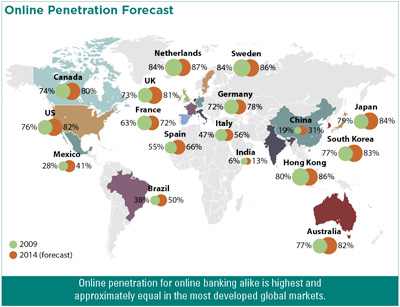
Online banking and mobile banking are quickly becoming the same thing, according to Forrester Research.

Forrester researchers defined online bankers as consumers who have checked account balances, transferred money, or paid bills at a bank’s website in the past three months.

Mobile bankers were defined as those who have ever used mobile banking services via text alerts, mobile Internet, or a mobile application to check account balances, transfer money or pay a bill.

That doesn't mean all mobile banking will involve mobile payments, a subset of mobile banking activity. But the study does suggest that consumers are becoming more comfortable using mobile devices for banking operations. That's important for banks, among others. It took some time for people to get comfortable with automated teller machines as well, but that level of acceptance has major implications for the cost of supporting banking operations.

ATMs made "bank branches" affordable and abundant. Mobile phones should do the same, to a wider extent.

Dwolla Launches “Proxi” For Proximity-Based Mobile Payments

1. Home page proxiOnline and mobile payment platform Dwolla just launched a new feature called “Proxi” which allows users to send and receive cash-based mobile payments based on their current proximity to another connected device.

The technology bypasses the need for special hardware, like Square’s plastic dongles or NFC chips built into a phone, in order to make mobile payments, and operates on a peer-to-peer basis.

Dwolla Launches “Proxi” For Proximity-Based Mobile Payments

Development Impact of Mobile Banking

exhibitIt isn't often that some communications application or service can clearly be seen as having enormous social or development impact, in a way that normal people can grasp.

Consider the area of international remittances. Worldwide, some 200 million migrant workers send more than $300 billion a year to their relatives in their home countries.

For some nations, the remittance sums exceed their foreign direct-investment totals. One can question the impact of the hundreds of billions in government and non-governmental aid over the past 60 or so years. It is easy to understand the impact of family members sending money "back home."

Sure, economists can calculate the benefit of just about any type of economic activity. But such estimates often fail to capture benefit in a way an average person can understand. Mobile banking in developing nations is the exception to the rule.

The average cost of sending money across borders is currently about nine percent, which gives mobile-money platforms a vast opportunity to reduce these costs, which leaves more money in the pockets of the recipients and the wage earners.

The People Who Give Your Social Media Its Buzz

According to new data from Yahoo and market research firm Added Value, just 15 percent of social networkers fall into this elite category of “power sharers.” Social Media Buzz

The two firms surveyed 1,500 people between the ages of 15 and 64, and found that 56 percent of social media users share something from news or entertainment media at least once a day through a broad range of online platforms, including email and instant messaging.

Power "sharers" tend to be male (61 percent), young, and politically and socially liberal, the study finds. 

Erply takes on Square, Verifone with new mobile payment device

Erply has launched a new mobile credit card reader for handheld mobile devices. The Erply card reader is designed to support traditional credit card processing as well as near field communications (NFC) technology. http://www.erply.com/

The Erply card reader can be used the Apple iPad, though an iPhone version is promised within three months or so. The Erply mobile credit card reader costs $50, and then there is a 1.9 percent transaction fee per charge.

Steve Jobs Resigns

Apple’s Board of Directors today announced that Steve Jobs has resigned as Chief Executive Officer, and the Board has named Tim Cook, previously Apple’s Chief Operating Officer, as the company’s new CEO. Jobs has been elected Chairman of the Board and Cook will join the Board, effective immediately. Steve Jobs resigns


The day Steve Jobs was not able to lead Apple has been dreaded by investors for quite some time. Jobs remains chairman, but the questions now will become real.

Few companies in any industry have been so personally bound up with a founding executive, and Apple has been one of the few. Few executives in any industry have had the ability to reshape whole industries, and Jobs has done that, more than once.

Supporters will say Apple has a management culture and leadership team that will be able to continue to guide Apple in the future. That seems reasonable enough. But Steve Jobs was not just any executive. And no matter how talented his successors might be, one has to wonder what the implications might be.

In an open letter, Jobs said "I have always said if there ever came a day when I could no longer meet my duties and expectations as Apple’s CEO, I would be the first to let you know. Unfortunately, that day has come."

Jobs remains Chairman of the Board and a director of the company. Jobs has been on medical leave recently, and it is safe to say many will be praying for him.

Which E-Reader has the Best Customer Service?

There might be times when retail outlets come in very handy for technical support. Granted, you probably don't typically require technical support for things you buy on Amazon.com. And Amazon generally gets very high marks for customer support. But Amzon also sells Kindles, and mobile devices can occasionally require some technical support.

Those might be times where a network of retail outlets could affect consumer experiences. Here’s an overview of the support offered by four of the most popular E-readers.

If You Build It, Will They Come?

"Build it and they will come" turned out not to be true for many application and service providers in the Internet and telecom bubble of the late 1990s. But where it comes to broadband, might it be true?

Service providers might tend to be skeptical, having lived through one bubble, and more importantly, having begun offering 50 Mbps and 100 Mbps services already, with relatively modest take rates. But Blair Levin, executive director of an entity called Gig.U , a coalition of 29 U.S. universities, thinks that is precisely what has to happen.

To some extent, bandwidth and innovation are a bit of a "chicken and egg" problem. Apps don't get built until bandwidth is available, but consumers don't buy more broadband unless there are compelling apps.

Gig.U is meeting with service providers, businesses, nonprofits and any other interested parties to flesh out plans to build it first and then see what happens, at least in college towns.

Yes, Follow the Data. Even if it Does Not Fit Your Agenda

When people argue we need to “follow the science” that should be true in all cases, not only in cases where the data fits one’s political pr...