Friday, May 25, 2012

Mayors Want FiOS, But "You Can't Always Get What You Want"

It is not surprising either that nine New York mayors, as well as their counterparts in Boston and Baltimore want FiOS. By the industry's own reckoning, fiber to the home is the ultimate, future-proof network. Nor would the mayors be alone in thinking better consumer outcomes could result if there were robust competition between an incumbent cable operator and Verizon, in each city.

But the economics of fiber-to-home networks have never been especially easy. Verizon itself justified the FiOS network choice to investors by arguing a combination of benefits, including operating cost savings, would provide the payback.

But Verizon seems to have found the operating cost savings were not as large as hoped, and the incremental new revenue not large enough, to continue with the program. You can be sure that if FiOS were throwing off huge amounts of new cash, you couldn't keep Verizon from building as fast as it could.

The problem is that an argument can be made that major investments in all new fixed network infrastructure are questionable, at a time when a variety of reasons make wireless networks a clearly-better financial investment. Even proponents say the business case varies from location to location. 


Observers are right to wonder about the impact on competition if Verizon continues to refrain from FiOS expansion. On the other hand, wireless does provide an important developing element of the competitive picture. Wireless might never be a full-fledged alternative to fixed network access. 


But neither is it clear that the fixed network business case will remain where it is today. At least in principle, some shift in end user demand could boost the FiOS business case far beyond where it exists now. 


The point is that promoting competition, a reasonable public policy concern, also has to take acoount of the fundamental economics of various approaches to providing broadband access. What we might prefer is one thing. The economics might dictate something else.
Wireless also has become a feasible alternative for broadband access in many areas, and for some use cases.

Nor is there much evidence that service providers are doing anything but increasing investment, globally. It also is true that industry revenue is growing, globally. The issue is where growth is occurring.

In the 10 years from 2005 to 2015, telecom service provider revenue has shown and will continue to show year-over-year growth every year except in 2009, Infonetics Research says.
With industry revenues expected to grow at a modest two percent a year, overall capital expenditure will thus remain stable (0.7 percent CAGR) for the foreseeable future, with growth coming from spending on equipment. But capex is shifting to mobile, globally.

Wireless access infrastructure, already accounting for 43 percent of total telecom infrastructure capex, will increase its overall share as spending continues to shift away from fixed infrastructure.

That has to raise questions about the long-term role, revenue and services suite to be offered by broadband fixed network operators. Not, it must be said, because demand will be lacking, but only because cable operators seem to be executing on their premise that they can deliver bandwidth more affordbly than fixed-line telcos.

Indirect evidence for that view comes from the A.D. Little analysis, which suggests that fiber to the home investment for very-high broadband will be “mainly” driven by non-telecom players.

In part, in some markets, that will be the case because 65 percent of all households with access to FTTH  networks in Europe are on networks deployed by fixed-line incumbents. In other words, in Europe, much fiber investment already has been made. Where it has not been made, there likely are payback issues that make FTTH highly questionable.

So utility companies and alternative operators are expected to split the value chain as well as the financial investments, by forming innovative partnerships to invest in more fiber access, A.D. Little believes.

If cable operators continue to nibble away at available demand for fixed broadband, telcos will face the challenge of a radical rethinking of their business models and offerings.

If one assumes that broadband will underpin and drive most future revenue for fixed line providers, and if one assumes it is the cable companies who can do so at lower cost, telcos will face a challenging investment case, especially given the arguably better financial prospects in mobility and wireless.

Strategically, one might argue that, though expensive, a full fiber to home upgrade might be necessary. In some cases a fiber to neighborhood approach might be “good enough” as a bridging strategy over the medium term.

Either that, or a telco has to dramatically lower its operating costs to compete as a provider of lower-bandwidth solutions, with cable claiming the premium segments. That will not be an appetizing prospect for most telco executives, especially those without wireless assets.

FTTH is better, no doubt. But the business case remains challenging, especially where cable operators are able to boost bandwidth at much lower costs.

Thursday, May 24, 2012

Does LTE Enable Flexible Mobile Pricing Plans?

Verizon CFO Fran Shammo says Long Term Evolution allows Verizon Wireless to consider, and possibly offer, many different types of retail charging plans. One might question whether that necessarily is true, while noting that introducing a new network offers a chance to position retail plans in different ways, even if the network itself is not the reason such different plans are offered.

In principle, Verizon could have offered, or could offer, the equivalent of "toll free" content consumption on its 3G network as well. As always is the case, billing platforms have to be able to handle such arrangements. Regulators have to stay out of the way.

Users have to perceive an advantage to consuming that way and service providers must be careful not to introduce plans that produce significantly less revenue, instead of generally adding revenue because incremental usage is encouraged.

Content providers likewise have to see a clear business advantage to pay mobile service providers for their customers' use of bandwidth.

That's a lot of "ifs," and it is unclear whether there actually is anything about LTE that makes such different retail packaging possible, in a direct sense. Latency is lower, to be sure, and that could create a premium pricing position for real-time services.

LTE does offer significantly faster access, and additional bandwidth. But it might not seem that such network advantages necessarily create the platform for different packaging. Those are management decisions, with attendant billing capabilities and organizational process requirements.

"Daily" access to public hotspots has been standard for years, and Clearwire has offered "by the day" access to its retail customers. It might be fair to say those efforts have been moderately successful.

One might argue that the billing and marketing effort required to sell and support true "a la carte" mobile broadband might, at present, exceed the potential revenue.

What Does Your Business Look Like in a Cloud-Based Business Apps Environment?

What would your business look like if most important and frequently-used business applications were a one-click app on a PC, tablet or smartphone?

What if key technology assumptions most businesses have to make boil down to convenient access to reasonably-fast broadband, and devices with Web browsing capability?

What if most businesses didn’t have to supply much more than broadband and Web-browsing devices to immediately download and use key business apps? There could be lots of implications for service providers, app providers, information technology providers and telcos and cable companies if all that happens.

What becomes of much of today’s premises network business? What happens to distributors of business software? How many more sales personnel in a range of industries might find they now can sell such products because installation, configuration and support now are a “mobile app” process?

What new channels could develop? Which channels will be disrupted?

Will European Telcos Lose 20 Percent of Revenue, 40 Percent of Earnings by 2020?

Many large service providers could face excruciating revenue pressures over the next decade.

By 2020, for example, European telcos could see their sales fall by up to 20 percent, while; earnings (EBITDA) could even drop by 40 percent, according to an analysis by Roland Berger Strategy Consultants 

Change of that sort might lead to relatively shocking changes for many service providers, including separation of retail and wholesale units or a switch to “wholesale-only” operations.

To respond, telcos must reduce operating costs, adopt new, sales and service models and tap growth markets, Roland Berger says.

The study suggests European telcos will have to invest up to EUR 600 billion, mostly for optical fiber and Long Term Evolution fourth generation mobile networks, says Alexander Dahlke, Partner at Roland Berger Strategy Consultants.

Business Revenue Driving ILEC Growth

There is an interesting pattern shaping up in first quarter financial reports from U.S. independent local exchange carriers, namely that revenue growth is strongest in the business customer segment.

In Windstream's first quarter of 2012, business revenue was $897 million, while consumer revenue was $338 million. In other words, business revenues were 73 percent of total revenues. Other telcos that once were more known for operating rural telephone exchanges, such as Frontier Communications, likewise generate more than half their revenue from business customers.

In the U.S. cable industry, services for business customers likewise represent the highest-growth potential, not services to consumers.

Mobile Data Revenue Mismatch is Getting Worse

It isn’t news that mobile service providers face bandwidth demands that threaten to outrun revenue while boosting capital spending and operating expense as well.

In Germany, Solon expects a 15-fold increase in data demand over the next five years. The additional network capacity required would almost double network operating expense from 12 percent of revenues in 2011 to 23 percent of revenues in 2016, not to mention the capital investment.

So bandwidth demand is growing much faster than revenue earned from supplying that bandwidth. That's a problem.

Where Do Service Providers Actually Make Their Profits?

One of the truths about virtually every business is that 80 percent of the profits will tend to come from about 20 percent of the activities people at those businesses conduct. In the communications business, profit historically was generated by business customers, who provided the surplus required to run the money-losing rural parts of the business, and later the break-even suburban residential business.

Those realities are changing with the advent of mobile service and broadband.

"Phablets" Will Surpass 208 Million Shipments Annually in 2015

You might have noticed, recently, that there is plenty of experimentation around form factors in both the tablet and smart phone markets, with each category containing devices that are migrating in a direction in the middle, namely smart phones with bigger screens and tablets with smaller screens.

Though cost reduction and portability might be reasons for creating seven-inch tablets, better content consumption experience might be the reason for crafting smart phones with screens in the five-inch range.

More than 208 million "phablets," a hybrid device that is larger than a smartphone but smaller than a tablet, like the Samsung Galaxy Note, will be shipped globally in 2015, says ABI Research.

Despite the slow start for phablet smart phones in 2011, HTC, LG, and Huawei each will introduce phablet smart phones in 2012, joining the ranks of Samsung’s Galaxy Note and Nexus. Additionally, another phablet smartphone was released earlier this month, the Samsung Galaxy S3, according to ABI Research.

“One of the chief drivers for phablets is the amount of time people use their smartphones for web browsing, reading articles and newspapers on the go, or simply navigating their journeys,” says ABI Research senior analyst Joshua Flood. “The larger screen sizes make a significant difference to the user’s experience when compared to conventional-sized touchscreens between 3.5 to 4 inches.”

Sale of all of T-Mobile USA "Unlikely"

Deutsche Telekom AG considers a complete sale of its troubled U.S. wireless unit T-Mobile USA as "unlikely,"  Chief Executive Rene Obermann says.

"We continue to look for a long-term solution to improve earnings in our U.S. business," Obermann  told shareholders at Deutsche Telekom's annual general meeting. "However, a complete sale like the one to AT&T is considered unlikely."

Among the options some believe T-Mobile USA could consider is a spin out of the asset to shareholders or a merger with a smaller regional provider. Few seem to believe T-Mobile USA realistically can grow its way to greater scale on an organic basis.

The problem is that Deutsche Telekom itself says it must increase its return on capital or reduce its capital investment in the U.S. market. That will be tough as T-Mobile USA continues to bleed its most-profitable customers and lags the other leading U.S. mobile firms in creating Long Term Evolution fourth generation networks. 

Android- and iOS-Powered Smart Phones Gain More Share

Smart phones powered by the Android and iOS mobile operating systems accounted for more than eight out of ten smartphones shipped in the first quarter of 2012, according to IDC.

Android had 59 percent market share, while iOS had 23 percent share of the 152.3 million smart phones shipped in the first quarter of 2012. Those statistics do not exactly related to "sales," though.

During the first quarter of 2011, the two operating systems held a combined installed base of 54.4 percent. IDC notes that  Android and iOS have grown their share over Symbian and BlackBerry, Linux and Windows Phone 7/Windows Mobile.

                                   Top Six Smart Phone Share, 2012 Q1 (Units in Millions) 
Mobile Operating System
1Q12 Unit Shipments
1Q12 Market Share
1Q11 Unit Shipments
1Q11 Market Share
Year-over-Year Change
Android
89.9
59.0%
36.7
36.1%
145.0%
iOS
35.1
23.0%
18.6
18.3%
88.7%
Symbian
10.4
6.8%
26.4
26.0%
-60.6%
BlackBerry OS
9.7
6.4%
13.8
13.6%
-29.7%
Linux
3.5
2.3%
3.2
3.1%
9.4%
Windows Phone 7/Windows Mobile
3.3
2.2%
2.6
2.6%
26.9%
Other
0.4
0.3%
0.3
0.3%
33.3%
Total
152.3
100.0%
101.6
100.0%
49.9%

Google Launching Knowledge Graph

Google has begun to introduce "Knowledge Graph" to U.S. English users. It also will be available on mobile devices


The Knowledge Graph allows users to search for things, people or places that Google knows about and then filters that information for relevance to a particular query. This is a critical first step towards building the next generation of search, which taps into the collective intelligence of the web and understands the world a bit more like people do.

Google’s Knowledge Graph builds on Freebase, Wikipedia and the CIA World Factbook but is augmented by facts Google already has amassed, as well as the relationships between these different objects. It also is tuned based on what people search for on the Web.


Tablet Growth Changing Ad Market

Non-phone mobile devices, especially tablets, accounted for 20 percent of all mobile advertising impressions on the Millennial Media platform during the first quarter of 2012, compared to 15 percent in the first quarter of 2011, showing the growing importance of tablets in the portable device universe and mobile advertising business.

Android remained the top overall operating system on the Millennial Media platform in Q1 2012, with a 49 percent share of impressions, and Apple remained the leading individual mobile device manufacturer, Millennial Media says.

The Apple iPad, Samsung Galaxy Tab and Amazon Kindle Fire were the top tablets in the first quarter of 2012, and all three were among the top 20 mobile devices.


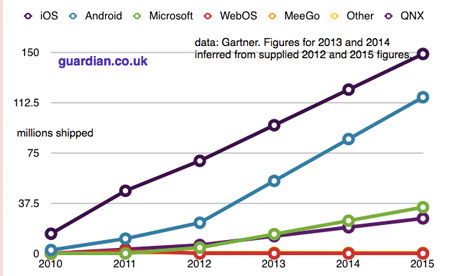
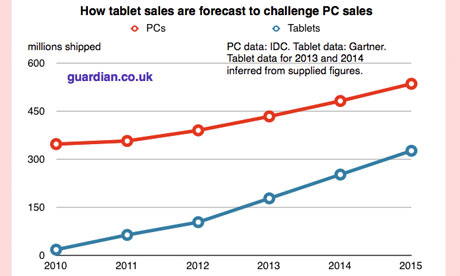
Gartner tablet forecast to 2015Though the common observation is that tablets are displacing PCs for content consumption, tablets also are becoming a more-important platform for mobile content consumption as well.


IDC has forecast 2015 sales of 535 million PCs. That would imply tablet shipments about 60 percent of the PC level, heavily weighted towards developing regions of the world, the Guardian reports.


Apple will have just under 50 percent of the market of 326 million devices by about 2015, Gartner says. The Gartner forecast suggests tablet sales to end users will total 118.9 million units in 2012, a 98 percent increase from 2011 sales of 60 million units.
Apple's iOS continues to be the dominant media tablet operating system, as it is projected to account for 61.4 percent of worldwide media tablet sales to end users in 2012. Despite the arrival of Microsoft-based devices to this market, and the expected international rollout of the Kindle Fire, Apple will continue to be the market leader through the forecast period, Gartner argues. 


IDC and Gartner PC v Tablet forecast to 2015

Wednesday, May 23, 2012

The Next Wave Of Tech Disruption Will Hit Commerce

“We’re now entering an era around the democratization of commerce,”  Kleiner Perkins Caulfield and Byers partner Chi-Hua Chien argues. As you might expect, that means smaller firms now will have opportunities not possible before. 


The past, he said, has been about “mass aggregation,” with companies such as Safeway and Wal-Mart rising to the top of the commerce space by simply being the best at aggregating a suite of products into one spaceTechCrunch reports. 


Today, credibility can be established by smaller players using a variety of tools such as social media, while real estate and inventory can be outsourced much easier. 


Even in the traditional "big box" retailing space, retailers such as Best Buy are rethinking the "big box" economics. 


One reason there has been so much attention paid recently to "offers," "deals," mobile commerce, mobile wallet and mobile payments, as well as the use of smart phones and tablets as part of the shopping experience, that is why. 

Usage-Based Pricing is Not "Anti-Consumer"

An analysis of consumer benefits or costs from usage-based telecom service pricing suggests that regulatory oversight may not  improve well-being even in the presence of clear anti-competitive conduct by broadband providers, the Phoenix Center for for Advanced Legal and Economic Public Policy
Studies argues.

Oversight is something regulators and politicians like to say they are conducting. But it won't help, in terms of  consumer benefits, the Phoenix Center analysis suggests.

In fact, such practices as charging over-the-top video service providers a fee to reach consumers, though considered an outrage by some policy advocates, actually helps end users.

New Undersea Cables Drive Retail Capacity Prices Lower


A recent wave of new submarine cable builds and upgrades to existing cable systems has brought an influx of submarine cable capacity to many historically high cost markets, including Africa, the Middle East, Southern Asia, and Latin America, TeleGeography reports.
New cable builds in Asia have greatly increased both supply and competition in the region, driving down prices. Median lease prices for a 10 Gbps wavelength between Los Angeles and Tokyo fell 35 percent between Q1 2011 and Q1 2012, and at a compounded rate of 33 percent between Q1 2009 and Q1 2012
Prices of 10 Gbps wavelengths between Hong Kong and Singapore fell 10 percent between Q1 2011 and Q1 2012, to $43,935 per month, and declined at a compounded 31 percent annually between Q1 2009 and Q1 2012.

10 Gbps Median Monthly Lease Prices, Q1 2012 BPD_fig_5-2012_2.png

Source: TeleGeography

Mobile Online Commerce Grows 400% in a Year

About 64 percent of U.K. smart phone owners are now using their mobile devices to shop online, a number that has quadrupled since June 2010,  eDigitalResearch and Portaltech Reply say. 


The study also found that an impressive 84 percent of smartphone owners have used their devices to browse websites, with one third (33 percent) doing so on a daily basis, while three quarters (77 percent) are using their smartphones to research products.


Download the study here.

Can't Keep Up with Mobile Marketing? There's a Reason

This is one take on the ecosystem. Complicated? Oh yes! 

34% of Mobile Ops Plan to Launch LTE in 2012

A majority of mobile operators plan to launch Long Term Evolution  services in 2012 or 2013,  according to a recent survey by Informa Telecoms & Media. Almost 60 percent of operators say that they will launch 4G services n 2012 (33.7 percent) or next (24.9 percent), while the vast majority – 70.5 percent – believe there is a viable business case to launch 4G today, Informa Telecoms & Media says.

The survey shows that the main reasons operators are launching LTE is to create new revenue streams (34.7 percent); to increase capacity to offer mobile broadband services (23.3 percent); and to build brand value through technology leadership (31.3 percent).

Tuesday, May 22, 2012

Verizon Goes Over the Top for Internet Video Aggregation

As one more example of how mobile service providers are learning to go "over the top," Verizon Wireless is launching a new app called "Viewdini" for its mobile subscribers. The app allows users to search for a particular title, actor or keyword across a variety of video services, including Netflix, Hulu Plus, Comcast Xfinity and mSpot. 

Verizon Wireless essentially is going to provide a search engine that aggregates video, rather than launching a branded video service, and is an example of content curation. The big problem with Internet video is finding something interesting to watch, and that is the problem Viewdini hopes to help solve. 

Xfinity Voice Introduces Free Phone Calls Over WiFi

Comcast is introducing a Wi-Fi calling service that uses a subscriber's home phone number and  "Voice 2go" feature of the Xfinity Connect Mobile app.


Customers can make free domestic phone calls and send text messages at Wi-Fi hotspots.


But the app also supports mobile calling using 4G or 3G mobile data plans as well.


Customers also can send and receive text messages domestically and internationally to more than 40 countries, including Canada, Brazil, China and, soon, Mexico, Comcast says.


Xfinity Voice also now offers up to four "Personal Phone Numbers" that can be assigned to family members, and are separate from the primary account holder’s phone number. 
One example is that a child can use an iPod touch to communicate, eliminating the need to subscribe to an additional monthly mobile service plan.
These features will be coming soon to new Xfinity Voice customers, so the business model is sales of Xfinity voice lines and retention of those customers, not ancillary revenue from use of the app.
The Xfinity Connect Mobile app can be downloaded for free on the iTunes Store or Android Market as well as online through Xfinity Connect.

Sprint Changing Personal Hotspot Plans

Beginning May 18, 2012, Sprint is launching two new mobile hotspot add-ons for smart phone and tablet customers. One plan costs $19.99 a month and comes with  2 GBytes of combined 3G/4G on-network data. The other plan costs $49.99 a month for 6 GBytes of combined 3G/4G on-network data.

Additional on-network data usage above the monthly allowance is charged at $0.05 per MByte, , Sprint says

Sprint will be ending its current 5 GByte for $29.99 a month plan. Customers who currently have this mobile hotspot add-on can continue on this plan until they cancel service.

At least in part, the move is expected to entice more users to add the mobile Wi-Fi hotspot feature, since the entry-level plan costs less than previously. The larger plan, at higher cost, might be a way of resetting Sprint pricing more in line with its competition, in terms of value and price.

Verizon to Hike FiOS Speeds in June 2012?

Verizon will be raising the speed of several of their FiOS broadband tiers very soon, according to DSL Reports. Reportedly, Verizon's symmetrical 25 Mbps tier will soon be changed to 50 Mbps downstream and 25 Mbps upstream. The company's current symmetrical 35 Mbps tier will be increased to 75 Mbps downstream and 35 Mbps upstream.


Verizon also reportedly has been considering offering a 300-Mbps service that would be aimed at business customers. 


One wonders what will happen to pricing for the new tiers, though price hikes would not be unexpected. 


Monday, May 21, 2012

Uberconference Launches

Uberconference is a new audio conferencing service created by FireSpotter Labs. It offers what it hopes will be the easiest audio conferencing tool, dispensing with user PIN codes. 


Participants can just dial into the conference number and will be automatically authenticated based on their phone number.  From any computer, anyone in the call can see the names, photos, and other information of the others in the call. 


The display shows the current speaker, and the organizer has a number of helpful tools to keep the conference running smoothly, Uberconference says.  Organizers can record calls, mute participants to get rid of background noise or put “earmuffs” on people they may not want to hear part of the conversation.


Will LTE Adoption Grow Faster Than Earlier Broadband Networks?

Generally speaking, the latest consumer electronics devices, applications and services get adopted faster than older analog products. 


So it is not surprising that Strategy Analytics predicts fourth generation Long Term Evolution will be adopted faster than earlier CDMA, GSM and WCDMA and HSPA networks. 


Skeptics might argue that "faster" is a relative term. It might take eight to 10 years for massive adoption to occur.

  Image 1

Changing Revenue Metrics Always Show Industry Evolution

Back in the middle 1990s, many U.S. service providers, especially competitive local exchange carriers, began reporting usage metrics in a different way. For most of its history, "phone lines" made sense as a key metric for telcos, just as "basic video" customers made sense for cable TV operators.


But as each of those businesses began to change, different metrics were needed. For CLECs, the perceived better metric was "voice grade equivalents," since much of the revenue came from private line revenue, typically to support delivery of Internet access and voice trunks. 


You might argue that such changes also were a way of trying to refocus investor and analyst attention, but there still was a logic to the practice, as "voice lines" were starting to become less important, as broadband access revenue become more important.


In a similar way, once cable operators started selling voice and broadband access, "basic video subscribers" became less meaningful as a key metric. Instead, "revenue generating units" became more significant, although, as always, there is an effort to redirect analyst and investor attention. 


Something like that is about to happen in the mobile business, as average revenue per user becomes less important for some providers, especially Verizon Wireless, which expects to see a big shift to "revenue per account," as it introduces family plans for mobile data, and as it moves into machine-to-machine applications, where average revenue per "user" (in this case telemetry devices) is modest. 


In fact, given enough volume, M2M sensor connections, which might represent only a couple of dollars a month of revenue, will distort all the other older average revenue per user metrics that have assumed a "user" was a person with a mobile account. 


During Verizon's first quarter 2012 conference call, CFO Fran Shammo said Verizon is not disclosing total connections because "M2M is more complicated." He said the main thing for investors to focus on is that the company's revenue is increasing and it is adding more customers. 


Shared data plans likewise will require different metrics, according to a transcript of the event. As voice, messaging and mobile broadband shift, for many users, to a "shared account" basis, it will be harder to compare "device" revenue in a meaningful way. 


On current family plans for voice and data, the first device might "cost" more than a hundred dollars a month, while each additional phone might cost only scores of dollars, while stand-alone mobile broadband dongles, or personal Wi-Fi hotspot services have different revenue metrics as well. 


Those changes in "how to measure" and "what to measure" always are signs that a business is changing. 

Wireless Churn: Most Mobile Companies Lose 100% of their Customers Every 3 Years

With just a few exceptions (AT&T, Verizon Wireless and US Cellular), most mobile service providers lose enough customers each month that they must replace the equivalent of 100 percent of their customer bases at least every three years.


That also explains why mobile service providers spend so much money on advertising. Two-year contracts and family plans partly explain why some of the service providers are doing better on the churn front. Device selection also helps. 


AT&T, Verizon Wireless Earn 68% of all U.S. Mobile Data Revenue


The U.S. mobile data market grew six percent quarter over quarter and 21 percent year over year to reach $18.7 billion in the first quarter of 2012, Chetan Sharma reports. 
Data now generates more than 40 percent of the U.S. mobile industry service revenue, and virtually all observers expect that percentage to keep growing.
In 2012, Sharma expects mobile data revenues in the U.S. market will reach $80 billion. 
Verizon Wireless and AT&T between them have two thirds of all U.S. mobile subscribers and earn 68 percent of all mobile data services revenue. 

App Stores Turn 4

App stores will turn four in July 2012. Four years ago, mobile apps sparked a vigorous debate about whether "apps" or "Web" were the "best" ways for people to interact with content and experiences on mobile devices and PCs. 


One hears less of that debate these days, in part because users have found uses for both Web and app approaches to content and experiences. And those behaviors are extensive. 


In a next iteration, apps will become hybrid, integrating more naturally with Web approaches, though, says Thomas Husson, Forrester Research analyst. 


A third of European online consumers ages 18 who own a smart phone are using apps daily or more often, Forrester Research says.


Some 17 percent are using apps several times a day. Among European online consumers ages 18 with installed apps on their smart phones, 57 percent use social networking and 48 percent use news apps at least daily, while 69 percent use finance and banking apps at least weekly.


Google Chrome is the World's Number-One Browser


According to figures from online research company StatsCounter, Google’s Chrome overtook Internet Explorer as the world's most widely used browser, at least on desktops. In the mobile browser arena, Chrome and Opera are neck and neck.


You might say browser use is a simple matter of end user preference. But huge advertising and placement revenues are driven by browsers and selection of some browsers as the "default" on mobile devices and PCs. 


Grocers Go Mobile for Loyalty

ht mobile phone
Mobile devices and apps have lots of value for retailers beyond the use of mobile payment capabilities that replace use of cash, debit or credit cards.


Starbucks might be the best example of a retailer whose mobile payment app is as much about loyalty as it is expediting payments. 


In fact, services such as Google Wallet and Isis think the big value lies in a variety of loyalty and marketing services such payment apps can provide.


Many grocers in the United States are not waiting for such mobile wallet efforts to get established, and are launching their own mobile apps, designed to provide value for customers while they are shopping. The important observation is that there are many ways to use mobile devices in a retail setting aside from the actual payment process, which seems to get most of the attention. 


Neither "showrooming" or "payments" are the problems the grocer apps are trying to solve. Rather, the grocer apps aim to improve the shopping experience in other ways, frequently by enabling mobile shopping lists and applying all relevant coupons and offers, based on a particular shopper's past buying history.


In a way, those efforts aim to personalize the shopping experience by building on past buying behavior and rewarding repeat shopping with special offers that often are customized for each shopper, based on that history.


At least in some part, the branded mobile apps are an attempt to fend off use of third-party shopping lists, and in part an effort to provide more "stickiness" for repeat customers. 


Grocery store chain Safeway is beefing up its mobile strategy with a new shopping application, available for both Android and iOS devices,  that allows users to build shopping lists and then delivers coupons and other offers to a customer’s loyalty card that are applied automatically at check out. 


The "Just for U" app offers "personalized pricing" on items Safeway believes a particular shopper wants, based on buying history, and all special pricing is applied automatically when the shopper checks out, using the loyalty card. 


 Safeway isn't the only grocery chain to start using such apps. Harris Teeter's "ht mobile" app, available for Android and iOS devices, provides automated prescription ordering and refills, a mobile shopping list, barcode scanning, a favorite items feature, automated delivery of coupons,  an item search function and driving directions to the nearest location. 

The Harris Teeter app is similar in many ways to the SuperValu mobile app that can be used at Albertsons, Cub Foods and Shop 'n Save. 


In fact, SUPERVALU's retail technology group provides information technology solutions to other retailers, ranging from electronic payment services to scheduling, shrink-prevention services, computing and mobile infrastructure, gift card programs and other consulting services.


Sunday, May 20, 2012

Bandwidth to Grow 15 Times, Operating Expense 2 Times, Next 5 Years

The good news for mobile service providers is that consumer spending on mobile broadband is growing fast. The bad news is that bandwidth demands that threaten to outrun revenue while boosting capital spending and operating expense as well.

In Germany, Solon expects a 15-fold increase in data demand over the next five years. The additional network capacity required would almost double network operating expense from 12 per cent of revenues in 2011 to 23 per cent of revenues in 2016.

In terms of remedies, a move to Long Term Evolution fourth generation networks will help, as LTE is more spectrally efficient by seven to 12 times. Also, new spectrum allocations for LTE are incremental to existing 3G spectrum allocations, so LTE will add net spectrum.

But that will take some time. Analysts at Solon assume that by 2016, not more than 25 to 35 percent of the total Western European data traffic will be handled by 4G networks.

Handling of video streams also might be important. More than half of all video sessions are abandoned before the viewer reaches midpoint, Solon says.

That means “downloading” complete videos is wasteful, if half of all those videos are terminated about half way through.

In some cases, service providers might be able to changing video resolution and compression ratios, or lower the bit-rate of a video, at least when those actions can be taken without damaging user experience.

And though some object, traffic shaping can be used in ways that change user behavior or otherwise match revenue to data consumption while lessening network congestion. Usage caps, time-based tariffs, or rate-limiting after a certain download volume is reached are some basic tools for “steering user behavior” and managing traffic loads at peak usage periods.

Solon also estimates that only about 30 percent of today’s mobile usage actually takes place at locations without access to fixed-line services. So Wi-Fi offload can help, as well.

Is 11% North American Telecom Revenue Growth Possible?


Insight Research predicts that global telecommunications services revenue will grow from $2.1 trillion in 2012 to $2.7 trillion in 2017 at a combined average growth rate of 5.3 percent. For most people, that will seem reasonable, given the growth of wireless services globally.

Wireless subscriber growth, particularly in Asia and other emerging markets, will raise wireless revenues by 64 percent from current levels, while wireline revenues show only modest growth. And what growth occurs in the fixed network realm will happen in broadband services.

Wireless 3G and 4G broadband services are projected to grow at a compounded rate of 24 percent over the forecast period and wireline broadband services projected to grow at a 13 percent compounded rate over the same forecast horizon, the Insight Research predicts.  

The most-surprising prediction, by far, is the forecast that, between 2011 and 2016, North American carrier revenue will  rise from $287 billion to $662 billion, representing 11 percent compound annual revenue growth.


Granted, there is lots of activity in the U.S. and Canadian markets around mobile payments, mobile banking, advertising, commerce and machine-to-machine services. But not many think those initiatives will produce lots of revenue within the next five years. 


So if an 11-percent compound revenue growth rate were to occur, it would have to be driven by the basic services people already buy.
That rapid growth, on a compound basis, would lead to a doubling of industry revenue in five years. Unlike the global forecast, that will raise some eyebrows.

For starters, since U.S. firms represent about 90 percent of North American revenue, that forecast has to be based on U.S. revenue growth. And since just a few U.S. firms control about 80 percent of all revenue, that forecast also assumes a few firms, necessarily including AT&T and Verizon Wireless, will find huge new markets, fast.

That isn’t to discount what Sprint, T-Mobile USA, Comcast, Tme Warner Cable and others might be able to do. It’s just that a doubling of revenue in such a short time would require extraordinary growth, likely requiring an assumption that every North American customer will double the amount they are spending on communications services over the next five years.

That is not “impossible,” but would be extraordinarily rare. Consider that revenue growth in Europe, a similar market in many respects, might grow at far-lower rates of perhaps four percent annually.

Most rational observers would probably agree that North American growth rates of four percent a year for the next five years would be reasonable.

Likewise, global carrier revenue is expected to achieve a nine percent compound annual growth rate  from 2011 to 2016, growing to a total of $5.13 trillion, Insight Research says.

In terms of segment revenue, the latest forecast projects a 45 percent CAGR for global wireless broadband revenue, 14 percent for fixed-line broadband, about six percent growth for narrowband wireless services and negative three percent revenue change for fixed network narrowband services.

One way to look at the structure of the global market is to note that, by 2016, wireless broadband will account for about 28 percent of all communications service revenue. Narrowband wireless services will account for 38 percent of global revenue. Altogether, wireless will represent 66 percent of total industry revenue.

Fixed-line broadband will account for 11 percent of global revenue, while fixed-line narrowband services will represent 23 percent of total revenue. In aggregate, fixed line revenue will account for 34 percent of total service provider revenue, on a global basis.

For some of us, the big surprise is the aggressive forecast for North American growth.

Business Spending on Telecommunications Has Shifted to Wireless

U.S. businesses will spend $154 billion for telecommunications services in 2012, growing to $184 billion by the close of 2016, representing a compound annual growth rate (CAGR) of 4.8 percent over the forecast period,  according to Insight Research.


Significantly, business spending for cellular and other wireless services is creating all of the business revenue growth, the firm says.

While U.S. business spending for wireline services is essentially flat over the five year forecast horizon, wireless expenditures are expected to grow at a compounded rate of 9.4 percent from 2011 to 2016, Insight Research forecasts.

Four vertical industries, including wholesale trade; financial, insurance, and real estate services; professional business services; and communications, accounted for 68 percent of total business telecom expenditures in 2011.


Of course, one might also note that consumer spending is shifting to wireless as well.


Insight Research also predicts that global telecommunications services revenue will grow from $2.1 trillion in 2012 to $2.7 trillion in 2017 at a combined average growth rate of 5.3 percent.


Wireless subscriber growth, particularly in Asia and other emerging markets, will raise wireless revenues by 64 percent from current levels, while wireline revenues show only modest growth.


Nearly all of the growth in both sectors is expected to occur in broadband services, with wireless 3G and 4G broadband services projected to grow at a compounded rate of 24 percent over the forecast period and wireline broadband services projected to grow at a 13 percent compounded rate over the same forecast horizon, the company predicts.


Voyager Mobile: $19 a Month Mobile Service Leans on Wi-Fi

Some of the phones available from Voyager MobileVoyager Mobile, a new mobile virtual network operator using wholesale Sprint facilities, is going to test the notion that outsourcing virtually everything but sales and marketing will allow it to build a profitable business selling basic voice and texting service at $19 a month, without a contract, and smart phone service with mobile broadband at $39 a month.


Voyager Mobile plans to operate nationwide, but currently is selling actively only in  Alabama, Delaware, Georgia, Illinois, Iowa, Kentucky, Maryland, Massachusetts, Minnesota, Mississippi, New Hampshire, New Jersey, North Carolina, Ohio, Oregon, Rhode Island,South Carolina, South Dakota, Tennessee, Virginia, Washington and West Virginia at the moment.


Users buy their own devices at full retail, online only. The company plans to sell USB dongles, personal hotspot devices and tablets as well. 


A loyalty program is a distinguishing feature of its marketing pitch.  For every minute you use Voyager's service, users receive reward points they can use for airline tickets, gift cards, pay for monthly service, or to upgrade their phones. 


Backbone Optical Investments Drop, Wireless Climbs

Service provider spending on optical gear dropped 23 percent globally in the first quarter of 2012, compared to the fourth quarter of 2011, Infonetics Research reports, with the biggest declines occurring in all regions except North America. 


"While optical hardware revenue trends in all world regions were not positive in the first quarter of 2012, the most alarming development is that year-over-year in EMEA, particularly Europe,  spending on WDM optical equipment decreased faster than spending on legacy SDH equipment," notes Andrew Schmitt, principal analyst for optical at Infonetics Research.


That might indicate a longer-term change, not just a quarterly fluctuation, Schmitt says. Of course, it is not uncommon for capital investment in various forms of infrastructure to fluctuate a bit, especially in the long-haul networks, where new construction projects drive spending above baseline "maintenance" and "upgrade" investments. 


Mergers, Joint Ventures or Investments as Routes to Controlling AI Model Costs

Just how artificial intelligence model providers might improve their economics is a key business model issue.  A shift to inference operatio...