Sunday, August 30, 2015

Valuation "Envy" and Importance of Content Businesses for Telcos

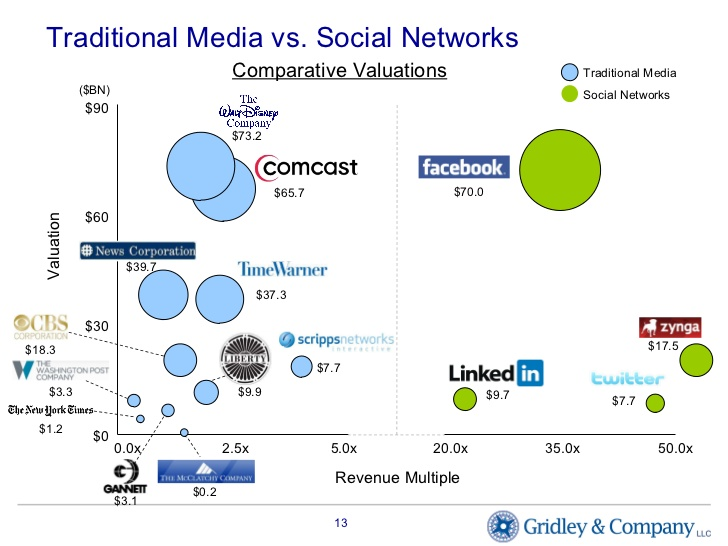
Some executives might be forgiven a bit of envy where it comes to valuations. Access providers might envy the higher valuations of media properties, while media executives might envy the valuations given to technology firms.

Among the reasons for the difference in valuations is scarcity. Technology firms often create uniqueness hard to replicate, while media firms do so with exclusive content.

That explains why most major video suppliers try to acquire exclusive rights to some content. At the same time, that also means the value of bundles will remain substantially intact. If content is fragmented, then aggregating content will generally create value.

The point is that video entertainment, and all content businesses, are valued differently than “access” businesses that more or less sell “commodity” network access.


Fiber to Home Has Been the Superior Access Network for Nearly 4 Decades: Still Doesn't Always Win

Some believe hybrid fiber coax networks will not be able to deliver gigabit speeds, or even 100 Mbps, symmetrically.

Others might argue those claims are correct, in one sense: since HFC networks are designed to be asymmetrical, even at bandwidths that do hit a gigabit per customer location, HFC does not deliver bandwidth symmetrically.

Some might argue that is not the point. The claims about symmetrical bandwidth are largely correct, but irrelevant. After all, the claim of technological superiority of fiber to the home has been made for three decades, going on four decades.

But that is not the point. The point is which platform helps an ISP best match the twin goals of being the low cost provider of the services customers want to buy, with suitable profit margins.

The fundamental test is going to be whether HFC, fiber to the home or some other platform, in the relevant time period (a decade or more) best matches market cost, revenue and performance requirements.

In markets where HFC is widespread, such as the United States, the formal technological superiority of fiber to the home has not clearly helped most of its practitioners to dominate the supposedly inferior HFC platform in terms of market share or profitability.

So far,  as a business platform, HFC has more than held its own. In fact, as Comcast is the largest U.S. Internet service provider, and since cable TV has the largest market share in most local markets, with the overwhelming majority of net new additions, the technical merits of the platform--however one wishes to evaluate them--do not seem to matter.

What has mattered is the ability to translate platform features into revenue, market share and profit. On that score, cable has outperformed nearly all telcos.

The new wrinkle, as fiber to home physical media costs have declined, is whether new providers, with different cost structures or business models, can use FTTH to support their business models, typically based solely on selling Internet access; sometimes Internet access and entertainment video, and sometimes a triple play.


That applies to Google Fiber and the dozens of gigabit fiber operations springing up around the United States, for example.

The cost of physical media and construction are important parts of a cost model. But, so far, physical media cost arguably has not determined business success.
Saturday, August 29, 2015

India Public Wi-Fi Initiatives Grow

Public Wi-Fi is assuming a bigger role in Internet access in cities in India.

The government of India has said it will create facilities offering public Wi-Fi in 2,500 cities and towns across the country over three years, with the network built and operated by state-owned Bharat Sanchar Nigam Ltd (BSNL).

The city of Delhi also separately is working on a municipal Wi-Fi plan of its own, that might use a freemium business model.

For its part, Bharti Airtel Limited (Airtel) announced that Uber riders across India will be able to pay for their trips using Airtel Money, the firm’s mobile wallet service. As part of that plan, Uber vehicles will be outfitted with Airtel 4G connections, offering free Wi-Fi inside Uber vehicles.

The government of Bihar, meanwhile, plans to offer free Wi-Fi at all colleges within the state.

Though an introductory no-charge promotion is expected for the BSNL service, it will be “for fee,” analogous to the model of many prior municipal broadband efforts or the amenity Wi-Fi offered by firms such as Boingo.

The initial phases of service are expected to start with government buildings and other anchor institutions such as colleges, in Kolkata, Chennai, Lucknow, Dehradun, Hyderabad, Varanasi, Bhopal, Jaipur, Patna, Indore, Chandigarh and Ludhiana.

At least in part, the networks are viewed as a possible way to support BSNL mobile operations, which have lost market share to rivals.

Usage allowances and minimum speeds remain a bit fluid.  

Friday, August 28, 2015

Philippines is Exception to the Rule that Duopoly Markets are Not Competitive

There is an exception to every rule, including the “rule” that telecom duopolies stifle robust competition. Some would point to cable TV companies and telcos in the U.S. market, but a better case is the Philippine telecommunications market, where just two providers compete aggressively.

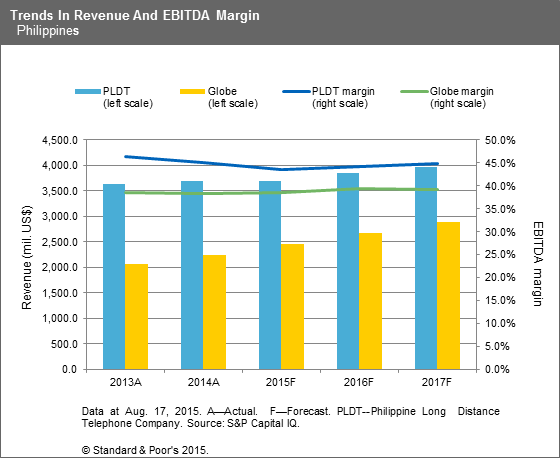
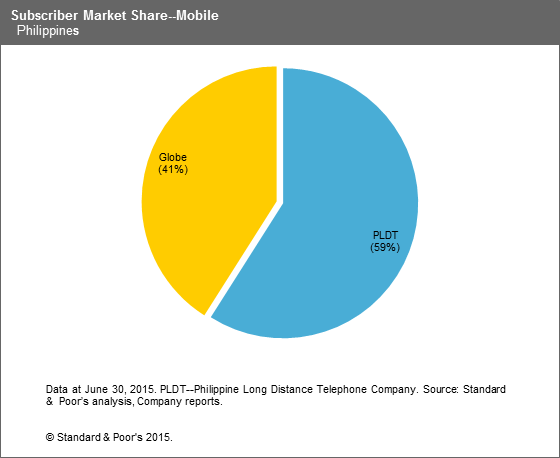
The telecom industry in the Philippines is a duopoly, with PLDT and Globe Telecom being the two dominant players in the mobile market.

Local media company ABS-CBN Corp. is trying to become the third player in the country's mobile  industry, operating using wholesale facilities supplied by Globe.

In addition, Philippine-based conglomerate San Miguel Corp. has also expressed interest in entering the telecom market, and is in talks with Telstra in that regard.

PLDT is the market leader with a dominant market share in all segments (mobile, fixed line, and broadband), having 60 percent to 70 percent market share in all these segments.

Analysts at Standard & Poors consider the Philippines telecom market moderately to highly competitive.

The market is price sensitive, and subject to periodic bouts of intense price competition, typically features of competitive markets.

The new contestants face high hurdles. The maturing cellular market in the Philippines features penetration of 113 percent.

Smartphone penetration will reach about 35 percent by the end of 2015.
image

image

Reliance Jio Market Entry Might Not Trigger Consolidation

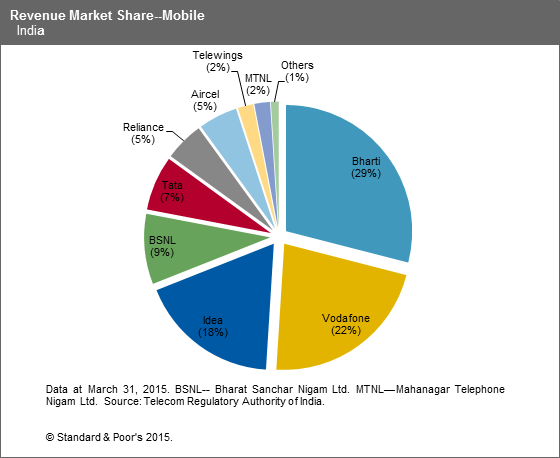
The only certainty in India’s mobile market is that market share will change after Reliance Jio enters the market late in 2015. What might not change is the degree of market fragmentation, however.

Many believe the market will consolidate to a smaller number of providers after Reliance Jio enters the market. But that might remain difficult for several reasons. Some would question how much upside is gained by any acquisitions of the smallest providers, given caps on permissible market share and spectrum limit the “growth by acquisition” strategy.

The point is that even if suppliers think consolidation would be helpful, there are regulatory barriers to serious structural change.

The other likelihood, though, is that Increasing data consumption and growing average revenue per user should lift revenue growth in India's telecommunications industry at eight percent annually up to 13 percent annually over the next several years, according to Standard & Poors.


What Happens When an Incumbent's Core Strategy Goes Wrong

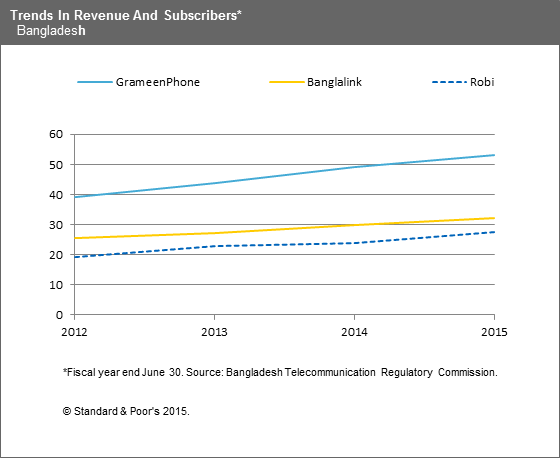
The current market status of the government-owned Bangladesh Telecommunications Company Ltd. (BTCL) provides one example of just how much the market share of a former incumbent carrier can fall.
With a declining base of less than a million connections, BTCL has shrunk to being mainly an infrastructure services provider, while Telenor--Grameenphone, Vimpelcom–Banglalink, and Axiata–Robi hold about 90 percent share of the mobile market of 126 million accounts.
Bharti Airtel–Airtel, Singtel–Citycell, and state-owned TeleTalk round the ranks of mobile providers.
image
Generally speaking, analysts have suggested there are but a handful of strategies any former incumbent can choose, ranging from full wholesale on one end to roles that are application heavy at the other extreme.

Fundamentally, the options range from focusing on pipes or over the top apps, being a wholesale supplier of bandwidth and fundamental services or becoming a provider of over the top apps at retail.

Many tier one service providers rightly worry about the dangers of embracing the wholesale role. In addition to strategic choices, execution risk is a major issue, BTCL illustrates those dangers.

Competition and Regulation are Risks for Asia Telecom Firms

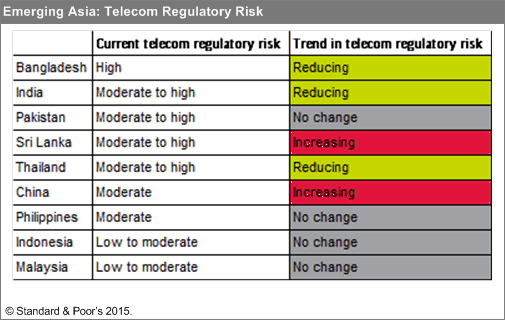
Telecom companies in the Asian region, including India, face regulatory risks and intense price competition that can undermine returns and investment, Standard & Poor's (S&P) Rating Services said.

Many emerging Asian telecom markets have strong growth prospects, based on large populations and growth of gross domestic product.
But competition is an issue, ranging from moderate to high levels, and concentrated market structures prevail.
However, in some emerging Asian telecom markets, such as India, regulatory constraints have restricted consolidation that would typically occur in more market-driven economies.
Emerging Asia's Competitive Intensity In The Telecom Industry
Country
Competitive intensity
Bangladesh
High
Pakistan
High
Sri Lanka
High
India
Moderate to High
Indonesia
Moderate to High
Philippines
Moderate to High
Thailand
Moderate to High
China
Moderate
Malaysia
Moderate
source: Standard & Poors

Regulatory risk varies, and is highest in Bangladesh, India, Pakistan, Sri Lanka and Thailand. .

image

In India, regulatory constraints have been a key barrier to market consolidation that could reduce competitive intensity, S&P says. “That said, we believe that more recent regulatory developments in India offer greater potential for market consolidation in the future.”

“While we believe that greater pricing rationality has returned to the Indian market in recent quarters after several years of stiff competition and margin pressure, the likely entry of Reliance Jio could substantially change the competitive landscape, especially for data services,” the ratings agency said.
In Malaysia, Telekom Malaysia's entry into the wireless market also could ramp up market competition in the next few years.
Although some markets are highly concentrated, they still exhibit a degree of competitive intensity typically associated with a more fragmented market structure. For example, in the Philippines, bouts of fierce price competition frequently occur, despite the country having one of the most concentrated telecom markets globally.
Still, GDP growth, and voracious appetite for data services will boost revenues across most of the region's telecom markets, S&P believes.

Several telecom operators are also pursuing new business segments such as cloud computing, exposing them to nontraditional, formidable
competitors.

Physically-Embodied AI Market is an Order of Magnitude Bigger than Informational AI

Most of the time I actively use artificial intelligence for some sort of cognitive, content or informational task. But that’s only one way A...