Tuesday, November 24, 2009

Do Usage Caps for Wireless and Mobile Broadband Make Sense?


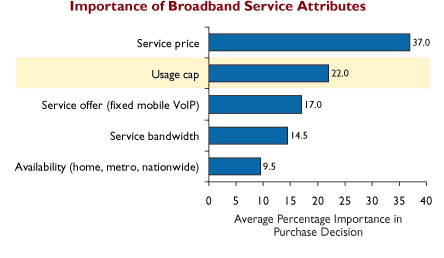
Consumers say 60 percent of the wireless broadband decision is based on two factors: monthly recurring charge and existence or size of a usage cap. For that reason, "data caps" are a particularly unfriendly way to manage overall traffic, says Yankee Group analyst Philip Marshall. 

A better approach, from a service provider perspective, is to offer unlimited usage and then manage traffic usingreal-time, network intelligence-based solutions like deep packet inspection and policy enforcement, Marshall argues.

Some would argue that fair use policies that throttle maximum speeds when policies are violated is no picnic, either. But temporary limits on consumption, only at peak hours of usage, arguably is more consumer friendly than absolute caps with overage charges. 

To test consumer preferences, Yankee Group conducted a custom survey that included a "choice-based conjoint analysis," which allowed Yankee Group analysts to estimate the relative importance to consumers of key wireless broadband service attributes. The survey was taken by 1,000 mobile consumers who also use broadband access services. 

From the conjoint analysis, "we found that, on average, 59 percent of a wireless broadband purchase decision depends on two factors: service price, and the presence or absence of a 2 GByte per month usage cap," Marshall says. 

The results also indicate that 14.5 percent of a typical purchase decision is affected by service bandwidth, and that the implied average revenue per user lift when increasing bandwidth from 768 Kbps to 2 Mbps ranges between $5 and $10 per month.

The results also indicate, however, that there are diminishing returns for service plans that offer speeds above 3 Mbps, though speed increases might be useful for other reasons, such as competitive positioning. 

"Our price elasticity analysis implies that consumers are willing to pay $25 to $30 more per month for plans that offer unlimited usage, compared to plans that have a 2 GBytes a month usage cap," says Marshall.

"In a competitive operating environment, consumers will tend to migrate toward higher bandwidth services, all else being equal, but they are not necessarily willing to pay a significant premium for the added performance capability," says Marshall.

Our most recent survey results indicate that consumers require 2 Mbps to 3 Mbps bandwidth for their broadband service. This is likely to increase dramatically over the next two to three years, but the consumer survey suggests dramatically-higher bandwidth does not affect decisions as much as recurring price and existence of bandwidth caps. 

For example, when offered a choice between one package featuring a 2 GByte per month usage cap with 6 Mbps bandwidth, and another package with unlimited monthly usage but just 2 Mbps service speed, 63 percent of consumers opted for the 2 Mbps service with no cap.

Even when the choice is between an unlimited package offering only 768 Kbps bandwidth, compared to an alternative plan with 6 Mbps bandwidth and a 2 GByte per month usage cap, 57 percent preferred the 768 kbps package.

Service providers still must manage bandwidth demand though, with or without usage caps
Usage caps work to regulate demand, but users do not like them.

The other approach is not to impose the usage caps, but instead to use policy managment and deep packet inspection to manage traffic flows.

If such solutions are implemented in a non-discriminatory manner, so that all like services are treated equally, they can be implemented irrespective of network neutrality regimes currently under consideration, Marshall believes.

Small Business Commits to Social Media, Email, Search


About 75 percent of small businesses will increase their spending on email marketing in 2010, while nearly 70 percent will spend more on social media, according to VerticalResponse.

The findings might not suggest small businesses are spending wildly. In most cases the firms likely are testing new media. But the testing seems very widespread.

Almost all businesses with 500 or fewer employees will use email marketing next year, the company says. Only 3.8 percent of small business executives say they will not be using email marketing in 2010.

More than 70 percent also indicated they would not use TV or radio advertising.

Search advertising is used by about 72 percent of small businesses, but banner advertising is used by about 40 percent of small businesses, VerticalResponse says.

Facebook, Twitter and YouTube, as well as other social media sites, are used by about 78 percent of small businesses, the firm says.

Monday, November 23, 2009

Best Buy Sells Phone Power Nationwide

Best Buy now is distributing the "Phone Power" VoIP service nationwide. That's a pretty big boost for any retailer, and especially so for an independent VoIP provider aware that the market is consolidating and that scale is sorely needed.

Phone Power costs $19.95 per month with no contract, $16.95 with a one-year contract and $14.95 for a two-year contract. The service offers unlimited calling within the United States and Canada and 60 international minutes in 88 countries.

The Best Buy offering includes a two-line home adapter as well as a USB travel adapter. It sells for $79.95, and comes with a $79.95 instant service credit to be applied when the customer activates service on an eligible one or two year service plan.

It isn't clear yet whether Best Buy also will be actively selling Phone Power business packages, which come in both multi-line and single-line versions, offering unlimited inbound calling and 5,000 minutes of outbound calling with auto-attendant feature, and other popular business features, included on multi-line packages.

Apple And Android Dominate U.S. Smartphone Web Traffic


It is starting to look like just two smartphone platforms "matter" where it comes to use of the mobile Web: the Apple iPhone and the Android devices, a new analysis by AdMob suggests.

AdMob’s October, 2009 measurements show that the iPhone/iPod Touch and Android phones account for 75 percent of mobile Web traffic in the United States.

Apple devices continue to dominate, with 55 percent share, but Android users in October represented 20 percent of all activity, up from 17 percent in September, 2009.

The iPhone and iPod Touch grew their share from 48 percent to 55 percent share over the same period.

The Blackberry ’s mobile Web traffic share went down from 14 percent to 12 percent, and Palm’s webOS shrank from 10 percent to five percent.

On a global basis, the iPhone operating system now accounts for 50 percent of all mobile traffic, up from 43 percent the month before.

Android has an 11 percent global share, which makes it third globally after Nokia/Symbian’s 25 percent share.

Since Verizon launched the Droid about two weeks ago, Droids now make up 24 percent of all Android mobile Web traffic. The HTC Dream, which is the oldest Android device on the market, is the only Android device with more share, at 36 percent of Android traffic. Give it a few more weeks. The Droid is shaping up to be the most-popular Android device so far.

The data suggests that the BlackBerry, though a worthy enterprise device, continues to lag as a smartphone choice for users whose key applications lean to the Web.

Sunday, November 22, 2009

Why Isn't All Voice Free?

"When I wrote a story about various VoIP initiatives a decade ago, nearly every expert I spoke to spouted the same prediction: within 10 years, all phone calls will be free," says John Dvorak, PC magazine columnist. "The rationale behind the pronouncement was that the wires and systems used for phone calls will eventually be used to transfer data, just like everything else."

"You don't get charged for visiting a Web page, so why get charged for making a phone call, if both are essentially data?" he muses.

It's an old argument, but is akin to asking why a diamond, made of carbon, is worth more than a thimble's worth of oil, also made of carbon, or a tiny cube of apple.

The answer to the question of different incremental pricing or costs to use network features has little to do with the representation of symbols and everything to do with larger permissible business models mandated by government entities.

In a legal and regulatory sense, bits are never "just bits." Cable TV bits are regulated differently from voice bits that touch the "public phone network," while Internet bits are regulated differently from each of those other types of bits and from private network data.

Still, it is one thing to argue that use of communications or other bits may not impose an incremental cost to a user. That is not to say there are not specific costs associated with use of the bits. Google Voice might not charge an end user for completing a specific call. But there are actual costs, imposed by the regulatory regime. Google pays them, not the end user.

But that does not mean the call has no cost, only that the cost is indirectly paid.

As for why others, besides Skype, other instantt messaging-based call providers, have not moved more aggressively to offer various forms of "no incremental cost to offer" calling, financial interests are involved as they always are.

One might as well ask why no-incremental cost education, music, video, books or plane tickets are not available.

In 1977, for example, long distance calling represented about half of all U.S. telephone company revenue. By 2007, that was no longer true. Instead, wireless services had taken the place long distance once played in underpinning the whole business. That isn't to say long distance has dropped to insignificance. It remains important. It is to say that there must be some revenue model underpinning the business, and if it is not long distance or voice, it will be something else.

No, there is no mystery about why VoIP has not lead, over the last 10 years, to "universally-free" (no incremental cost to end user)  voice calls. Voice, though declining, remains a key underpinning of the carrier business model. Nor do government regulators permit "free to end user" calling between networks.

Google Voice might not charge a U.S. user for a U.S.-terminated call. But Google Voice is compensating the terminating networks for use of their networks. Google Voice envisions a different business model for domestic calling than "per minute" use of the network. Lack of end user charges does not mean "terminating minutes" do not carry costs.

That, in fact, is behind Google Voice's blocking of some numbers, in some high-cost exchanges. And those charges are radically higher. Some firms report that the high-cost termination charges are as much as 25 times higher than typical.

Saturday, November 21, 2009

Do We Need to Rethink What We Think We Know About Consumer Behavior?

Though 2010 widely is expected to provide a recovery from the depths of the recent recession, questions logically remain about how consumers will behave in a recovery most expect will be extended.

A new study by consumer research firm Decitica suggests lasting effects that could shape consumer spending on any number of communications services, applications and devices.

"The effects of the Great Recession on consumer behavior are so profound that many of the assumptions underpinning consumer segmentation are no longer valid," says Dr. Val Srinivas, Principal at Decitica.

Among the key findings: "Price has become the dominant consideration in the purchase of all kinds of products." For this reason, Decitica predicts "a long uphill struggle by marketers to shift the focus away from price."

The recession has caused a profound, deep-rooted change in consumers' spending habits in favor a more restrained approach, Decitica says. Many have accepted this radical change as the "new normal," and not just a cyclical phenomenon.

American consumers have proven researchers wrong in the past. The issue is whether this time might be different. See full post at http://blogs.metaswitch.com/gk/.


How Strong a Recovery; What Impact on Communications and Technology?

Since 70 percent of U.S. economic activity is generated by consumers, consumer behavior will be key to the arrival of a sustained period of growth. Conversely, anything that imperils consumer spending will weaken, choke off or abort any recovery.

In the past, this hasn't been an especially tough question to answer. Historically, recessions and recoveries roughly conformed to the principle of the bigger the bust, the bigger the boom, and vice versa. That, in turn, was underpinned by the underlying robust health of the U.S. economy.

Real growth in the four quarters following postwar recessions averaged 6.6 percent and 4.3 percent over the following five years.

Those figures are substantially above what economists seem to be calling for at the moment. The current recession has lasted a record seven quarters and has been marked by a near-record average gross domestic product decline of 1.8 percent per quarter.

All of that would, by historical standards, lead to a prediction of a powerful and sustained recovery. Yet forecasts of a two-percent recovery in growth are only one-fourth as strong as postwar experience suggests.

That suggests economists believe something has changed. We can argue about what the changes might be, and what is causing them. But this is not a political issue. As a simple matter of hope for America to get back to work, the anemic growth forecast is worrisome.

As someone who historically has tracked new technology and communications, as well as a citizen who wants the best for his country, it must be said: this does not bode well for our nation, our children or faster deployment of all sorts of interesting and useful tools people can use to enrich their lives and their work.

We might disagree from time to time about what should be done. That isn't the point. Clearly, something rather important is happening; something that defies historical precedent.

Perhaps the economists are wrong. They have been wrong in the past. I hope they are wrong about this. I continue to believe in the power of technology to make a huge difference in peoples' lives, and to fuel robust economic growth, which is, first and foremost, the way we are able to increase wealth and spread it around. I hope, for our nation's sake, that this continues to be true.

For that reason, I really hope the economists are dead wrong about the recovery rate. If not, we have some serious soul searching to do. Perhaps we have been dead wrong about some of our core beliefs.

"People Don't Like Ads" Yes and No


Surveys for decades have shown that "consumers don't like ads." But there's a big caveat. People always say they don't like ads when those ads are interruptions of some desired experience.

But sometimes ads are part of the desired experience. If you are an outdoors enthusiast, ads about gear you can use outdoors are very interesting. If you are a runner, ads about shoes, clothing, nutrition and events are very interesting.

If you are a surfer, ads about surfboards are very interesting.

So it comes as absolutely no surprise that 38 percent of respondents to a Parks Associates survey say they do not want to receive ads for any reaon. About 37 percent of respondents say they are neutral about ads and 25 percent are open to getting them.

(click image for larger view)

The study also confirms the notion that people will not mind getting ads when those messages are personally relevant, timely and valuable. To be sure, 18 percent of respondents say they don't mind seeing personally relevant ads, with 39 percent reporting they are indifferent and 43 percent not interested.

The problem with surveys, though, is that they sometimes cannot capture the complexity of consumer attitudes. Just about any survey will show that people dislike ads. But if asked whether they would rather pay money to gain access to desired content, for example, or get that same access for free, in exchange for the presence of ads, most people say they'll accept the ads.

Targeting and value make the difference. If the ads are relevant, they are unobjectionable, for the most part. If the user gets something in exchange for receipt of the ads, and the ads also are relevant, surveys show people are accepting, if not entirely happy all the time.

Twitter: "What's Happening," Not "What are You Doing?"


Twitter has made a refreshing, helpful and important change in the basic question our tweeting bird friend asks us.

"What are you doing?" had been the question. The new question is "What's Happening?" That makes more sense to me, corresponds to the way I use the service, and I suspect will deepen and extend the use of tweets as a broadcast, one-to-many information service.

"The fundamentally open model of Twitter created a new kind of information network and it has long outgrown the concept of personal status updates," says Twitter founder Biz Stone. "Twitter helps you share and discover what's happening now among all the things, people and events you care about."

What's interesting here is an important, if subtle shift from "you" to "the world around you." That isn't to say people will stop posting about where they are, random musing or what they are doing, as people.

It is to say that Twitter now is poised to become a more important "news" or "media" format, as it already has been becoming.  I like it.

Another Broadband Stimulus Delay

The National Telecommunications and Information Administration told the U.S. House and Senate Appropriations Committees it will start awarding grants in February 2010, another slip from the revised timetable of December 2009.

The first round of grants was supposed to be issued in June 2009. All during the year, telecom suppliers who are thought to benefit from the program have been asked about when the funding would show up in company activity. Now we know the answer: not until 2010 and probably 2011.

The delay presumably means grants or loans issued by the Rural Utilities Service might also slip into next year. Both programs have experienced delays, perhaps inevitably, given the huge increase in workload.

The NTIA and the Rural Utilities Service say they have received roughly 2,200 applications for the $4 billion worth of grants available for broadband projects in the United States that is available in the first round of funding.

The applications ask for total of about $28 billion in broadband projects, or seven times the total funds available.

The $4 billion in grants currently available to applicants is just the first part of the $7.2 billion that the government has allotted to fund broadband infrastructure investment over the next two years.

Of that money, $4.7 billion has been given to the NTIA to award grants for projects that will build out broadband infrastructure in un-served or under-served areas; to deliver broadband capabilities for public safety agencies; and to stimulate broadband demand through training and education.

The remaining $2.5 billion in broadband stimulus money has been allotted to the Department of Agriculture to make loans to companies building out broadband infrastructure in rural areas.

Barnes & Noble Runs Out of E-Book Readers, Demand Stronger than Forecast


Barnes & Noble says it has run out of available stock of the new Nook e-book reader. Customers who ordger now won't get it until the week of Jan. 4, 2010. "Preorders have exceeded our expectations," said Barnes & Noble spokeswoman Mary Ellen Keating. The company says its $259 e-book reader "continues to be the fastest-selling product at Barnes & Noble.

That has been true for Amazon's Kindle, as well, which is the leading e-book reader at the moment. Analysts have been ratcheting up their sales forecasts over the past two years as consumers exceed earlier forecasts.

Apple, meanwhile, is rumored to be preparing a tablet style device that could double as an e-book reader, and, rumor suggests, will be available early in 2010.

So there is lots of "action" in the e-book reader space, interesting for what it implies about the future economics and distribution formats to be used by the publishing and news industries, the sustainability of "single-purpose" mobile device markets over time, contrasted with "multi-purpose devices," and the associated impact on mobile service provider business models.

There doesn't seem to be much question that distribution of print content now is at the beginning of a change that music already has gone through, and that video also is undergoing. Book distributors and publishers have to be wondering whether this is all such a good thing for them.

From an end user standpoint, one of the interesting angles is whether the e-book reader remains a stand-alone, single-purpose device or whether it ultimately becomes a feature of a multi-purpose device. The answer obviously has huge ramifications for smartphone, netbook and e-book providers.

There is no single historical pattern here. TV displays, home audio systems, microwave ovens and landline phones generally have remained single-purpose devices. The iPod has been a single-purpose device, but the "touch" and now the iPhone might be changing that situation.

Smartphones are multi-purpose devices. Portable navigation devices traditionally have been single-purpose devices, but the Motorola Droid is challenging that notion.

Apple's rumored tablet would be an attempt to provider a multi-function device, and that probably is the form factor necessary for such a convergence. Though people have speculated on smartphones becoming e-book readers, the challenges of form factor (small enough to fit in purse or pocket, light enough to use as a phone, plus large enough screen size to read) seem rather implausible in a single device.

Besides Amazon and Barnes & Noble, other companies offering e-readers include Japan's Sony, Britain's Interead, and Dutch company IREX Technologies.

Forrester Research estimates that three million e-readers will be sold in the United States this year, up from a previous forecast of two million units.

Forrester said it expected 900,000 units to be sold in the upcoming holiday season alone and for e-reader sales to double to six million units in 2010, bringing cumulative sales to 10 million units.

Citi analyst Mark Mahaney thinks Amazon will sell 1.5 million Kindles in 2009, up from his previous estimate of one million. Mahaney thinks Amazon will sell 2.7 million Kindles in 2010.

“Book applications for smartphones have the potential to become a bridge to other devices such as tablet readers and netbooks,” said Mr. Weiner. “Apple, for example, could migrate the more than 500 book applications in the iTunes store to a tablet device and Google, which recently announced a browser-based e-reader, could offer applications for Android-based devices of various form factors,” he says.

Friday, November 20, 2009

Mobile Broadband Complementary to Fixed Broadband


Over the next three to five years, mobile broadband will be complementary to fixed broadband, rather than a substitute, says William Lehr, economist and research associate in the Computer Science and Artificial Intelligence Laboratory at Massachusetts Institute of Technology.

"I expect fixed and mobile broadband services to offer distinctly different sets of basic capabilities, and as a consequence, to remain distinct services that will not be perceived as close substitutes in most user and usage contexts for the foreseeable future," Lehr says.

There will be situations where it is reasonable to expect that mobile services will be perceived as substitutes, if imperfect substitutes, for fixed connections, and will therefore result in some cannibalization, he says.

Users who are more budget conscious (the young or others with limited incomes, for example) are more likely to choose one instead of both services, Lehr suggests.

Heavy users may prefer fixed broadband access, while light users (or those who live alone) may find the mobile alternative more appealing.

Also, users who place a high value on mobility are more likely to opt for mobile over fixed services. Conversely, those whose principal mode of usage is at a fixed location and who would have a high need for a large sized display, may strictly prefer fixed broadband services.

As mobile data rates increase, some users may find that for their usage profile, mobile is fast enough to meet their needs even for shared household use. That should especially be true now that MiFi devices can allow sharing of one mobile connection by as many as five devices.

On the other hand, even though mobile bandwidth is increasing, so is fixed bandwidth. So the relative value of mobile over fixed services is greater when the fixed service is less capable. In other words, a fast 4G wireless connection might be perceived as superior to a lower-speed digital subscriber line connection, compared to a fiber-to-home connection or DOCSIS 3.0 cable modem service.

What the situation might be in 10 years is likely unknowable, but it is reasonable enough to assume that if today's smartphones are simply tomorrow's phones, and if new devices continue to be developed, that mobile broadband always will be a distinctly complementary service. If you assume today's 276 million mobile phone users in the future will simply be smartphone users with broadband connections, you get the point.

In fact, it probably makes more sense to say that fixed services are not going to be substitutes for mobile broadband, than to argue that mobile will be a substitute for fixed access. Nearly every mobile device will require broadband, irrespective of what in-home or in-office devices require.

Whatever you think about mobile broadband, it is worth remembering that mobile broadband services were not available in the U.S. market until 2005. So we are at this point just five years into the product's lifecycle.

By the first quarter of 2008, 40 million or almost 16 percent of mobile subscribers were regularly accessing the Internet using mobile broadband services, according to Nielsen.

Analysts at Forrester Research use a lower figure of 34 million subscribers in 2008. That will have grown at a 52 percent rate in 2009 to 52 million, and mobile broadband will continue to exhibit double-digit growth through 2014, when 106 million users, or a full 39 percent of all wireless subscribers, will become regular mobile Internet users, Forrester now projects.

PC data cards represent about 34 percent of mobile broadband subscriptions, while smartphones rapidly have emerged as the key driver of new mobile broadband accounts.

Is Twitter Traffic Falling?


More than one recent study has suggested that Twitter traffic is declining, after leveling off in the summer of 2009. But is it really? The answer is complicated.

According to Nielsen, traffic to Twitter.com was down a dramatic 27.8 percent between September and October 2009, falling to 18.9 million unique visitors.

Research firm comScore also noted that unique visitors were down 8.1 percent in October, while Compete reported a 2.1 percent decline.

Some might suggest the traffic decline is caused by falling interest in Twitter, while others suggest the traffic simply is caused by Twitter third-party applications and mobile access.

Crowd Science, for example, in August studied traffic patterns and found 43 percent of Twitter users accessed the service through third-party applications, and 19 percent using text messaging.

Personally, I'd bet on the use of third party apps and mobility as the explanation. Nielsen says the third quarter of 2009 was the first quarter in which more than half of mobile Internet users were accessing the Web using a smartphone, and since social network updates are a huge driver of smartphone usage, it stands to reason that traffic sources are changing.

Are Recession Driven Product Substitutions Permanent?


Whatever else one might say about it, a recession is a prime opportunity for product substitution whose immediate benefit might only be seen to be “saving money,” but which then might create a satisfying habit that leads to a permanent shift in demand, not just a temporary change of provider or service level.

In the U.S. market, the issue is whether the millions of customers who have opted for prepaid mobility will keep those plans even after the recession has past. Virtually nobody thinks consumers who have cut the landline voice cord in favor of mobility are likely to reverse course.

The poster child for substitution of mobile broadband for fixed broadband, for example,  is Austria, where  almost all broadband net adds have over the last year or two been mobile connections, rather than fixed connections.

And though the market in Austria and in the United States appear to have different structural characteristics, the danger of product substitution is amply highlighted in the Austrian market, where aggressive mobile providers, high fixed broadband prices and relatively low value of entertainment video create a sort of perfect storm for mobile broadband substitution.

And though it is not certain, past recessions were linked with, though perhaps not directly contributors to, the rise of disruptive new players in media or communications ecosystems.

Google was born in 1998, in the midst of the Asian financial crisis, while Skype was born in 2003, after the dot-com implosion, for example.

Changes in industry structure and the emergence of disruptive new industry leaders will not be ascertainable for some time. But churn is going to be easier to track, as we normally get reasonable trend data from any number of public companies every three months. We largely will have to guess at how product substitution might be occurring.

Some forms of substitution are now so commonplace as to be expected: cable companies and mobile providers gaining voice customers while telcos shed them; telcos gaining video customers while cable companies shed them while online viewing grows.

Other likely product substitutions are less visible. It is not clear there is any appreciable substitution of mobile wireless broadband for fixed broadband. But logic suggests that will become a greater opportunity and danger in several years, when fourth-generation services are more widely available.

Parks Associates research, for example, finds 80 percent of broadband users in key European markets prefer traditional video viewing to online viewing. Depending on how you want to spin it, that is a glass half empty or half full.

“Broadband has transformed video viewing habits in Western Europe, where over 20 percent of broadband households have watched a film or TV program online in the past six months,” say researchers at Parks Associates.

Mobile broadband and mobile broadband modems and dongles (including embedded devices) are growing dramatically. In several major European markets, including Austria, Ireland and Sweden, as many as 15 percent to 30 percent of broadband subscriptions are now over cellular networks, up from nearly zero a year ago, the International Telecommunications Union says.

Think about that for just a moment. From zero, mobile broadband jumps to 15 to 30 percent of total broadband accounts, in a single year.

That represents some mix of additional access accounts supplemental to fixed broadband, and some substitution. But it is significant that the ITU report believes the growth shows “mobile broadband can substitute for light-usage DSL.”

So the logical question is whether mobile broadband is to fixed broadband as mobile voice was to fixed voice.

Analysys Mason notes that one of the key success factors for the rapid take-up of HSPA (3G) has been the introduction of flat-rate pricing with either unlimited usage or very large inclusive data bundles.

So at least in some markets, the recession could be leading some significant number of consumers to trade off their fixed broadband connections in favor of mobile broadband.

The longer-term issue is more important. Once they have learned to live that way, will they continue when the recession ends?

That is the big danger on a number of fronts. And it is a bigger change than simple churn, as important as that is.

If a business customer picks another provider for one or more services, the danger for the original provider is that this particular customer never returns.

If a customer switches from cable to telco or satellite for video, does the cable company ever get that customer back? And if a customer abandons all landline service, does a telco have much of a shot at getting that customer back later?

Those issues are real enough. More challenging though is a fundamental new behavior pattern that changes the size and value of an entire market segment, application or service, not simply the market share various contenders can claim.

Sure, there will be important but temporary effects during the recession. What bears closer scrutiny are permanent changes in end user demand. The recession will provide incentive to try new things. Once that happens, we might see the behavior persist even after the recession-induced driver has passed.

We won’t know precisely how important all that is for some time. What does seem clear is that lots of people are going to try new things, maybe just to save money at first. There is no way all that behavior is going to stop once the recession is a memory.

Thursday, November 19, 2009

If You Wanted to Build a National 100-Mbps Access Network, Could You?

The Federal Communications Commission says it will cost $350 billion to build a single, nationally available broadband access network operating at 100 Mbps and reaching virtually every American. The FCC also says it is studying whether telcos and cable companies should be forced to offer open access to third parties that want access to their networks.

Assuming one believes that both ubiquitous access and 100 Mbps speeds are a desirable thing, and virtually everyone might agree, in principle, that that is a worthy goal, the issue becomes "how to get there."

At some fundamental level, policymakers will have to decide whether they want maximum deployment and innovation in terms of new physical facilities, or mazimum third party access. 

Some will argue this is a false choice. That is possible. There is no way to predict with certainty what will happen if robust open access policies are instituted. 

That would be especially true if cable operators, for the first time in industry history, also were forced to open up their facilities for open access. 

Many will point to mandatory open access policies existing elsewhere in the world, and argue the same sorts of benefits can accrue in the U.S. setting. Some consumer advocates say open access is one reason why Internet service is cheaper and faster in those countries. it's a complicated question to answer, however. 

In most, if not all countries where robust open access rules apply to telcos, the competitive landscape is quite different from that of the United States. Few other countries have ubiquitous cable broadband and telco broadband. 

That might not seem, at first blush, to be much of an issue. It is, and the reason is as simple as pointing out that competitive markets are distinctly different from monopoly markets. Keep in mind that a single provider of very-high-speed access, operating on an open access model, still is a monopoly. There is one network and all comers can pay to use it. 

The issue is that such a provider, or providers, as would be the case in the United States, would not be able to operate as a monopoly, because there no longer is any such thing in the U.S. broadband communications business. 

In most communities, there already exist two fixed broadband access providers in the cable and telephone company. In addition, there are places where a third fixed operator exists, or one or more fixed wireless providers.

Then there are two national satellite broadband providers, Wildblue and HughesNet.

Beyond that, there are four mobile providers with existing or partially-built mobile broadband networks, as well as Clearwire, also in the process of building its own national broadband network.

So here's the problem. Where open access broadband networks are most successful, there is not a ubiquitous cable competitor fighting head to head for customers. Assume for the sake of argument that cable providers, nationally, have about 48 percent share of the fixed market, all telcos collectively have 38 percent, and other providers have the rest. 

Assume away all the issues of changing the business models of the whole industry so that one provider in each locality is charged with building a 100-Mbps access network, and is then free to provide service to all comers, at government-mandated rates.

Assume away the problem of the actual wholesale rate, which was part of the Telecommunications Act of 1996. That Act imposed just such an open access policy on major U.S. telcos.

To simplify what happened in the aftermath, telcos violently disagreed with the wholesale rates, while competitors argued just as vociferously that the mandated rates were too high. At the same time, investment in faster broadband facilities slowed dramatically, for one simple reason. Telcos saw no advantage to investing in expensive new facilities that provided a financial return unappealing to the entities who would have to lend the money.

All of that changed when new rules were written that exempted new fiber-based facilities from the open access requirements. Keep in mind that cable companies still do not have any open access requirements of any sort, and that any new broadband policies might well require them to provide wholesale access as well, and that they might also object to the mandatory wholesale rates. 

But ignore that for the moment. Here's the investment problem. Companies have to raise $350 billion in private capital to build the network. And when they develop their financial projections, they will have to note that the new revenue from building the $350 billion network is based on the incremental difference between what typical customers now pay for broadband access, and what they will pay for 100 Mbps access.

But there are other services on the network, you might point out. That's true. But here's the problem. The new network only replicates voice and video revenue already earned on the existing networks. No smart lender is going to okay huge sums based on replicating existing revenues. They will want to know what new and additional sources of revenue will exist. 

The providers can argue that where consumers now pay $40 a month for single-digit megabits per second of access, they will pay $100 to $200 a month for 100 Mbps access. Then the providers will have to model what percentage of customers will do so. When the number turns out to be quite small, the money will not be raised.

There just aren't all that many customers willing to pay $100 to $200 a month to get 100 Mbps when they can do nicely with 20 Mbps to 40 Mbps for lots less money. Ask people. They will tell you what they'll do.

You might argue that take rates will be very high if people can buy 100 Mbps for $40 a month. And that's correct. The problem is again that $350 billion cannot be raised if the new network has no ability to pay a return, in a reasonable amount of time, on the investment. And at anything like $40 a month, no lenders are going to cooperate. 

But matters actually are more complicated than that, as if that was not a show stopper. Recall that most people who want broadband access already buy it. Recall that cable providers, with their own networks, serve about 48 percent of the customers. 

Ask any cable executive you can find whether they would be willing to stop using their own network and just buy access from the telco. Go ahead. Ask anybody you can find. Let me know when you find anybody that says they will do so. 

But ignore that. Say the local telco is charged with building the 100-Mbps access network, and that somehow lenders are convinced that large numbers of people will buy the more-expensive 100 Mbps service. How many of its own customers, and customers of other providers, will switch to buying the 100-Mbps service? 

Be generous and say 20 percent of all broadband access customers can be convinced to buy the 100-Mbps service. That means about eight percent of the telco's own retail customers will do so. 

Say 20 percent of cable customers desert. That adds another 10 percent of U.S. broadband customers. Then assume 20 percent of all the other customers likewise make the move. That adds another three percent of current broadband customers.

What that all works out to is that about one in five homes or locations the new 100-Mbps network passes will buy the higher-priced access service. So the issue is whether an adequate financial payback can be built on serving one of five locations passed with a single new service.

You might argue there also is voice and video, but the problem is that the existing networks already provide those services. Additional revenue is not created just because the network changes.  

But assume an investment of $2700 per passing to build the network. Assume the 20 percent take rate and $60 a month incremental revenue per customer ($100 a month). 

Based on those assumptions, the network costs $13,500 per customer, since only one in five homes is a buyer. At an incremental $60 a month in revenue, breakeven (even at zero interest cost) is 225 months, or 18.75 years per customer.

Nobody will lend money for a breakeven of 18.75 years, and that is assuming zero interest on borrowed money.

An open-access 100-Mbps network might be a worthy public policy goal. But it is hard to see how money can be raised to build it. 
On the Use and Misuse of Principles, Theorems and Concepts

When financial commentators compile lists of "potential black swans," they misunderstand the concept. As explained by Taleb Nasim ...