Wednesday, May 26, 2010
Buy Dawn. Help Birds in Gulf
Help birds. Buy Dawn. Then go to http.://www.dawn-dish.com/en_US/savingwildlife/home.do

 Gary Kim was cited as a global "Power Mobile Influencer" by Forbes, ranked second in the world for coverage of the mobile business, and as a "top 10" telecom analyst. He is a member of Mensa, the international organization for people with IQs in the top two percent.
86% of UK Youngsters Own a Mobile;' 73% Own Their Own Books

The study of over 17,000 young people reveals a strong link between both young people’s reading ability and access to books at home, the National Literacy Trust says.
Gary Kim was cited as a global "Power Mobile Influencer" by Forbes, ranked second in the world for coverage of the mobile business, and as a "top 10" telecom analyst. He is a member of Mensa, the international organization for people with IQs in the top two percent.
270 Degrees of Rotation for Android 2.2 Devices
Android version 2.2 supports 270 degrees of device rotation, with the display adjusting as the orientation changes, either left or right.
Gary Kim was cited as a global "Power Mobile Influencer" by Forbes, ranked second in the world for coverage of the mobile business, and as a "top 10" telecom analyst. He is a member of Mensa, the international organization for people with IQs in the top two percent.
New Dell "Streak" Tablet
I have no idea how well this new tablet driven by Android and featuring a five-inch screen will fare, compared to the nearly-10-inch screen on the iPad. But it will be very interesting to see whether the vastly-different form factor is the same, or a different use case.
Gary Kim was cited as a global "Power Mobile Influencer" by Forbes, ranked second in the world for coverage of the mobile business, and as a "top 10" telecom analyst. He is a member of Mensa, the international organization for people with IQs in the top two percent.
Apple Tops Microsoft Equity Value for First Time

Over the past year, Apple’s share price has nearly doubled to more than $244, as the computer and device maker has ridden a wave of success with its iPhone and new iPad.
The movement of Apple to the top position in market capitalization among technology companies perhaps reflects its growing stature in emerging product categories and services, ranging from new devices to mobile advertising.
Presumably, that is why regulators suddenly have taken an interest in Apple's market dominance as well.
Gary Kim was cited as a global "Power Mobile Influencer" by Forbes, ranked second in the world for coverage of the mobile business, and as a "top 10" telecom analyst. He is a member of Mensa, the international organization for people with IQs in the top two percent.
Facebook Updates Privacy Rules
Basically, users will have more control over their own sharing.
Gary Kim was cited as a global "Power Mobile Influencer" by Forbes, ranked second in the world for coverage of the mobile business, and as a "top 10" telecom analyst. He is a member of Mensa, the international organization for people with IQs in the top two percent.
Who is More Careful About Personal Information:Younger or Older People?

Internet users between the ages of 18 to 29 are more likely than older adults to say they take steps to limit the amount of personal information available about them online. About 44 percent of young adult Internet users say this, compared with 33 percent of Internet users between the ages of 30 to 49, 25 percent of those 50 to 64 and 20 percent of those ages 65 and older.
Also, 71 percent of social networking users ages 18 to 29 have changed the privacy settings on their profile to limit what they share with others online. By comparison, just 55 percent of users ages 50 to 64 have done so.
Compared with older users, young adults are not only the most attentive to customizing their privacy settings and limiting what they share on their profiles, but they are also generally less trusting of the sites that host their content.
When asked how much of the time they think they can trust social networking sites like Facebook, MySpace and LinkedIn, 28 percent of social networking site users ages 18 to 29 say “never.” By comparison, 19 percent of users ages 30 to 49 and 14 percent of those ages 50 to 64 say they never trust the sites.
See all the findings
Gary Kim was cited as a global "Power Mobile Influencer" by Forbes, ranked second in the world for coverage of the mobile business, and as a "top 10" telecom analyst. He is a member of Mensa, the international organization for people with IQs in the top two percent.
Is the iPad Really a PC?

"The iPad is a new kind of PC, argues Sarah Rotman Epps, Forrester Research analyst. If so, it might be said to be so in the same way that a high-end smartphone also is a PC, which is to say an iPad both "is" and "isn't" a PC.
The iPad’s features don’t line up with what consumers think they want. The top features that consumers say they want in their next PC — DVD drives and burners, CD drives and burners,
and Webcams — are all absent from the iPad.
Click on the image for a larger view.
The features that the iPad does have, such as a touchscreen, are lower on the list of features buyers say they are looking for.
Two-thirds of U.S. online consumers say they want a DVD drive in their next PC, while only 22 percent want a touchscreen. This doesn’t mean that consumers won’t buy the iPad without these features, but it does mean that Apple will need to teach consumers that they can live without them in the device.
So a question yet to be answered is whether people will figure out "what" the tablet PC is, and how it can be used. Form factor might be important as users try to figure out what a device between a smartphone and a PC looks like, and what it must do to be useful.
Gary Kim was cited as a global "Power Mobile Influencer" by Forbes, ranked second in the world for coverage of the mobile business, and as a "top 10" telecom analyst. He is a member of Mensa, the international organization for people with IQs in the top two percent.
Google Adds Dashboard for Mobile Location History
Google has a new beta dashboard for its "Location History" function, which might be useful for people who want to know how they actually behave, rather than how they think they behave, at least from a location perspective. The dashboard, which is private and viewable only by the user, will highlight

location trends.
You might want some detail on trips taken, places visited, or time spent in the house compared to outside it, for example.
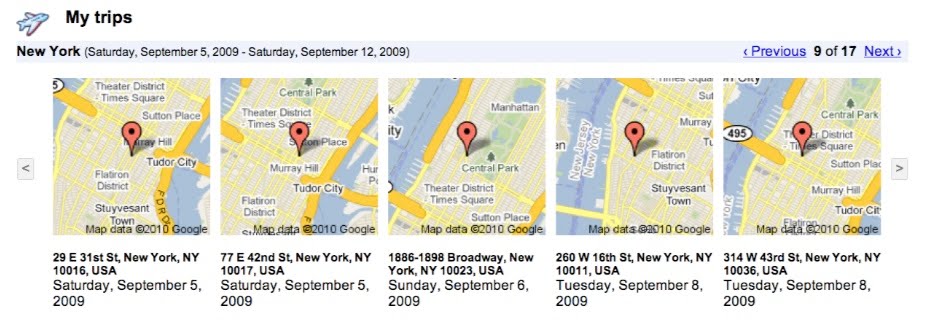
The dashboard can be used to review how much time time you have spent at an office location over the last month or year, and whether your patterns are changing, for example.
If you want to know where you stopped on a recent trip, the dashboard can be used to find the answer.
To try out the new dashboard, enable Google Latitude in the background on your phone, turn on Google Location History, and wait a few days (up to a week) to build up enough history for the dashboard to begin showing information.
Gary Kim was cited as a global "Power Mobile Influencer" by Forbes, ranked second in the world for coverage of the mobile business, and as a "top 10" telecom analyst. He is a member of Mensa, the international organization for people with IQs in the top two percent.
Facebook Not Completely Set on How It Will Use "Location"

Sometimes it is quite refreshing to hear influential CEOs frankly say they aren't completely sure how they will use an important feature, or what the business model might be. Perhaps that is a problem when a CEO "never" seems to have answers about such questions, but it is okay to figure it out and get it right, even if it sometimes takes a while.
Of course, it is less comforting when a firm does not basically have enough current revenue to fund current operations, but that isn't Facebook's problem.
Gary Kim was cited as a global "Power Mobile Influencer" by Forbes, ranked second in the world for coverage of the mobile business, and as a "top 10" telecom analyst. He is a member of Mensa, the international organization for people with IQs in the top two percent.
73 Democrats tell FCC to Drop Title II Gambit

'The uncertainty this proposal creates will jeopardize jobs and deter needed investment for years to come,' wrote Texas Congressman Gene Green. 'The significant regulatory impact of reclassifying broadband service is not something that should be taken lightly and should not be done without additional direction from Congress.'"
Common carrier regulation in the U.S. communications business historically has been good for coverage, bad for innovation. It was good for quality but bad for prices.
Whether common carrier regulation would have the same impact on broadband and innovation in the broadband business is the question
Gary Kim was cited as a global "Power Mobile Influencer" by Forbes, ranked second in the world for coverage of the mobile business, and as a "top 10" telecom analyst. He is a member of Mensa, the international organization for people with IQs in the top two percent.
Tuesday, May 25, 2010
Access for "One Price Across Digital Platforms" Will Come

The same sort of thing ultimately will happen in broadband access as well, as users start to experience greater pain paying separately, by the device, by the form of access, by the place for their broadband access services.
Both AT&T and Verizon already have spoken about a future scenario where an authorized user can use wireless and wired broadband access, across multiple devices. Think of it as a sort of family plan for individual users, where the "family" includes all the communications-capable devices a particular user wants to use.
If you think the future will feature communications need for a wide variety of appliances, used across home and mobile enviornments, but with differing usage characteristics, a unified plan makes sense.
Gary Kim was cited as a global "Power Mobile Influencer" by Forbes, ranked second in the world for coverage of the mobile business, and as a "top 10" telecom analyst. He is a member of Mensa, the international organization for people with IQs in the top two percent.
Android Music versus iTunes: Table Stakes

Not that music stores per se are that big a deal on the revenue front. Of course the music download store has never been the end game. The margins are so small that the a la carte download store only has any value as a means to an end, a way to add a sticky application and increase device value, for example, as well as to provide an e-commerce platform, to a lesser extent.
Gary Kim was cited as a global "Power Mobile Influencer" by Forbes, ranked second in the world for coverage of the mobile business, and as a "top 10" telecom analyst. He is a member of Mensa, the international organization for people with IQs in the top two percent.
4G Speeds From T-Mobile

Users will not care about which air interface gives them their bandwidth, but they will care about the speed. It's true "4G speed" is not the same thing as "4G network," but only carriers care about such things. Users just want the better performance.
The latest activations are in the New York City metropolitan area, including New Jersey and Long Island, Albany, Buffalo, Rochester and Syracuse, Connecticut (Hartford, New Haven, Milford and Stamford) and Providence, R.I.
The latest activations are in the New York City metropolitan area, including New Jersey and Long Island, Albany, Buffalo, Rochester and Syracuse, Connecticut (Hartford, New Haven, Milford and Stamford) and Providence, R.I.
The faster network already is live in Philadelphia, as well the Washington, D.C. suburbs. Boston and Washington, D.C. are expected to be "lit" in the coming weeks.
Gary Kim was cited as a global "Power Mobile Influencer" by Forbes, ranked second in the world for coverage of the mobile business, and as a "top 10" telecom analyst. He is a member of Mensa, the international organization for people with IQs in the top two percent.
Are Millennials A Predictable Part of the Generational Cycle? | Millennial Marketing

If at all accurate, Millennials are part of a pattern. Though their common generational experiences mark them as different from the three preceding generations in the cycle, the cycle will repeat, with Millennials in turn succeeded by a generation with different, but broadly predictable outlooks.
Sometimes we mistake the forest for the trees, focusing on how much "technology" is simply a background factor for Millennials. What we overlook is the pattern that suggests why their values and views are different from that of their parents, but also that those values are part of an old pattern.
If so, yet another turn is coming.
Gary Kim was cited as a global "Power Mobile Influencer" by Forbes, ranked second in the world for coverage of the mobile business, and as a "top 10" telecom analyst. He is a member of Mensa, the international organization for people with IQs in the top two percent.
Subscribe to:
Posts (Atom)
-
We have all repeatedly seen comparisons of equity value of hyperscale app providers compared to the value of connectivity providers, which s...
-
It really is surprising how often a Pareto distribution--the “80/20 rule--appears in business life, or in life, generally. Basically, the...
-
Financial analysts typically express concern when any firm’s customer base is too concentrated. Consider that, In 2024, CoreWeave’s top two ...

