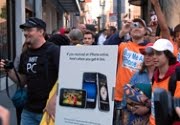
A survey by Piper Jaffray suggests that most early iPhone 4 buyers were upgrading from previous iPhones and that very few were switching to AT&T from other carriers. About 77 percent of iPhone 4 buyers polled in three cities (San Francisco, New York, and Minneapolis) were upgrading from old iPhones.
That's up from 56 percent last year and 38 percent in 2008, and represents brand loyalty that is likely unmatched in the mobile industry.
About 16 percent of buyers were switching to AT&T from other carriers, down from 28 percent last year.
Some 54 percent purchased the $299 32 GB model, up from 43 percent who bought the 32 GB iPhone 3GS last year.
About 28 percent of iPhone 4 buyers owned an iPad, which confirms that the people waiting in line were the most serious of the Apple fanatics. Of the 72 percent who did not own an iPad, 39 percent said they would probably buy one within the next year, while 61 percent said they would not.
About 65 percent were Mac owners, down from 75 percent at the first iPhone launch in 2007.
link
Friday, June 25, 2010
77% of iPhone 4 Buyers Are Upgrading from Earlier Models
Gary Kim was cited as a global "Power Mobile Influencer" by Forbes, ranked second in the world for coverage of the mobile business, and as a "top 10" telecom analyst. He is a member of Mensa, the international organization for people with IQs in the top two percent.
iPhone 4 Reception Issues: Use a Bumper
One of the solutions to the iPhone 4 signal reception issue is to use a rubber bumper, which was designed to protect the phone from physical damage but also keeps skin from touching the antenna, which is the cause of the signal reception problem.
Apparently the left side of the iPhone 4 receives Wi-Fi signals while the right side picks up the 3G signal for calls. And human tissue blocks reception of radio waves. Holding the device, when the antenna is on the exterior of the device, also means the antenna's physical length is affected. That's important because antenna length is proportional to the wavelength of the signals a device is trying to capture.
What seems like long ago, when people used TV antennae on their roofs to pick up broadcast TV, the antenna array was fairly large: feet worth of antennae. That was because the broadcast TV signals had a fairly long wavelength, so one needed a fairly-long antenna to catch the signals.
Cell phone signals are higher frequency, with shorter wavelength, so antennae are correspondingly shorter, measured in inches. But touching the antenna can effectively shorten its length, thus affecting reception, aside from the absorption of some of the signal.
link
Apparently the left side of the iPhone 4 receives Wi-Fi signals while the right side picks up the 3G signal for calls. And human tissue blocks reception of radio waves. Holding the device, when the antenna is on the exterior of the device, also means the antenna's physical length is affected. That's important because antenna length is proportional to the wavelength of the signals a device is trying to capture.
What seems like long ago, when people used TV antennae on their roofs to pick up broadcast TV, the antenna array was fairly large: feet worth of antennae. That was because the broadcast TV signals had a fairly long wavelength, so one needed a fairly-long antenna to catch the signals.
Cell phone signals are higher frequency, with shorter wavelength, so antennae are correspondingly shorter, measured in inches. But touching the antenna can effectively shorten its length, thus affecting reception, aside from the absorption of some of the signal.
link
Labels:
iphone 4
Gary Kim was cited as a global "Power Mobile Influencer" by Forbes, ranked second in the world for coverage of the mobile business, and as a "top 10" telecom analyst. He is a member of Mensa, the international organization for people with IQs in the top two percent.
iPhone 4 Reception Problems? Stop Holding It The Wrong Way, Apple Says
Apple has acknowledged and responded to the reception problems people are having with their new iPhone 4, which seem to happen based on the way the phone is being held.
The advice? Stop holding the phone the wrong way.
Apple sent Engadget the following statement: "Gripping any mobile phone will result in some attenuation of its antenna performance, with certain places being worse than others depending on the placement of the antennas. This is a fact of life for every wireless phone. If you ever experience this on your iPhone 4, avoid gripping it in the lower left corner in a way that covers both sides of the black strip in the metal band, or simply use one of many available cases."
Labels:
iphone 4
Gary Kim was cited as a global "Power Mobile Influencer" by Forbes, ranked second in the world for coverage of the mobile business, and as a "top 10" telecom analyst. He is a member of Mensa, the international organization for people with IQs in the top two percent.
Thursday, June 24, 2010
Marketing in a Broadband Context
You might be able to pull some nuggets from this presentation.
Labels:
marketing
Gary Kim was cited as a global "Power Mobile Influencer" by Forbes, ranked second in the world for coverage of the mobile business, and as a "top 10" telecom analyst. He is a member of Mensa, the international organization for people with IQs in the top two percent.
Vote: Do You Have Signal Strength Issues on Your iPhone 4?
http://polldaddy.com/poll/3387884/
And don't forget to try it using both hands, left and right. You should get different results.
Labels:
iphone 4
Gary Kim was cited as a global "Power Mobile Influencer" by Forbes, ranked second in the world for coverage of the mobile business, and as a "top 10" telecom analyst. He is a member of Mensa, the international organization for people with IQs in the top two percent.
Gap Between Revenue and Bandwidth is The Heart of the Matter
One doesn't have to love, or even like, any of the communication providers out there to acknowledge that there is a key business problem here that directly affects any user's ability to get the most out of their communication spending and experience.
The global voice market is declining, first on the fixed line networks and now starting on the mobile networks as well. You don't have to care about that. But if you want better services, you have to acknowledge that if current revenue gets cut in half, then perhaps to a third, the people who run networks will have a hard time investing in better networks. This is not a matter of sentiment but of economics.
Everybody knows that the replacement revenues will have to come from the broadband, video, content mobile, data and commerce services realms. So the practical issue providers have is to scale the new revenues at least up to the point where voice revenue is now. Along the way service providers will have to cut costs as well, but the key issue is new revenues.
And the problem there on the bandwidth services front is that across all networks, revenue does not scale linearly with bandwidth supplied. Since nobody seems to think that can be changed too much, the burden of growth will come on the new applications and services fronts.
That means most issues related to terms of service or price of service are simply efforts to better match cost and revenue for the access part of the business. Nobody thinks the whole problem can be fixed that way, but it is part of the solution, in addition to deploying more-efficient networks and creating new services that people are comfortable paying for.
You don't have to love or like any particular service provider to hope service providers can figure this out. Unless of course you have a way of creating your own services.
The global voice market is declining, first on the fixed line networks and now starting on the mobile networks as well. You don't have to care about that. But if you want better services, you have to acknowledge that if current revenue gets cut in half, then perhaps to a third, the people who run networks will have a hard time investing in better networks. This is not a matter of sentiment but of economics.
Everybody knows that the replacement revenues will have to come from the broadband, video, content mobile, data and commerce services realms. So the practical issue providers have is to scale the new revenues at least up to the point where voice revenue is now. Along the way service providers will have to cut costs as well, but the key issue is new revenues.
And the problem there on the bandwidth services front is that across all networks, revenue does not scale linearly with bandwidth supplied. Since nobody seems to think that can be changed too much, the burden of growth will come on the new applications and services fronts.
That means most issues related to terms of service or price of service are simply efforts to better match cost and revenue for the access part of the business. Nobody thinks the whole problem can be fixed that way, but it is part of the solution, in addition to deploying more-efficient networks and creating new services that people are comfortable paying for.
You don't have to love or like any particular service provider to hope service providers can figure this out. Unless of course you have a way of creating your own services.
Labels:
business model
Gary Kim was cited as a global "Power Mobile Influencer" by Forbes, ranked second in the world for coverage of the mobile business, and as a "top 10" telecom analyst. He is a member of Mensa, the international organization for people with IQs in the top two percent.
Is the Apple 4 Steel Band Antenna the Problem, or Something Else?
Users are reporting problems with signal reception when the Apple iPhone 4 is held in the left hand, as opposed to the right. But the earlier iPhone 3 also had reception issues, leading one to wonder whether it is a physical issue or a software issue.
It is starting to appear as though every new smartphone has some issues, despite the strengths. HTC Evo users will tell you that despite the bigger battery and beautiful screen, battery life is poor. Poor as in, if you do a lot of web operations, you might have to charge it more than once a day. Of course, iPhone 3 users probably would agree that heavy web use kills battery life as well.
Gary Kim was cited as a global "Power Mobile Influencer" by Forbes, ranked second in the world for coverage of the mobile business, and as a "top 10" telecom analyst. He is a member of Mensa, the international organization for people with IQs in the top two percent.
Nobody Likes ETFs, But Nobody Wants to Pay Full Retail, Either
Consumers don't like early termination fees. But neither do they like paying full price. A new Apple iPhone 4 with 32 GBytes of memory can be purchased now for $299 with a two-year contract, or at full retail for $699, without a contract.
Which option do you suspect most people will choose? If you want to know why the hated ETFs exist, it is the subsidy.
AT&T’s ETF on a smartphone like the iPhone is $325, up from $175 in May. Why? Some will carrier greed. But under the old pricing rules, a consumer could buy a phone for $99 on contract, instead of $600. Then the consumer could break the contract, pay the $175 fee, getting the device, without a contract commitment, for $274.
The customer then could sell the device on eBay or simply sign up for service with no contract.
Nobody likes contracts or ETFs. But nobody wants to pay full retail, either.
Gary Kim was cited as a global "Power Mobile Influencer" by Forbes, ranked second in the world for coverage of the mobile business, and as a "top 10" telecom analyst. He is a member of Mensa, the international organization for people with IQs in the top two percent.
Right-Handed Users May Have Signal Reception Problems on iPhone 4
Most people now know that when using a mobile device, moving the antenna just several feet can sometimes change signal reception. Most people may not know that physical objects such as hands can interfere with signal reception.
It appears Apple's new iPhone 4 may suffer from that problem. Apparently, the iPhone 4 signal strength drops when a user grips the phone by the metal antenna band. Gizmodo has over a dozen videos of users showing off this problem.
When held in the left hand with our fingers touching the metal band, the bars representing signal strength dropped from 5 to 1 in less than a minute.
The problem appears to involve finger-contact on certain parts of the metal band. When the phone is switched to the right hand, which put our fingers in different position, the signal strength remained the same. So for many people, user experience may depend on whether they are left-handed or right-handed.
Right-handed people are going to tend to hold the device in the left hand, and navigate with the fingers of the right hand. That means most people are going to be prone to block the signal themselves, simply based on which hand they are using to hold the device.
And you might have thought mobile phone design was easy!
It appears Apple's new iPhone 4 may suffer from that problem. Apparently, the iPhone 4 signal strength drops when a user grips the phone by the metal antenna band. Gizmodo has over a dozen videos of users showing off this problem.
When held in the left hand with our fingers touching the metal band, the bars representing signal strength dropped from 5 to 1 in less than a minute.
The problem appears to involve finger-contact on certain parts of the metal band. When the phone is switched to the right hand, which put our fingers in different position, the signal strength remained the same. So for many people, user experience may depend on whether they are left-handed or right-handed.
Right-handed people are going to tend to hold the device in the left hand, and navigate with the fingers of the right hand. That means most people are going to be prone to block the signal themselves, simply based on which hand they are using to hold the device.
And you might have thought mobile phone design was easy!
Labels:
iphone 4
Gary Kim was cited as a global "Power Mobile Influencer" by Forbes, ranked second in the world for coverage of the mobile business, and as a "top 10" telecom analyst. He is a member of Mensa, the international organization for people with IQs in the top two percent.
81% of App Store Downloads are "Free"
Piper Jaffray analyst Gene Munster estimates that 81 percent of downloads from Apple's App Store are free.
His analysis of the Top 50 paid apps reveals that their average selling price is $1.49. Munster estimates that on average, Apple receives $0.29 for every app that's downloaded from its store.
Munster calculates that this means $428 million for Apple based on its 70-30 revenue-share split. Munster estimates that the App Store is generating more than 16.6 million app downloads a day, compared to 8.9 million song downloads from the iTunes Store.
His analysis of the Top 50 paid apps reveals that their average selling price is $1.49. Munster estimates that on average, Apple receives $0.29 for every app that's downloaded from its store.
Munster calculates that this means $428 million for Apple based on its 70-30 revenue-share split. Munster estimates that the App Store is generating more than 16.6 million app downloads a day, compared to 8.9 million song downloads from the iTunes Store.
Gary Kim was cited as a global "Power Mobile Influencer" by Forbes, ranked second in the world for coverage of the mobile business, and as a "top 10" telecom analyst. He is a member of Mensa, the international organization for people with IQs in the top two percent.
GetJar Raises $11 Million
Fast-growing mobile app store GetJar, which says it has had more than one billion apps downloaded from its store to date, making it second in size only to Apple’s app store, has raised $11 million in a second round of funding.
GetJar’s app store includes about 70,000 apps for all of the major mobile operating systems, including Apple’s, although CEO Ilja Laurs tells us that most of the company’s growth is coming from “open” platforms where there is less of an “established and convenient place” to get apps.
He says the company, which he calls the “Wal-Mart for mobile apps,” will invest much of the new cash in building up its presence on the Android platform.
Labels:
app store,
Getjar,
mobile app store
Gary Kim was cited as a global "Power Mobile Influencer" by Forbes, ranked second in the world for coverage of the mobile business, and as a "top 10" telecom analyst. He is a member of Mensa, the international organization for people with IQs in the top two percent.
Only Issue: Will Apple Sell 1 Million iPhone 4 Devices Today?
The only issue is whether Apple will sell one million iPhone 4 devices today. A couple of obvious questions suggst themselves. Since all the early-adopter technophiles and even early majority users made their decisions long ago, Apple's sales now must come from the "typical" consumer.
Smartphone sales have been climbing for the past couple of years, so the issue is how much of the growth Apple is able to grab. The harder-to-answer question is whether Facetime, the videoconferencing app, which encourage families with widely-scattered members to get the device just for that feature.
Gary Kim was cited as a global "Power Mobile Influencer" by Forbes, ranked second in the world for coverage of the mobile business, and as a "top 10" telecom analyst. He is a member of Mensa, the international organization for people with IQs in the top two percent.
Wednesday, June 23, 2010
Carrier Ethernet Displaces Nearly All Mobile Backhaul Orders
Wireless network operators are requesting fewer T1s and more carrier Ethernet connections for mobile backhaul, and could stop ordering T1s entirely as soon as next year, Tower Cloud Inc. CEO Ron Mudry says.
link
link
Labels:
mobile backhaul,
Tower Cloud
Gary Kim was cited as a global "Power Mobile Influencer" by Forbes, ranked second in the world for coverage of the mobile business, and as a "top 10" telecom analyst. He is a member of Mensa, the international organization for people with IQs in the top two percent.
U.S. Consumers Show High Interest in Femtocell Services, Survey Finds
More than half of U.S. broadband households with mobile phones are interested in femtocell benefits, and are willing to pay for the devices and associated new services, a survey by Parks Associates, conducted for the Femto Forum has found.
The survey found that fewer than 10 percent of consumers were previously familiar with femtocells. However after hearing a description of the femtocell and its benefits, 56 percent of respondents found femtocells appealing, and two thirds found the technology either “very” or “extremely” appealing. Additionally, 89 percent of those respondents who were already familiar with femtocells found them appealing.
The primary driver for femtocell interest was improved in-home coverage. Important secondary drivers included increased mobile handset battery life, faster mobile broadband, advanced femtocell services and home-zone calling tariffs.
The survey found that 72 percent of consumers who found femtocells appealing were very interested in at least one advanced femtocell service. Examples of such services include "Virtual Home Number," which rings every cell phone in the home, or "Family Alerts," which warn when a subscriber has left or returned home.
Half of these respondents indicated a willingness to pay $4.99 a month for their single favorite service or $9.99 a month for a bundle of their favorite three services.
Although Wi-Fi is sometimes viewed as a femtocell alternative, the survey showed that 84 percent of people who heavily use Wi-Fi on their 3G devices found femtocells appealing, apparently because of the improved voice coverage and battery life.
Among consumers who consider themselves likely to change operator in the next 12 months, 44 percent said that they would very likely reconsider if their current operator offered a femtocell. Similarly, 35 percent of consumers in multi-operator households said they would likely consolidate their services around a single provider who offered a femtocell.
Demand is highest when upfront device costs are in the $20 to $50 range. This demand is cut in half when device prices are in the $50 to $100 range and halves again when the cost exceeds $100.
“The clear message from this research is that femtocells have widespread appeal and consumers are willing to pay for them," said Harry Wang, director of mobile product research, Parks Associates.
link
The survey found that fewer than 10 percent of consumers were previously familiar with femtocells. However after hearing a description of the femtocell and its benefits, 56 percent of respondents found femtocells appealing, and two thirds found the technology either “very” or “extremely” appealing. Additionally, 89 percent of those respondents who were already familiar with femtocells found them appealing.
The primary driver for femtocell interest was improved in-home coverage. Important secondary drivers included increased mobile handset battery life, faster mobile broadband, advanced femtocell services and home-zone calling tariffs.
The survey found that 72 percent of consumers who found femtocells appealing were very interested in at least one advanced femtocell service. Examples of such services include "Virtual Home Number," which rings every cell phone in the home, or "Family Alerts," which warn when a subscriber has left or returned home.
Half of these respondents indicated a willingness to pay $4.99 a month for their single favorite service or $9.99 a month for a bundle of their favorite three services.
Although Wi-Fi is sometimes viewed as a femtocell alternative, the survey showed that 84 percent of people who heavily use Wi-Fi on their 3G devices found femtocells appealing, apparently because of the improved voice coverage and battery life.
Among consumers who consider themselves likely to change operator in the next 12 months, 44 percent said that they would very likely reconsider if their current operator offered a femtocell. Similarly, 35 percent of consumers in multi-operator households said they would likely consolidate their services around a single provider who offered a femtocell.
Demand is highest when upfront device costs are in the $20 to $50 range. This demand is cut in half when device prices are in the $50 to $100 range and halves again when the cost exceeds $100.
“The clear message from this research is that femtocells have widespread appeal and consumers are willing to pay for them," said Harry Wang, director of mobile product research, Parks Associates.
link
Labels:
consumer behavior,
femtocell
Gary Kim was cited as a global "Power Mobile Influencer" by Forbes, ranked second in the world for coverage of the mobile business, and as a "top 10" telecom analyst. He is a member of Mensa, the international organization for people with IQs in the top two percent.
Verizon Tests 10 Gbps to Home
Verizon says it has managed to push 10 gigabits per second through its FiOS trunking network, including 2 gigabit per second service to a customer’s house with two simultaneously-used PCs.
The XG-PON field trial connected a FiOS customer location with 10 gigabits per second downstream to the home and 2.5 Gbps upstream.
The test demonstrates the capability of the Verizon's FiOS network to accommodate a wide array of new and emerging video services and the growing demand for streaming video content and other bandwidth-intensive applications.
The latest field trial was conducted in May in Taunton, Mass., with a XG-PON system developed by Motorola, a supplier of BPON and GPON optical networking equipment to Verizon.
At the customer's home, the optical network terminal (ONT) received the 10/2.5 Gbps feed and used two data communication ports to simultaneously provide transmission speeds of close to 1 Gbps to each of two PCs inside the home. Combined, the two ports delivered approximately 1.85 Gbps in aggregate bandwidth in each direction.
Tests were designed to simulate what two different customers might experience while using their PCs to download, upload or share files to the Internet when served by a 10G PON system. In addition, speed tests were performed to Verizon's speed test server located more than 400 miles away in Reston, Va., realized speeds of up to 915 Mbps between the PC and the speed test server.
"XG-PON can provide the capacity needed to support the explosive growth in bandwidth envisioned for new and emerging services such as 3DTV and Ultra HD TV, and the growing demand for streaming video content to the PC and TV, as well as the increased use of concurrent applications," said Vincent O'Byrne, director of technology for Verizon's FTTP architecture and design effort.
Verizon trumpeted the test as proof that its gamble on building out a large fiber-optic network will pay off in the future, as user needs for bandwidth outstrip the capabilities of cable and DSL.
The test appears aimed to reassure investors that Verizon made the right decision to deploy the fiber-to-home network, and to assure observers that Verizon can keep up with any new bandwidth initiatives cable competitors may deploy.
The XG-PON field trial connected a FiOS customer location with 10 gigabits per second downstream to the home and 2.5 Gbps upstream.
The test demonstrates the capability of the Verizon's FiOS network to accommodate a wide array of new and emerging video services and the growing demand for streaming video content and other bandwidth-intensive applications.
The latest field trial was conducted in May in Taunton, Mass., with a XG-PON system developed by Motorola, a supplier of BPON and GPON optical networking equipment to Verizon.
At the customer's home, the optical network terminal (ONT) received the 10/2.5 Gbps feed and used two data communication ports to simultaneously provide transmission speeds of close to 1 Gbps to each of two PCs inside the home. Combined, the two ports delivered approximately 1.85 Gbps in aggregate bandwidth in each direction.
Tests were designed to simulate what two different customers might experience while using their PCs to download, upload or share files to the Internet when served by a 10G PON system. In addition, speed tests were performed to Verizon's speed test server located more than 400 miles away in Reston, Va., realized speeds of up to 915 Mbps between the PC and the speed test server.
"XG-PON can provide the capacity needed to support the explosive growth in bandwidth envisioned for new and emerging services such as 3DTV and Ultra HD TV, and the growing demand for streaming video content to the PC and TV, as well as the increased use of concurrent applications," said Vincent O'Byrne, director of technology for Verizon's FTTP architecture and design effort.
Verizon trumpeted the test as proof that its gamble on building out a large fiber-optic network will pay off in the future, as user needs for bandwidth outstrip the capabilities of cable and DSL.
The test appears aimed to reassure investors that Verizon made the right decision to deploy the fiber-to-home network, and to assure observers that Verizon can keep up with any new bandwidth initiatives cable competitors may deploy.
Gary Kim was cited as a global "Power Mobile Influencer" by Forbes, ranked second in the world for coverage of the mobile business, and as a "top 10" telecom analyst. He is a member of Mensa, the international organization for people with IQs in the top two percent.
Subscribe to:
Comments (Atom)
On the Use and Misuse of Principles, Theorems and Concepts
When financial commentators compile lists of "potential black swans," they misunderstand the concept. As explained by Taleb Nasim ...
-
We have all repeatedly seen comparisons of equity value of hyperscale app providers compared to the value of connectivity providers, which s...
-
It really is surprising how often a Pareto distribution--the “80/20 rule--appears in business life, or in life, generally. Basically, the...
-
One recurring issue with forecasts of multi-access edge computing is that it is easier to make predictions about cost than revenue and infra...


