Monday, June 28, 2010
Should Nokia Abandon 90% of its Market?
One way you might read this is that Nokia needs to get "more social with its fans." The other way is that 90 percent of younger users are not fans. There are hazards either way. "Abandon" might be too strong a way of putting matters, but it is the obvious inverse of a strategy focused on the 10 percent of fans.

 Gary Kim was cited as a global "Power Mobile Influencer" by Forbes, ranked second in the world for coverage of the mobile business, and as a "top 10" telecom analyst. He is a member of Mensa, the international organization for people with IQs in the top two percent.
Easy to Use Web Browser Impact

To the extent that Symbian and Research in Motion devices have been harder to use, their web usage shows the impact of the barrier, while Apple and Android devices indicate what happens when the barrier is removed.
Some will say this poses a potential problem for mobile service providers. But there is one problem worse than dramatically increased data demand: insufficient demand.
Gary Kim was cited as a global "Power Mobile Influencer" by Forbes, ranked second in the world for coverage of the mobile business, and as a "top 10" telecom analyst. He is a member of Mensa, the international organization for people with IQs in the top two percent.
Friday, June 25, 2010
World Cup Sets an Online Video Record
ESPN says 1.1 million people watched at least some of the USA-Algeria World Cup match. One suspects that is largely because the match was aired from 10 a.m. to noon EDT, during working hours for most of the United States.
One wonders what the impact was on enterprise Internet connections and local area networks.
Gary Kim was cited as a global "Power Mobile Influencer" by Forbes, ranked second in the world for coverage of the mobile business, and as a "top 10" telecom analyst. He is a member of Mensa, the international organization for people with IQs in the top two percent.
Debt Now is THE Economic Problem

The battle between borrowers and creditors may be the defining struggle of the next generation. If you have children or grandchildren, this is why "debt" suddenly has exploded as a major political issue in all developed economies, though it typically has been a "snoozer" of a voter issue.
Gary Kim was cited as a global "Power Mobile Influencer" by Forbes, ranked second in the world for coverage of the mobile business, and as a "top 10" telecom analyst. He is a member of Mensa, the international organization for people with IQs in the top two percent.
Net Neutrality is a Fight Over Ecosystem Revenue Share

And there are legitimate concerns about potential anti-competitive behavior.
But at its heart the arguments are about gaining the best positioning with the new ecosystem. Were it not for mobile services, communication service providers would be in big financial trouble.
Broadband services have helped, but are a fraction of the voice revenue now dwindling away. To replace lost voice revenues, access provider broadband revenues would have to triple. To many observers, that must mean revenue shared with business partners, as it is hard to see end-user payments tripling.
link
Gary Kim was cited as a global "Power Mobile Influencer" by Forbes, ranked second in the world for coverage of the mobile business, and as a "top 10" telecom analyst. He is a member of Mensa, the international organization for people with IQs in the top two percent.
U.K. Regulator Not Initially Convinced Net Neutrality Rules Needed

Ofcom's proceeding is noteworthy for its refreshing honesty about the "network neutrality" debate; namely that the stakes include the utlimate division of revenue and profit in the developing broadband ecosystem.
"As the telecommunications market, content sector and online sector change, points of friction will inevitably arise over who controls customer relationships and the rate of innovation," Ofcom said. "Firms across these sectors are also competing for a share of advertising revenues and consumers’ expenditure at a time when there are concerns about the sustainability of many of the existing business models, not just for traditional telco and content distribution businesses but also a surprisingly large number of online businesses."
"As the value chain is taking shape, network operators and content providers are bargaining over how future rents will be divided and technical measures such as DPI and DRM are being deployed in part to strengthen relative negotiating positions," Ofcom noted.
The situation is especially acute in the mobile space, where bandwidth consumed, and hence network cost, is growing far faster than revenue.
link
Gary Kim was cited as a global "Power Mobile Influencer" by Forbes, ranked second in the world for coverage of the mobile business, and as a "top 10" telecom analyst. He is a member of Mensa, the international organization for people with IQs in the top two percent.
RIM Co-CEO Promises "Quantum Leap"
BlackBerrry changed the experience of using a mobile once, and believes it can do so again. The BlackBerry 6 platform, and new devices based on it, will be available in the second half of 2010.
"You'll just be amazed that how it's a quantum leap over anything that's out there," says RIM co-CEO Jim Balsillie. That's a pretty-big claim, but it will be interesting to see what RIM can deliver. Quantum leaps are about sudden and dramatic changes of physical form, on the order of water turning to ice or steam, for example.
That would be a big thing indeed, if RIM can deliver.
Gary Kim was cited as a global "Power Mobile Influencer" by Forbes, ranked second in the world for coverage of the mobile business, and as a "top 10" telecom analyst. He is a member of Mensa, the international organization for people with IQs in the top two percent.
Phone Support as a Marketing Channel at Zappos
Zappos CEO Tony Hsieh thinks customer service and support can be an excellent marketing channel. "We believe the telephone is one of the best branding devices out there," he says. "We have the customer’s undivided attention for five to 10 minutes."
"If we get the interaction right, what we’ve found is that customers remember that for a very long time and tell their friends and family about us," says Hsieh.
One of the reasons such customer contacts, not typically thought of as a marketing channel, can have so much impact on a brand is that opinions about firms travel much more quickly in a social media context, he argues.
Gary Kim was cited as a global "Power Mobile Influencer" by Forbes, ranked second in the world for coverage of the mobile business, and as a "top 10" telecom analyst. He is a member of Mensa, the international organization for people with IQs in the top two percent.
Facebook Is Closing the Ad Revenue Gap with the Portals
 Gary Kim was cited as a global "Power Mobile Influencer" by Forbes, ranked second in the world for coverage of the mobile business, and as a "top 10" telecom analyst. He is a member of Mensa, the international organization for people with IQs in the top two percent.
77% of iPhone 4 Buyers Are Upgrading from Earlier Models
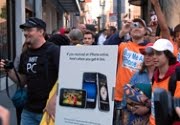
That's up from 56 percent last year and 38 percent in 2008, and represents brand loyalty that is likely unmatched in the mobile industry.
About 16 percent of buyers were switching to AT&T from other carriers, down from 28 percent last year.
Some 54 percent purchased the $299 32 GB model, up from 43 percent who bought the 32 GB iPhone 3GS last year.
About 28 percent of iPhone 4 buyers owned an iPad, which confirms that the people waiting in line were the most serious of the Apple fanatics. Of the 72 percent who did not own an iPad, 39 percent said they would probably buy one within the next year, while 61 percent said they would not.
About 65 percent were Mac owners, down from 75 percent at the first iPhone launch in 2007.
link
Gary Kim was cited as a global "Power Mobile Influencer" by Forbes, ranked second in the world for coverage of the mobile business, and as a "top 10" telecom analyst. He is a member of Mensa, the international organization for people with IQs in the top two percent.
iPhone 4 Reception Issues: Use a Bumper
One of the solutions to the iPhone 4 signal reception issue is to use a rubber bumper, which was designed to protect the phone from physical damage but also keeps skin from touching the antenna, which is the cause of the signal reception problem.
Apparently the left side of the iPhone 4 receives Wi-Fi signals while the right side picks up the 3G signal for calls. And human tissue blocks reception of radio waves. Holding the device, when the antenna is on the exterior of the device, also means the antenna's physical length is affected. That's important because antenna length is proportional to the wavelength of the signals a device is trying to capture.
What seems like long ago, when people used TV antennae on their roofs to pick up broadcast TV, the antenna array was fairly large: feet worth of antennae. That was because the broadcast TV signals had a fairly long wavelength, so one needed a fairly-long antenna to catch the signals.
Cell phone signals are higher frequency, with shorter wavelength, so antennae are correspondingly shorter, measured in inches. But touching the antenna can effectively shorten its length, thus affecting reception, aside from the absorption of some of the signal.
link
Apparently the left side of the iPhone 4 receives Wi-Fi signals while the right side picks up the 3G signal for calls. And human tissue blocks reception of radio waves. Holding the device, when the antenna is on the exterior of the device, also means the antenna's physical length is affected. That's important because antenna length is proportional to the wavelength of the signals a device is trying to capture.
What seems like long ago, when people used TV antennae on their roofs to pick up broadcast TV, the antenna array was fairly large: feet worth of antennae. That was because the broadcast TV signals had a fairly long wavelength, so one needed a fairly-long antenna to catch the signals.
Cell phone signals are higher frequency, with shorter wavelength, so antennae are correspondingly shorter, measured in inches. But touching the antenna can effectively shorten its length, thus affecting reception, aside from the absorption of some of the signal.
link
Gary Kim was cited as a global "Power Mobile Influencer" by Forbes, ranked second in the world for coverage of the mobile business, and as a "top 10" telecom analyst. He is a member of Mensa, the international organization for people with IQs in the top two percent.
iPhone 4 Reception Problems? Stop Holding It The Wrong Way, Apple Says

The advice? Stop holding the phone the wrong way.
Apple sent Engadget the following statement: "Gripping any mobile phone will result in some attenuation of its antenna performance, with certain places being worse than others depending on the placement of the antennas. This is a fact of life for every wireless phone. If you ever experience this on your iPhone 4, avoid gripping it in the lower left corner in a way that covers both sides of the black strip in the metal band, or simply use one of many available cases."
Gary Kim was cited as a global "Power Mobile Influencer" by Forbes, ranked second in the world for coverage of the mobile business, and as a "top 10" telecom analyst. He is a member of Mensa, the international organization for people with IQs in the top two percent.
Thursday, June 24, 2010
Marketing in a Broadband Context
You might be able to pull some nuggets from this presentation.
Gary Kim was cited as a global "Power Mobile Influencer" by Forbes, ranked second in the world for coverage of the mobile business, and as a "top 10" telecom analyst. He is a member of Mensa, the international organization for people with IQs in the top two percent.
Vote: Do You Have Signal Strength Issues on Your iPhone 4?

And don't forget to try it using both hands, left and right. You should get different results.
Gary Kim was cited as a global "Power Mobile Influencer" by Forbes, ranked second in the world for coverage of the mobile business, and as a "top 10" telecom analyst. He is a member of Mensa, the international organization for people with IQs in the top two percent.
Gap Between Revenue and Bandwidth is The Heart of the Matter
One doesn't have to love, or even like, any of the communication providers out there to acknowledge that there is a key business problem here that directly affects any user's ability to get the most out of their communication spending and experience.
The global voice market is declining, first on the fixed line networks and now starting on the mobile networks as well. You don't have to care about that. But if you want better services, you have to acknowledge that if current revenue gets cut in half, then perhaps to a third, the people who run networks will have a hard time investing in better networks. This is not a matter of sentiment but of economics.
Everybody knows that the replacement revenues will have to come from the broadband, video, content mobile, data and commerce services realms. So the practical issue providers have is to scale the new revenues at least up to the point where voice revenue is now. Along the way service providers will have to cut costs as well, but the key issue is new revenues.
And the problem there on the bandwidth services front is that across all networks, revenue does not scale linearly with bandwidth supplied. Since nobody seems to think that can be changed too much, the burden of growth will come on the new applications and services fronts.
That means most issues related to terms of service or price of service are simply efforts to better match cost and revenue for the access part of the business. Nobody thinks the whole problem can be fixed that way, but it is part of the solution, in addition to deploying more-efficient networks and creating new services that people are comfortable paying for.
You don't have to love or like any particular service provider to hope service providers can figure this out. Unless of course you have a way of creating your own services.
The global voice market is declining, first on the fixed line networks and now starting on the mobile networks as well. You don't have to care about that. But if you want better services, you have to acknowledge that if current revenue gets cut in half, then perhaps to a third, the people who run networks will have a hard time investing in better networks. This is not a matter of sentiment but of economics.
Everybody knows that the replacement revenues will have to come from the broadband, video, content mobile, data and commerce services realms. So the practical issue providers have is to scale the new revenues at least up to the point where voice revenue is now. Along the way service providers will have to cut costs as well, but the key issue is new revenues.
And the problem there on the bandwidth services front is that across all networks, revenue does not scale linearly with bandwidth supplied. Since nobody seems to think that can be changed too much, the burden of growth will come on the new applications and services fronts.
That means most issues related to terms of service or price of service are simply efforts to better match cost and revenue for the access part of the business. Nobody thinks the whole problem can be fixed that way, but it is part of the solution, in addition to deploying more-efficient networks and creating new services that people are comfortable paying for.
You don't have to love or like any particular service provider to hope service providers can figure this out. Unless of course you have a way of creating your own services.
Gary Kim was cited as a global "Power Mobile Influencer" by Forbes, ranked second in the world for coverage of the mobile business, and as a "top 10" telecom analyst. He is a member of Mensa, the international organization for people with IQs in the top two percent.
Subscribe to:
Comments (Atom)
Indirect Monetization of Language Models is Likely
Monetization of most language models might ultimately come down to the ability to earn revenues indirectly, as AI is used to add useful fe...
-
We have all repeatedly seen comparisons of equity value of hyperscale app providers compared to the value of connectivity providers, which s...
-
It really is surprising how often a Pareto distribution--the “80/20 rule--appears in business life, or in life, generally. Basically, the...
-
One recurring issue with forecasts of multi-access edge computing is that it is easier to make predictions about cost than revenue and infra...


