Thursday, June 16, 2011
T-Mobile USA Launches HTC "Sensation"

 Gary Kim was cited as a global "Power Mobile Influencer" by Forbes, ranked second in the world for coverage of the mobile business, and as a "top 10" telecom analyst. He is a member of Mensa, the international organization for people with IQs in the top two percent.
T-Mobile USA Boosts Speeds in 42 Markets
 T-Mobile USA is doubling the speed of its 4G network in 42 additional markets including Albuquerque, N.M.; Cleveland and Columbus, Ohio; Sacramento and San Diego, Calif.; Salt Lake City, Utah and San Antonio, Texas. Now, customers in 97 markets across the country have access to T-Mobile’s HSPA 42 network.
T-Mobile has seen average download speeds approaching 10 Mbps with peak speeds of 27 Mbps on the T-Mobile Rocket 3.0 laptop stick, the company’s first 42 Mbps device. T-Mobile expects more than 150 million American’s to have access to these increased 4G speeds by mid-2011.
Gary Kim was cited as a global "Power Mobile Influencer" by Forbes, ranked second in the world for coverage of the mobile business, and as a "top 10" telecom analyst. He is a member of Mensa, the international organization for people with IQs in the top two percent.
New Data Shows More Content Means More Leads
Companies that blogged 20 or more times in a month saw the most return in traffic and leads, a recent HubSpot analysis of lead generation numbers for over 4,000 companies found.
The results make quite a compelling case that "more is better" when it comes to content creation. Companies with over 400 indexed pages generated the most traffic and leads.
In the case of blogs, landing pages, and indexed pages -- which are all critical pieces of the inbound marketing methodologies, the data showed that companies that created more, generated more leads and traffic back in return. Companies with over 31 landing pages generated the most leads (nearly 10 times that of the lowest, ‘less that 5’ category).
Gary Kim was cited as a global "Power Mobile Influencer" by Forbes, ranked second in the world for coverage of the mobile business, and as a "top 10" telecom analyst. He is a member of Mensa, the international organization for people with IQs in the top two percent.
What is "Influence"?
Conversation Agent quotes on Influence
Probably more important to most brands is "how do I gain influence?"
View more presentations from Valeria Maltoni
Gary Kim was cited as a global "Power Mobile Influencer" by Forbes, ranked second in the world for coverage of the mobile business, and as a "top 10" telecom analyst. He is a member of Mensa, the international organization for people with IQs in the top two percent.
T-Mobile Launches "More for Me" Social Shopping Service
 T-Mobile USA has launched "More for Me," a nationwide aggregation service that offers consumers the best in daily deals. The free service runs on Android devices, and the app can be downloaded from the Android Market.
 More for Me is the first nationwide daily deal aggregation service of its kind from a national wireless carrier, T-Mobile USA says. Discounts and deals are generated from popular social buying sites, such as LivingSocial, as well as exclusive offers from T-Mobile and its partners.
Gary Kim was cited as a global "Power Mobile Influencer" by Forbes, ranked second in the world for coverage of the mobile business, and as a "top 10" telecom analyst. He is a member of Mensa, the international organization for people with IQs in the top two percent.
Worldwide Mobile Advertising Revenue to Reach $3.3 Billion in 2011
Worldwide mobile advertising revenue is forecast to reach $3.3 billion in 2011, more than double the $1.6 billion generated in 2010, according to Gartner.
Worldwide revenue will reach $20.6 billion by 2015, but not all types of mobile advertising will generate the same opportunity. Search and maps will deliver the highest revenue, while video and audio ads will see the fastest growth through 2015.
2010 | 2011 | 2015 | |
North America | 304.3 | 701.7 | 5,791.4 |
Western Europe | 257.1 | 569.3 | 5,131.9 |
Asia/Pacific and Japan | 868.8 | 1,628.5 | 6,925.0 |
Rest of the World | 196.9 | 410.4 | 2,761.7 |
Total | 1,627.1 | 3,309.9 | 20,610.0 |
Source: Gartner (June 2011)
Gary Kim was cited as a global "Power Mobile Influencer" by Forbes, ranked second in the world for coverage of the mobile business, and as a "top 10" telecom analyst. He is a member of Mensa, the international organization for people with IQs in the top two percent.
Blogging, Tweeting, and What's In Between
 Some people think "blogs are dead." Usually, when that gets said, it is a reference to massive growth of tweeting, Facebook posts and other very-short snippets of stuff. Tumblr is a good example of the in-between space between a tweet and a blog post, with its emphasis on visual elements. Of course, some would argue something else is going on, namely that blogs remain a place where relatively more thoughtful stuff happens, while Tumblr is better for highly-visual, word spare content. See http://inessential.com/2011/06/15/gopher_dead_blogging_lives.
All we are seeing is the evolution of tools to fit different use cases. Consider tablets. They work really well for most people, who only have to create a minor amount of content, such as replying to an email, or taking a limited amount of notes at a meeting, creating a calendar event or something simple.

Sure, you can add a keyboard to a tablet, plus other peripherals (one of these days), but then what you have is a PC.
It's the same thing with media that allow people to express themselves.
Not everybody needs a blog. For lots of people, tweeting and Facebook are all they require. For others, who want to share content of a highly-visual nature, Tumblr works great.
Not everybody needs a blog. For lots of people, tweeting and Facebook are all they require. For others, who want to share content of a highly-visual nature, Tumblr works great.
"Tumblr, to me at least, isn’t a blog platform but something new entirely - a social network for both original and curated content that is longer than a tweet and often more visual in nature. It’s a hybrid," says Steve Rubel. See http://www.steverubel.me/post/6583713687/tumblr-is-the-next-great-social-network.
For some purposes, such as a "fashion portal," Tumblr is a great tool. See http://blog.pret-a-portel.com/.
Gary Kim was cited as a global "Power Mobile Influencer" by Forbes, ranked second in the world for coverage of the mobile business, and as a "top 10" telecom analyst. He is a member of Mensa, the international organization for people with IQs in the top two percent.
Does Skype Matter?
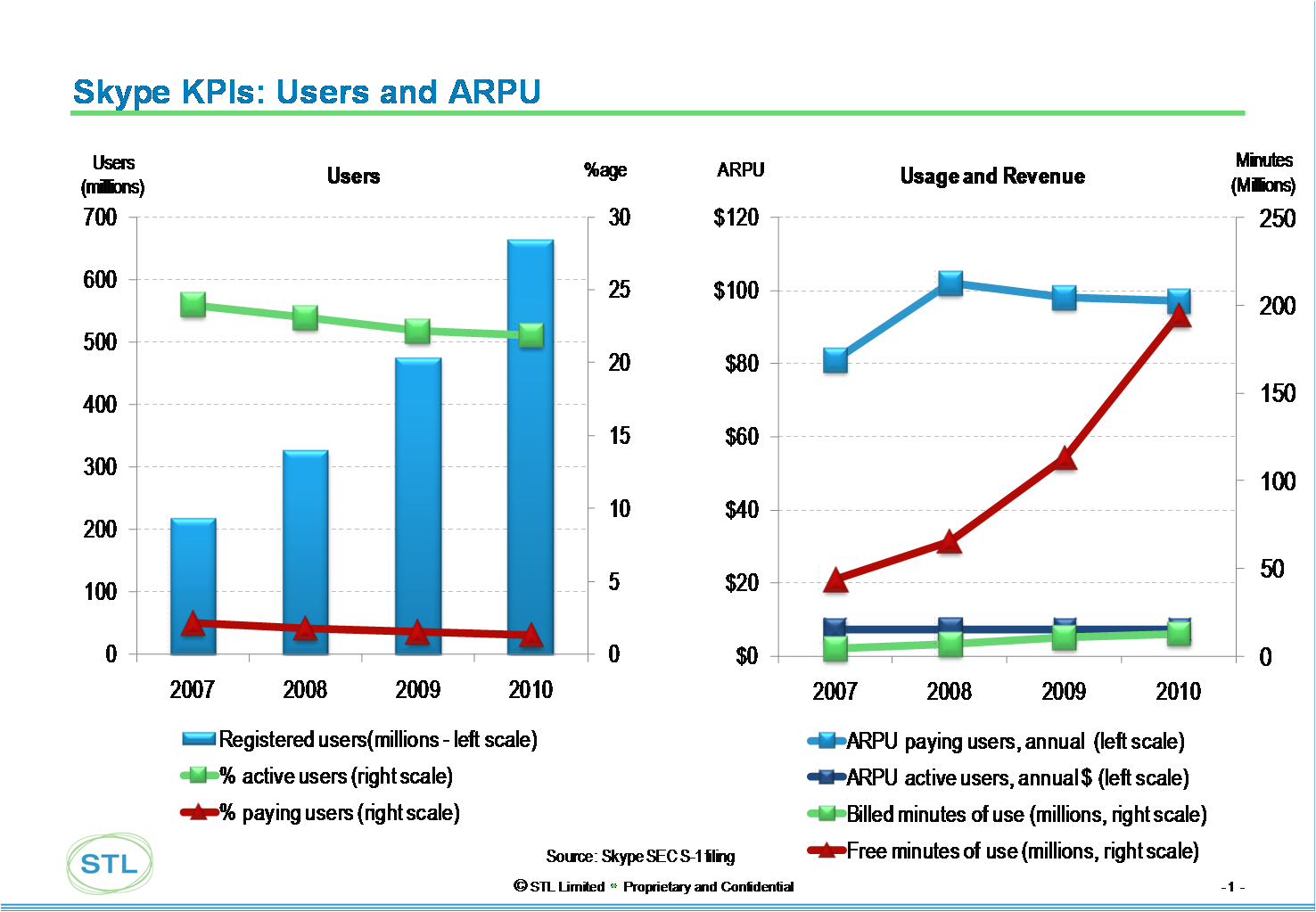 It will sound presumptuous to ask whether Skype matters. It has 663 million registered users, now has the resources of Microsoft, is profitable and contributed more net new minutes of international voice than the rest of the industry put together in 2010, according to Telegeography.
Most people you know use Skype at times, at the very least, and audio quality is quite good.
The reason one might ask the question of whether Skype really matters is that, strategically, aside from cleverly managing a decline as gracefully as possible, one might question whether voice in itself is a strategic product for most service providers, or is getting to the point where it is tactically important. Important, but mostly important tactically.
By way of comparison, mobility is probably strategic, for example.
That is not to discount the huge role voice revenues continue to play in the service provider business model, its continued relevance as a value driver for users or importance. It is to ask whether anything about voice rises to the strategic level of what to do about creating new revenue, how an access provider can remain relevant i the Internet ecosystem and whether the growing importance of "dumb pipe" access services (not to be confused with "low gross revenue, low margin or low value" adjectives) can be matched by new ways to monetize other carrier assets.
With the coming shift to cloud computing, the growing role of devices and application providers in the rest of the Internet ecosystem, the question about Skype is whether it really makes sense for most people, even within the service provider industry, to worry about voice, or Skype, very much. Of course, businesses that sell voice products and applications are an exception. They will care quite a lot.
But it isn't so clear most people, even within the communications and network-based entertainment businesses, need to care so much. True, there was a time when Skype frightened most telco executives. That time has passed. There was a time when Google was seen as the biggest competitive threat. That, too, has passed.
So, in a strategic sense, one might ask whether Skype really matters. That isn't the same thing as asking whether it is clever, widely used or capable of gaining more share of international voice minutes. How much time and effort does a strategist want to spend thinking about voice, when there seemingly are a zillion other challenges to be met?
It will sound odd to some, but for many in the Internet ecosystem, the access and transport networks essentially are assumed to exist. All the other important business and software issues are handled elsewhere. That's something of the sense in which the question about Skype might be asked. Do users and providers not simply assume that Skype and communications capability exists?
It might not yet be the equivalent of "electricity," but it is getting closer. If one assumes the availability of electricity then many other products and businesses can be built. That doesn't mean electricity ceases to be a business for some entities. But it might mean most people will not obsess about it.
Gary Kim was cited as a global "Power Mobile Influencer" by Forbes, ranked second in the world for coverage of the mobile business, and as a "top 10" telecom analyst. He is a member of Mensa, the international organization for people with IQs in the top two percent.
Wednesday, June 15, 2011
AppGlide Allows Service Providers Visibility into Content Choices and QoE
The Alcatel-Lucent "AppGlide" Video Analytics service equips broadband providers with video analytics that measure end-user quality of experience and uncover content delivery issues.
Service providers can use AppGlide to identify degradation in the QoE of any on-line video service delivered over their networks.
AppGlide allows service providers to accurately determine where QoE-affecting problems reside: with the content provider, an off-net (external) content delivery network (CDN) or within their own network. That might have uses for determining when quality of service violations have occurred.
AppGlide also can monitor the QoE of content delivered from an on-net (internal) CDN and gather important content-based metrics.
The application also can leverage information about content usage and trends to forge stronger relationships with content owners and advertisers.
Perhaps more importantly, the app can be used to determine, in aggregate, what consumers are watching, when and how long. The app can tell service which particular videos and programs are most viewed as well.
The app also can help service providers determine when QoE is causing users to abandon watching, for example.
That, in turn, might help service providers match QoE measures with retail pricing of QoE mechanisms. Basically, the tool helps service providers tie network activity to subscriber behavior.
Read more here.
Gary Kim was cited as a global "Power Mobile Influencer" by Forbes, ranked second in the world for coverage of the mobile business, and as a "top 10" telecom analyst. He is a member of Mensa, the international organization for people with IQs in the top two percent.
Sprint Might Get LightSquared Spectrum in Case of LightSquared Default
LightSquared has won approval from its lenders to give Sprint Nextel Corp. a second lien on its spectrum, part of a deal under which the wireless start-up will rent space on Sprint's network, the Wall Street Journal reports. See LightSquared Gets OK on Sprint Spectrum Lien
The concession gives Sprint additional security if a deal with LightSquared is finalized, but might also provide a path for Sprint to acquire the LightSquared spectrum in the event LightSquared fails. The issue, some might say, is whether Sprint would want to do so.
It isn't yet clear whether the Federal Communications Commission will allow LightSquared to use the upper part of its L-band spectrum, to avoid GPS interference problems which seem to be caused by signals in the upper part of the band. In that case, Sprint might be paying for about 20 MHz of LTE-capable spectrum.
The concession gives Sprint additional security if a deal with LightSquared is finalized, but might also provide a path for Sprint to acquire the LightSquared spectrum in the event LightSquared fails. The issue, some might say, is whether Sprint would want to do so.
It isn't yet clear whether the Federal Communications Commission will allow LightSquared to use the upper part of its L-band spectrum, to avoid GPS interference problems which seem to be caused by signals in the upper part of the band. In that case, Sprint might be paying for about 20 MHz of LTE-capable spectrum.
If you have followed various mobile satellite ventures over the last two decades, you will remember that there has been more failure than success in the field, which is one reason why the satellite spectrum is available in the first place. If it turns out that LightSquared can use only about 20 MHz of its 40 MHz worth of spectrum, you would think there will additional repercussions.
At a rough level, wouldn't you say the venture is "worth" only about half of whatever valuation you thought it had before it lost half its spectrum?
And as far as Sprint's plans for additional spectrum, there is some growing speculation that Clearwire is getting ready to sell itself in any case. Sprint owns about 54 percent of Clearwire already, and if it were sold, Sprint would have all the spectrum it needs to build a new Long Term Evolution network, which clearly is coming. http://blogs.forbes.com/joanlappin/2011/06/09/clearwire-clearing-the-decks-for-sale/.
Wouldn't it be odd if LightSquared, which wanted to build a network, ultimately finds itself a tenant on Sprint's LTE network instead, with Clearwire history? What that would do to LightSquared's wholesale business plan is unclear. LightSquared might find itself using its satellite links mostly for backhaul, and using Sprint's LTE network (formerly Clearwire) for the actual terrestrial connections.
Even then, some analysts would have trouble coming up with a plausible, self-sustaining business model for LightSquared. The wholesale-only model hasn't worked all that well in the U.S. market, in any segment of the business, on a long-term basis.
Gary Kim was cited as a global "Power Mobile Influencer" by Forbes, ranked second in the world for coverage of the mobile business, and as a "top 10" telecom analyst. He is a member of Mensa, the international organization for people with IQs in the top two percent.
Netflix And Hulu On Cable Set Tops?
Cable operators already deliver Netflix and Hulu over broadband. Could both services, now perceived as competitors, wind up as part of the cable package? Time Warner Cable Chief Programming Officer Melinda Witmer thinks it is a possibility.
“Consumers are getting it on every device that’s coming on an IP basis today but not the set top. They look like a programmer to me and it makes me sense that we’d be doing business with them in the home on our equipment too.”
“We’ve reached out and I think probably virtually every operator has had some discussions," she said. "It’s unclear what their rights are to be able to come to a set-top box."
“Consumers are getting it on every device that’s coming on an IP basis today but not the set top. They look like a programmer to me and it makes me sense that we’d be doing business with them in the home on our equipment too.”
“We’ve reached out and I think probably virtually every operator has had some discussions," she said. "It’s unclear what their rights are to be able to come to a set-top box."
"But we’re interested in offering our customers what they want and if 23 million people or 25 million subscribe to Netflix, there might be something we can do with them that makes sense," said Witmer.
Gary Kim was cited as a global "Power Mobile Influencer" by Forbes, ranked second in the world for coverage of the mobile business, and as a "top 10" telecom analyst. He is a member of Mensa, the international organization for people with IQs in the top two percent.
Google to Expand Wallet to Europe in 2012; Sees One Wallet Per Phone
 Google plans to launch its Google Wallet in at least one major European city during the first half of 2012, said Osama Bedier, Google’s vice president of payments, who politely, if disingenuously, discounted talk of a coming wallet war in either the United States or Europe.
Bedier suggested that any given near field communications capable phone would have only one mobile wallet, and if that wallet is Google's, the company would need to either control the secure chip that holds the wallet applications or be able to manage those applications.
That means a Google Wallet is unlikely to share space on the same phone with, say, a wallet from the Isis mobile operator joint venture or one from card network Visa Inc. No wallet war? Really?
Google to Expand Wallet to Europe in 2012; Sees One Wallet Per Phone
Gary Kim was cited as a global "Power Mobile Influencer" by Forbes, ranked second in the world for coverage of the mobile business, and as a "top 10" telecom analyst. He is a member of Mensa, the international organization for people with IQs in the top two percent.
3 Ways to Prepare Your Business for Social Search
It is quite easy to become overwhelmed with all the things "you should be doing" as part of your content marketing initiatives. There's your blog or blogs, your videos, your social media, your white papers, studies, search engine optimization, commenting on other blogs and industry forums. In most cases, no organization has the time or resources to do all of this, as well as experts say it should be done.
But there is one practical bit of advice that concerns only your blogging and your social media efforts, and it relates to Google, and the way Google is starting to alter its ranking algorithms to incorporate "social content."
"You may have already noticed that socially shared content is rising to the top of your Google search results," says Jeff Korhan. What that means, in part, is that Google is giving more weight to original content that social network users think is interesting enough to "retweet," "like" or otherwise share.
So, if you want to earn higher rankings with Google, you not only need to be creating high-quality content, but also actively encouraging its sharing on the social networks. To be sure, you can only "encourage," you cannot compel. So you need to write about things interesting enough, or provocative enough, or important enough, that other social network users will share it.
You will hear lots of people offer you lots of advice about how to create that sort of content. Personally, I don't think there is any "silver bullet." People share things that make them laugh, or think, that make them mad or happy, that are "news" items of interest or things that seem really "dumb." People share items of beauty or inspiration, and in almost all cases items that have some shared meaning.
Lots of people will share videos of cats doing funny, cat-like things. None of that is especially easy for brands selling consumer or business products to incorporate.
There is no one rule about how to create such copy. But the important bit of advice is that Google now believes items people share deserve a higher ranking than items people do not share. That means a bigger emphasis than ever not just on original content, but original content that is worth sharing.
Gary Kim was cited as a global "Power Mobile Influencer" by Forbes, ranked second in the world for coverage of the mobile business, and as a "top 10" telecom analyst. He is a member of Mensa, the international organization for people with IQs in the top two percent.
Mobile TV Advertising $1.4 Billion in 2015
 Tablets are poised to help U.S. newspapers increase paid digital circulation to 4.6 million in 2015, for example, with most of the growth coming at general interest newspapers, from 1.5 million last year, primarily at the Wall Street Journal, according to annual Global Entertainment and Media Outlook from PricewaterhouseCoopers.
Mobile-TV ad spending in the U.S. will grow to $1.4 billion in 2015 from $370 million last year. Traditional TV ad revenue in the United States, meanwhile, will grow to $89.8 billion in 2015 from $70.7 billion last year, according to the report. And online TV, excluding mobile, will see U.S. advertising grow to $4.1 billion in 2015 from $1.6 billion last year.
The number of people viewing mobile TV in the U.S. will grow to 52.5 million in 2015 from 17.6 million in 2010.
Gary Kim was cited as a global "Power Mobile Influencer" by Forbes, ranked second in the world for coverage of the mobile business, and as a "top 10" telecom analyst. He is a member of Mensa, the international organization for people with IQs in the top two percent.
Airline to Speed Check-ins with Stickers; NFC App Likely to Follow
 Scandinavian Airlines will issue contactless stickers to its top frequent fliers, enabling them to check in faster at the airlines self-service kiosks, lounges and gates.
SAS plans to issue the passive contactless stickers to 50,000 of its "EuroBonus Gold members" starting in September 2011. They could attach the stickers to the back of their phone and tap them on readers at the kiosks, lounges and boarding gates or other check-in points to automatically transmit their membership numbers. The system would be able to identify the customers and call up their flight details more quickly.
Gary Kim was cited as a global "Power Mobile Influencer" by Forbes, ranked second in the world for coverage of the mobile business, and as a "top 10" telecom analyst. He is a member of Mensa, the international organization for people with IQs in the top two percent.
Subscribe to:
Posts (Atom)
-
We have all repeatedly seen comparisons of equity value of hyperscale app providers compared to the value of connectivity providers, which s...
-
It really is surprising how often a Pareto distribution--the “80/20 rule--appears in business life, or in life, generally. Basically, the...
-
Financial analysts typically express concern when any firm’s customer base is too concentrated. Consider that, In 2024, CoreWeave’s top two ...

