Thursday, July 18, 2013

Verizon Edge Device Upgrade Plan Coming Aug. 25, 2013

Verizon Edge, the new device upgrade plan, will be available Aug. 25, 2013. 

Verizon Edge essentially is an installment payment plan for devices, spreading a device purchase over 24 months. 

If a consumer wants to upgrade a device after six months, that is possible if 50 percent of the retail cost of the device has been paid. 

Verizon says there are no long-term service contracts, finance charges or upgrade fees with Verizon Edge. 

Every six months, as long as 50 percent of the cost of the phone has been paid, you can upgrade to the newest basic or smartphone available.

The Verizon plan is a reaction to T-Mobile USA's "Jump" program, which allows customers to trade in their existing phone as much as twice a year, with payment of a $10 a month fee. 

That innovation was intended to differentiate T-Mobile USA from the policies of the other three national carriers, which have restricted “new phone upgrades” to about once every 20 months or so.


But AT&T already has countered with its own similar "Next" program, and Verizon has responded as well.
“Sustainable competitive advantage” is a difficult challenge in competitive markets, and especially when the advantages are new retail packaging concepts. T-Mobile USA has gotten confirmation of that difficulty.


Firms can obtain a competitive advantage by “implementing value-creating strategies, not simultaneously being implemented by any current competitor,” strategists might say. But it often is too easy to claim such advantage.


Competitive advantage really only is possible when strategies provide value that is rare, valuable, and non-substitutable.


“Sustainable competitive advantage” is obtained when those advantages that are not easily copied by other contestants and can be maintained over a long period of time.


If a firm’s competitors can counter quickly, there is no sustainable advantage. In fact, one might argue whether there is much advantage.


In the mobile service provider business, one might ask whether there is any such thing as sustainable competitive advantage. From time to time, a firm can gain some ground. AT&T having a monopoly on the Apple iPhone provides a recent example.


Verizon Wireless building out its Long Term Evolution 4G network might provide another example of a tactical advantage.


But it is hard to point to sustainable sources of advantage in the mobile business, in the sense of “rare” and “non-substitutable.”


AT&T “Next,” to be available July 26, 2013, allows AT&T customers to buy their devices on installment plans that pay off the device cost in 20 months, as does the T-Mobile USA plan.


AT&T customers also can upgrade after a year by turning in their old phone and beginning payments on a new phone.


Using AT&T Next, a customer buying an Apple iPhone 5 with a retail price of $650 would make monthly payments of $32.50 a month. Under a traditional AT&T two-year contract plan, the same device would cost about $200 upfront.


The shift of all three carriers to new device payment plans will arguably be more transparent and will allow customers the freedom to upgrade devices on a more timely basis.


But the moves by Verizon Wireless and AT&T to match the new T-Mobile USA device programs also shows how hard it will be for T-Mobile USA to mount and sustain any marketing initiatives that truly distinguish T-Mobile USA from either AT&T and Verizon Wireless, when those carriers think the new initiatives, offers or retail packaging actually will resonate with customers.


Fiber to Home Reaches 15% of Broadband Lines in OECD Countries

Fiber to home deployments have reached nearly 15 percent of fixed broadband connections at the end of December 2012, representing some 48.7 million connections, according to the Organization for Economic Cooperation and Development.


Fiber deployments  grew by 12.7 percent  in 2012, four times as much as fixed broadband at 3.27 percent, the study suggests.
Luxembourg (324 percent), Austria (194 percent), Turkey (170 percent) and Switzerland (150 percent) had the strongest annual growth in fiber connections, while seven countries had growth rates above 100 percent year over year and 11 countries had growth rates higher than 50 percent, according to the Organization for Economic Cooperation and Development.


Japan and Korea still are the countries with the highest broadband penetration, with over 60 percent of fixed broadband lines using fiber to home technology. In Estonia, Sweden and the Slovak Republic, fiber to the home now represents 30 percent of broadband access lines.
Switzerland (43 percent), Netherlands (40 percent) and Denmark (39 percent) top the OECD’s fixed broadband penetration rankings, in terms of adoption per 100 inhabitants.


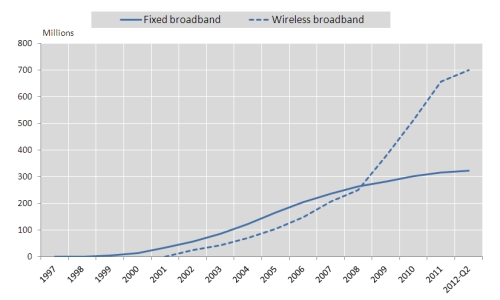
The OECD’s average fixed broadband penetration is 26.3 lines per 100 inhabitants (327.2 million subscriptions).
Wireless broadband increased by 14 percent year over year and reached a penetration of 62.75 lines per 100 inhabitants, up from 58.6 lines per 100 people in June 2012.


The total number of wireless broadband subscriptions in the OECD area is just above 780 million.


Separately, the OECD says fixed networks have, in effect, become the backhaul for mobile and wireless devices with some studies claiming that 80 percent of data used on mobile devices is received using Wi‑Fi connections to fixed networks.


For that reason, communications policy makers and regulators need to ensure there is enough backhaul for for wireless networks, especially if there is insufficient fixed access network competition.

Wireless Backhaul a Major Policy Concern Across OECD

Policy makers and regulators need to ensure enough supply to maintain sufficient backhaul for wireless networks, especially if there is insufficient fixed access network competition, a new report by the Organization for Economic Cooperation and Development says.


The challenge for regulators is that, regardless of the technology used, many parts of the OECD look likely to face monopolies or duopolies for fixed networks. Wireless can provide competition, but spectrum availability will always impose limits that are not a constraint for fiber networks.


Fixed networks have, in effect, become the backhaul for mobile and wireless devices with some studies claiming that 80 percent of data used on mobile devices is received using Wi‑Fi connections to fixed networks.


Wireless and fixed broadband subscriptions in OECD countries

Policy makers and regulators have a vital role to play in ensuring sufficient competition, the study argues.  This includes making sure there is adequate available spectrum, abundant IP addresses or other numbering resources for new market entry, and fair competition between operators and over the top providers.


Ensuring markets remain open to OTT and facilities‑based providers is essential to innovation in broadband infrastructures, and critical to addressing major industry and broader economic and social challenges.

A growing number of industry leaders claim high prices for international mobile roaming are detrimental to their relationship with their customers, and a significant barrier to trade and travel in OECD economies. The OECD Recommendation of the Council on International Mobile Roaming Services (February 2012) recommends removing such barriers to lower-cost roaming.


Among other findings, the study points out that telephony costs have continued to fall, at least up to the 2012 period for which the OECD report reports results.


In 2011, mobile subscriptions represented 65.4 percent of paths, up from 64 percent in 2009, while use of  traditional fixed telephony subscriptions continued to decline.


The average subscription rate of mobile Internet access in OECD countries as a whole rose to 56.6 percent in June 2012, up from just 23.1 percent in 2009.


Prices for fixed telephony and, more markedly, for mobile voice services decreased from 2010 to 2012, showing significant declines across all consumption patterns, with the exception of fixed business services.


A laptop‑based wireless broadband usage bucket (offers within the 500 MB per month range) cost US$13.04 on average across the OECD in purchasing power parity terms, although it reached US$30 in some countries.


Average expenditure was US$37.15 for a 10 GB bucket. A 250 MB tablet package cost US$11.02 per month on average. A 5 GB basket for tablets cost US$24.74 on average, but varied from US$7.98 (Finland) to US$61.84 (New Zealand).


Telecommunication revenues experienced a notable decline in 2009 but stabilised in 2010 and rebounded in 2011, the report notes.

But data services are growing at double‑digit rates in most OECD countries, and transport of data is now the major source of growth for network operators.


Few expect growth in traditional services such as telephony or text messaging, the report also says.

With 2000 as a baseline, typical consumer spending on communications is up about five percent to 2011.

Wednesday, July 17, 2013

U.S. Smart Phone Customers Slow Device Upgrades

U.S. mobile customers are upgrading their devices at slower rates than they had been doing a few years ago, a trend many will attribute to the more-incremental advances in smart phone devices.


According to analysts at UBS, replacement rates actually turned negative in 2012, when device upgrades dropped about nine percent, year over year.


UBS predicts upgrades will fall again in 2013.

The trend will worry device makers, but might have unclear impact on service providers, who gain when users upgrade from basic phones to smart phones, adding a data plan.

It is far less clear how service providers fare if their customers upgrade less often.

Service providers might spend less money buying devices. Assuming those users already have and use data services, device upgrades might have relatively little impact on data revenues.


Tablets Increasingly are Video Consumption Devices

Video is one of the main reasons people use tablets, according to Business Intelligence. That has been true for a couple of years. 

Watching videos and sharing them are among the top-10 activities tablet users engage in on their tablets,

For smart phone users, neither activity cracks the top-10 list.

Tablet owners are far more likely than the average U.S. consumer to disconnect their video subscriptions and use streaming and download services such as Hulu, Apple TV, iTunes, Netflix, and Google TV.

The U.S. Digital Video Benchmark 2012 study from Adobe showed growth of mobile video views of 300 percent. 
All Media Video View Rate Adobe 2012

Among U.S. Millennials 14 to 23, tablets are nearly as popular for watching TV shows as Blu-rays or DVDs. That might be a trend that changes as Millennials age, but it is too early to say for certain.

Some 25 percent of respondents in this age group say they watch TV shows on tablets every day or weekly, compared to 24 percent who do so on DVD or Blu-ray.


A 2011 Ooyala study found that tablet users watch videos nearly 30 percent longer than those who watch video on desktops and that tablet users complete videos at double the desktop rate.


- See more at: http://www.newsy.com/blogs/greater-video-consumption-found-on-tablets-than-desktops/#sthash.nUdRsksr.dpuf

Tuesday, July 16, 2013

How Much Competitive Advantage Did T-Mobile USA Gain from "Jump?"

“Sustainable competitive advantage” is a difficult challenge in competitive markets, and especially when the advantages are new retail packaging concepts. T-Mobile USA has gotten confirmation of that difficulty.

T-Mobile USA had unveiled its “Jump” program just a few days ago. Jump allows customers to trade in their existing phone as much as twice a year, with payment of a $10 a month fee. That innovation was intended to differentiate T-Mobile USA from the policies of the other three national carriers, which have restricted “new phone upgrades” to about once every 20 months or so.

That move is part of T-Mobile USA’s “Uncarrier” campaign, designed to position T-Mobile USA as different than AT&T or Verizon Wireless.

But AT&T already has countered with its own similar program, and Verizon will unveil the details of its new plan shortly. Sprint’s response is not yet known.

Firms can obtain a competitive advantage by “implementing value-creating strategies, not simultaneously being implemented by any current competitor,” strategists might say. But it often is too easy to claim such advantage.

Competitive advantage really only is possible when strategies provide value that is rare, valuable, and non-substitutable.

“Sustainable competitive advantage” is obtained when those advantages that are not easily copied by other contestants and can be maintained over a long period of time.

If a firm’s competitors can counter quickly, there is no sustainable advantage. In fact, one might argue whether there is much advantage.

In the mobile service provider business, one might ask whether there is any such thing as sustainable competitive advantage. From time to time, a firm can gain some ground. AT&T having a monopoly on the Apple iPhone provides a recent example.

Verizon Wireless building out its Long Term Evolution 4G network might provide another example of a tactical advantage.

But it is hard to point to sustainable sources of advantage in the mobile business, in the sense of “rare” and “non-substitutable.”

AT&T “Next,” to be available July 26, allows AT&T customers to buy their devices on installment plans that pay off the device cost in 20 months, as does the T-Mobile USA plan.

AT&T customers also can upgrade after a year by turning in their old phone and beginning payments on a new phone.

Verizon is expected to detail its "VZ Edge" upgrade option in the near future as well.

Using AT&T Next, a customer buying an Apple iPhone 5 with a retail price of $650 would make monthly payments of $32.50 a month. Under a traditional AT&T two-year contract plan, the same device would cost about $200 upfront.

The shift of all three carriers to new device payment plans will arguably be more transparent and will allow customers the freedom to upgrade devices on a more timely basis.

But the moves by Verizon Wireless and AT&T to match the new T-Mobile USA device programs also shows how hard it will be for T-Mobile USA to mount and sustain any marketing initiatives that truly distinguish T-Mobile USA from either AT&T and Verizon Wireless, when those carriers think the new initiatives, offers or retail packaging actually will resonate with customers.
Sunday, July 14, 2013

A Look at LTE Prices Across Countries

The folks over at Phone Arena have put together an interesting analysis of Long Term Evolution rates and plans across the United States, Canada, United Kingdom, Germany, South Africa, India and Australia.


The analysis plotted the cost, as it relates to the size of data plans, generally for the largest service provider in each country. As you might expect, there are wide differences in price, especially for entry-level plans.

That would be expected when comparing countries such as India or South Africa with the United States, Germany or Australia, where average incomes and prices are higher, across the board.


Some of the findings you would expect, such as the lower cost per megabyte of use as the customer buys in greater volume. One also would expect prices to vary between countries, and that also was found to  be the case.


There is much less correlation of plans and prices between leading service providers across countries. 

One suspects the results would be far more consistent (cost per month) if nominal prices were adjusted for living costs in each country, so that the cost of using LTE was measured as a percentage of income, for example.


The reason for that adjustment is that living costs, and therefore wages and income levels, are quite different in India or South Africa and North America, for example. So all nominal prices for similar or identical goods will vary accordingly.


It therefore will cost more to build an LTE network in North America than in India or South Africa, one might argue.

There are also regulatory costs and scale effects that vary from country to country, and the level of competition arguably will play a role in prices as well. 


On the other hand, those same competitive dynamics probably will suggest that all competitors in a single market will have prices that are fairly closely correlated.


Saturday, July 13, 2013

Why Web Apps are Slow

Thosse of you who are developers, or at least "technical," will enjoy this detailed analysis of why mobile apps are destined to underperform mobile web apps for quite some time. 


Why Does AT&T Want to Buy Leap Wireless Now?

Why does AT&T want to buy Leap Wireless now? That’s a different question than asking why AT&T might want to buy additional assets.

AT&T has been among the list of potential Leap Wireless acquirers for some time, along with T-Mobile USA and Sprint.

There are lots of reasons for the expectations of further acquisitions by the U.S. market leaders. Organic growth has become quite difficult in a saturated market, making acquisitions within the core market, and acquisitions in new markets, the fastest way to obtain additional subscribers and revenue growth.

And though top-tier mobile service providers are not unduly enamored of prepaid accounts, as opposed to postpaid, prepaid remains one of the few places in the domestic market where growth is expected.

And since the major carriers have tended to favor separate brands when participating in the prepaid business, the Cricket business works for AT&T.

One motivation that was behind the ill-fated bid for T-Mobile USA--spectrum assets--also is an attraction here. Getting additional customers is helpful, but spectrum assets also are helpful, especially when complementary to AT&T’s current holdings.

Still, there is the issue of timing. Assuming regulatory issues are not an issue, and market conditions are neutral to favorable, why make the bid now?

Maybe because other potential rivals are preoccupied. T-Mobile USA continues to digest MetroPCS, while Sprint has combined with SoftBank and Clearwire. Verizon Wireless has little interest in becoming a bigger force in prepaid.

But there is Dish Network.

Friday, July 12, 2013

AT&T to Buy Leap Wireless

AT&T is buying Leap Wireless, including its five million subscribers, the Cricket brand and spectrum, network and retail assets, though the deal is subject to regulatory approval.

Leap's network covers 96 million people in 35 U.S. states, most of whom use Leap’s CDMA 3G network. But Leap also has a 4G Long Term Evolution network covering 21 million people.

AT&T says it will retain the Cricket brand name, provide Cricket customers with access to AT&T's 4G LTE mobile network, use Cricket's distribution channels and expand Cricket's presence to additional U.S. cities.

The move arguably offers the primary advantage of a new platform to gain share in the prepaid market.

But the proposed acquisition also includes spectrum in the PCS and AWS bands covering 137 million people and is largely complementary to AT&T's existing spectrum licenses.

AT&T says that Immediately after approval of the transaction, AT&T plans to add Leap's unutilized spectrum, covering 41 million people, to AT&T’s LTE network.

Regulatory approval might take as long as nine months, if past precedent applies. The deal would not change U.S. market share in a material way, one might argue. Leap Wireless has market share of less than two percent, and lower average revenue per user than typically is the case for a postpaid service provider.

EE in the United Kingdom typically sees postepaid average revenue per user that is as much as six times the value of a prepaid account.


One Immediate Benefit of New Competition in Myanmar: SIM Cards 2 Orders of Magnitude Cheaper

Competition is supposed to bring new consumer benefits. And that appears to be what new mobile service providers have planned for their new networks in Myanmar.

Norway's Telenor and Qatar's Ooredoo say they will charge around 1,500 kyat ($1.53) for a SIM card. Consider that, at present, SIM cards can cost more than $200 each. So SIM cards will be available at two orders of magnitude less than at present.


Thursday, July 11, 2013

What Does Google See in Chromebooks?

Google’s Chromebook initiative initially was derided by many as “too little, too late,” coming at a time when the market was turning to tablets as the growth category in computing devices.

Google obviously did not agree then, and sales results now suggest Google was on to something. Though Chromebooks still represent a small portion of the total U.S. market for laptops and netbooks, Chromebook market share, and apparently growth rate, is increasing.

The devices had about four percent to five percent market share in the first quarter, though that was up from one percent to two percent in 2012, according to Mikako Kitagawa, Gartner analyst.

On the other hand, there is little question that tablets are leading consumer interest in computing devices at the moment. Global PC shipments dropped to 76 million units in the second quarter of 2013, a 10.9 percent decrease from the second quarter of 2012, according to preliminary results by Gartner.

This marks the fifth consecutive quarter of declining shipments, which is the longest duration of decline in the PC market’s history, Gartner says.

“We are seeing the PC market reduction directly tied to the shrinking installed base of PCs, as inexpensive tablets displace the low-end machines used primarily for consumption in mature and developed markets,” said Mikako Kitagawa, Gartner principal analyst.

“In emerging markets, inexpensive tablets have become the first computing device for many people, who at best are deferring the purchase of a PC,” Kitagawa says.

What does Google see in the PC market that others might not? As with Android, Google’s revenue model benefits from increasing the ways Google can steer users to its own apps, devices and operating systems.

Though it might be hard to quantify directly, the more touchpoints Google has, the more places and times it can display ads that underpin its current revenue model. That is the same reason Google has been so proactive in pushing for faster broadband access, lower cost broadband access and ubiquitous access.

In addition to the “always connected” angle, future web apps might act much like launch “native apps” on devices, even when those devices momentarily are not connected.

Chromebook might seem like a distraction. But it is a piece with Google’s support of Android, maps, office suites, YouTube and other apps, devices and operating systems. All of that contributes to creating an ecosystem where the ability to sell ads based on detailed knowledge of people, their behaviors and activities is possible.

If "the Employee is Part of the Product" Then Boosting Investment in Employee Engagement Can Pay Off

Even if a “leaner” approach to employee staffing might make sense for some firms, at some times, there also is an argument to be made that f...