Friday, April 15, 2011

Apple and Google Capture U.S. Video Game Market Share in 2010

Apple iPhone and Android smart phones are taking game revenue and market share from dedicated mobile game playing units, a new analysis by Flurry suggests. From 2009 to 2010, iOS and Android game sales increased from five percent to eight percent market share within the U.S. video game market.
Flurry iOS Android USvideoGameShare 2010
Flurry estimates that iOS and Android game revenue increased from $500 million in 2009 to more $800 million in 2010. Of this, the significant majority of revenue was generated by iPhone games.

Flurry estimates that retail PC game revenue was $700 million in 2010. That implies that smart phone and tablet game revenue has surpassed the U.S. PC game category, for the first time, in 2010.

Overall, total U.S. game revenue from 2009 to 2010 was relatively flat, totalling $10.4 billion and $10.7 billion, respectively. However, while console game revenue increased slightly, from about $7.4 billion in 2009 to $7.8 billion in 2010, the combination of declines in portable gaming software and a jump in smart-device app sales has squeezed the portable game category down from 24 percent market share in 2009 to just 16 percent in 2010.

It’s clear that prolific intalled base gains by Apple and Android devices, low priced games (including a very robust free-to-play model enabled by in-app purchases) and seamless digital distribution to games on devices so near to consumers 24-hours-a-day, is driving potent industry-disruption.

Over 2011, Flurry expects to see continued and significant smart-device game growth fueled by the recent launch of iPad 2, iPhone coming into distribution on Verizon, the expected release of iPhone 5, a relentless expansion of Android devices by leading OEMs across all major U.S. carriers, and Google’s enablement of in-app purchase billing, a proven key driver in iOS game revenue.

U.S. Internet Users Watched 4.3 Billion Video Ads in March 2011

Americans viewed 4.3 billion video ads in March 2011, with Hulu generating the highest number of video ad impressions at more than 1.2 billion, according to comScore.

Tremor Media Video Network ranked second overall (and highest among video ad networks) with 804.3 million ad views, followed by Adap.tv (553 million) and BrightRoll Video Network (398 million).

Time spent watching videos ads neared 1.9 billion minutes during the month, with Hulu delivering the highest duration of video ads at 520 million minutes. Video ads reached 43 percent of the total U.S. population an average of 33 times during the month.

Hulu also delivered the highest frequency of video ads to its viewers with an average of 47 over the course of the month.

North America Will Have Half of all NFC Phones in Service in 2014

At least one in five smart phones globally will have near field communications functionality by 2014, Juniper Research estimates.

Worldwide, Juniper Research forecasts almost 300 million NFC capable smart phones by 2014. Juniper’s analysis shows that this growth will be driven in the short term by mobile network operators launching services in 20 early adopting countries before the end of 2012.

Juniper Research forecasts that NFC-based mobile payments and retail marketing capability via coupons and smart posters will become common amongst smart phone users in Western Europe, North America and other developed regions.

North America will account for half of all NFC smart phones in 2014, followed by Western Europe.

Kotak Mahindra Bank Launches Mobile Banking

Kotak Mahindra Bank has launched "Interbank Mobile Payment Service" (IMPS) for its customers. The mobile banking system allows customers to transfer funds between retailers or people who have banking services and are part of the IMPS network.

In order to send money using IMPS, the sender losg into the Kotak mobile banking application, enters the mobile number and the Mobile Money Identifier (MMID) of the beneficiary along with the amount to be transferred.

The beneficiary gets the credit instantly.

MMID is a 7-digit code issued by the bank which along with the mobile number will identify the customer’s bank and account number. To receive money using IMPS, the customer needs to share the mobile number registered with the bank along with the MMID for the account in which he/she wishes to receive money.

T-Mobile Adds 10 New 4G Markets

Ten more markets have T-Mobile's 4G (HSPA+)network, bringing the 4G network up to 167 markets and more than 200 million people in the United States.

The new 4G markets include:
Ames, Iowa
Anderson, Indiana
Battle Creek, Michigan
Benton Harbor, Michigan
Jackson, Michigan
Fort Collins-Loveland, Colorado
Lawrence, Kansas
Manhattan, Kansas
Springfield, Illinois
Wichita Falls, Texas.

T-Mobile is also working to double the speeds of its 4G service to 42 Mbps in 25 of its 4G markets, covering more than 140 million people, this year.

New York City, Las Vegas and Orlando are already online with 42 Mbps service. Chicago, Long Island and parts of New Jersey are slated to follow soon.

G-Slate by LG, on T-Mobile USA

T-Mobile is launching a new Android tablet, the GSlate by LG.

Google Capex for Data Centers Grows

Google invested $890 million in its data center infrastructure in the first three months of 2011, the second-highest total in its history.

In fact, it’s Google’s biggest capital expenditure spending for any quarter in which it hasn’t bought real estate for other reasons.

Of course, Google also slowed investment in 2008 and 2009.

Google spent a record $2.55 billion on capital expenses in the fourth quarter of 2010, most of it related to the purchase of 111 8th Avenue, a 2.9 million square foot building in New York that is one of the city’s premier Internet and telecom hubs. It also serves as the main New York office for Google, which has about 2,000 employees on site.

Thursday, April 14, 2011

Google 1Q 2011 Earnings

Google says there have been three billion Android apps downloaded. Apple just passed 10 billion app downloads mark in January 2011. But sales of Android phones are growing fast, so Google app downloads should accelerate as well. The first billion installs took 20 months, the second billion installs took another five months, and the third billion took only two months.

Alcatel-Lucent Explores Sale of PBX Business

Alcatel-Lucent SA is exploring the sale of its enterprise phone system business, according to the Wall Street Journal.

The company has hired advisers and during recent days began to examine options for the business, which has about $1.5 billion in annual sales.

Lucent, you will recall, sold off its enterprise phone system unit as Avaya, in 2000. You might argue that a business phone system business these days requires a level of concentration that might be easier in the context of a stand-alone company. Lucent certainly came to that conclusion over a decade ago.

Hawk Cam: Live From the Nest

This is a live video feed from the 12th floor of Bobst Library at New York University where a pair of red-tailed hawks — Violet and Bobby — have built a nest, stick by twig, outside the office of the university’s president, John E. Sexton, overlooking Washington Square Park.

Just another way to waste a bit of time, but I admit, I watched it.

Worldwide PC Shipments Decline in 1Q 2011

"Worldwide PC shipments totaled 84.3 million units in the first quarter of 2011, a 1.1 percent decline from the first quarter of 2010, according to preliminary results from Gartner. Although the first quarter is traditionally a slow one for PC sales, these shipment results indicate potential sluggishness, not just a normal seasonal slowdown. These figures are below Gartner's earlier forecast for three percent growth in the first quarter of 2011.

Low prices for consumer PCs, which had long stimulated growth, no longer attracted buyers. Instead, consumers turned their attention to media tablets and other consumer electronics.

With the launch of the iPad 2 in February, more consumers either switched to buying an alternative device, or simply held back from buying PCs. Gartner is not yet sure whether this is a temporary situation or indicative of a trend.

Global Telco Capex Stable to 2014, Wireless Grows

Capital expenditures by the top 100 global telecom operators between now and 2014 suggests carriers collectively will decrease their capex-to-sales ratio to 16.5 percent of revenues by 2014, down from 18.4 percent of sales in 2008.

With industry revenues expected to grow at a modest two percent a year to 2014, overall capital expenditure will remain stable (0.7 percent CAGR) to 2014. Wireless access infrastructure, already accounting for 43 percent of total telecom infrastructure capex, will increase its overall share as spending continues to shift away from fixed infrastructure.

As a consequence, the rollout of LTE networks in Europe and North America, and 3G deployments in India and South America will be key drivers of overall equipment revenues.

Read more here

Study Finds Broadband Stimulus Funds Were "Wasted"

A new economic analysis of federal government broadband stimulus projects awarded by the Department of Agriculture’s Rural Utilities Service concludes that the program’s funding of duplicative broadband networks has resulted in an extremely high cost to reach a small number of unserved households.

The study shows that the RUS’ history of funding duplicative service has continued under its Broadband Initiatives Program and that the current program is not a cost-effective means of achieving universal broadband availability. 

The study examined three large BIP subsidy awards which total $231.7 million, or about seven percent of the total BIP $3.5 billion combined loan and grant program:
  • $101.2 million in western Kansas
  • $66.4 million for Lake and St. Louis counties in northeastern Minnesota 
  • $64.1 million to cover a portion of Gallatin County in southwest Montana. 
The study was commissioned by the National Cable Telecommunications Association and prepared by Jeffrey Eisenach and Kevin Caves of Navigant Economics of Washington, D.C.

The American Recovery and Reinvestment Act (ARRA) included $7.2 billion to subsidize broadband deployment – $4.7 billion to the National Telecommunications and Information Administration (NTIA) and $2.5 billion to RUS. The NTIA and RUS programs funded by ARRA make up the largest federal subsidies ever provided for broadband construction in the U.S.

Read more here

    Motorola, Verizon Top Harris Poll Survey

    Verizon is the "Mobile Networks Brand of the Year" among consumers surveyed by the Harris Poll EquiTrend study. In the Mobile Networks category, Verizon is highest ranked for the second-year running over archrival AT&T.

    Motorola led the "Mobile Phones" category, followed by HTC and Sony Ericsson. Nokia is fourth and Apple, ranked just above industry average, is fifth. Those results might surprise many, but the Harris Poll includes both smart and feature phones. Apple does not sell a feature phone.

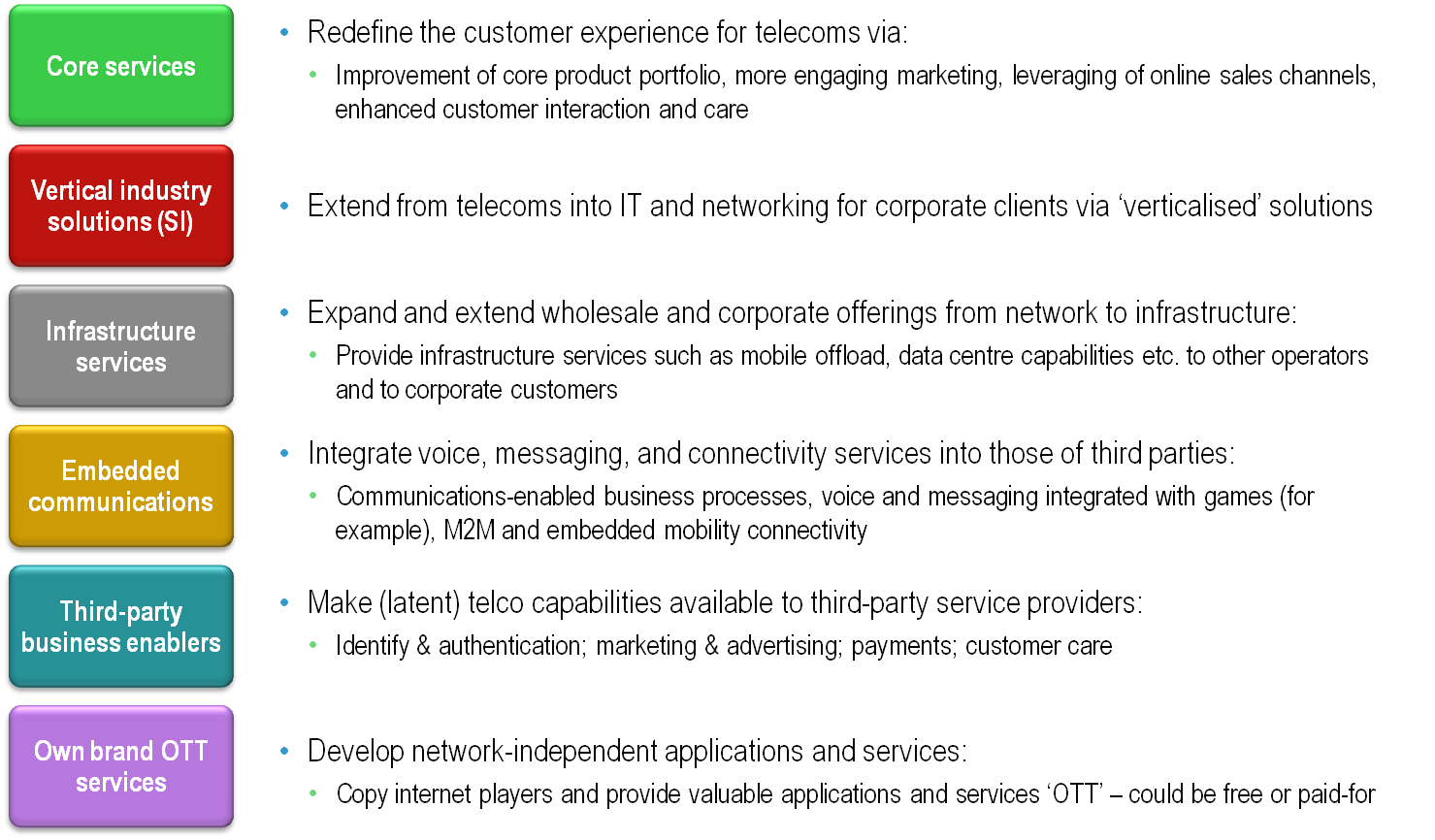
    6 Ways Telcos Can Grow

    There are six fundamental ways incumbent telcos can attain significant revenue growth, on the way to becoming "Telco 2.0" organizations, according to a new report by STL Partners. Some of the strategies are process oriented, and aim to enhance what service providers already are doing. That might include such things as better marketing, better use of sales channels or core product enhancements.

    Six Telco 2.0 Opportunity TypesOther strategies require a bit more, or substantially different profiles. Among the more far-reaching, one might argue, is the strategy of becoming an over-the-top application provider. That move essentially breaks the "territorial" model by severing the tight connection between access services and applications. Whether this ultimately will prove more strategic for fixed line providers or mobile providers might be debatable, in some markets.

    Where widespread and easy access to incumbent facilities is possible, "footprint" extension for a facilities-based strategy is easier. In other markets, where wholesale is more expensive and harder to negotiate, facilities-based approaches using wholesale access might be more difficult. Most European markets are examples of the former, the U.S. market an example of the latter.

    But most of the six major strategies will make sense as logical extensions of what service providers already do, with significant new emphasis. Providing more targeted solutions to business customers in some verticals, as well as providing other infrastructure-type services such as data center or hosting services, will not be foreign suggestions for most service provider executives.

    Likewise, the suggestion that service providers can generate revenue by exposing network features to third parties will resonate.

    read more here

    Wednesday, April 13, 2011

    Payfone Gets $19M, Alliance with American Express

    Payfone has gotten $19 million in a new funding round, led by American Express with additional investment from Verizon Investments, Rogers Ventures and existing investors Opus Capital, BlackBerry Partners Fund and RRE Ventures.

    Payfone says it will use the new funds to continue innovations in its market approach and to support its global expansion across North America, EMEA, Latin America and Asia.

    "The payments industry is going through a fundamental transformation, with the move to digital payments becoming the primary driver," said Dan Schulman, Group President, Enterprise Growth, American Expres

    American Express and Payfone are getting together to create and power a new global mobile checkout service. Payfone will combine its mobile authorization and payment services with American Express' digital payments platform, Serve.

    What is 'Better Broadband' and Who Should Pay for It?

    People will disagree about what "better broadband" might mean, but it probably remains the case that "more" is better. There still seems to be huge disagreement about how to fund 'much better' broadband, though. Better broadband. 'What does the customer want to do?' asked Jack Weixel, who heads up Google's service provider markets (enterprise) efforts. Better broadband means that users are able to do the things they want to do, he said. 'At the end of the day, speed does matter,' said Weixel.

    Raymond Henagen, CEO, Rock Port Telephone, had another practical perspective on faster broadband: 'who is going to pay as users keep demanding more capacity?"

    Former Federal Communications Commission Chairman Kevin Martin noted that "speed matters," where it comes to broadband. Specifically, faster broadband leads to applications innovation. Developers always create applications that take advantage of faster broadband, and people seem to learn to rely on those apps.

    That basically is why Google is building a symmetrical 1-Gbps fiber network in Kansas City, Kansas. Google wants to see what will happen once that level of broadband is available to developers and users.

    Mobile Operators in Western Europe See Earnings Erosion, Opex Increases in 4Q 2010

    Mobile operators in Western Europe recorded further revenue losses and earnings (earnings before interest, taxes, depreciation and amortization) erosion in the fourth quarter of 2010, according to new research from Strategy Analytics. Gains those operators had made in operating expenditures in the first half of 2010 were reversed by year-end.

    Looking at financial data from 200 mobile operators serving over 77 percent of global subscribers, Strategy Analytics found found that mobile service revenues fell by 1.3 percent in the fourth quarter of 2010 in Western Europe. Meanwhile, mobile operators worldwide saw revenue grew by 6.1 percent.

    “This weak performance is less about the after-shocks of the global recession and more about the changing data-centric market environment," Strategy Analytics says.

    Subsidies associated with smartphone sales and upgrades, and the relentless growth in data traffic from these devices, reversed the long-term trend of falling operating expenses per subscriber,” said Phil Kendall, Director, Wireless Operator Strategies. “For example, the average cost to retain a customer has increased for T-Mobile in several countries: Germany (26 percent), Austria (57 percent) and the Netherlands (12 percent). Orange customer retention costs have increased in France (11 percent) and Spain (14 percent)."

    Read more here

    Steve Jobs Hid iPad From Google

    Apple i-phone Versus Google Android
    Steven Levy’s book “In the Plex” apparently reveals that Steve Jobs hid development of the iPad from Eric Schmidt while Schmidt was still on Apple’s board of directors.

    Jobs reportedly didn’t like how Google’s OS was starting to match up blow for blow to iOS and didn’t want the same to happen with tablets. Jobs was angry because he felt that Android was ripping off the key features of the iPhone.

    Read more here

    Explicit Search Versus Search Share: Market Share Depends on How You Count

    As with many other things in life, how one counts affects the results. The same thing is true with measures of search share: how one counts makes a difference.

    One can count Google slideshows, contextual search in places like Yahoo News, and Google Instant, or one can count only search terms entered into search boxes.

    Using the former technique, every time you go through a slideshow on Yahoo, for instance, related search results appear below, inflating the numbers.

    The latter approach strips out those numbers to come up with what it calls “explicit search,” which counts only those searches triggered when someone actually types a query into a search box.

    Will the 2026 World Cup Create Any Long-Term Economic Benefit for Host Nations?

    World Cup long-term economic effects will be negligible, economists at Goldman Sachs say. That might seem unlikely, given the 2026 FIFA Wor...