Tuesday, October 11, 2011

What’s the future of mobile banking in Europe? - McKinsey Quarterly - Financial Services - Banking

Bankers across Europe believe that mobile devices will transform the retail-banking landscape in the next three to five years, but also believe they are not investing sufficiently to take advantage of the opportunities. They also think mobile service providers and other nonbanks are leading the way. That might come as a surprise to some, but banking applications and services are among the few new businesses tier-one telcos can get into that offer enough incremental revenue to justify the effort.

The study by McKinsey and the European Financial Management and Marketing Association also suggests that mobile devices’ overall economic impact on the banking industry may be neutral at best.

Individual banks should be able to increase their revenues and cut costs if they successfully exploit the convenience of mobile, its potential to drive digital commerce, and the opportunity it represents to target the unbanked in emerging markets, researchers at McKinsey say.

Some banks, however, may find that mobile adds to costs and erodes prices unless they offer a truly differentiated product or service. Mobile banking in Europe

Some 87 percent of banks aim to have a mobile site, and 84 percent are planning to launch some sort of mobile-banking “app” within the next 12 months, compared with 59 percent and 47 percent, respectively, that have them now. The mobile features these institutions currently offer are traditional banking services, such as the ability to check account balances and recent transactions and to conduct simple transactions. But 70 percent of banks said they plan to add more advanced functionality within the next 12 months.

Worldwide Social Media Revenue $14.9 Billion in 2012

Worldwide social media revenue is on track to reach $10.3 billion in 2011, a 41.4 percent increase from 2010 revenue of $7.3 billion, according to Gartner, Inc. Worldwide social media revenue is forecast for consistent growth with 2012 revenue totaling $14.9 billion, and the market is projected to reach $29.1 billion in 2015.

Advertising revenue is, and will remain, the largest contributor to overall social media revenue. Social media advertising revenue is forecast to total $5.5 billion in 2011, and grow to $8.2 billion in 2012. Advertising revenue includes display advertising and digital video commercials on any device including PCs, mobile and media tablets.

Hollywood Tries One More Way to Embrace Streaming Without Cannibalizing Legacy Business

Lots of people are hoping that streaming and over the top delivery of professional content will somehow lead not only to more "on demand" access, but somehow lead to lower prices. That might happen, but not if content owners and distributors have success creating "sell through" requirements that link streaming to purchase of legacy products.

The "Ultraviolet" initiative is one more example. Some have dubbed the streaming service the “Giant Media DRM Cloud Coalition Featuring Everyone Except Apple and Disney and Amazon."

The service allows users to buy movies first on DVD or Blu-Ray, providing a code that will let users stream or download the film on other devices, like iPads, Android phones and laptops. Hollywood Hopes "Ultraviolet" Will Save DVDs

Monday, October 10, 2011

Nearly 7 Percent of U.S. Content is Consumed on Mobile Devices

Share of Non-Computer Device Traffic in the U.S. U.S. consumers are increasingly connecting to digital content using a variety of devices such as smart phones, tablets and other mobile devices. In August 2011, the share of non-computer traffic for the U.S. increased to 6.8 percent from just 6.2 percent at the end of the previous quarter.

The largest percentage from this share came from mobile devices, which drove 4.4 percent of total digital traffic in the U.S.

The second largest driver of non-computer traffic was the tablet category, contributing nearly two percent of total traffic. Nearly 7 Percent of U.S. digital content now consumed on mobiles


Marketing is Business Driver for Mobile Wallets

Possibly the most meaningful impact that Google Wallet will have is on the advertising and marketing communities. Google offers will be Google’s application for deals, coupons, and offers that will inform you of promotions based on your location.

In that sense, the business case for mobile wallet apps will be location based advertising, the ability to view and compare the deals of local vendors, and coupons that do not have to be cut out of magazines or newspapers.

Local-targeted advertising will sound like Living Social and Groupon, and that's essentially correct.

Is Information Technology Like Railroads? If So, What Does That Mean?

What kind of Jobs Will Fuel the Next ExpansionFor those of you who believe the Internet will be a transforming technology, it might also be helpful to keep in mind that such transformations can be hugely unsettling, and take quite a long time to become obvious.

Still, there is something out of character with job growth coming out of the last handful of recoveries from recessions.

What we historically expect to see is a sort of "shark fin" pattern of job growth. Since 2000, though the fin was almost non-existent after the early 2000s recession.

It is an inverse fin after the "recovery" from the 2008 recession. Does that relate to a broader economic transformation? If so, we are in for a jarring, unpleasant ride, in the medium term.

In 1850, a decade before the Civil War, the United States’ economy was small, in fact not much bigger than Italy’s. Forty years later, it was the largest economy in the world. What happened in-between was the railroads.

Deep changes like this are not unusual. Every so often—every 60 years or so—a body of technology comes along and over several decades, quietly, almost unnoticeably, transforms the economy and creates a different world for business. So the issue is whether mobility, applications and the Internet might be such a wave. The second economy

If so, the changes will take decades to play out.

If something that big is going on with information technology, something that goes well beyond the use of computers, social media, and commerce on the Internet, a second economy is being built. But there will be casualties. When the shift of developed economies "from farm to factory" occurred, there was widespread dislocation. Think of the United Kingdom in the mid-1980s, "A Christmas Carol" and all that.

In the early 20th century, U.S. farm jobs became mechanized and there was less need for farm labor, and some decades later manufacturing jobs became mechanized and there was less need for factory labor.

Now business processes—many in the service sector—are becoming “mechanized” and fewer people are needed, and this is exerting systematic downward pressure on jobs. We don’t have paralegals in the numbers we used to. Or draftsmen, telephone operators, typists, or bookkeeping people.

A lot of that work is now done digitally. We do have police and teachers and doctors; where there’s a need for human judgment and human interaction, we still have that. But the primary cause of all of the downsizing we’ve had since the mid-1990s is that a lot of human jobs are disappearing into the second economy. Not to reappear.

Perhaps that is why recoveries from recessions starting in 2000 have been so different.

What Kindle Fire Means for Telcos

The Amazon Kindle Fire launch, with the simultaneous release of three new versions of the Kindle designed more as e-readers, likely illustrates a fundamental change in consumer electronics ecosystems, just as the application ecosystem also has changed around smart phones.

Needless to say, network access providers also face the need to create entirely new businesses based on partners of various types, all working within a larger context where devices, applications, commerce, advertising and cloud-based applications all are essential parts of the value consumers and businesses pay for.

The content and communications businesses these days are fundamentally different from those same businesses of 30 years ago in one fundamental way. Unlike the situation several decades ago, when value almost completely could be controlled by vertically-integrated providers, value now is derived from loosely coupled ecosystems.

In other words, where a telco in the past could control and vertically integrate every part of the “voice delivery” business, these days network-delivered applications with high value can be delivered to end users (both business and consumer) without any formal business relationship with an access provider. Razorsight | Corporate Blog

U.S. Consumers Not Convinced they Need Mobile Payments

A new survey finds that most U.S. consumers are not eagerly awaiting mobile payments. Lightspeed Research surveyed 10,000 credit card customers, including some 2,400 smartphone users, and found that half of those with smartphones described the ability to make mobile payments as "very unimportant" to them. Americans greet mobile payments with a yawn


Only 15 percent of those surveyed said mobile payment was very or somewhat important. The findings should come as no surprise. The payments process is not broken. Cash, check, credit and debit card payments are well understood, reliable, safe and easy to use.


On the other hand, there appear to be brighter prospects for new types of credit cards co-branded with daily deal sites. The Lightspeed research reveals that more than one quarter (27 percent) of Living Social customers would be interested in a Living Social-branded credit card, while more than one third (34 percent) of Groupon customers would be interested in a Groupon-branded card. 
Further, the research determined that daily deal customers’ creditworthiness and overall spending behaviors make them an attractive target from a credit product standpoint. Relative to the overall U.S. credit cardholder population, Groupon and Living Social customers are lucrative. Life for credit card
Users of the two leading daily deal services are about 50 percent more likely to have household incomes above $75,000, have higher credit scores, make three times as many credit card purchases and are about twice as likely to pay their monthly credit card balances in full. 

Steve Jobs Plans: How Far Do They Go?

Apple Steve JobsApple Inc. co-founder Steve Jobs reportedly left behind plans for four more years worth of Apple products when he died last week.

The Daily Mail reported over the weekend that Jobs worked for the last year of his life on a plan for more products to ensure his Cupertino company's success after his death.

The report cites unnamed Apple sources who said that while he knew his end was near, Jobs was outlining new versions of the iPad, iPhone, iPods and Macbooks, as well as working on iCloud, the automatic remote backup of photos, music and other files.

Apple does not pre-announce what it is working on, so those reports, though having the ring of authenticity, do not make clear whether Apple now has plans only to tweak its existing products, or whether there is some additional roadmap for products that could create whole new markets, something Steve Jobs uniquely was able to do.

That's the big issue for Apple. Its ability to manage its current business is not really in doubt. The issue is whether Apple in the future can create additional brand new markets without Steve Jobs. You might use the analogy of Disney. It has a profitable business long after its founder, Walt Disney, died. But you might also note that much of its recent success is due to ownership of the ABC network and its properties, such as ESPN.

It is harder to see how Disney, without Walt Disney, has "created" and "innovated" in quite the same way without Walt Disney.

Intel "Ultrabooks": Not the Way Apple Would Approach a New Category

Acer Aspire S3
It remains to been seen whether Intel actually can create yet another segment in the mobile device category, but it is going to try with its new "ultrabook" approach to PCs. If ultrabooks fail, it won’t be for lack of research. Intel has long studied what people want in future computer chips and computing devices. 


In 2009 the company decided to take a different approach with a project focused on the idea of "performance." Some might think that is too much a focus on speeds and feeds. Intel will argue the idea of performance actually extends beyond "speeds and feeds."


The notable contrast is that although most executives would take comfort in extensive research, it is the diametrical opposite of what Apple traditionally has done, which is decide what people need, even when they cannot explain it to you, and then build products that address unarticulated needs.


Some will suggest that there is not enough here to create a new category of high-performance PCs. They might say it is just a "Macbook Air."


Why People Will Want Ultrabooks

Managed Services Spending Set To Boom

Small to medium-size businesses (SMBs) in the United States will be spending $7 billion on managed services in 2011, according to Techaisle. Growth will be in double digits over the next several years as well. At the moment, most of those services are related to IT infrastructure, rather than applications, but one would assume that will shift, over time. Managed Services Spending Set To Boom

The survey of 2000 SMBs and 600 channel partners in America also suggests that, as a percent of support and maintenance (known as break-fix), US-based SMB managed services’ spend will increase from 27 percent in 2011 to 40 percent in 2015. More than one in five small businesses (companies with 1-99 employees) use some type of managed services with greatest use observed among businesses with 50-99 employees.


Another percent of small businesses plan to use managed services suggesting robust opportunities for MSPs (managed services providers). Of the U.S. medium businesses (100-999 employees), 65 percent are using one or more managed services.


It also would be reasonable to expect some shifts in the IT services ecosystem, with MSPs displacing traditional "master distributors" to a greater or lesser extent. Ecosystem to shift

Why Thought Leadership Matters

"Thought leadership" really is important in the business-to-business buying process, says consultant Chris Koch. When we asked buyers how important good ideas are to the buying decision, 58 percent of executive-level buyers (people buying more than $500,000 worth of IT services in a single transaction) say that it is important or critical for making it onto the short list of providers. 


More than half of your buyers say that if you can’t demonstrate that you have good ideas for solving their business problems, they won’t buy from you. That's why "thought leadership" is important. 


When asked whether a provider with a good idea means a prospect is more likely to buy from that supplier, 30 percent of respondents said "yes." Of that 30 percent, 54 percent said they’d consider sole sourcing the project.  Buyers look for "ideas" first


The other important element is that information technology buyers rank "peer" advice and experience right at the top of all buying influences. Research, in other words, inherently is social. You draw your own conclusions about what that means for use of social media. 


In addition to talking with peers, buyers also rank talking to analysts and advisors as the second most important source of information. Information gathered from web searches ranks third in importance when IT buyers are conducting their research. IT buyers do their own research

23 Questions from Google on "Quality" Rankings

Without disclosing anything about its algorithms, here are 23 questions Google suggests content creators think about when creating content that Google's algorithms will tend to rank favorably. 


The questions are analogous to what Google's algorithms try to do when assessing the "quality" of a page or an article.


"Our advice for publishers continues to be to focus on delivering the best possible user experience on your websites and not to focus too much on what they think are Google’s current ranking algorithms or signals," Google says . "Some publishers have fixated on our prior Panda algorithm change, but Panda was just one of roughly 500 search improvements we expect to roll out to search this year."

"In fact, since we launched Panda, we've rolled out over a dozen additional tweaks to our ranking algorithms, and some sites have incorrectly assumed that changes in their rankings were related to Panda. Search is a complicated and evolving art and science, so rather than focusing on specific algorithmic tweaks, we encourage you to focus on delivering the best possible experience for users."

ISPs add low-cost broadband access

Internet access provides including Comcast and CenturyLink now are offering lower-cost access to broadband for lower-income households that buy fixed-line broadband access at lower rates than higher-income households. The services generally offer access at about 1.5 Mbps for $9.95 per month to qualifying households. Low-cost broadband access: How do MSOs compare?

The obvious business logic is that it makes sense to convert a non-customer into a customer by offering products optimized for those non-customers. Having a customer relationship is always better than not having one, even if the gross revenue is not so great.

Netflix Reverses Course on Qwikster

Netflix has decided to reverse course on its plan to separate the "DVD by mail" business from its streaming business. "It is clear that for many of our members two websites would make things more difficult, so we are going to keep Netflix as one place to go for streaming and DVDs," Netflix now says. 


Netflix says it is keeping the new price structure, though. Still, users who want both DVD content and streamed content will not have to navigate two websites, or pay two different bills. 


The reversal is the most-recent demonstration of the power of social mechanisms that let consumers voice their opinions, as Netflix was bombarded with negative reviews when the plan was announced. 

Sunday, October 9, 2011

An Additional Star on Yelp Can Boost Restaurant Revenues 5% to 9%

Reviews at the popular crowd-sourcing site Yelp.com are having a significant effect on the restaurant business, according to a study of more than 3,500 Seattle restaurants from 2003 through October 2009. But there is an interesting caveat: the effect does not seem to be seen for chains that already have spent considerable effort to create a well-defined "brand."

In other words, Yelp doesn't work for chain restaurants that already have spent heavily on branding. Chain restaurants in that category seem to be unaffected by changes in their Yelp ratings. If you were wondering whether content marketing can be an alternative to advertising, there is your answer.


Using data provided by the Seattle Department of Revenue, the study by Harvard Business School Professor Michael Luca found that a one-star increase in Yelp's five-star rating scale was associated with a quarter-to-quarter revenue rise of five percent to nine percent.

Luca combined Yelp reviews with revenues for every restaurant that operated in Seattle, Wash. at any point between 2003 and 2009. This suggests that consumer reviews present a new way of learning in the Internet age, and are fast becoming a substitute for traditional forms of reputation. Reviews affect revenue


Online consumer review websites provide more information to consumers than was previously thought to be cost effective, in large part because Yelp relies on user-generated content.


Consumer reviews also provide a substitute for more traditional forms of marketing, the study suggests. The study also suggests that other forms of reputation management, such as chain affiliation, may become less influential as websites like Yelp continue to gain traction. That means the value of a franchise might be less than it once was, for example.


Consumers rely on simple metrics such as the average rating and the number of reviews, and are more trusting of reviews that are written by "elite" reviewers. Yelp changes restaurant revenue

Saturday, October 8, 2011

Mobile Ads $2.5 Billion in 2014

Mobile advertising spend is projected to reach $2.5 billion by 2014, according to Informa Telecoms. 


That still is but a fraction of online advertising, though. Analysts at Deutsche Bank say they are "highly optimistic" on the prospects for mobile advertising in 2011, and expect it to become a billion dollar segment (up from $400 million to $500 million in 2010). 


 Of course, that is a relatively small amount, compared to the U.S. online advertising market, which will represent $28.5 billion in 2011 spending


Revenue growth in 2010 was 14 percent, with a likely increase of 11 percent in 2011. Also, online advertising in total will represent only about 12 percent of total U.S. ad spending.

Citi and América Móvil in mobile banking venture

Citigroup and América Móvil have announced a $50m joint venture to offer mobile banking services to millions of people throughout Latin America, starting with Mexico. 

The alliance between the biggest providers of financial and telecommunications services in Latin America, dubbed "Transfer," will allow customers to use basic mobile telephones to set up bank accounts, transfer money, withdraw cash from automatic teller machines, make purchases in stores, receive payments and pay bills.


Google's Patent Search Likely is Not Finished

An analysis of more than 1,000 patents that Google bought from IBM offers a glimpse inside the search giant's increasingly frantic efforts to protect its Android mobile operating system against legal attacks from competitors.

IPVision, which makes patent-analyzing software, says that the 1,029 patents that Google bought from IBM in July contain little that the company could use to either attack its competitors or defend its own products.

Bundles of patents covering computing—especially mobile computing—technology have become a hot property in recent months. Apple, Nokia, Microsoft, and others have used them to extract money from competitors, or even to block those competitors' products from being sold. This year, Apple successfully prevented the sale of some Samsung devices in much of Europe, while Microsoft has used patents to extract millions of dollars in licensing fees, from companies including Samsung and HTC, for using Google's "free" Android operating system.

Mobile Payments Will Take 10 Years to Reach 50% of U.S. Households

Optimists might think mobile payments will be a significant business in as little as two to four years. 


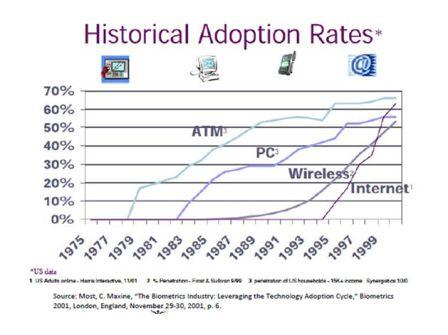
Some might argue from history that it will take a decade or so for mobile payments to be adopted by a significant number of users. By "significant" we might say half of households using mobile payments. KPMG survey


History suggests why that might be so. After 20 years, the percentage of U.S. households using automatic bill paying is still only about 50 percent. Likewise, after 20 years, use of debit cards by U.S. households is only about 50 percent. 


It took about a decade for use of automated teller machines to reach usage by about half of U.S. households. 


The takeaway is that payments innovation tends to be a rather deliberate process, with adoption processes that take between 10 years to 20 years to reach 50 percent of consumer households.


Will the 2026 World Cup Create Any Long-Term Economic Benefit for Host Nations?

World Cup long-term economic effects will be negligible, economists at Goldman Sachs say. That might seem unlikely, given the 2026 FIFA Wor...