Monday, May 7, 2012

U.S. Mobile Providers Face Spectrum Uncertainty

U.S. wireless operators and equity analysts have argued for well over a decade that there is "too much competition" in the U.S. mobile market. The notion is that a stable national market would have no more than three providers. 


Also, with the emergence of the smart phone business, all mobile service providers need lots more spectrum, though some would contest the notion in a near-term sense. 


But some also note that, at least for the moment, contestants are stymied, in large part because recent deals that would have changed spectrum allocations, and some deals still pending, signal to most contestants the likely regulatory resistance.


Recent regulatory action includes the successful regulator resistance to the AT&T purchase of T-Mobile USA, and scrutiny of the spectrum sales by Comcast, Time Warner Telecom, Cox Communications and Bright House Networks to Verizon. 


The denial of LightSquared to use satellite spectrum for a terrestrial Long Term Evolution network is a separate case, many would argue, as the issue there was not market structure (indeed, one might have argued LightSquared would increase the level of competition in the U.S. market), but signal interference with other licensed users. 


Is the share of market now characteristic of the U.S. market sustainable? Most would say "no." Among the common observations is that two of the top four national providers have market share two to three times greater than two of the others.

Many observers would say a market with four national providers is about one too many for a sustainable and stable market. Significantly, that view is held by the Federal Communications Commission and Department of Justice, both of which use a standard test of market concentration in deeming the U.S. mobile market already

One of the ways to measure market concentration is the Heffindahl-Hirshman Index or HHI, often used as a measure of market concentration. The HHI is the square of the percentage market share of each firm summed over the largest 50 firms in a market. 

The  HHI which already suggests that the market is uncompetitive. HHI is the problem where it comes to further mergers among the four largest national mobile providers, even a merger of Sprint and T-Mobile USA, which despite its complexity would create three national providers with roughly equivalent market share. 

Market share concerns also will permeate any spectrum acquisitions, as well, since spectrum is a key "raw material" from which any mobile service provider can build a business. 

Over the long term, there is perhaps general agreement that more spectrum will be required. At issue is the way such spectrum is allocated. In the past, many regulators, in many countries, have restricted availability of new spectrum by incumbents, hoping thereby to create more competition. 

Over the long term, one has to question whether this actually ever works, as all markets, over time, consolidate, even when the initial implications would appear to be positive, from an "enabling of competition" perspective. 


Cloud Winners and Losers Will Cross Ecosystems

Who wins, and who loses, as mobile apps and services, especially cloud-based apps and services, gain more traction? The “obvious” answer is that device and app providers are “winning,” while service providers “lose.” Though obviously true in the case of over-the-top voice, messaging, videoconferencing and entertainment video realms, the larger reality is more complicated.

In many cases substantial and real competition now is occurring between firms in different ecosystems, not only within single ecosystems. And, as has been the case for a couple of decades, contestants have to balance effort between protecting existing businesses and growing new lines of business. 


The difference now is that many of the new revenue streams and businesses actually cross ecosystems and redefine them.
For example, mobile payment systems offered by Square, Intuit and PayPal arguably represent incremental revenue within the credit card and debit card transaction business, rather than primarily a shift of transaction volume within the business. The reason is that such services are used primarily by businesses that would not have used merchant point of sale systems in the past.

Likewise, to some extent, services that turn smart phones and tablets into merchant point of sale systems will compete with supplier of traditional merchant terminals, as well.

Enterprise cloud services might compete with packaged software suppliers, data centers or server manufacturers, for example. That would mean some amount of competition between segments of one industry.

Small business cloud services might reduce the amount of revenue earned by value-added resellers or system integrators, for example. That also is a form of intra-ecosystem competition.

Consumer cloud services, especially those related to storage, will displace some of the need for local storage, and could reduce demand for external hard drive storage and some amount of PC sales. That might be more an example of competition between ecosystems

Cloud storage might reduce need for PCs and storage devices, for example, reducing some amount of device spending and shifting that spending into software and services. So some device manufacturers might lose, while others might gain (PCs, external storage lose; mobile devices win).

By the end of 2013, consumer cloud services for accessing content will be integrated into 90 percent of all connected consumer devices, according to Gartner.

The other dynamic is that, in the case of brand-new services, such as cloud storage, there could also be winners within and between ecosystems. App providers could win, as well as hosting facilities.

Traditional entertainment video suppliers such as cable companies hope to win, even as some amount of entertainment video shifts to cloud mechanisms, even as rivals think cloud delivery will eventually displace traditional distribution mechanisms.

Likewise, cloud services could help device manufacturers as much as app providers. Certain handsets and environments, such as iOS iTunes and Apple tablets and phones, or Google Drive and Android-based devices, provide early examples. That might be an example of value and revenue shifts within the mobile ecosystem.

In other cases, such as many parts of the mobile commerce business, competition might entail substantial amounts of competition between ecosystems. Services offered by the likes of Square, Intuit and PayPal that turn a smart phone into a merchant point of service terminal represent competition between those firms and other existing payment systems, merchant POS terminal providers and emerging application provider or mobile communications service provider payment systems.

“Inside the spending envelope, market dynamics will collapse some markets while creating others that expand the captured revenue,” says Gartner managing vice president Andrew Johnson.

Providers of consumer devices, services and content must anticipate the risk of sweeping changes to their business models,” said Johnson. “The personal cloud will force technology providers not only to rethink how they approach markets, but also, more importantly, how they define markets.”

Emerging and mature markets are no longer useful form of market segmentation, Johnson argues.

Sunday, May 6, 2012

Online Video Still Needs Scale to Attract More Advertising

Note: eMarketer benchmarks its U.S. online ad spending projections against the IAB/PwC data, for which the last full year measured was 2010; includes in-banner, in-stream (such as pre-roll and overlays) and in-text (ads delivered when users mouse-over relevant words); mobile included.The online-video market represented about $1.8 billion worth of ad spending in 2011, with half of that going to just two players: Hulu (about $300 million) and YouTube (about $600 million), according to Brian Wieser, an analyst at Pivotal Research Group, and reported by Ad Age. 


Most of the advertising growth in online video could happen because it shifts spending from the $70 billion spent annually on TV ads in the U.S. market. 


High-quality video lots of people want to watch might be necessary. But it is not sufficient for success, simply because video advertisers want large audiences.


And the simple fact is that not many providers have both attractive programming and large audiences. Subscription revenue is dominated by Netflix. 

Friday, May 4, 2012

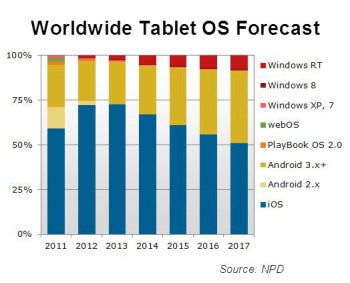
Apple Tablet Share 51% in 2017

Apple, after reaching a market share high of nearly 75 percent in 2013, will see its share decline steadily to 50.9 percent in 2017, according to forecasts by the NPD Group.


Shipments of tablet PCs are expected to grow from 81.6 million units in 2011 to 424.9 million units by 2017, according to NPD Group


That forecast suggests that in 2016 more tablet PCs will be shipped than notebook PCs. 

Most of Apple's declining market share will be grabbed by Android tablets, which will increase its market share to 40.5 percent from an estimated 22.5 percent in 2012, NPD says. It adds that Windows RT slates may be at 7.5 percent of the market in 2017.


The iOS operating system has been dominant in tablet PCs, but it is expected to lose share, from 72.1 percent in 2012 to 50.9 percent in 2017, as Android increases from 22.5 percent in  2012 to 40.5 percent over the same period. 


Meanwhile, share for Windows RT is also expected to grow, but from a very small base of 1.5 percent in 2012 to 7.5 percent in 2017.


Subscription Video Market Shrinks 1.5% in 2011

U.S. cable operators lost about 2.9 million video subscribers in 2011, shrinking the overall subscription TV market by 1.5 percent even as telcos added 1.1 million and satellite TV providers were roughly flat at 280,000 net adds, according to Nielsen data.


The big take away is that cable TV subs fell five percent. That steady drip, drip, drip of deserting customers now is the cable analogy to telco wired voice. 


Meanwhile, households with broadband and only free, over-the-air broadcast TV increased by 631,000 over the course of last year, climbing 14 percent to 5.1 million. 

Why Google Has to Go "Mobile First"

Three numbers explain why Google has taken the "mobile first" approach to application development, why it has chosen to lose some money on Android and create mobile devices.


A recent survey by Strata Marketing of  1,000 advertising agencies that together process $50 billion in media buys annually found 69 percent focused their digital spend on social media. 


That's more than those who focused on search (65.5 percent) and just short of online display (71.3 percent), Strata says


Keep in mind that Google built its business on search advertising. So leading ad agencies now are placing inventory on display and social more than search. 


Within social media, the majority of advertising agencies (85.1 percent) said they and their clients focused most on Facebook, 44.8 percent on YouTube, 39.1 percent on LinkedIn, 24.1 percent on Google , 9.2 percent on Foursquare and 1.1 percent  on  MySpace. 

The YouTube figures are helpful, but the fact remains that Google has to do better in display and social advertising, as well as mobile, to remain a force in advertising. And it is mobile where the opportunity is greatest, and the market as yet unconsolidated. 

Thursday, May 3, 2012

Tablet Market Grew Less than Expected in First Quarter, 2012

The global tablet market did not grow as fast as analysts at International Data Corporation had expected in the first quarter of 2012. A steep drop in shipments of Android-based tablets offset a strong quarter from Apple, according to International Data Corporation Worldwide Quarterly Media Tablet and eReader Tracker.

Total worldwide media tablet shipments for the quarter reached 17.4 million units in the first quarter of 2012, about 1.2 million units below IDC's projection for the quarter.

While IDC predicted a sharp seasonal slowdown of -34 percent from the previous quarter’s record-breaking 28.2 million units, the actual decline was slightly steeper at -38.4 percent.

The total still represents a robust year-over-year growth rate of 120 percent, up from 7.9 million units in the first quarter of 2011.

Apple shipped 11.8 million iPads during the quarter, down from 15.4 million units in the fourth quarter of 2011, and grew its worldwide share from 54.7 percent in the fourth quarter of 2011 to 68 percent in the first quarter of 2012.

Amazon, which had 16.8 percent of the market on shipment of 4.8 million units, saw its share decline significantly in the first quarter to just over four percent, falling to third place as a result.

Samsung took the number-two position while Lenovo vaulted into the number four spot, followed by Barnes & Noble at number five.

Although total Android shipments were down sharply in the first quarter of 2012, companies such as Samsung and Lenovo are beginning to gain traction in the market with their latest generation of Android products. IDC expects the segment to rebound quickly as other vendors introduce new products in the second quarter and beyond.

"The worldwide tablet market is entering a new phase in the second half of 2012 that will undoubtedly reshape the competitive landscape," said Bob O'Donnell, program vice president, Clients and Displays. "While Apple will continue to sit comfortably on the top for now, the battle for the next several positions is going to be fierce. Throw in Ultrabooks, the launch of Windows 8, and a few surprise product launches, and you have all the makings of an incredible 2012 holiday shopping season."

Will "Mobile First" Will Wipe Out The Big Software Makers?

"A lot of legacy players — folks that build enterprise apps on prior platforms — will end up being disrupted by new players who are better equipped to take advantage of the new mobile platform, says Kevin Spain, Emergence Partners general partner. That could even happen to Salesforce and SuccessFactors that grew up in the Web world, he believes.

The startups with the greatest potential to generate outsized returns are those creating “mobile-first enterprise applications” – those that leverage the unique capabilities of mobile devices to enable the creation of new categories of enterprise applications. 


These applications are very different from mobile-enabled versions of traditional enterprise software such as Salesforce.com and Workday,Spain argues.

True “mobile-first enterprise applications” are built for mobile platforms initially or exclusively and enable a worker or business to do things that simply were not possible before the proliferation of advanced connected devices.


The point is that mobile and cloud delivery and consumption of applications might have disruptive impact on industry suppliers. 

Samsung Galaxy S III the Challenger to Apple iPhone?

Virtually every smart phone supplier aspires to compete head to head with the Apple iPhone. You can make your own assessment about how well all those efforts have fared. 


But at least some observers believe Samsung might be in position to do so. That is based in part on the profitability of Samsung's smart phone business, as well as sales volume. 


Samsung has displaced longtime mobile device market share leader Nokia as the world's top mobile phone vendor. 


According to International Data Corporation, vendors shipped 398.4 million units in the first quarter of 2012 compared to 404.3 million units in the first quarter of 2011. 


Samsung's ascension to the market's top spot is largely a reflection of its gains in the smart phone market over the past two years, said Kevin Restivo, IDC senior research analyst. 


Apple and Samsung also accounted for a stunning 95 percent of the handset industry's profits during the fourth quarter, according to a study by Canaccord Genuity.


The issue now is whether the Galaxy S III can legitimately compete head to head with the iPhone. 

SAMPHONE

Is Mobile VoIP More Reliable than Mobile Service Provider Voice?

Most observers would agree that dropped calls are a driver of customer churn. The perhaps-unknown question is whether mobile VoIP offered by over-the-top providers is more reliable than carrier-provided voice. 


Ask yourself whether you ever have seen a study comparing mobile VoIP dropped call rates to mobile carrier voice dropped call rates. It's difficult to impossible. 


Some 39 percent of  mobile users surveyed on behalf of Rebtel experienced more than five dropped calls per month. Perhaps the implication is that over-the-top mobile VoIP can be as reliable, if not more reliable, than carrier-supplied voice. But it is hard to test the assertion. 


Do you believe that mobile over-the-top VoIP will lead to fewer dropped calls than a mobile service provider's own voice service? 


The general rule of thumb is that over-the-top VoIP, in general, is less reliable than landline voice, but good enough to match mobile call quality and reliability. One might argue that service provider or enterprise IP telephony are as reliable as landline voice, though even that claim is hard to test. 


The study also showed that having a clear call connection is very important to 89 percent of respondents, with 84 percent of those claiming they are at least somewhat likely to switch smart phones as a result of poor quality. 


About 78 percent said they would be likely to switch carriers due to poor network performance, according to Rebtel.  


Dropped calls raise the likelihood of customer churn. What is difficult to determine is whether mobile VoIP, over the top, actually provides reliability that is better than what most consumers experience with mobile voice. Try to find any studies on that particular subject. It is virtually impossible. 


20% of Americans, 34% of Smart Phone Owners Purchased Using a Mobile Phone in 2011

A new survey conducted by Harris Interactive on behalf of Placecast claims that 20 percent of adult mobile phone owners in the U.S. made an online purchase with their phone last year. 


Those with smartphones were more likely to make purchases on their phones. 


Thirty-four percent of smart phone owners made a purchase on their phone last year, compared to 11 percent of those with feature phones. Thirty-eight percent of the respondents to the study  said that making a purchase on their mobile phone was at least somewhat important to them.


Overall interest in using phones for purchases has grown by eight percentage points in the past two years, with 38 percent of all mobile phone owners saying it is at least somewhat important. 

Some 59 percent of smart phone owners surveyed say it is at least somewhat important to be able to make a purchase on their device.

U.S. TV Viewers Using More Screens

The average American watches nearly five hours of video each day, 98 percent of which they watch on a traditional TV set, according to Nielsen. 


After several years of consistent year-over-year growth, traditional TV viewing declined one half of one percent or roughly 46 minutes per month. Nielsen suggests that dip could be explained by any number of drivers other than a shift in viewing habits. 


As more homes adopt DVRs and move to greater use of  time-shifted viewing, time-shifted TV growth has offset the bulk of live TV declines. Other potential factors include time spent using game consoles, tablets and other emerging devices, or even short-term weather, Nielsen says


Still, in the fall of 2011 there was a slight decline in the number of TV homes in the U.S. market. This shift is prompting an important conversation around the definition of a “TV household” and a “TV viewer,” as some homes not using "TV" might be watching video on tablets, PCs and smart phones. 


Some 33.5 million mobile phone owners now watch video on their phones—an increase of 35.7 percent year over year. 


viewing-in-review

Greater Reliance on Wholesale in Telecom Future?

It seems likely that most tier-one service providers, especially in the mobile end of the business, will be relying on more "wholesale" services in the future. To some extent, this already is the case, as when a facilities-based service provider leases capacity and features to a mobile virtual network operator. 


Likewise, enterprise customers have for many decades created their own voice services using their own phone systems, while buying bulk access from service providers only to carry and terminate those derived services. 


Telecom service providers likewise have sold bulk capacity and features to third parties that create enterprise services for retail sale. 


But there now is much talk of ways service providers can increase the volume of services and access sold to third party business partners. Content delivery networks provide one example. Cloud computing services provide other examples. 


But sale of network features and "big data" features likely will be more important as well. The general notion is that application providers could be encouraged to purchase network functions or features in a bulk or wholesale capacity, to enhance or create new application experiences. Advertising or content firms are said to be likely buyers. 


There might be quite a lot more of that sort of activity in the future, representing a shift to more business-to-business sales than traditional business-to-end-user sales. 


Wholesale strategies could become more radical. A few service providers might opt to become wholesale-only capacity providers, though that is likely to remain a fairly unusual strategy for any tier-one service provider. 


But some believe the agency agreements between Verizon and Comcast, Time Warner Telecom and Cox Communications, allowing the cable companies to sell Verizon products, and Verizon to sell cable products, could lead the cable operators to become wholesale providers to Verizon, while Verizon becomes a wholesale supplier to the cable firms. 

Will Apple, Google, Facebook, Amazon or Microsoft Become Mobile Service Providers?

Apple will provide wireless service directly to its iPad and iPhone customers, argues consultant Whitey Bluestein. In his hypothetical scenario, Apple first will sell data packages bundled with iPads. Then it will sell data and international roaming plans to iPhone customers through the iTunes Store, Bluestein argues


Over time, Apple will strike wholesale deals with several mobile operators so that Apple can provide wireless service directly to its customers, as Apple Mobile, Bluestein predicts. As “crazy” as that might sound, it might be a fairly common tack taken by any number of device, service or application providers, eventually. 


In fact, it fits well with the general thinking that, over time, mobile and fixed network service providers will increasingly want to sell services to third-party business partners as well as end users.


Other potential moves by a number of leading application or software providers show the ways business advantage is shifting in the mobility business. 


Microsoft's recent investment in the new company that will own the Nook tablet and content business shows the growing importance content, advertising and commerce operations are assuming for device and application suppliers, for example. 

Some believe the "Four Horsemen" of the Internet include Facebook, Apple, Google and Amazon. Others might say the list actually is "Five Horsemen" and include Microsoft. Either way, the notion is that  handful of firms have the ability, at least in principle, to create and own a complete and walled-off ecosystem in which consumers use a single company’s hardware, operating system and storefront to search online, buy apps and purchase digital media and  physical products. 

What remains less clear is the importance of bundling "access" with those other device, content, commerce and advertising capabilities, though. In principle, the separation of applications from access is quite helpful for any app provider. 


On the other hand, are there ways app providers can create a better end user experience by bundling apps, devices and connectivity? 

That remains less clear. But one approach that might have clear advantages is the ability to create mobile access services that are optimized for media consumption. In other words, the aim might be to optimize the streaming media and gaming experience, not provide a "better" voice or messaging experience. 


That could take the form of a branded content delivery service distinct from general-purpose Internet apps, voice or messaging services. What might be bundled, in other words, is a branded experience enhanced by CDN capabilities. In each ecosystem, content delivered as part of a content app or service might essentially be a "private network" experience taking advantage of available optimization techniques. 

Think of a content virtual private network and you get the idea. That sort of optimized access might make more sense than any of the leading ecosystem providers becoming actual general-purpose mobile service providers. 

Mobile Commerce and Shopping Behavior Quite Common

According to a survey conducted by Nielsen, 79 percent of U.S. smart phone and tablet owners have used their mobile devices for shopping-related activities. 


Smart phones are used more often than tablets for activities on-the-go, as you would expect. By some studies, up to 95 percent of tablet usage occurs indoors, rather than in a mobile context.
About 73 percent of respondents polled by Nielsen used their smart phone to locate a store, compared to about 42 percent using a tablet to search for a store.
Some 42 percent of respondents used a mobile device to create a shopping list while shopping. About 16 percent of tablet users reported they did so.
Some 36 percent of respondents said they redeemed a mobile coupon on their smart phone, compared to  11 percent of  tablet owners.   
Some 42 percent of tablet owners have “used their device to purchase an item,” compared to 29 percent of smart phone owners.
Both smart phones and tablets have been used to “research an item before purchase.” About 66 percent of tablet owners and 57 percent of smart phone owners reported doing so.
Some 27 percent of smart phone owners and 28 percent of tablet owners say they have used their devices to make a payment. 


shopping-smartphones-tablet

Apple, Google, Amazon Microsoft: Who Wins the Ecosystem War?

Microsoft's recent investment in the new company that will own the Nook tablet and content business illustrates a couple of important strategic shifts now happening in the mobile device and application markets. The biggest shift is the growing importance content, advertising and commerce operations are assuming for device and application suppliers. 


Among the secondary issues is a new take on "open" versus "closed" approaches to software development have been a live issue for decades. These days, with the emergence of content and commerce as key elements of device and application strategy, the questions are taking new shape. 


Some believe the "Four Horsemen" of the Internet include Facebook, Apple, Google and Amazon. Others might say the list actually is "Five Horsemen" and include Microsoft. Either way, the notion is that  handful of firms have the ability, at least in principle, to create and own a complete and walled-off ecosystem in which consumers use a single company’s hardware, operating system and storefront to search online, buy apps and purchase digital media and  physical products. 


If that proves to be true then a couple of predictions are easy to make. Facebook and Amazon will produce their own smart phones. Facebook might also have to produce a tablet. Apple will have to create a mobile payment service, as will Microsoft. 


Google and Facebook will have to get more share of the e-commerce and mobile commerce transactions, and all will deepen the activities they now already support around mobile advertising, promotion and loyalty. 


Last week, yet another rumor surfaced that Facebook is getting closer to releasing its own branded smartphone, an obvious attempt at owning a stack component (hardware) that’s currently missing from its line-up, Wired reports. Rumors about an Amazon smart phone have circulated for a couple of years, on and off, as well. 


“A smartphone would be a logical next step for Amazon,” ABI Research Analyst Aapo Markkanen says. 


Either of those moves, plus an eventual move to create a Facebook tablet, illustrate the changing role of devices and connectivity in the mobile space. Traditionally, mobile phones simply were devices carriers had to provide to sell voice and messaging services. 


These days, matters are more complex. In addition to communications, hot consumer devices frequently are used for content consumption. That means smart phones are more important to application providers as platforms for selling content and advertising. 


Everyone expects a mobile device to handle voice and texting. Beyond that, more users expect the ability to consume content and conduct transactions. That changes the strategic importance of being a device manufacturer. 


For mobile service providers, phones have been a sort of prop to produce revenue indirectly, in the form of service subscriptions. But that also now is increasingly true for application providers. 


For Apple, which merchandises all sorts of content to sell devices, the tight bundling of content and commerce is a major reason it can sell so many devices. That also is true for some other mobile device manufacturers. But not for all. 


For Google and Amazon, devices are a way to sell more advertising, content and merchandise. Microsoft has a slightly different take, as it always has preferred to sell operating systems to partners who make phones. But Microsoft has to succeed in mobile operating systems to profit from the device ecosystem that supports the advertising, commerce and content businesses. 


Such thinking is not terribly new. Consumer electronics manufacturers have for decades understood that content was important for the devices business. Sony is probably the best example of that. Apple arguably was the first consumer devices firm to really achieve that integration, with its iPod and iTunes. 


These days, gaining the ability to lock consumer into a particular content ecosystem is the reason producing devices matters. 


Wednesday, May 2, 2012

Smart Phones Really Are Content Consumption Devices

During the three-month average ending March 2012, 50 percent of U.S. mobile subscribers used downloaded applications on their mobile device, up about five percent from 47.6 percent during the three-month average ending December 2011, according to comScore. 


For the period, downloaded applications extended their lead in penetration over browsers, which were used by 49.3 percent of subscribers (up from 47.5 percent, quarter over quarter). 


Texting remained the most common activity, used by 74.3 percent of U.S. mobile subscribers, unchanged from the previous three-month period. 


In addition to apps, users also made significant use of music, gaming, social networking and browser interactions. 

comscore-mobile-content-usage-dec11-v-mar12-may2012.jpg

Over the Tip is Like "Showrooming;" Best Buy and Target Responses are Like "Retail" and "Wholesale" in Telecom

Target is not happy about "showrooming," the practice whereby many consumers take a look at products, but then wind up buying that same merchandise online. Target now appears to be concerned enough about lost sales to Amazon that it will stop selling Kindles in May 2012.

Every firm has to decide what to do about competition, and Target seems to have no similar qualms about selling Apple tablets. In fact, Target is preparing to launch Apple Stores inside Target locations.

Since Target stores began selling Amazon's Kindle line back in 2010, and the Kindle Fire was even the retailer's best-selling tablet during Black Friday 2011.

The new deal with Apple is said to represent a "conflict of interest."  Target's move, in one sense, isn't unusual. Lots of distributors have special deals with certain suppliers, and Target might be betting it will make more money selling Apple tablets than Kindles. There might be clauses in the deal that require Target to remove Kindles. It just isn't clear.

But Target and Best Buy might be heading in opposite directions in dealing with "showrooming." Target has asked its suppliers for special "Target only" merchandise, for example, to limit "showrooming" impact. That might be likened to mobile phone "exclusives" offered by mobile service providers.

Best Buy, on the other hand, is mulling a shift in the opposite direction. Best Buy has, like Target expects to do, supported Apple mini-stores inside Best Buy locations for quite some time. But Best Buy might consider shifting even more fundamentally in that location, essentially allowing many other suppliers to rent space inside Best Buy as a primary revenue model.

In telecom terms, Target wants to remain a retail supplier, where Best Buy could move in the direction of a major reliance on a wholesale role in the value chain. Target's strategy is the more common approach in the communications business, where nearly all the money is made selling products directly to retail end users.

Best Buy might be considering a shift to a "Clearwire" style, wholesale-only strategy that is relatively uncommon in the communications business. Where the retail Target strategy rests on revenues created by end users, the wholesale strategy rests on sales of products to business partners.

Where Target is a business-to-consumer model, Best Buy might be contemplating a shift to a business-to-business model.

Is Cloud Computing Good or Bad for Telcos? "Yes" on Both Counts

It is far from easy to determine the complete impact of innovations such as PCs and tablets, broadband access and cloud computing on revenue streams of service providers. PCs obviously created demand for dial-up Internet access services, to the extent that email was a killer app for communicating PCs.

Tablets create demand for broadband connections, both fixed and mobile. But broadband-connected devices also allow enterprises and apps to create their own communications services and features.

Cloud computing likewise will create new requirements for connectivity, bandwidth and data center hosting. But cloud computing also enables the creation by people, apps and firms of cloud-based voice and messaging, in much the same way that businesses traditionally have used private branch exchanges to create their own voice services.

The point is that it is difficult to quantify all the gains and losses from cloud-based voice and messaging, from the standpoint of a communications service provider. Consider tt.One, a new platform being launched in North America by German-based mobile interaction specialist Tyntec.

The tt.One platform bridges the IP world of over-the-top apps with the telco world. The cloud-based solution gives businesses the power to integrate carrier voice, text messaging and mobile numbers into online services, applications and social networks.  

The service provides virtual mobile numbers that enable the two-way transmission of voice and SMS in multiple countries.

The tt.One service simplifies the complexities involved in integrating telecom services into a Web environment by virtualizing all of the core mobile communications capabilities into the cloud.

For example, Internet companies can provide mobile numbers to their users, enabling them to exchange SMS and voice calls, as well as making any device, such as an iPad, a mobile phone in WiFi areas.

U.S.-based Pinger uses tt.One in Germany for its free, device and carrier-independent voice and text service, and tyntec expects other OTT players with a desire to expand into Europe will follow.

So cloud-based voice and texting both grows usage while competing with established service provider offerings. Voice and text communications gain huge network effects, making both more valuable, but also compete with mobile service provider offerings.

The point is that cloud computing holds both upside and downside for service providers.

Tuesday, May 1, 2012

"Hybrid" Strategies Will be Common for Mobile Commerce Contestants

Transitional or hybrid strategies are emerging as an important staple of the mobile payments business. Stickers that add near field communications features for non-NFC phones are one example.

In other cases, new features are created that make use of existing payment infrastructure. Starbucks used its existing point of sale terminals and added bar code scanning to launch its branded mobile payments venture. PayPal is piggybacking its card mechanisms at Home Depot stores.

We are likely to see many more examples of such “bridging” strategies, even though some “greenfield” efforts such as Isis, Google Wallet or Visa mobile wallet services also will attempt to gain traction.

Barclaycard, for example,  has unveiled a stick-on credit card called "PayTag," which will sit on the back of a mobile phone (or any other item you carry everywhere) and then be used to make small, contactless payments using near field communications. The move illustrates some enduring issues with technology and services adoption.

First, what Barclay's is doing is not necessarily even "mobile payments," in one real sense. It is the sticker itself which communicates and represents the store of value. The phone is just a place to put the sticker.

The idea is to open mobile payments to Barclaycard's 12 million customers, even if their mobile phone is not equipped with an NFC chip, or not set up for contactless payments, or do not even use a mobile phone.

Right now, the sticker can be used to make payments of £15 and under, and it will rise to £20 in June 2012.

Second, the PayTag is probably a transitional strategy. That is a tactic often used when one era of technology is replaced by another. What is "hybrid fiber coax" but a bridge between an all copper network and an all-optical fiber network? What is a hybrid automobile? Why were existing sailing ships outfitted with steam boilers?

The point is that a proven strategy at times of fundamental change is to graft key elements of the coming technology to the existing way of doing things. It's a process Richard Foster, of Yale University, has written and talked about for decades.  

New technologies often cannot stand on their own in the marketplace, either because they are not initially cost competitive with the existing technologies, because the full ecosystem has not developed or because there is customer or other resistance of some sort.

There is nothing at all wrong with adopting a transitional strategy; it is a common way a next generation of technology displaces the former way of doing things. In this case, it means that even if you believe NFC ultimately will replace the credit card swipe, it will take some time. Taking an interim approach is better than doing nothing.

Third, the move by Barclay's to initially limit the transaction volume serve several purposes but also illustrates the existence of natural segments within the mobile payments business. At one level, the limitation protects Barclay's from unexpected financial losses.

At a higher level, the sticker approach, with a transaction volume limit, shows where several payment methods have a role. Where traditionally carrier billing has been used for small purchases of digital goods, other payment systems, including PayPal, credit, debit and prepaid cards also have been used to buy songs, game credits, stories, videos or other digital goods.

What many now are trying to figure out is how to use newer payment systems based on mobile devices, or associated with mobile devices, can be used to extend the range of payments for virtual and physical goods in the offline payments setting.

And at least initially, many of the early payment systems have been aimed at supporting small purchases. In the near term, that might be a reasonable approach for a number of reasons, including consumer unfamiliarity with the concept. The point is that it is one thing to get consumes to change behavior about small, casual payments. It is something else to get them to change behavior about larger transactions.

Nor is it yet clear whether distinct market segments for physical shopping and online or mobile purchases will continue to exist, though they are likely to be key market segments at first. Credit and debit cards, for example, seem to be used equally for online and physical store payments. But PayPal historically has been an online payment mechanism, and only now is PayPal attempting to become something that is used more universally.

Fourth, there are functional segments of the mobile payments market. Many systems essentially try to link the phone with a specific set of payment accounts, such as credit card, debit card, bank accounts, phone accounts, prepaid instruments or other stores of value. That makes the phone the payment instrument.

Others, such as Square, Intuit and PayPal, want to turn the phone into a cash register, allowing a standard credit, debit or prepaid card to be swiped. In that case, the mobile phone supports a point of sale terminal function for the merchant, rather than a payment mechanism for the buyer.

On the other hand, mobile wallet systems will try to piggyback on mobile payments to create new businesses based on advertising, marketing and loyalty. As Square uses the mobile phone to create a POS terminal business, so mobile wallet suppliers will use mobile payments to create new marketing, advertising and loyalty businesses.

Fifth, there are new possible roles within the ecosystem. The "trusted service manager," for example, to essentially create the networks of information required to sign up customers, ensure network interoperability and security, activate and deactivate services, manage databases and provide branding, for example. Think of the TSM as a new sort of "branded" network such as Visa or MasterCard, for example.

How Long Does Microsoft Have to Prevent Apple Dominance in Consumer Computing?

Microsoft Corp is investing $605 million over five years in Barnes & Noble new Nook e-reader and college book  business, in an effort to better compete with Amazon.com and Apple in the tablet computer market.

The move shows how important content stores have become in driving tablet sales, which clearly match the increasing role of computing devices as platforms for content. Beyond that important consideration, one might wonder whether Apple's growing strength in consumer electronics threatens to displace Microsoft's position in computing, at least in the consumer space.

The new touch-enabled Windows 8 operating system, and the inclusion of a Nook app on Windows tablets should allow them to compete with Apple's iPad and Amazon's Kindle Fire, some believe.

But the larger question is how much time Microsoft has before Apple's growing market share in a variety of consumer electronics categories threatens to relegate Microsoft to the sidelines in mobile phones, tablets, e-reading, music and other areas Apple hasn't attacked yet.

Though some will disagree, you can argue that Apple now leads the consumer electronics business, not only the computing business, while Microsoft has become more of an enterprise technology supplier.

Five years ago, in 2007, Microsoft reported quarterly revenue of $14.398 billion and  profit of $6.589 billion. In 2012, Microsoft’s revenue was $17.4 billion, while profit was $6.374 billion. The company is still growing, but not fast, and is less profitable.

The bigger story, though, is likely Apple.

Five years ago, in its first quarter of 2007, Apple revenue was $7.1 billion and profit was $1 billion,  the first quarter with a billion dollar profit in company history. In 2012, for the same quarter, Apple had $47 billion in revenue and $13 billion in profit.

The shift into different customer segments is not, in some ways, a surprise. Apple never has chased the enterprise market, preferring to sell directly to end users, and then watch enterprise sales grow as those users demanded the right to use their devices at work. You can say Apple has been the biggest beneficiary of "bring your own device" or "consumerization of IT" trends.

Workers now report using an average of four consumer devices and multiple third-party applications, such as social networking sites, in the course of their day, according to a study sponsored by Unisys.

Also, workers in the survey reported that they are using their own smartphones, laptops and mobile phones in the workplace at nearly twice the rate reported by employers.

In fact, 95 percent of respondents reported that they use at least one self-purchased device for work. Another big change is that where enterprise IT staffs used to assume they were responsible for training and supporting users on enterprise technology, these days many users simply will go ahead and train themselves to use tools they prefer. That also is a big change.

That "consumerization" of technology is quite a big shift. Decades ago, the pattern of technology diffusion was fairly straightforward. The latest new technology was purchased by large enterprises and large government entities.

Over time medium-sized businesses and organizations started to buy the same technology. Later, small businesses and organizations adopted the tools. Finally, some consumers 'brought the technology home' and used it as well.

All of that has changed over the last two decades. These days, many enterprise tools actually were brought into the enterprise by consumers who already had adopted the technology for home use.

The problem for Microsoft, and others, is that Apple increasingly is becoming a whole ecosystem in consumer electronics related to computing. And there is reason for all the others to worry. Apple's share in MP3 players, tablets and to some extent smart phones shows how hard it is to compete effectively with Apple, once a market is defined.

Some of us would argue that there is an iPod market, and then a smaller MP3 player market, an iPad market and then a separate tablet market, for example.

Samsung Takes Global Lead in Mobile Phone Share

Samsung displaced longtime mobile device market share leader Nokia as the world's top mobile phone vendor. According to International Data Corporation, vendors shipped 398.4 million units in the first quarter of 2012 compared to 404.3 million units in the first quarter of 2011.

Nokia has been the global market leader in total mobile phone shipments since the inception of IDC's Mobile Phone Tracker in 2004.

Samsung's ascension to the market's top spot is largely a reflection of its gains in the smart phone market over the past two years, said Kevin Restivo,  IDC senior research analyst.

Meanwhile, the worldwide smartphone market grew 42.5 percent year over year in the first quarter of 2012.

Top Five Worldwide Smartphone Vendors, Shipments, and Market Share, Q1 2012 (Units in Millions) 
Vendor
1Q12 Unit Shipments
1Q12 Market Share
1Q11 Unit Shipments
1Q11 Market Share
Year-over-year Change
Samsung
42.2
29.1%
11.5
11.3%
267.0%
Apple
35.1
24.2%
18.6
18.3%
88.7%
Nokia
11.9
8.2%
24.2
23.8%
-50.8%
Research In Motion
9.7
6.7%
13.8
13.6%
-29.7%
HTC
6.9
4.8%
9.0
8.9%
-23.3%
Others
39.1
27.0%
24.5
24.1%
59.6%
Total
144.9
100.0%
101.7
100.0%
42.5%

Apple Churn Impact: 6 to 8 Times the Normal Rate Around 4S Launch

A study by Consumer Intelligence Research Partners over the three-month period between December 2011 and February 2012 suggests that the Apple iPhone does play a role in churn.

About 18 percent of iPhone buyers over that period report they had an iPhone already, and switched carriers. The obvious flip side of that story is that 82 percent of iPhone buyers stuck with the same carrier and only switched devices.

Some 24 percent of new buyers said they switched from another type of device to an iPhone, and also switched carriers. That means 76 percent switched devices, but stayed with their original service providers.

Those statistics cover a three-month period during the launch of the 4S, so likely will not be so pronounced for latter periods.

That suggests the iPhone was a significant driver of churn away from carriers that do not sell the iPhone, if you assume that the 24 percent of new iPhone buyers switched carriers just to get the iPhone.

But 18 percent of new iPhone buyers already had an iPhone, but still switched carriers. Some would suggest that represents AT&T customers switching to Verizon Wireless.

Either set of statistics--18 percent or 24 percent churn--are significant. If you assume monthly churn of about one percent a month, then either rate represents monthly churn of perhaps six percent to eight percent. That is six to eight times higher than either firm typically experiences.

Also, Wal-Mart has emerged as an important sales channel for Apple iPads, a survey by Consumer Intelligence Research Partners has found. In the month of February 2012, Wal-Mart represented about 11 percent of sales. Best Buy sold 24 percent, Apple sold 26 percent.

Walmart iPad Sales Chart As you might guess, retail stores operated by mobile service providers were a bigger channel for iPhones. Over a three-month period, from December 2011 to the end of February 2012,retail stores accounted for 76 percent of iPhone sales; online stores, 24 percent. When the iPhone 4S first launched, retail stores and online outlets accounted for 67 percent and 33 percent of sales, respectively, largely due to online orders.


Mergers, Joint Ventures or Investments as Routes to Controlling AI Model Costs

Just how artificial intelligence model providers might improve their economics is a key business model issue.  A shift to inference operatio...