Saturday, October 29, 2011

Mobile "Payment" is Shifting to "Wallet"

Bloomberg technology writer Rich Jaroslovsky has been testing the new Google Wallet, and at least for the moment thinks mobile payment and wallets are less about improvements in the payments process, and lots more about the marketing and promotion advantages.


"This is really the secret sauce in mobile payments, because while, yeah, it is kind of a little bit more convenient, that isn't really what's going to get people to use it," he says. "What's going to get people to use it is the possibility that they can save money." Mobile payment more marketing than "payment"


The mobile payments business is starting over, says David W. Schropfer, a partner at Luciano Group. Ironically, as both Isis and the Google Wallet systems now essentially disclaim any interest in revenue from the transaction process, seeking instead to build new businesses based on advertising and loyalty, the “wallet” part of the mobile commerce business now seems to have “substantially slowed mobile commerce development in the rest of the developed world.”
To a large, though not complete extent, “payments” now are taking a back seat to “wallets,” which probably means we are headed for a period where “mobile commerce” becomes the headline phrase, not necessarily “mobile payments.” Mobile payments starting over 

Why Sprint is Capping Tethering

smartphone-cost-per-MBDespite fairly widespread confusion about the matter, Sprint Nextel Corp. is only capping mobile broadband usage by customers using the Wi-Fi hotspot feature. Data consumed directly by Sprint smart phones remains unlimited.


The disparity between smart phone and Wi-Fi hotspot data consumption explains the move.


Sprint and Clearwire Corp.are near an agreement to extend their existing network- sharing agreement for three to five years, Bloomberg said. That would allow Sprint to keep using Clearwire for support of either WiMAX or Long Term Evolution customers. But the contract terms explain the change of retail pricing for tethering. Sprint, Clearwire talk new contract


Jonathan Chaplin, an analyst at Credit Suisse Group AG, said he thinks Sprint will pay Clearwire between $6 and $10 per gigabyte of data, compared with the current charge of about $10, and he believes it will be close to the $6 figure.


Assume a monthly payment by the end user of $60 a month, and a wholesale payment to Clearwire of $6 per gigabyte, or $30. Were a specific end user to consume 10 Gbytes a month, revenue would be $60 and cost would be $60, just for bandwidth. Smart phone data consumption

That's why Sprint changed its tethering plans, in large part, one could argue, though support for the Apple iPhone also likely played an important role in shaping Sprint's thinking. Of course, now that Sprint has negotiated a new contract with Clearwire, the economics will change. 


Under the new deal, Sprint pays Clearwire a flat fee for 4G access, so usage is no longer an issue for Sprint, through the end of 2013, at least.


In the last 12 months (June 2010 to June 2011), the amount of data the average smartphone user consumes per month has grown by 89 percent from 230 Megabytes in the first quarter of 2010 to 435 MBytes in the first quarter of 2011.


The point is that a typical smart phone user consumes 435 Mbytes. A PC user typically consumes gigabytes. At the 80th percentile and below, users consume 500 Mbytes or less each month. In the 60th percentile, users consume 250 Mbytes or less each month.


The point is that the expected "breakage" between wholesale bandwidth cost and retail consumption and pricing is quite larger for a smart phone user, quite a bit less for a Wi-Fi hotspot user.


Internet Drives Capacity Demand

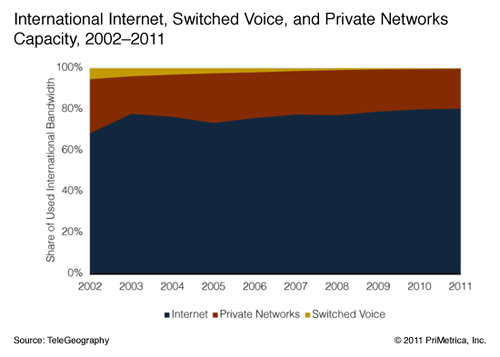
Internet capacity requirements have emerged as the principal source of overall communications bandwidth demand. As of 2011, international Internet bandwidth exceeds voice and private network bandwidth by a factor of 4. Given the Internet’s dominant role in bandwidth usage, Internet capacity data is an excellent proxy for overall demand for lit bandwidth on long-haul wholesale networks. Source: Global Internet GeographyAs of 2011, international Internet bandwidth exceeds voice and private network bandwidth by a factor of 400 percent, says TeleGeography.

Given the Internet’s dominant role in bandwidth usage, Internet capacity data is an excellent proxy for overall demand for lit bandwidth on long-haul wholesale networks.

Internet IS bandwidth

YouTube Launching 96 Channels

YouTube is launching 96 new channels, as part of its bid to create more original and professional programming in a context that is familiar and acceptable to advertisers.


The new channels span a variety of genres, initially funded by about $100 million in grants from YouTube to content creators . 96 new YouTube Channels

Here's a look at the formats and positioning of the new channels, which will start to launch in November 2011. Original Channels

Very-Small Businesses Use Social Media, But Spend Little

Very-small businesses, especially those with one to 10 employees, do not spend much money on their social media efforts. In fact, perhaps 42 percent say they spend nothing additional to support their activities, and perhaps 17 percent spend $100 or less on an annual basis, a survey by Zoomerang suggests. As many as 74 percent of respondents further say they do not employ anybody to manage social media programs.

None of that should be terribly surprising. One of the attractions of using social media is that, while it takes time, it does not necessarily require incremental spending.

Nearly half of the surveyed SMBs use social media to market to customers; of those, an overwhelming majority (86 percent) have Facebook accounts.


The top three favorite features used by both SMBs and consumers are photos, messages and status updates. At the same time, the reported "most effective" tactics for businesses to reach customers are wall posts and direct messages.  Zoomerang SMB survey:

The top three reasons SMBs use social networks are: connecting with customers, visibility and self-promotion. In other words, SMBs use social media for a mix of reasons, including lead generation and branding, loyalty and customer acquisition.


The top three things businesses want to know from customers on Facebook are customer satisfaction with products, customer satisfaction with service provided, and ideas for new business promotions. In other words, "how do you like our products," "how do you like the experience of buying" and "what can we do to convince you to buy more?"

Thursday, October 27, 2011

Microsoft, RIM Visions of the Future

Microsoft paints a world inhabited only by beautiful people, in which smartphones are about the size of a business card, and just about any surface you come into contact with has a touch-sensitive interface.

Cloud connections as the primary form of content transference, whether that be from a phone to a book-like tablet, or from a tablet to the kitchen table.

Interestingly, the “phone” type device (which no one actually speaks on throughout the whole video) sports a “live tile” interface very similar to the current Windows Phone Mango platform. There’s not a shred of paper in the video, which is bad news for the print industry should Redmond’s vision come to fruition.


RIM’s vision of the future, like Microsoft’s, is one that’s heavily powered by touch. Meanwhile, BlackBerrys have grown to be considerably more robust, and are able to seamlessly integrate with screens and surfaces that extend their functionality. Working on a long email and need a keyboard? Set your phone down on a table or a countertop and a keyboard pops up next to it.


BlackBerry Future Visions 2 from Evan Blass on Vimeo.


BlackBerry Future Visions 1 from Evan Blass on Vimeo.

Social Media ROI Still Tough to Measure

Leading Social Media Tools/Tactics Used by US B2C and B2B Marketers, Aug 2011 (% of respondents)
Since marketing is a "staff" function rather than a "line" function, it is hard to measure results. That's not unusual, as it can be hard to measure the return on investment from lots of other business activities, ranging from finance and accounting to legal support or most forms of operations support that are not customer-facing. 


On the other hand, marketers "need to prove" to resource allocation authorities that return from content or other forms of marketing actually can be measured. That's the driver behind current desire for better measurement of social and content marketing efforts.


Only 13 percent  of respondents in a recent Chief Marketer survey thought they were very effective at measuring social media campaigns, while 47 percent said somewhat effective, 28 percent  said not very effective and 12 percent said not at all effective. 


Data from the August 2011 Chief Marketer “2011 Social Marketing Survey” found that only 26 percent of marketing professionals saw amassing total followers as an aim for social media marketing. More popular goals included driving traffic to a website (66 percent), generating sales or leads (48 percent), and identifying and addressing brand fans (47 percent).


The most popular tactic among survey respondents was including a social sharing button in emails or on a company website, with 69 percent of respondents saying they did that. Additionally, 59 percent offered unique content for social media fans and followers, 58 percent had a Facebook “like” button on their websites and social pages, and 54 percent posted videos to social video sites. Marketers Seek to Measure Social Media Success

Why Did Amazon Profits Take A Hit? It Is Investing In The Future (Content And Web Services) | TechCrunch

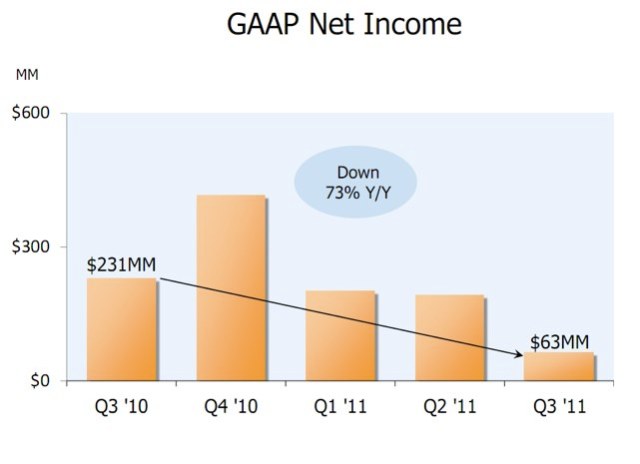
AMZN net income slideIf one is going to slam Netflix for investing in its future, one might as well add Amazon to this list. Amazon’s third quarter 2011 profits are down 73 percent and on Oct. 25, 2011 is being slammed in after-hours trading (down $28 a share).

As also was the case at Netflix, revenues were up, in Amazon's case, up 44 percent to $10.9 billion.


Orders for the new Kindle Fire apparently are substantially above what Amazon had projected, so Amazon is building millions more units than it originally expected.


Amazon also is ramping up investments in the backend infrastructure to support all the digital media it expects people will want to consume on their Kindles, especially their Kindle Fires. Amazon spent $769 million on “technology and content” in the quarter, up 74 percent from a year ago.

Sometimes companies have to take risks. Sometimes they have to invest. Investors don't like the quarterly fluctuations.

Will Consumers Use More Than One Mobile Wallet?

It might not make as much sense for consumers to use multiple "mobile wallet services" compared to a single repository for credentials, but on the other hand there might be some compelling reasons to do so, as when a particular retailer does not support multiple wallet services. Also, despite the initial set-up of credentials in any wallet system, how much on-going hassle is it for a consumer to use multiple platforms?

In some cases, the offers available on leading wallet services might be different, meaning consumers can take advantage of multiple offers. From a retailer's point of view, fewer is better, for logistical reasons. But in all cases, it is arguably true that mobile wallets have an immediate advantage for retailers that "mobile payments" do not.

Mobile payments will require greater investment in terminal equipment and systems. Mobile wallets will also require some investment, but where a new "mobile payment" scheme offers questionable or subtle benefits for a retailer.

Mobile wallets are a vehicle for customer loyalty, customer acquisition and probably average sale size as well. That's quite a bit more substantial and immediate than simply adding one new form of payment.

"If the wallet doesn't have the merchant in mind, the relationship fails," says Phil Kumnick, senior business leader for global processing at Visa. "This should be about making the merchants' business better." Will Consumers Use More Than One Mobile Wallet?

Smartphones and Tablets Drive Nearly 7 Percent of Total U.S. Digital Traffic - comScore, Inc

Wi-Fi Offload podcast
Mobile phones and tablets now represent 6.8 percent of U.S. traffic in August 2011, with approximately two thirds of that traffic coming from mobile phones.

And users are shifting 37 percent of their mobile device access to fixed connections, using Wi-Fi. The percentage of usage grew nearly three percentage points in just three months.

In August 2011, nearly 10 percent of traffic from tablets used a mobile network connection, a fact of some importance for mobile service providers, since that means additional revenue.

Today, half of the total U.S. mobile population uses mobile media. The mobile media user population (those who browse the mobile web, access applications, or download content) grew 19 percent in the past year to more than 116 million people at the end of August 2011.

France Telecom Revenue, Profit Fall as Evolution Continues

France Telecom’s third-quarter 2011 profit fell by 5.2 percent to €3.99 billion. All regions in which it operates, except Spain, had negative results. In France, revenue dipped 4.6 percent.

But France Telecom grew customers by 8.6 percent, pointing to a profit margin erosion issue. France Telecom attributes 1.7 percent of the revenue pressure to regulatory change.

Some of the revenue weakness was caused by a delay in iPhone 4 availability, while slower SMS, voice and roaming income also played a role, as did declining home phone line connections. On the other hand, France Telecom is doing better on the market share front, and loss of landline accounts is slowing.

Everything Everywhere, the joint venture with Deutsche Telekom’s T-Mobile UK, also saw revenue dip by 4.3 percent, with data and text messaging revenue growing 14 percent to comprise 42 percent of average per-customer revenue.

To be sure, the key revenue trends France Telecom is facing have been in place since the mid-2000s. As data from 2007 shows, mobile operators were almost certain to see a shift of revenue from voice to other services in the future, if only because mobile voice essentially was saturated, calling prices were high and VoIP alternatives were coming.

Also, a 2007 estimate of landline and mobile provider revenue contributors in five additional years showed about what one would expect. Analysts at the Yankee Group expected revenue from mobile data and TV, as well as broadband to be high-growth areas, and one would have to agree that has been the case. Beyond that, it has been much less clear what additional lines of business could fuel equivalent growth.

Up to this point, France Telecom primarily has used out-of-region strategies to maintain its growth, a strategy that is not exhausted.

CTIA Backs Net Neutrality Rules

CTIA-the Wireless Association, a trade group that represents wireless carriers, filed a motion in federal court supporting the Federal Communications Commission's net neutrality regulations. CTIA backs net neutrality rules


Four public interest groups, including Free Press, have sued the FCC, arguing that the agency's net neutrality rules do not go far enough. 

The CTIA filing might strike some as odd, to the extent that the industry group is supporting mandatory "best effort only" broadband access. Sometimes, half a loaf is better than no loaf. The rules allow mobile service providers greater freedom to manage their networks, in principle also preserving the ability to create quality of service mechanisms. 


Even for service providers that operate both fixed and mobile networks, freedom for the strategic mobile business means it is an acceptable compromise to give up the ability to create quality of service mechanisms for fixed line broadband access. 


Of course, there already is a challenge to all of the rules, filed by Verizon Wireless, so fixed-line interests are not completely sacrificed as a result of CTIA support for the net neutrality rules. 


For some, net neutrality is about denying ISPs the legal right to create new revenue-generating products that create quality of service mechanisms, as this is said to create a "two tier" Internet. Sometimes people mistakenly believe it is about "content blocking." 


In the former case, if there are restraint of trade issues, they can be dealt with by the Federal Trade Commission. There is a legitimate concern that ISPs might favor their own services over rival services by applying QoS only to "owned" services, not to all services willing to pay for such QoS. But many would note that other remedies already exist for such situations. 


In the latter case, the FCC and all ISPs already have agreed that consumers have the right to access all lawful content. 


For others it is about both consumer choice and network management, in the former case the right of a consumer to buy services that optimize voice, video or gaming experiences, in the latter case the simple necessity of managing a shared resource. In either case, anti-competitive conduct can be restrained by either effective market competition or the FTC. 

Time Warner Cable Loses Residential Voice Subs

Time Warner Cable grew its residential voice services revenue, but lost subscribers in its third quarter of 2011. The loss was slight, about 8,000 customer accounts on a base of about 4.5 million, but shows that voice is no longer a leading contributor to Time Warner Cable residential customer revenue growth. Neither is video, where Time Warner Cable lost 128,000 accounts.

High-speed data continued to grow revenues and subscribers, but is was business services that are showing the fastest growth rates.

Though smaller revenue contributors than any of the residential services, business high-speed data grew at a 16.7 percent annual rate, while business voice revenues grew 57 percent and wholesale transport grew 80 percent year over year. Time Warner Cable loses residential voice customers

Wholesale revenue was paced by mobile tower backhaul revenues.

Apple iPhone 50% More Bandwidth Efficient than Android?

Sprint thinks iPhone is 50% More Bandwidth Efficient
"There is a misperception that our launch of the iPhone will increase the load on Sprint 3G network and require us to spend more 3G capital," says Sprint CEO Dan Hesse. "The reverse is true."

"IPhone users are expected to use significantly less data than the typical user of a dual-mode, 3G-4G device," he says. Apple iPhone might help Sprint on bandwidth


"Even adjusting for more total new customers being added to the network, we believe it will put less load on our 3G network than they would have if we did not carry the iPhone."

Some of that difference might be due to user behavior, but some is undoubtedly related to signaling overhead, something AT&T worked on with Apple, and which is being addressed in the latest update to the Android operating system as well. Signaling overhead a big issue


As it turns out, mobile applications and handsets can be tweaked to reduce signaling load on mobile radios, something that alleviates network congestion. Signaling can cause congestion


YouTube’s top channels rival cable audiences


The top five channels on YouTube get the same number of average daily viewers as the top five U.S. cable channels, YouTube says. That's a fairly remarkable statistic, as it suggests the potential YouTube has to outgrow its somewhat chaotic past and become a venue for "the next generation of cable channels." YouTube’s top channels rival cable

As a way of creating a viable and interesting revenue stream for YouTube, that has huge promise.

Separately, comScore says 180 million U.S. Internet users watched online video content in August 2011 for an average of 18 hours per viewer. The total U.S. Internet audience engaged in a record 6.9 billion viewing sessions. comScore reports YouTube traffic

Video music channels VEVO (60.6 million viewers) and Warner Music (30.9 million viewers) assumed the top two positions. Gaming channel Machinima ranked third with 17.7 million viewers, followed by Maker Studios with 10 million, Demand Media with 8.4 million and Revision3 with 6.6 million. Within the top 10 partners, TheGameStation demonstrated the highest engagement with 76.5 minutes per viewer on average. Machinima was a close second on average engagement at 72.6 minutes per viewer.


YouTube Channel
Uniques (000)
Videos/ Viewer
Minutes/ Video
YOUTUBE.COM*158064.57114.33.1
VEVO59708.6814.14.7
Warner Music31251.436.34.5
Machinima16925.8215.74.6
Demand Media15222.323.04.0
Maker Studios11445.248.94.3
Revision37593.843.44.6
Clevvertv7301.642.44.3
Associated_Press__AP_6580.302.23.8
IGN5863.123.74.4
Next New Networks4771.564.44.0
Discovery Communications3831.532.84.1
Break Media3727.322.94.1
Hearst Television Inc.3102.472.14.0
Smosh3051.768.84.3

Yes, Follow the Data. Even if it Does Not Fit Your Agenda

When people argue we need to “follow the science” that should be true in all cases, not only in cases where the data fits one’s political pr...