Perhaps Clearwire did not initially think its business model would be anchored by wholesale wireless, but that seems to be shaping up as key to its future. Of the 283,000 net new subscribers added in the first quarter of 2010, 111,000 of them, or 39 percent, were gained by wholesale partners.
Most of the other major national wireless providers also have some wholesale operations, but none likely approach Clearwire's percentage. Clearwire’s network is behind Sprint’s 4G services as well as Comcast and Time Warner Cable wireless services. Then there is T-Mobile USA, which seems to need wholesale 4G capacity as well.
It might not be unreasonable to speculate that one reason Clearwire is preparing for a transition to Long Term Evolution, instead of sticking with its WiMAX air interface, is that T-Mobile USA might well require LTE capability in order to sign up.
"There was an agreement before that was really a commercial deal between Intel and Clearwire that would restrict us from using anything other than WiMAX up to, I think it’s February of 2012," said Bill Morrow, Clearwire CEO. "That deal is no longer in effect."
Now, either Intel or Clearwire can give 30 days notice and the deal is over. "So it does give us the flexibility that if we wanted to do a commercial launch of LTE or some other technology, that Intel would not be holding us back," said Morrow.
With less than a million total subscribers, it is too early to say how the retail versus wholesale customer mix holds up over time. Should Clearwire pick up T-Mobile USA as a wholesale partner, and as Comcast and Time Warner Cable gear up their wireless operations, it is not hard to envision wholesale growing to be a majority of customers.
Thursday, May 6, 2010
Clearwire Emerging as a Wholesaler
Gary Kim was cited as a global "Power Mobile Influencer" by Forbes, ranked second in the world for coverage of the mobile business, and as a "top 10" telecom analyst. He is a member of Mensa, the international organization for people with IQs in the top two percent.
FCC Goes for "Tactical" Nukes in Net Neutrality Fight; ISPs Will React as Though "Strategic" Weapons will Ultimately be Used
Federal Communications Commission officials seem well enough aware that proposed new "network neutrality" rules could lead to a reduction of investment in broadband facilities, which is why, reports the the Wall Street Journal, FCC officials are briefing market analysts who cover cable and telco equities before the market opens on Thursday, May 6.
The fear is that even before the rules have been announced, financial analysts will issue downgrades of cable and telco stocks as future revenue streams are jeopardized. Those analyst briefings will happen even before other FCC officials or congressional members are told how the FCC plans to proceed.
Chairman Julius Genachowski apparently plans to circulate a notice of inquiry to other FCC board members next week on his plans to reclassify broadband Internet access, provided by cable or telco providers, as common carrier services under Title II of the Communications Act.
That would put cable companies under common carrier regulation for the first time, something cable industry executives always have opposed, and will fight. Telco executives are hardly any more likely to support the changes.
The problem with the FCC's approach, which is to apply "some" Title II rules, but not all, is that there are no protections from future action that would simply apply all common carrier rules. The FCC wants to believe it can leave ISPs "sort of pregnant." They either are, or aren't, and can be expected to fight as though the outcomes were binary.
As often is the case, a natural desire for a "third way" is not possible. Title I or Title II is the issue. Forbearance rules or not, one or the other is going to apply. Get ready for war.
The fear is that even before the rules have been announced, financial analysts will issue downgrades of cable and telco stocks as future revenue streams are jeopardized. Those analyst briefings will happen even before other FCC officials or congressional members are told how the FCC plans to proceed.
Chairman Julius Genachowski apparently plans to circulate a notice of inquiry to other FCC board members next week on his plans to reclassify broadband Internet access, provided by cable or telco providers, as common carrier services under Title II of the Communications Act.
That would put cable companies under common carrier regulation for the first time, something cable industry executives always have opposed, and will fight. Telco executives are hardly any more likely to support the changes.
The problem with the FCC's approach, which is to apply "some" Title II rules, but not all, is that there are no protections from future action that would simply apply all common carrier rules. The FCC wants to believe it can leave ISPs "sort of pregnant." They either are, or aren't, and can be expected to fight as though the outcomes were binary.
As often is the case, a natural desire for a "third way" is not possible. Title I or Title II is the issue. Forbearance rules or not, one or the other is going to apply. Get ready for war.
Labels:
business model,
network neutrality,
regulation
Gary Kim was cited as a global "Power Mobile Influencer" by Forbes, ranked second in the world for coverage of the mobile business, and as a "top 10" telecom analyst. He is a member of Mensa, the international organization for people with IQs in the top two percent.
Wednesday, May 5, 2010
FCC Will Try to Apply Some Title II Rules to Broadband Access
Federal Communications Commission Chairman Julius Genachowski reportedly has decided to attempt Title II regulation of broadband access services, according to a report by the Wall Street Journal, despite some other reports that he was leaning against such rules.
We should know more on Thursday, May 6. Apparently the FCC will try to thread a camel through a needle, regulating only some parts of broadband access using Title II rules, without applying every Title II provision that applies to voice services.
It does not appear the chairman will propose new wholesale access rules, but it isn't clear whether strict rules about packet non-discrimination will be sought, theoretically barring quality-of-service features from being offered. That seems unlikely, but much will depend on whether industry participants think the actual new rules open the way for further rules, down the road, that would be highly unacceptable, even if the new immediate rules are not viewed as burdensome. We shall see.
We should know more on Thursday, May 6. Apparently the FCC will try to thread a camel through a needle, regulating only some parts of broadband access using Title II rules, without applying every Title II provision that applies to voice services.
It does not appear the chairman will propose new wholesale access rules, but it isn't clear whether strict rules about packet non-discrimination will be sought, theoretically barring quality-of-service features from being offered. That seems unlikely, but much will depend on whether industry participants think the actual new rules open the way for further rules, down the road, that would be highly unacceptable, even if the new immediate rules are not viewed as burdensome. We shall see.
Labels:
network neutrality,
regulation
Gary Kim was cited as a global "Power Mobile Influencer" by Forbes, ranked second in the world for coverage of the mobile business, and as a "top 10" telecom analyst. He is a member of Mensa, the international organization for people with IQs in the top two percent.
Clearwire Removes Obstacle to LTE Shift
Clearwire says it changed the terms of an agreement with Intel, one of its largest investors, that could eventually lead the way for Clearwire to switch to Long Term Evolution as its radio interface, ending its use of WiMAX. Clearwire and Sprint executives have said in the past they believe the two standards now are so similar it would not be difficult to adopt a unified air interface.
The new terms allow either Intel or Clearwire to exit the WiMAX agreement, which had until now forced Clearwire to use WiMAX through Nov. 28, 2011, with just 30 days notice. Those of you who believe Clearwire ultimately will switch to LTE can take that as a sign Clearwire might make the move before late 2011.
CFO Erik E. Prusch reiterated the company's view that the overall ecosystem for 4G wireless was converging and as such, the market won’t have the technology wars in the future that it has seen in the past.
The technologies underlying LTE and WiMAX aren’t so far off as to make a transition from one to the other all that expensive in terms of the network costs, but devices that are currently running on the WiMAX network might need to be replaced if Clearwire implements a wholesale technology change on its radio network.
link to webcast
The new terms allow either Intel or Clearwire to exit the WiMAX agreement, which had until now forced Clearwire to use WiMAX through Nov. 28, 2011, with just 30 days notice. Those of you who believe Clearwire ultimately will switch to LTE can take that as a sign Clearwire might make the move before late 2011.
CFO Erik E. Prusch reiterated the company's view that the overall ecosystem for 4G wireless was converging and as such, the market won’t have the technology wars in the future that it has seen in the past.
The technologies underlying LTE and WiMAX aren’t so far off as to make a transition from one to the other all that expensive in terms of the network costs, but devices that are currently running on the WiMAX network might need to be replaced if Clearwire implements a wholesale technology change on its radio network.
link to webcast
Gary Kim was cited as a global "Power Mobile Influencer" by Forbes, ranked second in the world for coverage of the mobile business, and as a "top 10" telecom analyst. He is a member of Mensa, the international organization for people with IQs in the top two percent.
FCC Leaning Against Title II Regulation of Broadband Access
Julius Genachowski, Chairman of the Federal Communications Commission, apparently now is leaning away from any attempt to re-regulate broadband access as a common carrier service, a move that would have set off a political firestorm.
The Washington Post reports that the chairman "is leaning" toward keeping in place the current regulatory framework for broadband services but making some changes that would still bolster the FCC's chances of overseeing some broadband policies.
The sources said Genachowski thinks "reclassifying" broadband to allow for more regulation would be overly burdensome on carriers and would deter investment, a belief likely bolstered by the constant criticism Verizon Communications has taken from investors who have questioned Verizon's investment in fiber-to-the-home almost every step of the way.
Congress could "remedy" the situation by passing new legislation directing the FCC to take action along the lines of reclassifying broadband access as a common carrier service, but prospects for any such legislation are unclear.
Aside from the historic objections cable and telco industry segments have had to common carrier regulation of data services, both industries are widely expected to oppose in the strongest possible way any moves to limit their ability to innovate in the area of services and features for broadband services, especially any moves to prohibit any forms of quality of service features.
"Network neutrality" rules that prohibit any form of packet discrimination would effectively prevent the creation of QoS features guaranteeing video or voice performance, for example, even if those are features end users actually want.
Some policy advocates fear that Internet access providers will not voluntarily and adequately police themselves, but end user pressure has proven to be quite effective in the applications space, and even firms that have attempted some forms of network management have voluntarily agreed not to use some forms of management that essentially
"block" legal applications.
That isn't to argue that there are no dangers, but simply that market pressure and end user outrage have so far proven to be effective inhibitors of anti-competitive behavior. Even without title II common carrier regulation, the amount of end user and policy attention now paid to anti-competitive behavior in the Internet business would effectively encourage responsible ISP behavior.
Proponents opposed to "over-regulating" the developing business have argued that any abuses that do arise can be dealt with as they potentially occur, and that this is preferable to regulating in advance, or that the proper venue is the Federal Trade Commission or Justice Department, in any case.
Aside from all those issues, nobody really believes that anything but growth lies ahead for the broadband access business. 'More bandwidth" does not solve all problems, but does solve many of the concerns users or policy advocates might have about continued progress on the bandwidth front.
source
The Washington Post reports that the chairman "is leaning" toward keeping in place the current regulatory framework for broadband services but making some changes that would still bolster the FCC's chances of overseeing some broadband policies.
The sources said Genachowski thinks "reclassifying" broadband to allow for more regulation would be overly burdensome on carriers and would deter investment, a belief likely bolstered by the constant criticism Verizon Communications has taken from investors who have questioned Verizon's investment in fiber-to-the-home almost every step of the way.
Congress could "remedy" the situation by passing new legislation directing the FCC to take action along the lines of reclassifying broadband access as a common carrier service, but prospects for any such legislation are unclear.
Aside from the historic objections cable and telco industry segments have had to common carrier regulation of data services, both industries are widely expected to oppose in the strongest possible way any moves to limit their ability to innovate in the area of services and features for broadband services, especially any moves to prohibit any forms of quality of service features.
"Network neutrality" rules that prohibit any form of packet discrimination would effectively prevent the creation of QoS features guaranteeing video or voice performance, for example, even if those are features end users actually want.
Some policy advocates fear that Internet access providers will not voluntarily and adequately police themselves, but end user pressure has proven to be quite effective in the applications space, and even firms that have attempted some forms of network management have voluntarily agreed not to use some forms of management that essentially
"block" legal applications.
That isn't to argue that there are no dangers, but simply that market pressure and end user outrage have so far proven to be effective inhibitors of anti-competitive behavior. Even without title II common carrier regulation, the amount of end user and policy attention now paid to anti-competitive behavior in the Internet business would effectively encourage responsible ISP behavior.
Proponents opposed to "over-regulating" the developing business have argued that any abuses that do arise can be dealt with as they potentially occur, and that this is preferable to regulating in advance, or that the proper venue is the Federal Trade Commission or Justice Department, in any case.
Aside from all those issues, nobody really believes that anything but growth lies ahead for the broadband access business. 'More bandwidth" does not solve all problems, but does solve many of the concerns users or policy advocates might have about continued progress on the bandwidth front.
source
Labels:
national broadband plan,
regulation
Gary Kim was cited as a global "Power Mobile Influencer" by Forbes, ranked second in the world for coverage of the mobile business, and as a "top 10" telecom analyst. He is a member of Mensa, the international organization for people with IQs in the top two percent.
Tuesday, May 4, 2010
98% of Fortune 1000 Firms Have UC Tests, Deployments or Plans
Only two percent of Fortune 1000 companies are not already in active pilot or deployment or are considering a unified communications implementation, a survey sponsored by Plantronics finds.
The only thing surprising in that finding is that there are any Fortune 1000 firms that are not using, planning or testing a UC implementation of some kind.
Given the wide range of UC applications, it would seem unlikely that any firms large enough to qualify for the Fortune 1000 list would not already be using some unified communications apps, whether they know it or not.
The survey suggests 34 percent of workers at such firms are road warriors while 29 percent are telecommuters (working mostly from home). As workforces become more distributed, technology that connects people and enables real-time collaboration becomes essential.
About 94 percent of those surveyed plan to roll out voice-related UC apps within the next 24 months while 66 percent of respondents plan to deploy desktop video within the next two years.
Some 45 percent of respondents said end-user training is key to help users understand basic audio and voice end-point functionality and to enable them to customize options and solve basic issues on their own.
Similarly, 48 percent of respondents said it’s critical to train IT on audio end-points, so they can educate users about end-points and resolve potential issues before they arise.
Employees who are accustomed to using traditional desk phones have very high expectations for audio quality. In fact, more than 50 percent of decision makers said end-points and audio quality are “extremely important” to the overall UC experience. If audio quality is poor when talking to customers, partners and other important audiences, users won’t adopt UC and deployments fail.
The only thing surprising in that finding is that there are any Fortune 1000 firms that are not using, planning or testing a UC implementation of some kind.
Given the wide range of UC applications, it would seem unlikely that any firms large enough to qualify for the Fortune 1000 list would not already be using some unified communications apps, whether they know it or not.
The survey suggests 34 percent of workers at such firms are road warriors while 29 percent are telecommuters (working mostly from home). As workforces become more distributed, technology that connects people and enables real-time collaboration becomes essential.
About 94 percent of those surveyed plan to roll out voice-related UC apps within the next 24 months while 66 percent of respondents plan to deploy desktop video within the next two years.
Some 45 percent of respondents said end-user training is key to help users understand basic audio and voice end-point functionality and to enable them to customize options and solve basic issues on their own.
Similarly, 48 percent of respondents said it’s critical to train IT on audio end-points, so they can educate users about end-points and resolve potential issues before they arise.
Employees who are accustomed to using traditional desk phones have very high expectations for audio quality. In fact, more than 50 percent of decision makers said end-points and audio quality are “extremely important” to the overall UC experience. If audio quality is poor when talking to customers, partners and other important audiences, users won’t adopt UC and deployments fail.
Labels:
UC,
unified communications
Gary Kim was cited as a global "Power Mobile Influencer" by Forbes, ranked second in the world for coverage of the mobile business, and as a "top 10" telecom analyst. He is a member of Mensa, the international organization for people with IQs in the top two percent.
"More" TV Seems to be the Story
U.S. consumers seem to be buying more TVs even as they watch more online video. "More," not "either, or" seems to be the story.
Labels:
online video,
tv
Gary Kim was cited as a global "Power Mobile Influencer" by Forbes, ranked second in the world for coverage of the mobile business, and as a "top 10" telecom analyst. He is a member of Mensa, the international organization for people with IQs in the top two percent.
Net Neutrality Would Reduce Investment, Says Frost & Sullivan
Network neutrality has the potential to significantly discourage broadband infrastructure investment, increasing the investment risk, Frost & Sullivan analysts say.
You won't be surprised at that conclusion if you are in the communications service provider business and have to work with investors, or are on the capital allocation side of the business, or ever have modeled expected returns from broadband investment under conditions where robust wholesale access is the rule, where competition is very heavy or where there is little opportunity to provide new revenue-generating services beyond simple access.
In a highly-competitive market, nvestments in access infrastructure are highly sensitive to expected subscriber revenue. Anything that reduces the potential new revenue can drastically affect the investment analysis.
In the presence of net neutrality, operators would likely reduce investment due to the increased risk. Where projects proceeded, consumers would ultimately pay the cost, as they always do.
Net neutrality acts like a tax on the Internet, Frost & Sullivan says. It imposes overhead on network operators, which, in turn, decrease network investments, providing less opportunity, not only for the operators, but also for those that use the operators' networks as well, analysts say.
link
You won't be surprised at that conclusion if you are in the communications service provider business and have to work with investors, or are on the capital allocation side of the business, or ever have modeled expected returns from broadband investment under conditions where robust wholesale access is the rule, where competition is very heavy or where there is little opportunity to provide new revenue-generating services beyond simple access.
In a highly-competitive market, nvestments in access infrastructure are highly sensitive to expected subscriber revenue. Anything that reduces the potential new revenue can drastically affect the investment analysis.
In the presence of net neutrality, operators would likely reduce investment due to the increased risk. Where projects proceeded, consumers would ultimately pay the cost, as they always do.
Net neutrality acts like a tax on the Internet, Frost & Sullivan says. It imposes overhead on network operators, which, in turn, decrease network investments, providing less opportunity, not only for the operators, but also for those that use the operators' networks as well, analysts say.
link
Labels:
net neutrality
Gary Kim was cited as a global "Power Mobile Influencer" by Forbes, ranked second in the world for coverage of the mobile business, and as a "top 10" telecom analyst. He is a member of Mensa, the international organization for people with IQs in the top two percent.
Google to Launch E-Bookstore This Summer
Google will begin selling digital books as early as late June or July, Google Manager Chris Palma says, as reported by the Wall Street Journal.
"Google Editions" hopes to distinguish itself by allowing users to access books from a broad range of websites using a broad array of devices, instead of tying software to one piece of hardware.
Google says users will be able to buy digital copies of books they discover through its book-search service. It will also allow book retailers, including independent shops, to sell Google Editions on their own sites, taking the bulk of the revenue. Google is still deciding whether it will follow the model where publishers set the retail price or where Google sets retail prices.
"As a publisher, what I like is that I won't have to think about audiences based on devices," says Evan Schnittman, vice president of global business development for Oxford University Press.
"Google Editions" hopes to distinguish itself by allowing users to access books from a broad range of websites using a broad array of devices, instead of tying software to one piece of hardware.
Google says users will be able to buy digital copies of books they discover through its book-search service. It will also allow book retailers, including independent shops, to sell Google Editions on their own sites, taking the bulk of the revenue. Google is still deciding whether it will follow the model where publishers set the retail price or where Google sets retail prices.
"As a publisher, what I like is that I won't have to think about audiences based on devices," says Evan Schnittman, vice president of global business development for Oxford University Press.
Labels:
ebook reader,
Google
Gary Kim was cited as a global "Power Mobile Influencer" by Forbes, ranked second in the world for coverage of the mobile business, and as a "top 10" telecom analyst. He is a member of Mensa, the international organization for people with IQs in the top two percent.
Status Drivers are Changing: What it Means for Consumer Marketers
Status in "consumer" societies is fragmenting rapidly, say researchers at Trendwatching.com. That's important for every consumer marketer because, "like it or not, the need for recognition and status is at the heart of every consumer trend," the researchers say. "Status is the ultimate hidden motive."
In a traditional consumer society, where consumption is one of the leading indicators of success, those who consume the most, and especially those who consume the rarest and most expensive, will typically also attain the highest status.
Mature consumer societies are changing, though. Though there is no shortage of the old type of status seeking, an increasing number of consumers are no longer solely obsessed with owning or experiencing the most or the most expensive goods.
In a growing number of cases, status is about acquired skills, eco-credentials, generosity, love and connectivity, Trendwatching says.
Not a single status symbol is ever safe from devaluation, as these symbols and stories are mere agreements between groups of people. The moment ‘society’ agrees that a car is just a method to safely move from A to B, or a nuisance that needs to be avoided due to environmental worries and space constraints, and not one of the dominant indicators of one’s financial standing, luxury car manufacturers will have a problem.
Status, in other words, is "social" to a large extent. A large part of the satisfaction any product, capability or experience provides is that most other people do not own a product, do not have a skill or have not been to a place.
Traditional consumption is about buying, enjoying and showing off more stuff or better stuff than other people have. That doesn't mean traditional satisfactions are gone; it is just as alternate satisfactions are growing.
It does explain why "experiences" increasingly are valued. The ‘mass’ that consumers are willing to put up with is either the stuff they don't really care about.
However, when it comes to experiences, status can only be derived from being seen by others, while experiencing the experience or by telling others about the experiences afterwards. In a real way, the status comes from the telling of the story.
Consumers increasingly will have to tell each other stories to achieve a status dividend from their purchases. Expect a shift from brands telling a story, to brands helping consumers tell their own status-yielding stories to other consumers, Trendwatching says.
Scotch whiskey brand Laphroaig offers lifetime leases for a square foot of land on the island of Islay (where the distillery is located) to each consumer who buys a bottle, for example.
Owning is no longer the only way for consumers to gain status; the act of giving also confers status.
Generosity is one example. Many consumers not only are disgusted with greed, but also can take advantage of an online-fuelled culture of individuals who share, give, engage, create and collaborate in large numbers.
One example of the "generosity" trend is the collaborative, free, crowdsourced, gift and sharing movement online, that fulfills in entirely new ways the perennial need of individuals to feel part of the greater good, to contribute, to help. But the online world of course also makes it easy to showcase and share one's acts of altruism.
The status-implications for non-profit organizations, and B2C brands big on giving initiatives? Work harder on helping your consumer-donors show and tell others about their donations and contributions.
As entire societies have embraced sustainability in everthing as the way forward, and as millions of consumers are now actively trying to greenify their lives, green credentials are an endless source of status. Just witness a substantial subset of consumers already bestowing recognition and praise on Prius and Insight owners while scorning SUV owners.
Consumers' interest in green credentials will lead to even more eco-friendly goods and services sporting bold, iconic markers and design, that help their eco-conscious owners show off their eco-credentials to their peers.
Also count on a massive increase in green stories (as told by consumers): detailed information on (eco-friendly) sourcing, production, ingredients and distribution all represents a potential benefit to consumers who are keen on sharing their green status stories. And the concept is extra attractive for service providers, who often don't have physical products with which to convey their eco credentials.
What will make green stories even more powerful is the fact that while each individual can ‘do their bit’ on the environmental issues, their actions are going to be wasted unless everybody else does the same. This gives individuals a great excuse to share their stories and to enjoy a status boost from occupying the moral high ground.
For an increasing number of consumers, the mere act of consuming less is the greenest status fix of all.
Needless to say that practitioners of "unconsumption" will heavily depend on the telling of stories to make their "low or no" impact on the environment known to others.
Growing pockets of consumers find pleasure and gain potential status by mastering skills and acquiring knowledge.
To be on the inside, to be in the know, to have access, to be knowledgeable, but also, to be able to lead the way to the unique, the avant-garde, the cool, the latest, the cutting-edge now is an established source of status.
Anything you as a brand can do to assist the pursuit of deep or trivial knowledge will be appreciated.
Nike’s True City is an iPhone app that aims to give consumers ‘insider’ information on six European cities, while also allowing users to share their own tips and delivering exclusive Nike offers and information.
The Adidas Urban Art Guide is a free iPhone travel guide listing Berlin and Hamburg's best graffiti. Users can click on each marked location to retrieve images and information about the piece and the artist.
Beck's Gig Finder app helps users to find local music gigs. The app's map and GPS interface allow users to see where they are in relation to the gigs.
Closely related to status and knowledge are status and skills. Especially for younger (and younger-at-heart) consumers, participation is the new consumption. Brands that help consumers develop skills and create professional-grade output will gain an appreciative audience.
Tesco’s Wine Finder app is capable of recognizing any wine in the retailer’s database from a photo of the bottle. The app also recommends wines based on price, country of origin and accompanying cuisine.
Swedish food brand Santa Maria offers an iPhone app that offers grilling tips and advice. The application features recipes, a BBQ handbook and a grilling timer.
Where it comes to online status, it’s all about who you connect to, and who connects to you, tribal style. It still is about being unique, but it's about belonging, too: belonging to tribes whose membership renders status to its members.
Unlike in the 'offline world', these connections (in numbers and in profiles) are visible. Then there are virtual goods garnered in online games, or gaming skill itself.
So what can consumer marketers do? Develop a better understanding of who (and how) your customers are trying to impress. If you find your brand is still mainly focusing on bigger and better but your customers aren't, then you might have a problem.
If you already actively serve a diverse crowd of status seekers, figure out how you can help them to better show off their new status symbols or better tell their status stories. Showcasing, visibility, and story ingredients are still often overlooked.
link
In a traditional consumer society, where consumption is one of the leading indicators of success, those who consume the most, and especially those who consume the rarest and most expensive, will typically also attain the highest status.
Mature consumer societies are changing, though. Though there is no shortage of the old type of status seeking, an increasing number of consumers are no longer solely obsessed with owning or experiencing the most or the most expensive goods.
In a growing number of cases, status is about acquired skills, eco-credentials, generosity, love and connectivity, Trendwatching says.
Not a single status symbol is ever safe from devaluation, as these symbols and stories are mere agreements between groups of people. The moment ‘society’ agrees that a car is just a method to safely move from A to B, or a nuisance that needs to be avoided due to environmental worries and space constraints, and not one of the dominant indicators of one’s financial standing, luxury car manufacturers will have a problem.
Status, in other words, is "social" to a large extent. A large part of the satisfaction any product, capability or experience provides is that most other people do not own a product, do not have a skill or have not been to a place.
Traditional consumption is about buying, enjoying and showing off more stuff or better stuff than other people have. That doesn't mean traditional satisfactions are gone; it is just as alternate satisfactions are growing.
It does explain why "experiences" increasingly are valued. The ‘mass’ that consumers are willing to put up with is either the stuff they don't really care about.
However, when it comes to experiences, status can only be derived from being seen by others, while experiencing the experience or by telling others about the experiences afterwards. In a real way, the status comes from the telling of the story.
Consumers increasingly will have to tell each other stories to achieve a status dividend from their purchases. Expect a shift from brands telling a story, to brands helping consumers tell their own status-yielding stories to other consumers, Trendwatching says.
Scotch whiskey brand Laphroaig offers lifetime leases for a square foot of land on the island of Islay (where the distillery is located) to each consumer who buys a bottle, for example.
Owning is no longer the only way for consumers to gain status; the act of giving also confers status.
Generosity is one example. Many consumers not only are disgusted with greed, but also can take advantage of an online-fuelled culture of individuals who share, give, engage, create and collaborate in large numbers.
One example of the "generosity" trend is the collaborative, free, crowdsourced, gift and sharing movement online, that fulfills in entirely new ways the perennial need of individuals to feel part of the greater good, to contribute, to help. But the online world of course also makes it easy to showcase and share one's acts of altruism.
The status-implications for non-profit organizations, and B2C brands big on giving initiatives? Work harder on helping your consumer-donors show and tell others about their donations and contributions.
As entire societies have embraced sustainability in everthing as the way forward, and as millions of consumers are now actively trying to greenify their lives, green credentials are an endless source of status. Just witness a substantial subset of consumers already bestowing recognition and praise on Prius and Insight owners while scorning SUV owners.
Consumers' interest in green credentials will lead to even more eco-friendly goods and services sporting bold, iconic markers and design, that help their eco-conscious owners show off their eco-credentials to their peers.
Also count on a massive increase in green stories (as told by consumers): detailed information on (eco-friendly) sourcing, production, ingredients and distribution all represents a potential benefit to consumers who are keen on sharing their green status stories. And the concept is extra attractive for service providers, who often don't have physical products with which to convey their eco credentials.
What will make green stories even more powerful is the fact that while each individual can ‘do their bit’ on the environmental issues, their actions are going to be wasted unless everybody else does the same. This gives individuals a great excuse to share their stories and to enjoy a status boost from occupying the moral high ground.
For an increasing number of consumers, the mere act of consuming less is the greenest status fix of all.
Needless to say that practitioners of "unconsumption" will heavily depend on the telling of stories to make their "low or no" impact on the environment known to others.
Growing pockets of consumers find pleasure and gain potential status by mastering skills and acquiring knowledge.
To be on the inside, to be in the know, to have access, to be knowledgeable, but also, to be able to lead the way to the unique, the avant-garde, the cool, the latest, the cutting-edge now is an established source of status.
Anything you as a brand can do to assist the pursuit of deep or trivial knowledge will be appreciated.
Nike’s True City is an iPhone app that aims to give consumers ‘insider’ information on six European cities, while also allowing users to share their own tips and delivering exclusive Nike offers and information.
The Adidas Urban Art Guide is a free iPhone travel guide listing Berlin and Hamburg's best graffiti. Users can click on each marked location to retrieve images and information about the piece and the artist.
Beck's Gig Finder app helps users to find local music gigs. The app's map and GPS interface allow users to see where they are in relation to the gigs.
Closely related to status and knowledge are status and skills. Especially for younger (and younger-at-heart) consumers, participation is the new consumption. Brands that help consumers develop skills and create professional-grade output will gain an appreciative audience.
Tesco’s Wine Finder app is capable of recognizing any wine in the retailer’s database from a photo of the bottle. The app also recommends wines based on price, country of origin and accompanying cuisine.
Swedish food brand Santa Maria offers an iPhone app that offers grilling tips and advice. The application features recipes, a BBQ handbook and a grilling timer.
Where it comes to online status, it’s all about who you connect to, and who connects to you, tribal style. It still is about being unique, but it's about belonging, too: belonging to tribes whose membership renders status to its members.
Unlike in the 'offline world', these connections (in numbers and in profiles) are visible. Then there are virtual goods garnered in online games, or gaming skill itself.
So what can consumer marketers do? Develop a better understanding of who (and how) your customers are trying to impress. If you find your brand is still mainly focusing on bigger and better but your customers aren't, then you might have a problem.
If you already actively serve a diverse crowd of status seekers, figure out how you can help them to better show off their new status symbols or better tell their status stories. Showcasing, visibility, and story ingredients are still often overlooked.
link
Labels:
consumer behavior
Gary Kim was cited as a global "Power Mobile Influencer" by Forbes, ranked second in the world for coverage of the mobile business, and as a "top 10" telecom analyst. He is a member of Mensa, the international organization for people with IQs in the top two percent.
YouTube to Launch Movie Rental Store
YouTube, the Google-owned video sharing site that claims to serve an average 96 videos per person to 135 million viewers each month, is building an automated system that will let movie makers upload full-length movies to the site’s recently launched video rental store.
Some observers think that feature might be most valuable for filmmakers unable to get much distribution from other outlets, especially independent filmmakers who cannot gain distribution on Netflix or Amazon, for example.
The service “will give moviemakers the ability to upload and provide their streaming content for rent,” MediaPost writer Laurie Sullivan says. Rental movies will be available in 1080-pixel resolution, much higher than the TV and movie streams on Hulu. Payments will be made through Google Checkout, a Paypal-like service.
Some observers think that feature might be most valuable for filmmakers unable to get much distribution from other outlets, especially independent filmmakers who cannot gain distribution on Netflix or Amazon, for example.
The service “will give moviemakers the ability to upload and provide their streaming content for rent,” MediaPost writer Laurie Sullivan says. Rental movies will be available in 1080-pixel resolution, much higher than the TV and movie streams on Hulu. Payments will be made through Google Checkout, a Paypal-like service.
Labels:
online video,
YouTube
Gary Kim was cited as a global "Power Mobile Influencer" by Forbes, ranked second in the world for coverage of the mobile business, and as a "top 10" telecom analyst. He is a member of Mensa, the international organization for people with IQs in the top two percent.
The Future of TV Is... TV
"The potential for video over the internet is huge, and always will be," says Mark Cuban, Dallas Mavericks owner and technology investor. That isn't a new argument: Cuban has made the argument repeatedly and forcefully.
"The future of TV is TV," he says. "That is what consumers want." Arguing that forecasters need only follow the money, he notes that consumers have made their choice to spend money on new HDTVs because they want a no-hassle way to watch TV, and do not want all the hassles associated with PC-based or Internet-delivered video.
"I don’t understand why so many people think that having millions of videos available online to watch any time is some big deal," Cuban says. "Consumer choice is about having the brand new device on which you just spent hundreds of dollars or more work immediately and just as you expected.
"When you buy a car, you don’t want to have to figure out how to make it work. You don’t want to have to bring someone in to make sure the engine starts, or have to buy some 3rd party device so that you can go full speed or blast the stereo. When you buy that car, you want to jump in the driver's seat, smell that new car smell, be excited when you turn it on, and crank that stereo and roll down the road in your brand new car. You made your choice as a consumer. You spent your money. You want immediate gratification.
"The future of TV is TV," he says. "That is what consumers want." Arguing that forecasters need only follow the money, he notes that consumers have made their choice to spend money on new HDTVs because they want a no-hassle way to watch TV, and do not want all the hassles associated with PC-based or Internet-delivered video.
"I don’t understand why so many people think that having millions of videos available online to watch any time is some big deal," Cuban says. "Consumer choice is about having the brand new device on which you just spent hundreds of dollars or more work immediately and just as you expected.
"When you buy a car, you don’t want to have to figure out how to make it work. You don’t want to have to bring someone in to make sure the engine starts, or have to buy some 3rd party device so that you can go full speed or blast the stereo. When you buy that car, you want to jump in the driver's seat, smell that new car smell, be excited when you turn it on, and crank that stereo and roll down the road in your brand new car. You made your choice as a consumer. You spent your money. You want immediate gratification.
Labels:
cable,
online video,
telco TV
Gary Kim was cited as a global "Power Mobile Influencer" by Forbes, ranked second in the world for coverage of the mobile business, and as a "top 10" telecom analyst. He is a member of Mensa, the international organization for people with IQs in the top two percent.
T-Mobile myTouch 3G Slide official: Android 2.1, QWERTY, coming in June (we go hands-on) | Technology Blog
T-Mobile is launching another midrange Android QWERTY slider, the "myTouch 3G Slide," with a 3.4-inch HVGA display, 5 megapixel camera, and a pretty heavily-customized skin based on Android 2.1.
Reviewers say "it's not quite like anything we've seen on a production Android device before, featuring a host of custom apps including the 'Faves Gallery,' a social aggregator for your most dearly beloved contacts; 'myModes,' a profile manager that can change the phone's themes and settings based on time or location; the Swype keyboard in place of Google's option; and the so-called 'Genius Button,' which seeks to extend Android's already decent voice command and text-to-speech systems by allowing you to do just about anything on the phone using your voice, hear messages read back to you."
Gary Kim was cited as a global "Power Mobile Influencer" by Forbes, ranked second in the world for coverage of the mobile business, and as a "top 10" telecom analyst. He is a member of Mensa, the international organization for people with IQs in the top two percent.
Customize Nokia Turn-by-Turn Directions
Now that most every Nokia device to come fresh out the factory comes with free turn-by-turn navigation, Nokia allows users to replace the pre-recorded voice samples with something the user can create.
The application, called “Own Voice“, runs you through 54 phrases you’re required to say, a process which takes about 7 minutes, and then you’ll have a one of a kind navigation experience that you can choose to either keep on your device, or share with the world.
Gary Kim was cited as a global "Power Mobile Influencer" by Forbes, ranked second in the world for coverage of the mobile business, and as a "top 10" telecom analyst. He is a member of Mensa, the international organization for people with IQs in the top two percent.
Monday, May 3, 2010
HTC Incredible, HTC Evo Ship Dates Set up Huge Contest
The Verizon Wireless HTC "Incredible," which sold out on its first day, now is being promised for additional sales on May 14, 2010. The delay pushes back by about 10 days the gap between the next round of Incredible sales and the first wave of HTC "Evo" sales, now slated for either June 6 or June 13, 2010.
The difference sets up a sales war between the Incredible and the Evo, both based on the latest HTC hardware and both using Android. The Evo is a dual-mode 4G and 3G device, though. Verizon Wireless has about a month headstart, but both devices are quite comparable in most respects.
Evo has huge potential for Sprint and Verizon Wireless, as they might finally be devices that can appeal to users who might otherwise default to the Apple iPhone.
link
The difference sets up a sales war between the Incredible and the Evo, both based on the latest HTC hardware and both using Android. The Evo is a dual-mode 4G and 3G device, though. Verizon Wireless has about a month headstart, but both devices are quite comparable in most respects.
Evo has huge potential for Sprint and Verizon Wireless, as they might finally be devices that can appeal to users who might otherwise default to the Apple iPhone.
link
Labels:
Evo,
Incredible,
Sprint Nextel,
Verizon Wireless
Gary Kim was cited as a global "Power Mobile Influencer" by Forbes, ranked second in the world for coverage of the mobile business, and as a "top 10" telecom analyst. He is a member of Mensa, the international organization for people with IQs in the top two percent.
Apple Gets DoJ, FTC Antitrust Attention
The Department of Justice and Federal Trade Commission reportedly are discussing which of the watchdog agencies will begin an antitrust inquiry into Apple’s new policy of requiring software developers who devise applications for devices such as the iPhone and iPad to use only Apple’s programming tools.
Regulators apparently are concerned the policy harms competition by forcing programmers to choose between developing apps that can run only on Apple devices, compared to platform-neutral versions.
The apparent interest shows that Apple has gotten big enough now to come under the typical scrutiny dominant firms always face.
The inquiry does not mean that there will be a full-blown investigation, only that there is some level of concern. Now that Apple's equity value ($237.6 billion) is bigger than Wal-Mart's ($201.7 billion), such scrutiny now will become an on-going concern for Apple, which will henceforth have to consider antitrust implications as part of its strategy.
That isn't to suggest Apple will face any immediate restriction of its freedom of movement. But that day is coming.
link
Regulators apparently are concerned the policy harms competition by forcing programmers to choose between developing apps that can run only on Apple devices, compared to platform-neutral versions.
The apparent interest shows that Apple has gotten big enough now to come under the typical scrutiny dominant firms always face.
The inquiry does not mean that there will be a full-blown investigation, only that there is some level of concern. Now that Apple's equity value ($237.6 billion) is bigger than Wal-Mart's ($201.7 billion), such scrutiny now will become an on-going concern for Apple, which will henceforth have to consider antitrust implications as part of its strategy.
That isn't to suggest Apple will face any immediate restriction of its freedom of movement. But that day is coming.
link
Labels:
antitrust,
Apple,
business model,
regulation
Gary Kim was cited as a global "Power Mobile Influencer" by Forbes, ranked second in the world for coverage of the mobile business, and as a "top 10" telecom analyst. He is a member of Mensa, the international organization for people with IQs in the top two percent.
Qwest: An Example of What to Do When Only "Bad" Choices Are Available
Sometimes a company might find it has only bad choices available to it. For Qwest, that might arguably be said to be case. Faced with huge debt burdens, Qwest sold off its high-growth wireless business and then spun off its cable-TV division.
The moves allowed U S West to trim debt, avoid expensive capital investments and maintain the healthy dividends long associated with a traditional telephone operator. But those moves also made a growth strategy nearly impossible, since other arguably comparable larger telcos such as AT&T and Verizon used wireless to underpin most of their growth over the last decade, while video services now are starting to be a material factor for the fixed services business.
From a short term financial perspective, divesting those assets was helpful, but strategically ensured that Qwest would not have the industry-standard growth drivers of wireless and video. Of the two, the lack of a wireless offering was most significant.
To be sure, Qwest had other problems. Its service territory was the least dense of any of the former Regional Bell Operating Companies, which would have been an issue even if Qwest had retained its wireless and video assets.
Nor will Qwest be the last company to face the problem of having only tough choices to make. That doesn't mean a firm cannot harvest the returns from a declining business for a time. That is precisely what EarthLink is doing, for example. But there is no long-term future.
Qwest, and many other firms in telecommunications, likely face issues not quite as severe as EarthLink does, but with the same limited set of strategic options. Communications remains a scale business, so the largest firms have had an advantage in both wireless and video. The largest firms also will have similar scale advantages for the next wave of potential innovations as well.
Though access providers of all sizes face some fundamental issues, such as their place and power within the Web and Internet ecosystems, wired services providers face such issues most acutely.
The moves allowed U S West to trim debt, avoid expensive capital investments and maintain the healthy dividends long associated with a traditional telephone operator. But those moves also made a growth strategy nearly impossible, since other arguably comparable larger telcos such as AT&T and Verizon used wireless to underpin most of their growth over the last decade, while video services now are starting to be a material factor for the fixed services business.
From a short term financial perspective, divesting those assets was helpful, but strategically ensured that Qwest would not have the industry-standard growth drivers of wireless and video. Of the two, the lack of a wireless offering was most significant.
To be sure, Qwest had other problems. Its service territory was the least dense of any of the former Regional Bell Operating Companies, which would have been an issue even if Qwest had retained its wireless and video assets.
Nor will Qwest be the last company to face the problem of having only tough choices to make. That doesn't mean a firm cannot harvest the returns from a declining business for a time. That is precisely what EarthLink is doing, for example. But there is no long-term future.
Qwest, and many other firms in telecommunications, likely face issues not quite as severe as EarthLink does, but with the same limited set of strategic options. Communications remains a scale business, so the largest firms have had an advantage in both wireless and video. The largest firms also will have similar scale advantages for the next wave of potential innovations as well.
Though access providers of all sizes face some fundamental issues, such as their place and power within the Web and Internet ecosystems, wired services providers face such issues most acutely.
Labels:
business strategy,
EarthLink,
Qwest
Gary Kim was cited as a global "Power Mobile Influencer" by Forbes, ranked second in the world for coverage of the mobile business, and as a "top 10" telecom analyst. He is a member of Mensa, the international organization for people with IQs in the top two percent.
Wireless Now Driving Broadband Business
It sometimes is hard to keep up with all the changes occurring in the communications business.
"In 2004, Wi-Fi was embryonic, the Motorola Razr was the hot phone, the BlackBerry was
a CEO’s email device, and Apple's most recognizable product was an orange-sicle laptop," says Bret Swanson, president of Entropy Economics LLC.
The point is that Internet innovation hardly has been a problem, and Swanson is not convinced creating new rules about "packet neutrality" actually would have a neutral impact on potential for further innovation on the facilities side of the Internet business.
But one of the sometimes unnoticed changes is the huge role wireless now plays in the broadband access business. In fact, by some measures wireless now accounts for the majority of bandwidth consumed by U.S. consumers, for example. Not surprisingly, that suggests wireless bandwidth is where key growth will occur over the coming decade as well.
"Wireless carriers invested $100 billion in just the past three years, and the United States vaulted past Europe in fast 3G mobile networks," he says. "Americans enjoy mobile voice prices 60 percent cheaper than foreign peers."
"And the once closed mobile ecosystem is more open, modular and dynamic than ever," he adds. "We estimate that between 2000 and 2008, total U.S. consumer bandwidth grew from just 7.9 terabits per second to 717 terabits per second."
"On a per capita basis, consumer bandwidth grew to almost 3 megabits per second in 2009 from just 28 kilobits per second in 2000," says Swanson.
Between 2000 and 2008, total residential bandwidth grew 54 times; total wireless bandwidth grew 542 times; total consumer bandwidth grew 91 times; residential bandwidth per capita grew 50 times; wireless bandwidth per capita grew 499 times and total consumer bandwidth per capita grew 84 times, for a compound annual growth rate of 74 percent.
Swanson estimates U.S. Internet traffic will continue to rise 50 percent annually through 2015. Cisco estimates wireless data traffic will rise 131 percent per year through 2013. That means hundreds of billions of dollars of new investment will be required.
So the question must be asked: "if network service providers can't design their own networks, offer creative services, or make fair business transactions with vendors, will they invest these massive sums to meet (and drive) demand?" Swanson rhetorically asks.
link
"In 2004, Wi-Fi was embryonic, the Motorola Razr was the hot phone, the BlackBerry was
a CEO’s email device, and Apple's most recognizable product was an orange-sicle laptop," says Bret Swanson, president of Entropy Economics LLC.
The point is that Internet innovation hardly has been a problem, and Swanson is not convinced creating new rules about "packet neutrality" actually would have a neutral impact on potential for further innovation on the facilities side of the Internet business.
But one of the sometimes unnoticed changes is the huge role wireless now plays in the broadband access business. In fact, by some measures wireless now accounts for the majority of bandwidth consumed by U.S. consumers, for example. Not surprisingly, that suggests wireless bandwidth is where key growth will occur over the coming decade as well.
"Wireless carriers invested $100 billion in just the past three years, and the United States vaulted past Europe in fast 3G mobile networks," he says. "Americans enjoy mobile voice prices 60 percent cheaper than foreign peers."
"And the once closed mobile ecosystem is more open, modular and dynamic than ever," he adds. "We estimate that between 2000 and 2008, total U.S. consumer bandwidth grew from just 7.9 terabits per second to 717 terabits per second."
"On a per capita basis, consumer bandwidth grew to almost 3 megabits per second in 2009 from just 28 kilobits per second in 2000," says Swanson.
Between 2000 and 2008, total residential bandwidth grew 54 times; total wireless bandwidth grew 542 times; total consumer bandwidth grew 91 times; residential bandwidth per capita grew 50 times; wireless bandwidth per capita grew 499 times and total consumer bandwidth per capita grew 84 times, for a compound annual growth rate of 74 percent.
Swanson estimates U.S. Internet traffic will continue to rise 50 percent annually through 2015. Cisco estimates wireless data traffic will rise 131 percent per year through 2013. That means hundreds of billions of dollars of new investment will be required.
So the question must be asked: "if network service providers can't design their own networks, offer creative services, or make fair business transactions with vendors, will they invest these massive sums to meet (and drive) demand?" Swanson rhetorically asks.
link
Gary Kim was cited as a global "Power Mobile Influencer" by Forbes, ranked second in the world for coverage of the mobile business, and as a "top 10" telecom analyst. He is a member of Mensa, the international organization for people with IQs in the top two percent.
Consumer spending surpasses pre-recession peak Economic Report - MarketWatch
Boosted by spending on autos and other durable goods, real U.S. consumer spending increased 0.5 percent in March 2010, at last surpassing the pre-recession peak set in November 2007, the Commerce Department estimates.
After-tax, inflation-adjusted incomes increased 0.2 percent in the month, with transfer payments such as unemployment benefits accounting for much of the gain. The tepid income gains should hamper the economic recovery, economists say.
The latest data confirms the "good news, bad news" nature of the economic recovery: the economy is recovering, but slowly, and with little robustness on the jobs front.
Gary Kim was cited as a global "Power Mobile Influencer" by Forbes, ranked second in the world for coverage of the mobile business, and as a "top 10" telecom analyst. He is a member of Mensa, the international organization for people with IQs in the top two percent.
More Twitter Searches than on Bing or Yahoo
As a search engine, Twitter already is bigger than Yahoo or Bing, by some measures. Twitter handles 19 billion searches a month, the company says.
That means Twitter handles five times the queries that Bing handles and about 20 percent of those Google conducts. Twitter cofounder Ev Williams says Twitter does about 600 million queries per day.
Working off comScore figures from December 2009 for worldwide search queries, we have:
Google: 88 billion per month
Twitter: 19 billion per month
Yahoo: 9.4 billion per month
Bing: 4.1 billion per month
Google: 88 billion per month
Twitter: 19 billion per month
Yahoo: 9.4 billion per month
Bing: 4.1 billion per month
Gary Kim was cited as a global "Power Mobile Influencer" by Forbes, ranked second in the world for coverage of the mobile business, and as a "top 10" telecom analyst. He is a member of Mensa, the international organization for people with IQs in the top two percent.
All Video Over the Top in 10 Years?
"The reality is that within the decade, the Internet will become the vehicle for distribution of all digital content, including the video and TV services currently still delivered within the walled garden of proprietary distribution networks, mostly satellite and cable," says Philip Hunter over at BroadbandBreakfast.com.
The physical network may still be cable or satellite, but it will be an IP-based infrastructure, with the content arriving “over the top” rather than within a walled garden, he argues. Access to the service will continue to be controlled. However, content providers now will be in direct contact with the end customer, in effect cutting out the broadcast distributor.
"Current TV operators will either morph into Internet service providers, which many are already anyway, or into content providers in their own right," he argues.
The physical network may still be cable or satellite, but it will be an IP-based infrastructure, with the content arriving “over the top” rather than within a walled garden, he argues. Access to the service will continue to be controlled. However, content providers now will be in direct contact with the end customer, in effect cutting out the broadcast distributor.
"Current TV operators will either morph into Internet service providers, which many are already anyway, or into content providers in their own right," he argues.
Labels:
online video,
over the top
Gary Kim was cited as a global "Power Mobile Influencer" by Forbes, ranked second in the world for coverage of the mobile business, and as a "top 10" telecom analyst. He is a member of Mensa, the international organization for people with IQs in the top two percent.
Apple Sold 1 Million Total iPads, Estimated 300K 3G Models Just This Weekend
"Apple says it sold its one millionth iPad™ on Friday, just 28 days after its introduction on April 3. iPad users have already downloaded over 12 million apps from the App Store and over 1.5 million ebooks from the new iBookstore.
“One million iPads in 28 days—that’s less than half of the 74 days it took to achieve this milestone with iPhone,” said Steve Jobs, Apple’s CEO. “Demand continues to exceed supply and we’re working hard to get this magical product into the hands of even more customers.”"
Apple Sold 1 Million Total iPads, Estimated 300K 3G Models Just This Weekend
“One million iPads in 28 days—that’s less than half of the 74 days it took to achieve this milestone with iPhone,” said Steve Jobs, Apple’s CEO. “Demand continues to exceed supply and we’re working hard to get this magical product into the hands of even more customers.”"
Apple Sold 1 Million Total iPads, Estimated 300K 3G Models Just This Weekend
Gary Kim was cited as a global "Power Mobile Influencer" by Forbes, ranked second in the world for coverage of the mobile business, and as a "top 10" telecom analyst. He is a member of Mensa, the international organization for people with IQs in the top two percent.
Saturday, May 1, 2010
Differential Video Experience on 3G iPad
Testers at iLounge say some video delivery applications act differently on an Apple iPad when using the 3G network than they do when the same device is using Wi-Fi access. Specifically, the iPad’s built-in YouTube application strips both standard and HD videos to a dramatically lower resolution over the cellular data connection, something that iTunes Store video previews notably do not do, instead staying at a higher quality and consuming a greater amount of data, iLounge says.
Other third-party applications, such as the ABC Player, refuse to work at all over the cellular connection, producing a notification pop-up that states, “Please connect to a Wi-Fi network to use this application. Cellular networks are not supported at this time.”
But Netflix appears to work fine.
The immediate temptation will be to blame AT&T for the variable performance, but since the applications are executing variably, it seems more likely there are video coding or even playback rights issues at play.
link
Other third-party applications, such as the ABC Player, refuse to work at all over the cellular connection, producing a notification pop-up that states, “Please connect to a Wi-Fi network to use this application. Cellular networks are not supported at this time.”
But Netflix appears to work fine.
The immediate temptation will be to blame AT&T for the variable performance, but since the applications are executing variably, it seems more likely there are video coding or even playback rights issues at play.
link
Gary Kim was cited as a global "Power Mobile Influencer" by Forbes, ranked second in the world for coverage of the mobile business, and as a "top 10" telecom analyst. He is a member of Mensa, the international organization for people with IQs in the top two percent.
Friday, April 30, 2010
Mobile Device Sales Surge 22% in First Quarter
The worldwide mobile phone market grew 21.7 percent in the first quarter of 2010, compared to contraction during the first quarter of 2009, when sales plunged 17 percent.
Stronger smartphone demand is part of the reason, says International Data Corporation. Vendors shipped 294.9 million units in the first quarter of 2010 compared to 242.4 million units in the first quarter of 2009.
Growing demand for smartphones also helped Research In Motion (RIM) move into the top-five vendor rankings for the first time. RIM, which replaced Motorola in the top five, tied Sony Ericsson for the number four position.
Annual sales are expected to up 11 percent, globally. The top-five suppliers include Nokia, Samsung, LG Electronics, Research In Motion and Sony Ericsson.
Stronger smartphone demand is part of the reason, says International Data Corporation. Vendors shipped 294.9 million units in the first quarter of 2010 compared to 242.4 million units in the first quarter of 2009.
Growing demand for smartphones also helped Research In Motion (RIM) move into the top-five vendor rankings for the first time. RIM, which replaced Motorola in the top five, tied Sony Ericsson for the number four position.
Annual sales are expected to up 11 percent, globally. The top-five suppliers include Nokia, Samsung, LG Electronics, Research In Motion and Sony Ericsson.
Labels:
global,
smart phone
Gary Kim was cited as a global "Power Mobile Influencer" by Forbes, ranked second in the world for coverage of the mobile business, and as a "top 10" telecom analyst. He is a member of Mensa, the international organization for people with IQs in the top two percent.
HP Cancels Windows 7 Slate
In a move that quite likely is related to its purchase of Palm, Hewlett Packard says it is dropping development of a Windows 7 tablet device. Microsoft itself recently decided to cancel its own tablet project based on Windows 7. link
HP may also be abandoning Intel-based hardware for its slate lineup simply because it’s too power hungry. That would also rule out Windows 7 as an operating system.
HP has been looking at Google-powered devices, but the Palm WebOS has been cited as an important tool for HP as it looks to compete in the smartphone market, and WebOS also has been talked about as suitable for slates as well.
link
HP may also be abandoning Intel-based hardware for its slate lineup simply because it’s too power hungry. That would also rule out Windows 7 as an operating system.
HP has been looking at Google-powered devices, but the Palm WebOS has been cited as an important tool for HP as it looks to compete in the smartphone market, and WebOS also has been talked about as suitable for slates as well.
link
Gary Kim was cited as a global "Power Mobile Influencer" by Forbes, ranked second in the world for coverage of the mobile business, and as a "top 10" telecom analyst. He is a member of Mensa, the international organization for people with IQs in the top two percent.
Smartphones for $65?
If smartphones represent the future for mobile phones, the cost of acquiring one will have to drop, and that appears to be precisely what HTC Corporation has in mind with its new HTC "Smart," a smartphone designed for use in all sorts of markets where cost might be an issue.
The HTC Smart will be available this spring across Europe and Asia, selling for a suggested retail price of Php 12,900 (Philippines pesos), or $65 in U.S. currency.
HTC Smart uses the HTC "Sense" user interface, allowing personal customization of each person’s own phone experience. It also provides a quick and easy way to see what friends are up to via various social networks as well as quickly communicating over the phone, through text messaging or email.
HTC Smart uses Qualcomm’s "Brew Mobile Platform," a popular mobile operating system that enables smartphone devices to be offered at more aggressive price points.
Such developments are important because they make smartphone features available to users beyond the advanced regions of the world.
Is it possible that simple tools, such as low-cost mobile phones, can have more positive economic and social impact than our typical large-scale government-to-government and typical development aid efforts? The aid establishment might not like the question, or the answers, but MIT NextLab project staff seem to believe the answer is "yes."
“Traditional aid does little for the very poor,” says Jhonatan Rotberg, founder and director of the NextLab program. “Only a fraction of the donated money trickles down to those who need it most."
"But with a mobile phone, poor people can get ahead," he says.
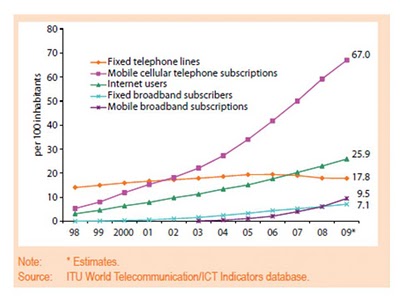
By any measure, recent progress, especially over the past few years, has been quite dramatic: mobile cellular penetration in developing countries has more than doubled since 2005, when it stood at only 23 per cent.
Last year, mobile cellular penetration in developing countries passed the 50 per cent mark, reaching an estimated 57 per 100 inhabitants at the end of 2009. Even though this remains well below the average in developed countries, where penetration exceeds 100 per cent, the rate of progress is remarkable.
Android might be the next big evolution, not that voice and text messaging are propagating. Using Android, devices could be customized for any number of applications that might otherwise be run on a PC, an important development in markets where device cost and access to electricity are issues.
Already, over four billion mobile phones are in use in the world today. The next billion new users, Rotberg says, will be spread out in the developing countries, mainly in Africa and Asia. Android could be important in that regard.
Not since abour 2006 have there been more fixed broadband lines in service in the most-developed broadband markets than emerging countries, and by 2009 a group of about 15 nations, including the BRICs, as well as countries in Southeast Asia, South American and Eastern Europe had surpassed the developed countries in total subscribers.
These days, the 15 emerging countries have the biggest share of broadband lines and the fastest growth rates as well, says Point Topic.
It's worth pondering that for just a moment. In 2000 there were 738 million global mobile subscribers. In 2010, there are 4.3 billion mobile subscribers, and most of those subscribers live in the developing world, according to the International Telecommunications Union.
It took just four years to double the number of global mobility users, from 2000 to 2004, and just another four years to double yet again, from 2004 to 2008. That sort of growth does not happen much in the telecom business, and has not happened before in the developed world.
Broadband growth is likely to assume something of the same pattern, but likely will be driven by mobile, not fixed access. Mobility has proven to be a raging, unexpected success story for people in developed regions. Broadband is about to repeat that feat.
Quietly, without much fanfare, communications really has become a capability available to all the world's people, after many decades of attempts by policymakers and providers to figure out how to do that. In the end, better technology has made all the difference. We don't use wires, we use airwaves. We don't use analog, we use digital. We don't use physical goods; we use electronic goods.
By 2014 just 15 developing nations will account for over 320 million broadband lines, 43 percent of the world total of 740 million broadband lines, by that time.
The fastest-growing group of 15 countries will have broadband growth rates of 14.2 percent annually. Another group of 12 countries, including the United States, Japan, Greece and Taiwan, will see annual growth of about 5.5 percent each year through 2014. Some 13 countries, including Western European nations, Canada, South Korea and Hong Kong, will see 4.6 percent annual growth rates.
All of those statistics are important for one compelling reason. Global subscriber and revenue growth for voice services, mobile services and broadband now has shifted to developing regions of the world.
The HTC Smart will be available this spring across Europe and Asia, selling for a suggested retail price of Php 12,900 (Philippines pesos), or $65 in U.S. currency.
HTC Smart uses the HTC "Sense" user interface, allowing personal customization of each person’s own phone experience. It also provides a quick and easy way to see what friends are up to via various social networks as well as quickly communicating over the phone, through text messaging or email.
HTC Smart uses Qualcomm’s "Brew Mobile Platform," a popular mobile operating system that enables smartphone devices to be offered at more aggressive price points.
Such developments are important because they make smartphone features available to users beyond the advanced regions of the world.
Is it possible that simple tools, such as low-cost mobile phones, can have more positive economic and social impact than our typical large-scale government-to-government and typical development aid efforts? The aid establishment might not like the question, or the answers, but MIT NextLab project staff seem to believe the answer is "yes."
“Traditional aid does little for the very poor,” says Jhonatan Rotberg, founder and director of the NextLab program. “Only a fraction of the donated money trickles down to those who need it most."
"But with a mobile phone, poor people can get ahead," he says.
By any measure, recent progress, especially over the past few years, has been quite dramatic: mobile cellular penetration in developing countries has more than doubled since 2005, when it stood at only 23 per cent.
Last year, mobile cellular penetration in developing countries passed the 50 per cent mark, reaching an estimated 57 per 100 inhabitants at the end of 2009. Even though this remains well below the average in developed countries, where penetration exceeds 100 per cent, the rate of progress is remarkable.
Android might be the next big evolution, not that voice and text messaging are propagating. Using Android, devices could be customized for any number of applications that might otherwise be run on a PC, an important development in markets where device cost and access to electricity are issues.
Already, over four billion mobile phones are in use in the world today. The next billion new users, Rotberg says, will be spread out in the developing countries, mainly in Africa and Asia. Android could be important in that regard.
Not since abour 2006 have there been more fixed broadband lines in service in the most-developed broadband markets than emerging countries, and by 2009 a group of about 15 nations, including the BRICs, as well as countries in Southeast Asia, South American and Eastern Europe had surpassed the developed countries in total subscribers.
These days, the 15 emerging countries have the biggest share of broadband lines and the fastest growth rates as well, says Point Topic.
It's worth pondering that for just a moment. In 2000 there were 738 million global mobile subscribers. In 2010, there are 4.3 billion mobile subscribers, and most of those subscribers live in the developing world, according to the International Telecommunications Union.
It took just four years to double the number of global mobility users, from 2000 to 2004, and just another four years to double yet again, from 2004 to 2008. That sort of growth does not happen much in the telecom business, and has not happened before in the developed world.
Broadband growth is likely to assume something of the same pattern, but likely will be driven by mobile, not fixed access. Mobility has proven to be a raging, unexpected success story for people in developed regions. Broadband is about to repeat that feat.
Quietly, without much fanfare, communications really has become a capability available to all the world's people, after many decades of attempts by policymakers and providers to figure out how to do that. In the end, better technology has made all the difference. We don't use wires, we use airwaves. We don't use analog, we use digital. We don't use physical goods; we use electronic goods.
By 2014 just 15 developing nations will account for over 320 million broadband lines, 43 percent of the world total of 740 million broadband lines, by that time.
The fastest-growing group of 15 countries will have broadband growth rates of 14.2 percent annually. Another group of 12 countries, including the United States, Japan, Greece and Taiwan, will see annual growth of about 5.5 percent each year through 2014. Some 13 countries, including Western European nations, Canada, South Korea and Hong Kong, will see 4.6 percent annual growth rates.
All of those statistics are important for one compelling reason. Global subscriber and revenue growth for voice services, mobile services and broadband now has shifted to developing regions of the world.
Labels:
Android,
HTC,
smart phone
Gary Kim was cited as a global "Power Mobile Influencer" by Forbes, ranked second in the world for coverage of the mobile business, and as a "top 10" telecom analyst. He is a member of Mensa, the international organization for people with IQs in the top two percent.
Apple Gets Ready for 3G iPad Launch
You might think the launch of the 3G version of the Apple iPad, able to use both Wi-Fi and mobile broadband access, will not get the attention the initial launch itself has gotten. Apple will launch the mobile network version today, April 29, 2010.
But it appears every Apple retail location will be closed for one hour, starting at 4 p.m, in order to prepare for the launch of the iPad 3G.
Apple might be expecting lines. It's a non-scientific, nearly random observation, but two Apple iPad owners I know of already plan to give their Wi-Fi-only versions to other family members and buy a 3G-capable unit. There could be lines.
Labels:
Apple,
iPad,
mobile broadband
Gary Kim was cited as a global "Power Mobile Influencer" by Forbes, ranked second in the world for coverage of the mobile business, and as a "top 10" telecom analyst. He is a member of Mensa, the international organization for people with IQs in the top two percent.
Apple Calls the Tune, Again
Apple might not yet have remade the notebook or netbook business, and might not have conclusively proved there is an undiscovered new consumer electronics niche for tablet devices, but it has caused Microsoft to kill its existing slate project, known as "Courier."
Microsoft’s Courier originally was conceived as the tablet of the future, Microsoft’s answer to Apple’s iPad, with two screens. Apple might disagree that the iPad is a "big iPod Touch," but Microsoft apparently has concluded that a two-screen device with a book style form factor is not what the market will want.
Perhaps the bigger deal, perhaps obvious in retrospect, is that although the device would have been "touch" capable, it somehow fails to offer an experience similar to the iPad. Make that one more case of Apple disrupting the conventional wisdom about user experience and user interface. And it apparently hopes to do the same in the mobile advertising businesss.
Apple never likes to play at the low end of any business, so we should not be surprised to see Apple taking that tack as it attempts to show what its iAd network can do on devices such as the iPad, iPhone and iPod Touch.
Apple also is famously "controlling" about the "user experience," so you should not be surprised to hear that Apple is making "initial demands for greater control over advertisers' marketing campaigns."
According to the Wall Street Journal, Apple is looking for placements priced about an order of magnitude (10 times) higher than is typical.
If you recall the demo Apple put together for its iAd announcment, you can understand why: Apple is aiming for content-rich campaigns that may involve branded characters and expensive production.
Apple Inc. aims to charge close to $1 million for ads on its mobile devices this year and perhaps even more--as much as $10 million--to be among the first participants.
Ad executives say they are used to paying between $100,000 and $200,000 for similar mobile deals.
Obviously, Apple is attempting to pull off a couple "hero" campaigns that likely cannot be replicated too widely in the future because most campaigns will not be able to afford the high rates.
One example Apple has been showing advertisers is an ad for Nike's Air Jordan basketball shoe.
When a user is in an application, an animated banner ad appears on the border of the screen, along with an iAd logo. If the user taps on the ad, it expands across the screen, displaying a video, an interactive store locator and exclusive offers at local stores, among other features.
Apple is planning to charge advertisers a penny each time a consumer sees a banner ad, ad executives say. When a user taps on the banner and the ad pops up, Apple will charge $2. Under large ad buys, such as the $1 million package, costs would rack up to reach $1 million with the various views and taps.
Marketers will be able to target ads to groups of users based on consumers' download preferences from its iTunes store, according to ad executives. For instance, a marketer could choose to show its ads to people who have downloaded financial applications or reggaeton music, horror movies or comedy TV shows.
Marketers also will be able to target ads to users in a general location like a city, although they cannot target ads to individual consumers or access personal details.
Apple is seeking high quality ads from big-name marketers for the launch, ad executives say. The ads will go through an approval process, and Apple will build the ads itself during the first couple of months to make sure they work well and attain a certain aesthetic and functionality, ad executives say. Eventually, Apple plans to create a developer kit so that agencies will be able to design and create the ads themselves.
The process is causing tension among some ad directors, who are hesitant to give up control. Welcome to Apple's world.
Microsoft’s Courier originally was conceived as the tablet of the future, Microsoft’s answer to Apple’s iPad, with two screens. Apple might disagree that the iPad is a "big iPod Touch," but Microsoft apparently has concluded that a two-screen device with a book style form factor is not what the market will want.Perhaps the bigger deal, perhaps obvious in retrospect, is that although the device would have been "touch" capable, it somehow fails to offer an experience similar to the iPad. Make that one more case of Apple disrupting the conventional wisdom about user experience and user interface. And it apparently hopes to do the same in the mobile advertising businesss.
Apple never likes to play at the low end of any business, so we should not be surprised to see Apple taking that tack as it attempts to show what its iAd network can do on devices such as the iPad, iPhone and iPod Touch.
Apple also is famously "controlling" about the "user experience," so you should not be surprised to hear that Apple is making "initial demands for greater control over advertisers' marketing campaigns."
According to the Wall Street Journal, Apple is looking for placements priced about an order of magnitude (10 times) higher than is typical.
If you recall the demo Apple put together for its iAd announcment, you can understand why: Apple is aiming for content-rich campaigns that may involve branded characters and expensive production.
Apple Inc. aims to charge close to $1 million for ads on its mobile devices this year and perhaps even more--as much as $10 million--to be among the first participants.
Ad executives say they are used to paying between $100,000 and $200,000 for similar mobile deals.
Obviously, Apple is attempting to pull off a couple "hero" campaigns that likely cannot be replicated too widely in the future because most campaigns will not be able to afford the high rates.
One example Apple has been showing advertisers is an ad for Nike's Air Jordan basketball shoe.
When a user is in an application, an animated banner ad appears on the border of the screen, along with an iAd logo. If the user taps on the ad, it expands across the screen, displaying a video, an interactive store locator and exclusive offers at local stores, among other features.
Apple is planning to charge advertisers a penny each time a consumer sees a banner ad, ad executives say. When a user taps on the banner and the ad pops up, Apple will charge $2. Under large ad buys, such as the $1 million package, costs would rack up to reach $1 million with the various views and taps.
Marketers will be able to target ads to groups of users based on consumers' download preferences from its iTunes store, according to ad executives. For instance, a marketer could choose to show its ads to people who have downloaded financial applications or reggaeton music, horror movies or comedy TV shows.
Marketers also will be able to target ads to users in a general location like a city, although they cannot target ads to individual consumers or access personal details.
Apple is seeking high quality ads from big-name marketers for the launch, ad executives say. The ads will go through an approval process, and Apple will build the ads itself during the first couple of months to make sure they work well and attain a certain aesthetic and functionality, ad executives say. Eventually, Apple plans to create a developer kit so that agencies will be able to design and create the ads themselves.
The process is causing tension among some ad directors, who are hesitant to give up control. Welcome to Apple's world.
Labels:
Apple,
enterprise iPhone,
iAd,
iPad,
mobile advertising
Gary Kim was cited as a global "Power Mobile Influencer" by Forbes, ranked second in the world for coverage of the mobile business, and as a "top 10" telecom analyst. He is a member of Mensa, the international organization for people with IQs in the top two percent.
Thursday, April 29, 2010
About 1/2 of 1 Percent of Time Warner Cable Customers Buy 50 Mbps Service
It's likely fair to keep in mind, as ISPs, regulators and policy advocates ponder future service offerings at speeds of 100 Mbps, or even higher, that few U.S. consumers appear to want to buy service at speeds of 50 Mbps or higher.
Time Warner Cable added 212,000 high-speed Internet subs in the first quarter, with about 1,000 buying the ultra-high-speed Docsis 3.0 services. That represents about one half of one percent of new customers, roughly in line with the few figures that have emerged from other ISPs able to sell 50 Mbps to 100 Mbps access services in Europe or North America.
The number of wideband subscription adds in the first quarter are consistent with recent trends at TWC, the only major US MSO so far that's even been willing to share those numbers. In January, TWC said it added only about 2,000 wideband subs in the fourth quarter of 2009.
Comcast, which has 80 percent of its plant wired up for wideband and intends to finish the job later this year, hasn't disclosed any D3 subscriber figures.
AT&T noted during its first quarter conference call that 59 percent of its customers buy access at speeds of at least 3 Mbps. What that might suggest is that most consumers still do not buy ultra-fast connections, preferring medium-speed connections instead.
Time Warner Cable added 212,000 high-speed Internet subs in the first quarter, with about 1,000 buying the ultra-high-speed Docsis 3.0 services. That represents about one half of one percent of new customers, roughly in line with the few figures that have emerged from other ISPs able to sell 50 Mbps to 100 Mbps access services in Europe or North America.
The number of wideband subscription adds in the first quarter are consistent with recent trends at TWC, the only major US MSO so far that's even been willing to share those numbers. In January, TWC said it added only about 2,000 wideband subs in the fourth quarter of 2009.
Comcast, which has 80 percent of its plant wired up for wideband and intends to finish the job later this year, hasn't disclosed any D3 subscriber figures.
AT&T noted during its first quarter conference call that 59 percent of its customers buy access at speeds of at least 3 Mbps. What that might suggest is that most consumers still do not buy ultra-fast connections, preferring medium-speed connections instead.
Labels:
100 Mbps,
50 Mbps,
DOCSIS,
national broadband plan,
Time Warner Cable
Gary Kim was cited as a global "Power Mobile Influencer" by Forbes, ranked second in the world for coverage of the mobile business, and as a "top 10" telecom analyst. He is a member of Mensa, the international organization for people with IQs in the top two percent.
Layar Launches First Augmented Reality Content Store
You might be wondering whether "augmented reality" is a feature or a business model. Layar hopes to prove it can be a business model, by introducing an AR content store that allows publishers to offer AR experiences on multiple mobile platforms such as iPhone and Android.
The content store is seamlessly integrated into the Layar "Reality Browser", which is already used on more than 1.6 million mobile devices globally.
The Layar Payment Platform supports multiple payment providers and multiple currencies, ready to serve the different local markets.
Layar deals with legal, administrative and tax rules enabling the publisher to focus on their core activities. The first payment provider is PayPal, supporting payments to residents of United States, United Kingdom, Canada and Australia. More countries, currencies, payment methods and payment providers will be added regularly, the company says.
Publishers can set up accounts at http://site.layar.com/create.
Among the developers that already have signed up are Berlitz City Guides, Mouse Reality for Disney World, UK Sold Prices and Disneyland and EyeTour.
UK sold prices allows users to check the latest UK residential sold price information while users are out and about. Berlitz helps people experience the city’s highlights: the best attractions, coziest restaurants, most comfortable hotels, coolest places to shop and most fashionable nightlife.
Mouse Reality for Disney World and Disneyland helps users find and navigate all attractions, shows, shops, dinning, transportation, and more in Disneyland and Disney World.
EyeTour helps users explore Puerto using exclusive video content of historical sites, museums, restaurants, parks and more.
Looking ahead, the company believes it can use AR to create a business offering a marketplace for content, services and goods, says Raimo van der Klein, Layar CEO.
Publishers can start selling their content without upfront investments while Layar facilitates payments between the end-user and the publisher. Publishers receive 60 percent of the net proceeds.
Android users who are residents of United States, United Kingdom, Canada or Australia can start buying layers right now after installing the new version of the Layar Augmented Reality Browser. The iPhone update is soon to follow.
Layar describes itself as the world’s leading Augmented Reality Platform on mobile. The Layar Reality Browser currently has more than 1.6 million users and comes pre-installed on tens of millions of phones from leading handset manufacturers and carriers by the end of the year. Over 500 layers are developed by the global community of 3000 Layar publishers.
The free Layar Reality Browser is available on Android devices and iPhone 3GS.
link
The content store is seamlessly integrated into the Layar "Reality Browser", which is already used on more than 1.6 million mobile devices globally.
The Layar Payment Platform supports multiple payment providers and multiple currencies, ready to serve the different local markets.
Layar deals with legal, administrative and tax rules enabling the publisher to focus on their core activities. The first payment provider is PayPal, supporting payments to residents of United States, United Kingdom, Canada and Australia. More countries, currencies, payment methods and payment providers will be added regularly, the company says.
Publishers can set up accounts at http://site.layar.com/create.
Among the developers that already have signed up are Berlitz City Guides, Mouse Reality for Disney World, UK Sold Prices and Disneyland and EyeTour.
UK sold prices allows users to check the latest UK residential sold price information while users are out and about. Berlitz helps people experience the city’s highlights: the best attractions, coziest restaurants, most comfortable hotels, coolest places to shop and most fashionable nightlife.
Mouse Reality for Disney World and Disneyland helps users find and navigate all attractions, shows, shops, dinning, transportation, and more in Disneyland and Disney World.
EyeTour helps users explore Puerto using exclusive video content of historical sites, museums, restaurants, parks and more.
Looking ahead, the company believes it can use AR to create a business offering a marketplace for content, services and goods, says Raimo van der Klein, Layar CEO.
Publishers can start selling their content without upfront investments while Layar facilitates payments between the end-user and the publisher. Publishers receive 60 percent of the net proceeds.
Android users who are residents of United States, United Kingdom, Canada or Australia can start buying layers right now after installing the new version of the Layar Augmented Reality Browser. The iPhone update is soon to follow.
Layar describes itself as the world’s leading Augmented Reality Platform on mobile. The Layar Reality Browser currently has more than 1.6 million users and comes pre-installed on tens of millions of phones from leading handset manufacturers and carriers by the end of the year. Over 500 layers are developed by the global community of 3000 Layar publishers.
The free Layar Reality Browser is available on Android devices and iPhone 3GS.
link
Labels:
AR,
augmented reality,
Layar
Gary Kim was cited as a global "Power Mobile Influencer" by Forbes, ranked second in the world for coverage of the mobile business, and as a "top 10" telecom analyst. He is a member of Mensa, the international organization for people with IQs in the top two percent.
HTC Incredible Goes On Sale Today at Verizon Wireless
Labels:
HTC,
Incredible,
Verizon Wireless
Gary Kim was cited as a global "Power Mobile Influencer" by Forbes, ranked second in the world for coverage of the mobile business, and as a "top 10" telecom analyst. He is a member of Mensa, the international organization for people with IQs in the top two percent.
19% CAGR for Tablet Style PCs
Sales of slate-style tablet PCs will grow at a 19-percent compound annual growth rate through 2015, the same rate as smartphones, while Wi-Fi-equipped handsets will grow at about a 21 percent CAGR, say researchers at Coda Research Consultancy.
That forecast could be taken to mean either that the tablet, such as the Apple iPad, really will create a new segment of the consumer electronics market, or that it will cannibalize part of existing markets such as netbooks, notebooks or laptops, or that tablets. In the former case the tablet might replace some parts of the need for e-book readers and netbooks or notebooks; in the latter case the tablet will change the user interface from keys to touchpad.
To be sure, devices such as the iPad could succeed simply by rearranging existing demand. But Apple, for one, seems to have achieved its greatest success when it can create a whole new market or rearrange an existing market. The iPod created a new market, while the iPhone rearranged an existing market.
Coda researchers so far think tablet computers represent the emergence of a new market, and new behaviors.
Consumer usage will tend to be around content consumption rather than creation, and for accessing information. A greater proportion of slates will be shared across household members than notebooks currently are. It is possible, in other words, that although high-end slates might continue to be personal items, as are mobile phones, some lower-end slates might be more like remote controls, used by everybody in a household, and not "owned" by individuals.
Business uses also could arise in healthcare, education, field sales and services, real estate, the insurance industry, and industrial design, Coda believes.
The other likely avenue is use by traveling workers, for the same reason many people now claim they can travel without a PC, and simply use a smartphone. Though the iPad and other tablets will not likely replace the smartphone on trips, many could decide it works well enough to take along as a substitute for the PC, the iPod and the e-book reader.
That forecast could be taken to mean either that the tablet, such as the Apple iPad, really will create a new segment of the consumer electronics market, or that it will cannibalize part of existing markets such as netbooks, notebooks or laptops, or that tablets. In the former case the tablet might replace some parts of the need for e-book readers and netbooks or notebooks; in the latter case the tablet will change the user interface from keys to touchpad.
To be sure, devices such as the iPad could succeed simply by rearranging existing demand. But Apple, for one, seems to have achieved its greatest success when it can create a whole new market or rearrange an existing market. The iPod created a new market, while the iPhone rearranged an existing market.
Coda researchers so far think tablet computers represent the emergence of a new market, and new behaviors.
Consumer usage will tend to be around content consumption rather than creation, and for accessing information. A greater proportion of slates will be shared across household members than notebooks currently are. It is possible, in other words, that although high-end slates might continue to be personal items, as are mobile phones, some lower-end slates might be more like remote controls, used by everybody in a household, and not "owned" by individuals.
Business uses also could arise in healthcare, education, field sales and services, real estate, the insurance industry, and industrial design, Coda believes.
The other likely avenue is use by traveling workers, for the same reason many people now claim they can travel without a PC, and simply use a smartphone. Though the iPad and other tablets will not likely replace the smartphone on trips, many could decide it works well enough to take along as a substitute for the PC, the iPod and the e-book reader.
Gary Kim was cited as a global "Power Mobile Influencer" by Forbes, ranked second in the world for coverage of the mobile business, and as a "top 10" telecom analyst. He is a member of Mensa, the international organization for people with IQs in the top two percent.
Tuesday, April 27, 2010
Nokia to Introduce N8, Using New Version of Symbian
The Nokia N8, Nokia's latest smartphone, using the new Symbian 3 operating system, is designed to challenge the iPhone and BlackBerry at the high end of the market, where Nokia arguably has been struggling.
The Nokia N8 will be available in selected markets from the third quarter of 2010 and comes with an estimated price tag of €370 (about $493) before taxes and subsidies.
The Nokia N8 introduces a 12 megapixel camera with Carl Zeiss optics, Xenon flash and a large sensor that rivals those found in compact digital cameras. Additionally, the Nokia N8 offers the ability to make HD-quality videos and edit them with an intuitive built-in editing suite.
Doubling as a portable entertainment center, people can enjoy HD-quality video with Dolby Digital Plus surround sound by plugging into their home theatre system. The Nokia N8 enables access to Web TV services that deliver programs, news and entertainment from channels like CNN, E! Entertainment, Paramount and National Geographic. Additional local Web TV content is also available from the Ovi Store.
Social networking also is featured. People can update their status, share location and photos, and view live feeds from Facebook and Twitter in a single app directly on the home screen. Calendar events from social networks can also be transferred to the device calendar.
The Nokia N8 comes with free global Ovi Maps walk and drive navigation, guiding people to places and points of interest in more than 70 countries worldwide.
Nokia has upgraded its Symbian software to make it more user friendly, a criticism of earlier versions of Symbian.
The Symbian 3 operating system supports features touchscreen commands such as multi-touch, flick scrolling and pinch-zoom, as well as faster multi-tasking, Nokia says.
The Nokia N8 will be available in selected markets from the third quarter of 2010 and comes with an estimated price tag of €370 (about $493) before taxes and subsidies.
The Nokia N8 introduces a 12 megapixel camera with Carl Zeiss optics, Xenon flash and a large sensor that rivals those found in compact digital cameras. Additionally, the Nokia N8 offers the ability to make HD-quality videos and edit them with an intuitive built-in editing suite.
Doubling as a portable entertainment center, people can enjoy HD-quality video with Dolby Digital Plus surround sound by plugging into their home theatre system. The Nokia N8 enables access to Web TV services that deliver programs, news and entertainment from channels like CNN, E! Entertainment, Paramount and National Geographic. Additional local Web TV content is also available from the Ovi Store.
Social networking also is featured. People can update their status, share location and photos, and view live feeds from Facebook and Twitter in a single app directly on the home screen. Calendar events from social networks can also be transferred to the device calendar.
The Nokia N8 comes with free global Ovi Maps walk and drive navigation, guiding people to places and points of interest in more than 70 countries worldwide.
Nokia has upgraded its Symbian software to make it more user friendly, a criticism of earlier versions of Symbian.
The Symbian 3 operating system supports features touchscreen commands such as multi-touch, flick scrolling and pinch-zoom, as well as faster multi-tasking, Nokia says.
Gary Kim was cited as a global "Power Mobile Influencer" by Forbes, ranked second in the world for coverage of the mobile business, and as a "top 10" telecom analyst. He is a member of Mensa, the international organization for people with IQs in the top two percent.
Will Rogers Introduce Bundled Mobile Broadband Plans?
Canadian wireless provider Rogers apparently is considering giving customers a data plan that would let them use an iPad (or other similar devices) plus mobile phones, on a single access plan, according to Electronista.
That's the sort of innovation in pricing plans and packaging that seems almost inevitable as people start using multiple wireless devices, and start to rebel against paying separate access fees for every single device they use, especially when some of those devices might not require much bandwidth, while others are used often enough to justify a typical $30 a month plan.
Observers often criticize mobile and other service providers for unimaginative thinking on such matters. Fair or not, one wonders what changes might be in store when fourth-generation Long Term Evolution networks start to enter their marketing phases.
So far, Clearwire has been more experimental than other leading mobile providers. To be fair, it isn't clear how much creativity actually can be brought to bear on the basic access service. But we ought to expect some changes as the types of devices benefiting from mobile access proliferate, and people start using multiple devices.
link
That's the sort of innovation in pricing plans and packaging that seems almost inevitable as people start using multiple wireless devices, and start to rebel against paying separate access fees for every single device they use, especially when some of those devices might not require much bandwidth, while others are used often enough to justify a typical $30 a month plan.
Observers often criticize mobile and other service providers for unimaginative thinking on such matters. Fair or not, one wonders what changes might be in store when fourth-generation Long Term Evolution networks start to enter their marketing phases.
So far, Clearwire has been more experimental than other leading mobile providers. To be fair, it isn't clear how much creativity actually can be brought to bear on the basic access service. But we ought to expect some changes as the types of devices benefiting from mobile access proliferate, and people start using multiple devices.
link
Labels:
mobile broadband,
Rogers
Gary Kim was cited as a global "Power Mobile Influencer" by Forbes, ranked second in the world for coverage of the mobile business, and as a "top 10" telecom analyst. He is a member of Mensa, the international organization for people with IQs in the top two percent.
Blockbuster Tries to Take Advantage of its 28-Day Release Window Advantage
We should soon see whether Blockbuster's 28-day earlier release window for new release DVDs confers any business advantage over other competitors in the space, especially Netflix and Redbox, as Blockbuster and its studio partners seem to think will be the case.
Blockbuster announced availability of the hit movie, "It's Complicated" from Blockbuster in stores, by mail, or digitally, a full four weeks before it will be available through some competitors.
Blockbuster's early advantage reflects its ongoing agreement with Universal Studios to provide customers with the opportunity to rent hit movies the day they are released. Blockbuster also has early availability of other box office hits like Sherlock Holmes and the highest grossing film of all-time, Avatar, as well as other upcoming new releases such as Tooth Fairy, Valentine's Day, and Invictus.
Blockbuster also has struck deals with mobile handset providers to put the "Blockbuster On Demand" app prominently on the main screens of about 60 models of Samsung Blu-ray Players, HDTVs, and Blu-ray Home Theater Systems, as well as on T-Mobile's HTC HD2.
Blockbuster is the only multichannel provider that has every hot new movie on the day of its release, it's just that simple. What we now shall see is whether that makes a material difference for Blockbuster. Release windows typically have been important in the movie distribution business, so some shift should be seen.
Blockbuster announced availability of the hit movie, "It's Complicated" from Blockbuster in stores, by mail, or digitally, a full four weeks before it will be available through some competitors.
Blockbuster's early advantage reflects its ongoing agreement with Universal Studios to provide customers with the opportunity to rent hit movies the day they are released. Blockbuster also has early availability of other box office hits like Sherlock Holmes and the highest grossing film of all-time, Avatar, as well as other upcoming new releases such as Tooth Fairy, Valentine's Day, and Invictus.
Blockbuster also has struck deals with mobile handset providers to put the "Blockbuster On Demand" app prominently on the main screens of about 60 models of Samsung Blu-ray Players, HDTVs, and Blu-ray Home Theater Systems, as well as on T-Mobile's HTC HD2.
Blockbuster is the only multichannel provider that has every hot new movie on the day of its release, it's just that simple. What we now shall see is whether that makes a material difference for Blockbuster. Release windows typically have been important in the movie distribution business, so some shift should be seen.
Labels:
Blockbuster,
DVD
Gary Kim was cited as a global "Power Mobile Influencer" by Forbes, ranked second in the world for coverage of the mobile business, and as a "top 10" telecom analyst. He is a member of Mensa, the international organization for people with IQs in the top two percent.
What do you Think of This Google Tablet?
<object width="640" height="385">
I don't know what you think, but this Android-powered tablet, if it winds up being a commercial product, does not seem to have the "wow" factor of the Apple iPad.
Labels:
Google tablet,
iPad
Gary Kim was cited as a global "Power Mobile Influencer" by Forbes, ranked second in the world for coverage of the mobile business, and as a "top 10" telecom analyst. He is a member of Mensa, the international organization for people with IQs in the top two percent.
A Skirmish in the Apple-Google Fight
It's a small skirmish, but Android will be supporting Flash natively in version 2.2 of the operating system, though Google appears to think highly of HTML5 as well. Apple, of course, does not support Flash for the iPad.
Adobe demonstrated Flash running on Android about 10 months ago, it seems, and HTC devices do support Flash on at least some "Sense"-capable devices.
Putting Flash support into Android does not mean Google will not also support HTML5, but the decision seems at least partly a stake in the ground in the growing battle over video playback standards for the mobile Web.
Adobe demonstrated Flash running on Android about 10 months ago, it seems, and HTC devices do support Flash on at least some "Sense"-capable devices.
Putting Flash support into Android does not mean Google will not also support HTML5, but the decision seems at least partly a stake in the ground in the growing battle over video playback standards for the mobile Web.
Gary Kim was cited as a global "Power Mobile Influencer" by Forbes, ranked second in the world for coverage of the mobile business, and as a "top 10" telecom analyst. He is a member of Mensa, the international organization for people with IQs in the top two percent.
Monday, April 26, 2010
Android Market Closes on 50,000 Apps
At this rate, it will not be long before the Android Market features 50,000 or so applications.
That's well behind Apple's total of about 150,000 apps, but Android is catching up pretty fast.
Labels:
Android Market,
Apple App Store
Gary Kim was cited as a global "Power Mobile Influencer" by Forbes, ranked second in the world for coverage of the mobile business, and as a "top 10" telecom analyst. He is a member of Mensa, the international organization for people with IQs in the top two percent.
Would You Rather Have had the First iPod or $14,500?
“If you spent the money on an original iPod in 2001 on Apple stock ($499), you would have $14,513.78 today.”
In part that's a commentary on Apple's soaring equity value;in part that's a clue about product pricing for device pricing.
So the issue is whether the same choices exist today for the Apple iPad. Of course, 2001 was a good time to buy equities.
In part that's a commentary on Apple's soaring equity value;in part that's a clue about product pricing for device pricing.
So the issue is whether the same choices exist today for the Apple iPad. Of course, 2001 was a good time to buy equities.
Labels:
Apple
Gary Kim was cited as a global "Power Mobile Influencer" by Forbes, ranked second in the world for coverage of the mobile business, and as a "top 10" telecom analyst. He is a member of Mensa, the international organization for people with IQs in the top two percent.
Sunday, April 25, 2010
Alcatel-Lucent Gets into Mobile Advertising Business
Alcatel-Lucent has created a white-label direct marketing platform called "Optism" that is designed to help mobile operators create “media inventory” and provide advertisers with easy access to highly-targeted audiences.
Optism is not an ad network so much as an enabler of ad networks, since it is the mobile service providers who actually will retail the services, but Optism does create a permission and preference-based mobile marketing capability aggregated across multiple mobile operators.
Optism features a media arm that brokers relationships between mobile operators and advertisers, greatly simplifying the media selling process for aggregated operator inventory.
You might wonder whether Alcatel-Lucent now is competing with Google or Apple. It says it isn't, since Optism primarily aims to create direct marketing campaigns taking advantage of mobile communication features, such as text messaging.
It's an interesting approach to creating business-to-business revenue streams that are not directly dependent on end-user subscriptions. Available as a hosted and white-labled solution, Optism might be able to get economies of scale no single mobile operator could.
watch the video
Optism is not an ad network so much as an enabler of ad networks, since it is the mobile service providers who actually will retail the services, but Optism does create a permission and preference-based mobile marketing capability aggregated across multiple mobile operators.
Optism features a media arm that brokers relationships between mobile operators and advertisers, greatly simplifying the media selling process for aggregated operator inventory.
You might wonder whether Alcatel-Lucent now is competing with Google or Apple. It says it isn't, since Optism primarily aims to create direct marketing campaigns taking advantage of mobile communication features, such as text messaging.
It's an interesting approach to creating business-to-business revenue streams that are not directly dependent on end-user subscriptions. Available as a hosted and white-labled solution, Optism might be able to get economies of scale no single mobile operator could.
watch the video
Labels:
Alcatel-Lucent,
mobile advertising,
Optism
Gary Kim was cited as a global "Power Mobile Influencer" by Forbes, ranked second in the world for coverage of the mobile business, and as a "top 10" telecom analyst. He is a member of Mensa, the international organization for people with IQs in the top two percent.
Saturday, April 24, 2010
Study Confirms: Wireless Cheaper than Fixed for Rural Broadband
Wireless infrastructure has significant cost advantages over wired access in reaching homes in rural areas, it is often the most efficient way to provide broadband access, says the Brattle Group. That will come as no surprise to anybody who ever has attempted to model the cost of building broadband access infrastructure
The Group's analysis suggests that the cost of bringing high-speed access to most rural counties is between $1,000 per household to $7,500 per household.
The bigger issue is the degree to which mobile broadband can be a viable subsitute for fixed broadband in urban areas where fixed access already is plentiful.
source document
Gary Kim was cited as a global "Power Mobile Influencer" by Forbes, ranked second in the world for coverage of the mobile business, and as a "top 10" telecom analyst. He is a member of Mensa, the international organization for people with IQs in the top two percent.
Can a Device Save a Brand?
Okay, it is a dumb idea to think any mobile device can "save" a brand, unless that brand is Apple. But it isn't so far fetched to imagine ways to use an iPad as a virtual sales assistant or automated checkout device in some scenarios, as Hertz does in its rental return lines.
With its bigger screen, the iPad could be useful as a platform for social shopping. That can be done on PCs or mobiles, but the portability and form factor is different from a netbook or laptop and screen size is a key difference from a mobile phone. One might argue the overall cost of creating an app and avoiding application-specific hardware are other advantages.
Conceivably it could replace kiosks or other digital signage approaches, especially where the attempt is to allow end users to imagine different products in different configurations, for example.
link
With its bigger screen, the iPad could be useful as a platform for social shopping. That can be done on PCs or mobiles, but the portability and form factor is different from a netbook or laptop and screen size is a key difference from a mobile phone. One might argue the overall cost of creating an app and avoiding application-specific hardware are other advantages.
Conceivably it could replace kiosks or other digital signage approaches, especially where the attempt is to allow end users to imagine different products in different configurations, for example.
link
Gary Kim was cited as a global "Power Mobile Influencer" by Forbes, ranked second in the world for coverage of the mobile business, and as a "top 10" telecom analyst. He is a member of Mensa, the international organization for people with IQs in the top two percent.
iPad Users Watch a Lot of Video
Data from MeFeedia suggests the Apple iPad, on the market for just a few weeks, already is the fifth most-used mobile device, trailing the iPhone, iPod Touch, SymbianOS, and Android in terms of unique users.
Based on its user data, MeFeedia says iPad users consume three times as many videos as PC-based Web users, up from the 2.5 times at launch. It appears iPad users also spend four times as much time watching videos as PC-based Web users.
Also, iPad users seem to consume five times as many videos as iPhone users do, MeFeedia says.
One might suggest that a lack of distractions accounts for the longer engagement time with video. One might also suggest the early adopters are more likely than the typical user to be heavy consumers of
media, games and video. It might also be the case that users are in an experimental phase, playing with the device to figure out what they can do with it, which might boost engagement on any number of levels.
Should those sorts of findings be confirmed as the device gets wider distribution past the early adopters, it would be safe to say that at least one of the iPad use modes is as a multimedia content device, in the same general class as an e-book reader, but with a focus on multimedia.
Should that be the case, the iPad might legitimately emerge as a showcase for video-based mobile advertising.
link
Based on its user data, MeFeedia says iPad users consume three times as many videos as PC-based Web users, up from the 2.5 times at launch. It appears iPad users also spend four times as much time watching videos as PC-based Web users.
Also, iPad users seem to consume five times as many videos as iPhone users do, MeFeedia says.
One might suggest that a lack of distractions accounts for the longer engagement time with video. One might also suggest the early adopters are more likely than the typical user to be heavy consumers of
media, games and video. It might also be the case that users are in an experimental phase, playing with the device to figure out what they can do with it, which might boost engagement on any number of levels.
Should those sorts of findings be confirmed as the device gets wider distribution past the early adopters, it would be safe to say that at least one of the iPad use modes is as a multimedia content device, in the same general class as an e-book reader, but with a focus on multimedia.
Should that be the case, the iPad might legitimately emerge as a showcase for video-based mobile advertising.
link
Labels:
Apple,
iPad,
mobile advertising
Gary Kim was cited as a global "Power Mobile Influencer" by Forbes, ranked second in the world for coverage of the mobile business, and as a "top 10" telecom analyst. He is a member of Mensa, the international organization for people with IQs in the top two percent.
Microsoft Sends Small Business to Alteva
Alteva, a provider of cloud-based unified communications solutions, is partnering with Microsoft and BroadSoft to provide a hosted Unified Communications solution to small businesses. Alteva has developed a way to interconnect its hosted voice and messaging services with Microsoft Communication Services product suite, including Microsoft Exchange, SharePoint and Office Communications Server for both its small business and enterprise customers.
Alteva also has launched a Web store, where organizations with less than 25 users can easily select the right UC solution to suit their needs. Alteva has designed four different UC packages from which small businesses can choose from.
The "UC Complete" bundle supplies a fully-integrated, high-definition voice and unified communications solution priced from $38 per user, per month. Other packages are priced at $28 to $15 per user, per month.
Alteva also offers a la carte purchasing options for those who seek only to purchase Exchange email, OCS or Alteva's hosted VoIP.
Alteva says it is North America's largest provider of enterprise-class hosted VoIP, and provides hosted UC solutions to businesses in all 50 states and four continents.
The "UC Complete" bundle supplies a fully-integrated, high-definition voice and unified communications solution priced from $38 per user, per month. Other packages are priced at $28 to $15 per user, per month.
Alteva also offers a la carte purchasing options for those who seek only to purchase Exchange email, OCS or Alteva's hosted VoIP.
Alteva says it is North America's largest provider of enterprise-class hosted VoIP, and provides hosted UC solutions to businesses in all 50 states and four continents.
Labels:
hosted IP telephony,
hosted PBX
Gary Kim was cited as a global "Power Mobile Influencer" by Forbes, ranked second in the world for coverage of the mobile business, and as a "top 10" telecom analyst. He is a member of Mensa, the international organization for people with IQs in the top two percent.
CounterPath Launches Nomadic PBX Capability
CounterPath Corporation, which many of you know as a provider of desktop and mobile voice over Internet protocol software solutions, announced "NomadicPBX", its turnkey platform for enabling converged mobile and broadband Session Initiation Protocol voice, messaging and presence services.
Available immediately, NomadicPBX enables wireless operators and other service providers to extend the value of mobility for small and medium enterprises by integrating mobile communications with the existing fixed communications infrastructure.
NomadicPBX allows the integration of mobile handsets into the enterprise communications architecture. End users benefit from a single number and identity, which lets them be reached immediately from any mobile, desk phone or VoIP softphone, including a client running on a mobile phone.
Extension dialing such as short-dialing or speed calling from any mobile handset is supported, as are
core calling features found in most PBX solutions.
Available immediately, NomadicPBX enables wireless operators and other service providers to extend the value of mobility for small and medium enterprises by integrating mobile communications with the existing fixed communications infrastructure.
NomadicPBX allows the integration of mobile handsets into the enterprise communications architecture. End users benefit from a single number and identity, which lets them be reached immediately from any mobile, desk phone or VoIP softphone, including a client running on a mobile phone.
Extension dialing such as short-dialing or speed calling from any mobile handset is supported, as are
core calling features found in most PBX solutions.
Labels:
CounterPath,
FMC
Gary Kim was cited as a global "Power Mobile Influencer" by Forbes, ranked second in the world for coverage of the mobile business, and as a "top 10" telecom analyst. He is a member of Mensa, the international organization for people with IQs in the top two percent.
Friday, April 23, 2010
Will 13% of Video Subs Cut All or Some of Their Services This Year?
It probably would not surprise you if the Yankee Group suggested that younger people are more likely to stop subscribing to cable, satellite or telco video services.
It might surprise you to learn that Yankee Group believes 13 percent of current subscribers will cut all or some of their video services within 12 months.
That would be unprecedented in the history of multi-channel video.
Keep in mine that Yankee Group says the forms of "cord cutting" might take the form of terminating premium channels or halting use of video-on-demand services, as well as terminating all service entirely. Still, that would be a stunning development.
It might surprise you to learn that Yankee Group believes 13 percent of current subscribers will cut all or some of their video services within 12 months.
That would be unprecedented in the history of multi-channel video.
Keep in mine that Yankee Group says the forms of "cord cutting" might take the form of terminating premium channels or halting use of video-on-demand services, as well as terminating all service entirely. Still, that would be a stunning development.
Labels:
cord cutters,
over the top,
VOD
Gary Kim was cited as a global "Power Mobile Influencer" by Forbes, ranked second in the world for coverage of the mobile business, and as a "top 10" telecom analyst. He is a member of Mensa, the international organization for people with IQs in the top two percent.
Remember When Netflix Was "Toast"?
Remember when Netflix was supposed to be "toast"? You remember the arguments: Physical media was
out, online was in; Netflix was wedded to a dying business model. Online distribution, by YouTube or
Hulu, was going to destroy Netflix.
That hasn't happened. Quite to the contrary, investors have bid up Netflix's stock by nearly 100 percent
since January 2010, in part because Netflix shows every sign of being a contender in online video. And now Hulu has announced a "paid" access model that puts it in head-to-head competition with Netflix to some extent.
True, Netflix often is thought of as primarily offering movie fare, while Hulu's content leans heavily towards TV shows.
Netflix has 14 million paying subscribers, while Hulu has about 40 million unique viewers, but so far zero paid subscribers. And that is the test for Hulu. Most observers think perhaps five percent to 10 percent of Hulu users might choose to buy the new paid service, suggesting a potential base of two million to four million paid subscribers.
If one assumes four million subscribers, at a monthly fee of $10, that implies $480 million worth of annual revenue. That's interesting, but not terribly interesting.
out, online was in; Netflix was wedded to a dying business model. Online distribution, by YouTube or
Hulu, was going to destroy Netflix.
That hasn't happened. Quite to the contrary, investors have bid up Netflix's stock by nearly 100 percent
since January 2010, in part because Netflix shows every sign of being a contender in online video. And now Hulu has announced a "paid" access model that puts it in head-to-head competition with Netflix to some extent.
True, Netflix often is thought of as primarily offering movie fare, while Hulu's content leans heavily towards TV shows.
Netflix has 14 million paying subscribers, while Hulu has about 40 million unique viewers, but so far zero paid subscribers. And that is the test for Hulu. Most observers think perhaps five percent to 10 percent of Hulu users might choose to buy the new paid service, suggesting a potential base of two million to four million paid subscribers.
If one assumes four million subscribers, at a monthly fee of $10, that implies $480 million worth of annual revenue. That's interesting, but not terribly interesting.
Labels:
Hulu,
Netflix,
online video
Gary Kim was cited as a global "Power Mobile Influencer" by Forbes, ranked second in the world for coverage of the mobile business, and as a "top 10" telecom analyst. He is a member of Mensa, the international organization for people with IQs in the top two percent.
Subscribe to:
Comments (Atom)
Access Network Limitations are Not the Performance Gate, Anymore
In the communications connectivity business, mobile or fixed, “more bandwidth” is an unchallenged good. And, to be sure, higher speeds have ...
-
We have all repeatedly seen comparisons of equity value of hyperscale app providers compared to the value of connectivity providers, which s...
-
It really is surprising how often a Pareto distribution--the “80/20 rule--appears in business life, or in life, generally. Basically, the...
-
One recurring issue with forecasts of multi-access edge computing is that it is easier to make predictions about cost than revenue and infra...