Sunday, April 4, 2010

How Long to Post-Recession Job Levels? Expect Huge Merger Wave in Any Case

So what does this chart showing job recoveries after recessions since World War II suggest to you (Click on image for larger view)?

Obviously, the immediate past recession was more costly in terms of jobs than any comparable recession since WWII.

The discouraging question is whether the job recovery curve looks more like the shallow "U" shape of the 2001 recession or all the others, which are "V" shaped.

You can make your own decision about which curve will manifest itself this time. But logic suggests the recovery will take a while, simply because the curve already looks more like 2001 than any of the other curves. Also, none of the other recoveries had to face the financial headwinds imposed by our shocking, and growing, deficits, which will crowd out private capital that is the fuel for business growth.

A rough guess, given the depth of losses, which are twice that of the 2001 recession, suggests it might take twice as long for the economy to return to the level of jobs it had when the recession started. That would be 40 months, or roughly 3.3 years from today.

But that assumes no additional fiscal drag from the deficits, and nobody seems to think that is reasonable. So some believe it might take six to eight years. As one might assume, this will make for sluggish sales growth.

In a business such as telecommunications, which irrespective of the recession was in the throes of a massive transformation of its core business model, which will in any case require replacement of perhaps 50 percent of its existing current revenue by new sources over a 10-year period, and perhaps another 50 percent of revenue over perhaps a 20-year period.

Those would challenges enough for virtually any industry, without the pressure of sluggish job and housing growth and high structural deficits. Normally, sluggish growth in the telecommunications business has lead to mergers and acquisitions, since one way to obtain growth in a sluggish market is to buy that growth in the form of acquired customer bases, revenues and assets.

One has to expect quite a lot of that in this environment.

Resurrexit Sicut Dixit

"Has arisen as he said." Happy Easter.

Mobile for the Next Billion Users

Is it possible that simple tools, such as low-cost mobile phones, can have more positive economic and social impact than our typical large-scale government-to-government and typical development aid efforts? The aid establishment might not like the question, or the answers, but MIT NextLab project staff seem to believe the answer is "yes."

“Traditional aid does little for the very poor,” says Jhonatan Rotberg, founder and director of the NextLab program. “Only a fraction of the donated money trickles down to those who need it most."

"But with a mobile phone, poor people can get ahead," he says.

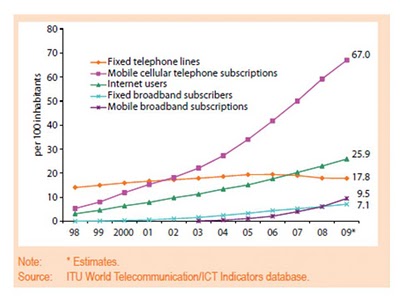
By any measure, recent progress, especially over the past few years, has been quite dramatic: mobile cellular penetration in developing countries has more than doubled since 2005, when it stood at only 23 per cent.

Last year, mobile cellular penetration in developing countries passed the 50 per cent mark, reaching an estimated 57 per 100 inhabitants at the end of 2009. Even though this remains well below the average in developed countries, where penetration exceeds 100 per cent, the rate of progress is remarkable.

Android might be the next big evolution, not that voice and text messaging are propagating. Using Android, devices could be customized for any number of applications that might otherwise be run on a PC, an important development in markets where device cost and access to electricity are issues.

Already, over four billion mobile phones are in use in the world today. The next billion new users, Rotberg says, will be spread out in the developing countries, mainly in Africa and Asia. Android could be important in that regard.

http://www.xconomy.com/boston/2010/03/31/mits-nextlab-designing-technology-for-the-next-billion-mobile-phone-owners/?single_page=true

Is Apple the New and Most-Important Gatekeeper?

Is Apple now more a transformative force in technology-using businesses than Google? Some observers have pointed out that it is possible, perhaps even likely, that Apple's equity value will exceed that of Microsoft in the near future. But Apple now is worth more than Google, with a market capitalization around $214 billion, compared to Google's $159 billion.

To be sure, content companies tend to pay more attention to Apple's moves, while communication companies tend to pay more attention to Google. One might argue that in the communications business, Apple mostly has changed the handset business, and user expectations about what can be done with handsets.

It likely will wind up being more transformative than that. Apple has proven that mobile application stores can be a source of huge end user value in the mobile ecosystem, and potentially a huge driver of revenue and margin in a business that is shifting inexorably towards applications as the driver of communications value overall.

Keep in mind that Apple previously redefined the online music business, if not the whole music business, by some estimates. Apple has had less success in the video arena, but the iPad could signal a potential shift of distribution in the print content business, or at least Apple has been arguing that is its objective.

In the mobile business, virtually everyone agrees that Apple changed end user expectations about what a handset should do, how it should work, and also cracked or broke the historic stranglehood mobile service providers have had over handset features.

In the developing mobile Internet experience, for example, there already are glimmers of a shift of experience from "Web" pages to applications. For a firm such as Google, dependent on search revenues for nearly all of its revenue, that potentially shifts revenue away from search and towards the mobile application as the way people find things.

To the extent that the mobile application, supplied by the application store, becomes the gateway for use of Web-based applications, power and financial success shift towards the app store and the device, and away from the access provider

So the issue that naturally arises is what to make of Apple's influence on the broader technology industry, which generally has moved to an "open" model, where Apple continues to operate on a "partially open" model, closed in terms of operating systems and hardware, but open--with editorial control--for applications.

As attention in the U.S. and some other markets now is turning to "gatekeeper" functions, the implications are that gatekeepers of many sorts now are arising in the Internet ecosystem. Though government regulators typically look at access providers, application providers are emerging as equally-important gatekeepers, as operating systems and browsers have caused concern in the past.

"The iPad is seen by many in the print business as a way of delivering high-value digital content to customers paying real money," notes U.K. technology observer John Naughton. There is a price: Apple will control the distribution channel and take a slice of every transaction.

The iPhone and iPad are really just gateways to the Internet, but are controlled (a better word than "closed") experiences, not the "open" or unfiltered way PCs have been used to access the Internet and its resources.

To the extent that gatekeepers are an issue, we likely will see new concerns about application and experience gatekeepers; nothing so crude as "access" gatekeeping.

Some think Google is the greatest emerging gatekeeper. Perhaps it is Apple.

related article

Saturday, April 3, 2010

Why Buy a Kindle if You Can Use an iPad?

An app to read e-books from Amazon’s Kindle store on the iPad has arrived in iTunes. If that is the case, why buy a Kindle at all? Price, you might correctly note, but wait a couple of years and that problem goes away.

That suggests a major Kindle price cut has to be coming. Historically, many multi-purpose computing devices have sold better than single-purpose devices, when there is a choice. That's why iPhone sales are cannibalizing iPod sales.

With the arrival of the Kindle app, iPad owners will be able to choose whether to read books from Amazon or from Apple. Using the iPad gives users access to all Kindle inventory, with Apple inventory thrown in, as well as color support and the ability to do lots of other things that require Internet access, ranging from email to Web browsing to messaging.

Waiting in Line for iPads...

Lines of people wrapping around the block at the SoHo Apple Store, waiting, presumably, to buy an iPad.

What will be interesting is to see how sales stack up, and I don't mean volume of sales, but whether people decide they want connectivity all the time, like a smartphone, or can live with Wi-Fi access, as iPod touch users now do.

The difference is that the Wi-Fi-only approach makes the iPad more a media consumption device, while full-time connections might make it something else.

What the "something else" might be, remains to be seen. Nobody seems to think it replaces a smartphone. Beyond that, people seem to be unsure about whether it represents an entirely new product category or "just" a new interface for a netbook or laptop.

Google Optimizes Apps For iPad: Which Raises a Question

Google says it has optimized applications for the iPad to take advantage of its large display. Using Gmail on the iPad, for example, users will see a two-pane display that mimics what they are used to seeing on PCs, notebooks or netbooks.

The YouTube and Google Maps apps are preloaded on iPads.

But those features still raise the as-yet-unanswered question: can the iPad uncover significant demand for a new category of device in between a smartphone and a netbook or notebook? Or is the iPad really going to wind up succeeding or failing as a replacement for the netbook or notebook?

Those are quite different outcomes. For me it comes down to the irreducible number of devices I must carry, both locally and when traveling. Around town, the irreducible and desired number is "one." When traveling, because when push comes to shove I use a laptop for work, the irreducible number is "two." Well, actually three, as I carry two mobiles.

Years ago, the irreducible number when traveling briefly floated up to four, when I added the iPod. That turned out to be one item too many, and I no longer travel with it, except when running.

My point is that consumers weighing use of an  iPad will have to decide what it is, before they buy. And that means an identity "crisis" has to be solved before it becomes a huge mass market success. It seems to me to be a very-good media consumption platform, crudely put, an iPod touch on steroids. That will raise the question of the physical need to add more more portable device to the purse or backpack. For some users, that will be a point of friction.

But some people very quickly are going to try seeing whether, in their circumstances, an iPad can displace an existing netbook or notebook. And that could point the way to the iPad becoming a new form of netbook, rather than creating a new category of devices people generally use.

Apple could win, in either scenario, but wins most if it can create a new product category.

link

Friday, April 2, 2010

Telcos "Playing Politics" With SEC Reports and Accounting Charges? Are You Kidding?

One of the calumnies heaped upon telecom service providers is that their recent Securities and Exchange Commission notifications of charges caused by the new health care legislation are somehow a political ploy. Some even say that AT&T and Verizon, for example, are doing so as a political act, because they "contribute to Republican candidates."

As often is the case, such claims are uninformed. In its most-recent report, the Federal Elections Commission reported that AT&T gave exactly the same amount of money to Democrats and Republicans, splitting about $1.7 million 50 percent to Democrats and 50 percent to Republicans, the FEC reports.

The truly unbalanced spending was by union political action committees. The Operating Engineers Union gave 89 percent to Democrats, the International Brotherhood of Electrical Workers gave 99 percent to Democrats, the American Federation of State, County and Municipal Employees gave 99 percent to Democrats, the Teamsters 98 percent to Democrats, the International Association of Frie Fighters gave 88 percent to Democrats, the Carpenters and Joiners Union gave 90 percent to Democrats, the Plumbers/Pipefiters Union gave 95 percent to Democrats.

If you take a look at the chart, the largest telecom-affiliated PACs split their giving between Republicans and Democrats. If one correlates the spending with which political party occupies the White House, or controls the Congress, the pattern of giving by telecom PACis clear: more spending for candidates representing the party in power.

Click on the image for a larger view. 


http://www.opensecrets.org/pacs/toppacs.php

Verizon Takes $970 Million Health Care Cost Charge

Verizon will take a one-time, non-cash tax charge of about $970 million in the first quarter 2010 to account for changes to its financial obligations required by the "Patient Protection and Affordable Care Act," which became law on March 23, 2010.

AT&T announced a similar charge of about $1 billion in March. Both firms have high retiree populations, and have been providing subsidized health care benefits to those retirees under Medicare Part D.

Because of the new law, Verizon and AT&T will no longer receive a Federal income tax deduction for those expenses.

Because future anticipated retiree health care liabilities and related subsidies are already reflected in Verizon’s financial statements, this change requires Verizon to reduce the value of the related tax benefits recognized in its financial statements in the period during which the law is enacted.

Going forward, both firms will face either higher operating costs or will reduce or cancel those retiree benefits.

Some observers have questioned whether the restatements are a "political ploy." Apparently those observers are not aware of how Sarbanes-Oxley legislation works. If the chief officers of a corporation, including its CEO and CFO, materially misrepresent a company's financial position--and $1 billion in a quarter is a material fact--those executives can be sent to jail.

Even medium-sized firms can incur costs of about $1 million a year to comply with Sarbanes-Oxley, by the way, imposing a huge financial drag on enterprises across the United States. And one reason many start-up firms say they will not, or cannot "go public" is the cost of Sarbanes-Oxley compliance costs.

Nor does it appear Sabanes-Oxley has prevented even a single case of corporate malfeasance. Our recent financial crisis does not seem to have been impeded one single bit. But it is a measure of how out of touch some observers seem to be that required accounting for financial obligations is considered a political act.

Thursday, April 1, 2010

Zerista Aims at Small Community Mobile Social Networking


Zerista is a new platform for managing smaller mobile communities, allowing groups to create schedules, send messages, conduct chats, take payments, support checkin operations, send invites, show maps and browse member lists.

This new mobile platform is either an informal or formal mashup of Ning, Eventbrite, Twitter and Foursquare for small groups, in other words.

The business model currently provides free use of the application for groups of 250 or less, then a charge for using the platform to support larger groups, such as convention or trade show groups.

Zerista believes there is a gap in the marketplace between social software for large groups, such as Facebook and Twitter, which are well suited to large macro communities. But those tools might not especially meet the needs of local or "mirco"-sized groups such as soccer leagues, wine clubs or agents working for a single realtor, for example.

In the mobile context, the issue of community "size" is important if you consider the cost of creating a mobile app that could do this, or even several versions of the app to work on a couple major mobile operating systems. Zerista is set up as a "cloud" application that can be published for use by mobile devices without the need to create a special app.


Free Polycom Phones With Speakeasy Offer Through May 31, 2010

Speakeasy, owned by Best Buy, is offering free IP phones to new business customers.until May 31, 2010. Speakeasy is including, free of charge, Polycom SoundPoint IP 321 VoIP-enabled phones to new business customers who purchase unlimited or global Hosted Voice calling plans and have a minimum of five lines.

To the extent that the need to buy new IP phones has been a barrier to adoption, the promotion eliminates that concern.

In addition to offering a free Polycom SoundPoint IP 321 to new customers (MSRP $139), Speakeasy is also announcing their new hardware lineup including two new Polycom phones and three new Cisco phones. Speakeasy's phone lineup now includes the Polycom SoundPoint IP 335, 650, 670, and SoundStation IP 6000; as well as the Cisco SPA 504G, SPA 509G and SPA 525G. Special prices are available for a limited time only for customers wishing to upgrade from the free phone offer to one of these new models.

http://www.speakeasy.net/press/pr/Speakeasy_offers_free_phones.php

Conflicting Employment Numbers in March: What the Heck Does That Mean?

There are conflicting numbers on unemployment coming out. The number of people applying for unemployment benefits fell 6,000 in the week ended March 27, 2010 to a seasonally adjusted 439,000, the Labor Department reports.

On the other hand, A day after the monthly ADP survey showed a private sector job loss of 23,000 compared to a predicted 40,000 gain, employment consulting firm, Challenger Gray, said employers cut 67,611 jobs last month.

The ADP and Challenger numbers indicate that after an improvement in the unemployment picture in January and February, March employment numbers began to decline again, though the Labor Department figures suggest a continued recovery.

So far, the recession has caused the loss of 7.2 million jobs, and the Administration $787 billion stimulus package may have slowed the rate of attrition, but it has not begun to reverse it.

The importance of the unemployment numbers is obvious enough. Consumer spending drives at least 66 percent to 70 percent of all gross domestic product. Until consumer spending recovers, the economy cannot recover.

If the jobless numbers begin to deteriorate again, there will be serious concern about the viability of the recovery.

"The March jobs picture may be the beginning of a trend that America cannot afford to live through for a second time, if there is any hope of a recovery this year," says financial analyst Douglas McIntyre of 247wallst.com.

There is some possibility that the difference between the Labor Department figures and the ADP and Challenger Gray numbers is that the latter are biased to private sector employment, and there obviously has been an increase in temporary jobs caused by the hiring of workers taking the U.S. Census.

The worrisome implication is that private sector employment continues to struggle, and might even have worsened in March 2010, if that is possible.

All of this matters to every citizen, and obviously to any business that sells products to consumers, including communication and video service providers. Historically, voice, broadband, mobile and video services have held up quite well in recessions, and that seems to be the case for the most-recent recession as well.

That is not to say market share shifts halted, or that some legacy products struggled while rising new products gained. Voice market share continued to shift away from telcos and to cable operators and wireless; mobility overall did well while use of smartphones and mobile broadband grew as if there was no recession. Cable operators generally continued to lose video market share to telcos and satellite providers. But all those trends were in place before the recession, and are not caused by it.

If the housing market remains stalled, and unemployment remains high, it seems unlikely there will be too much change in consumer markets. Business markets could be another matter. Most businesses can put off making needed investments for a year or two. But no business can afford to postpone required investments indefinitely.

That suggests business investments could be a brighter spot for service providers in the business segments.

source

View on 2020, Sponsored by Ericsson

If you enjoy "futurists," take a look at new series of videos sponsored by Ericsson and taking a look at various perspectives on "the future," some with direct relevance for communications, others less so.

http://www.ericsson.com/campaign/20about2020/index.html

Covad and MegaPath Merge, More Activity Expected

Covad Communications Companyand MegaPath say they have agreed to a merger combining their businesses to create a larger managed services company serving business customers, though Covad's wholesale operations will continue as well.

D. Craig Young, MegaPath CEO, will take the post of Executive Chairman of the combined businesses, while Pat Bennett, CEO of Covad, who will continue as Chief Executive Officer.

Covad offers IP broadband services in more than 4,400 central offices nationwide through its commercial and wholesale distribution channels, though the bulk of revenue still comes from the wholesale side of the business, where Covad sells service to wholesale partners including AT&T, Verizon Business, and Sprint.

MegaPath sells hosted VoIP, managed security, MPLS VPNs for connecting multiple sites, and SSL VPNs to19,000 direct SMB and enterprise customers.

Consolidation in the telecommunications industry is not new, nor is consolidation in the competitive telecom industry, so the deal is not a surprise in that regard. The "roll up" is a time-tested growth strategy in the competitive communications, cable and wireless industries. . Nor is it surprising that company executives say more deals are coming.

Telecom is a scale business, and scale is doubly important when margins are under pressure, as is the case for virtually all legacy telecom products. When profit margins get squeezed, financial performance can be maintained by selling more units. And that means more scale.

The combined businesses will be owned by Platinum and MegaPath investors.

Interest in Content Marketing Grows, Especially in Mobile Context

There are two huge takeaways from Junta42's new survey of 250 marketing professionals in North America: the dramatic growth of content marketing and the upsurge of interest in mobile content (blogs, social networks, video, newsletters, white papers, webinars, podcasts, custom events, magazines and so forth).

(click images for larger view)

Approximately 10 percent of marketers already are leveraging content through mobile applications and 38 percent say mobile content is something they need to know more about. Of all content marketing areas, only mobile marketing rose year over year re: educational needs, says Junta42.

56 percent of companies plan to increase budgets for mobile marketing in 2010 and a hike of 17 percent in 2010 marketing budgets will be funded by drawing money away from traditional channels such as print.

For the third straight year, marketers are planning to spend significantly more on their content marketing efforts in 2010 and 59 percent of marketing professionals surveyed plan to increase their spending on content initiatives, compared to 56 percent in 2009 and 42 percent in 2008.

Content marketing comprises 33 percent of the total marketing budget, in fact. Smaller companies are spending more on their content marketing as a percentage of budget than larger companies. Small
companies (less than 99 employees) spend approximately 40 percent of their total budget on content initiatives.

Larger companies (100 employees or more) spend an average of 18 percent of their budget for content marketing.

source

On the Use and Misuse of Principles, Theorems and Concepts

When financial commentators compile lists of "potential black swans," they misunderstand the concept. As explained by Taleb Nasim ...