Monday, May 2, 2011

PdaNet 3.0 Hides Android Tethering

The game of cat-and-mouse between developers and others in the ecosystem never ends. The developer of PdaNet, an app for tethering mobile phones to computers, has released an updated Android app that PdaNet says will hide tethering use from a user's wireless carrier. Data usage will look like regular smartphone data usage and won’t be distinguishable from data being transferred through your phone to your computer.

Carriers will respond, no doubt.

PdaNet is available as a free download from the Android Market. Users also will need to install a desktop app on a Windows or Mac computer, presumably the device using the tethered connection. A full license for the software currently runs $15.95.

Twitter Amplifies Other Media, Is Media

Some argue that Twitter is not in and of itself a "news source," though some will argue it sometimes is just that.

Some will point out, rightly, that Twitter is a channel for a source, or a channel for pointing to a source. But there might be cases, many cases, perhaps, where Twitter "acts" in its own right as a media channel, even when it amplifies other media.

One might argue about whether Drudge Report or Huffington Post, among many other outlets, is "media," or simply "points to" other media. In truth, it is hard to separate the roles.

But one suspects that more people every day are using Twitter precisely as any other news medium is used, to deliver "news."

Africa's Growing Middle Class is a Huge Deal

AFRICASome problems seem unsolvable; some probably are nearly unsolvable. But the growing middle class in many parts of Africa is a huge and important deal, given the relative or nearly-complete failure of many aid programs over the last half century, one might argue.

From a communications industry perspective, the growth explains, in part, not just growing interest but growing revenue possibility.

People often forget that all jobs come, in the final analysis, from the health of the private economy. People work in public sectors, to be sure, but all those jobs are funded by taxes on people who work, and companies that hire them. The whole point of any economic development effort is sustainable growth of the private economy.

Without robust economic growth, little in tax revenues is possible. The growth of the African middle class is a hugely-important development.

App Stores Pose Challenges Within Ecosystem

Global Mobile Applications Store RevenueThe "application store" might be among the more-significant innovations in the device and software businesses of recent years. Perhaps it is the single most-important innovation, as it illustrates the importance of content for many device strategies. It isn't so clear that the iPod could have come to dominate the MP3 player business without iTunes, and it seems unlikely the iPhone or iPad could have achieved their early market share leads without the trove of applications available in the Apple App Store.

Of course, app stores also mean that the relative balance of value within the software and device market also changes. Service provider businesses also are affected, obviously, as the device, with its app store, becomes the primary user connection with an access service.


Google Chrome Adds Speech-to-Text

Version 11 of Chrome now includes speech input and speech to text capabilities. Using Chrome, you can now translate what you say into other languages with Google Translate. If you’re translating from English, just click on the microphone on the bottom right of the input box, speak your text, and choose the language you want to translate to.

You can even click on the “Listen” feature to hear the translated words spoken back to you.

Motorola promises more Atrix-like Smart Phone Docks

Motorola CEO Sanjay Jha says "you will see multiple devices from us in the second half launching with these capabilities, and we will expand the range of our Lapdock devices so we cover a broader price point, addressing both the enterprise premium tier as well as more consumer tiers."

Some observers say they were disappointed by the Atrix, but lots of concepts do not fair so well in their first incarnation. Consider the tablet device itself, something suppliers have experimented with for more than a decade, and which conceptually has been thought about for several decades.

Not all users will necessarily be intrigued by future implementations, simply because a tablet with a touch interface is what works for them. There is another group of users that requires fuller PC style features in a device, typically because the work tasks to be accomplishments require more horsepower and a wider range of interface options.

And not all the initial issues were Motorola's doing. See http://www.bgr.com/2011/04/29/att-issues-update-for-motorola-atrix-4g-hsupa-restrictor-plate-removed/.

The potential for a docking system of this sort will appeal to some portion of those users who need a keyboard interface when traveling or otherwise away from a desk.

Video on Demand Consumption Grows, So Does Rest of "On Demand"

Video-on-demand services offered by cable, satellite and telco TV providers have been a modest success so far. In fact, one might well make the argument that digital video recorders represent the biggest innovation in "on demand" viewing in recent years, though some also would note even that viewing is relatively low, compared to total viewing.

Still, there was a 35 percent increase in VOD transactions in 2010, compared to 2009, according to Rentrak OnDemand Essentials, an audience measurement company.

According to the Leichtman Research Group, DVR penetration rates have reached 54 percent for consumers with households exceeding $75,000 while those with incomes below $30,000 only have a 16 percent penetration rate. See http://www.marketingforecast.com/archives/6941.

Last year, a Nielsen survey revealed that over 30 percent of consumers owned DVRs, but a more recent survey conducted by Comcast says that up to 60 percent of households may be time-shifting their TV viewing.

According to Leichtman analysts, live programming still represents about 80 percent of total viewing. But DVR now represents about 41 percent of that activity.

Online is 17 percent of total TV consumption while other forms of video on demand represent 16 percent of viewing.

But estimates vary. Overall, consumers watch an average of 158.25 minutes of TV per day, according to Nielsen. And they spend just 9:36 minutes watching time shifted TV daily, a 14 percent increase from last year, but still a small amount, according to Nielsen.

AT&T's Broadband Caps Start Now

AT&T's new broadband data caps take effect April 2, 2011, affecting more than 16 million U.S. broadband users. The new limits include 150 Gigabytes of consumption each month for DSL subscribers and 250 GBytes for UVerse users.

The typical Comcast residential broadband user consumes 2 Gbytes to 4 GBytes of bandwidth per month, Comcast's own studies have shown. See http://ipcarrier.blogspot.com/2010/12/typical-comcast-user-consumes-2-gbytes.html.

So the reason ISPs are worried about the impact of increased online video consumption is that the current level of usage is roughly equivalent to two or three or iTunes-sized movies per month. But everyone expects video consumption to keep growing.

A widespread shift to significant movie viewing online would disrupt usage patterns fairly quickly. But is probably fair to note that a typical consumer is two orders of magnitude (about 100 times) away from having to worry about the current caps.

Google, Apple Location Data Benefits Consumers

Google and Apple are facing, and will face more scrutiny, about the protections built into collection of Wi-Fi hostspot location data. A legitimate case can be made about potential abuses, but consumers will benefit directly if anonymous data can be used to enhance GPS and cell site mapping data.

"Information about the location of WiFi networks improves the accuracy of the location-based services, such as Google Maps or driving directions, that Google provides to consumers," Google explained last year in a letter to U.S. Rep. Henry Waxman, D-Los Angeles.

"Because GPS and cell tower data can be unreliable or inaccurate, in some cases using the location of Wi-Fi access points can enable a smartphone to pinpoint its own location more quickly and accurately," Google said.

Beyond improved navigation services, there is lots of interest in location-based marketing, promotion and e-commerce applications. Some would not see that as providing a direct consumer benefit, but advertising underwrites much access to free, reduced cost or "no incremental charge" content, for example. Consumers also will benefit from discount offers of other types.

In the future, Google and Apple will have to be more careful and transparent about how they collect such information, and well as how personally-identifiable data can be used. But the data will be directly useful to end users, all that said.

Sunday, May 1, 2011

Millennials Most Responsive To Text Ads

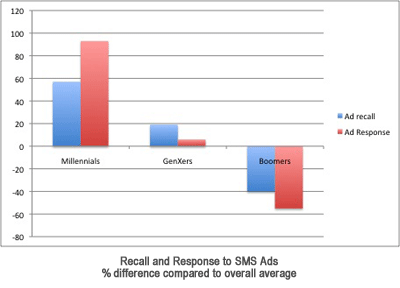
ad-response-by-age.gifGFK MRI has found that the Millennials (born between 1977 and 1994) are 57 percent more likely to recall seeing a text message ad on their mobile device, compared with the average mobile phone user. More importantly, they are 93 percent more likely to have responded to a text ad or made a purchase using text messaging.

Overall, the study found that about 6.2 percent of adults with a mobile phone had looked at an ad sent by SMS. In terms of response, 2.65 percent had used SMS to respond to an ad or make a purchase during the last 30 days.


Google, MasterCard, Citibank Team for Mobile Payments

Google is working with MasterCard and Citibank on mobile payments.

Saturday, April 30, 2011

How Social Drives Shopping

Mobile Content Ecosystem to Shift?

Mobile operators in emerging markets need to make urgent adjustments to content strategies if they are to adapt to rapid shifts in the market, according to Ovum analysts.

While mobile service providers currently are the dominant force in the emerging markets mobile content space, this is set to change due to strong competition from new platforms such as application stores.

“Unless telcos make rapid changes to their strategy and execution, their dominance is set to be challenged,' says Angel Dobardziev, Ovum analyst.

Some might argue that no matter what telcos do, that will happen anyway, given that the leading application stores are operated by device manufacturers such as Apple, independent providers such as GetJar or operating system providers such as Google.

“We have found that once a consumer has bought a data access plan, they begin to move away from telco services,' says Dobardziev. 'This will ultimately reduce the role of mobile operators to little more than providers of bandwidth.”

Some might argue that Dobardziev already has answered the original question.

Forrester Finds Most Enterprises Still Buy Phone Systems, Not Hosted IP Telephony

A recent Forrester Research survey of 567 enterprise and smaller business users that already have adopted IP telephony shows that most buyers so far have chosen premises-based solutions.

Just four percent of respondents say they have adopted a 'hosted' IP telephony service. Another four percent reported they had adopted a 'telephony as a service solution. About five percent said their IP telephony solution was outsourced. Taking all three as a group, just 13 percent of IP telephony solutions were hosted, cloud-based or outsourced.

That might make a great deal of sense. The economics of IP telephony tend to suggest that small users can benefit from hosted or cloud-based solutions, while enterprises often can justify owning their own solutions.

The study lends credence to the cable operator strategy of targeting businesses with 20 or fewer employees, as those are the venues where the economics of buying a service are best, compared to buying a premises-based solution.

About 71 percent said their IP telephony solutions were self maintained, while 16 percent said they owned their solution, but that it also was managed by a third party.

Telepresence ROI Still an Issue, According to CDW Survey

Return on investment continues to be an issue information technology staffs struggle with when trying to justify new investments in videoconferencing or telepresence, a survey sponsored by CDW has found.

Just slightly more than half of medium and large businesses currently track ROI, the report has found. Some 56 percent of respondents said they track hard dollar ROI and 58 percent track soft (productivity) ROI.

Of the medium and large businesses that track hard ROI, the majority are looking at dollars saved from trips avoided. Nearly half of medium and large businesses that track soft ROI are looking at employee productivity.

Still, half of medium and large businesses use video conferencing today, while another quarter plan to implement the technology within the next two years. Some eight percent plan to adopt within a year, while 17 said they would adopt in one to two years."

On the Use and Misuse of Principles, Theorems and Concepts

When financial commentators compile lists of "potential black swans," they misunderstand the concept. As explained by Taleb Nasim ...