Monday, October 17, 2011

Google To Launch 25 YouTube Channels

YouTube has said it would start creating some professionally-produced video channels and has invested  more than $100 million in cash advances to get some of the content produced, the Wall Street Journal reports.


YouTube thinks the new channels will allow it to create a better environment for advertisers who have been reluctant to advertise around user-generated videos. Google is expected to share ad revenue with channels at some point. YouTube to launch 25 channels 


The 25 or so new channels that will offer professionally produced news, information and entertainment. Partners expected in the the first round include Warner Bros., ShineReveille, BermanBraun, FremantleMedia and skate boarder Tony Hawk.


Additional potential partners include Everyday Health,  Iconic Entertainment and DECA, which creates online-video content for women.

Verso Entertainment may produce content for YouTube related to sports.  YouTube to Launch 25 Professional Video Channels


It might be premature to start thinking of YouTube as a "cable TV" distributor, anymore than it makes sense to think about Hulu or Netflix currently representing such an alternative. But things are heading that way, some would say. 

Google Fails Fast, Often: That's a Good Thing

It might be going too far to say that Google "celebrates" failure. But Google's "beta" culture can be seen as a good thing. The Next Web took a look at 251 Google products released since 1998 and found that 90, or 36 percent, had been cancelled.

TNW notes that there were among these products eight "major flops" and "14 major successes." It is hard to say that what Google learned from the failures lead to the 14 successes.


U.S. Mobile Companies Will Notify Users About Usage Caps

AT&T Inc., Verizon Wireless and other mobile service providers have agreed to begin sending alerts to customers who are approaching monthly voice, text or data limits.

The aim is to help them avoid hefty additional charges that cause what consumer advocates call bill shock.

Under the voluntary industry guidelines, companies also would send alerts when customers exceed their plans' limits and are subject to overage charges. Customers traveling abroad would be warned that they are about to incur often pricey international roaming fees, according to Federal Communications Commission officials.

The alerts will be free to customers, who will automatically receive them unless they choose not to. Service providers to send text alerts

Sunday, October 16, 2011

Free texting could kill SMS business

A survey of 1143 Australian smart phone users found 44 per cent had a free instant messaging application on their devices, Telsyte telecommunications analyst Foad Fadaghi says. So far, unlimited text messaging plans have blunted displacement of SMS by over the top messaging alternatives.

Some "53 per cent of mobile instant message users in our survey indicated they have not changed the amount of SMS messages they send and receive due to mobile IM," he said.

Fadaghi said that using services like Skype to replace phone calls had been limited due to 3G network reliability issues, but many were using it to save costs on overseas calls.

In the United States, more than two trillion text messages are sent each year, generating more than $20 billion in revenue for the industry. SMS revenues account for about a third of Verizon's operating income, in fact.

New study quantifies the impact of broadband speed on GDP - Ericsson

A new report, conducted jointly by Ericsson, Arthur D. Little and Chalmers University of Technology in 33 OECD countries, quantifies the isolated impact of broadband speed, showing that doubling the broadband speed for an economy increases GDP by 0.3 percent.

Other studies, such as a 2009 study by the World Bank, suggest similar relationships.

A 0.3 percent GDP growth in the OECD region is equivalent to $126 billion. This corresponds to more than one seventh of the average annual OECD growth rate in the last decade.

The study also shows that additional doublings of speed can yield growth in excess of 0.3 percent (e.g. quadrupling of speed equals 0.6 percent GDP growth stimulus)

Both broadband availability and speed are strong drivers in an economy. Last year Ericsson and Arthur D. Little concluded that for every 10 percentage point increase in broadband penetration, GDP increases by one percent.

Broadband impact on GDP

Content Ecosystems are Unstable: Watch Amazon

Most observers, looking at the matter of online or over the top video, and its potential impact on cable TV, telco and satellite video providers, will grasp the potential for disruption in the video business. Music and print content businesses already have been "disrupted." Could books be next?

Some will argue, with the rise of Amazon.com, and the demise of Borders, that the disruption already has happened. But some think additional far-reaching disruption is coming. After all, changes in distribution are one thing. But new patterns in product development and creation are perhaps more fundamental.

In Amazon's case, some would argue that the Amazon.com brand, back office, logistics operation and now Kindle devices allow Amazon to become a publisher, not just a distributor. To use the analogy, perhaps Apple iTunes becomes a music publisher; Google becomes a media company; Comcast becomes a studio; Verizon Wireless becomes a bank or TV network.

That should immediately strike you as a dangerous example of growing channel conflict, and you'd be right. Amazon has the distribution network and growing success in e-book publishing building blocks in place. Above all, the trade publishing houses seem to lack Amazon's ambition, some might say. Amazon might want to make money from the entire publishing chain, not just distribution.

Indeed, one reason content ecosystems are unstable is that as revenue and profit margins compress, expanding into an adjacency in any ecosystem starts to make more sense. There are potential conflicts, to be sure. But the lure of incrementally-important revenue and the ability to raise margins can be irresistible. 

Saturday, October 15, 2011

How "Sticky" are Bundles When Consumers See Value Mismatch?

It now is conventional wisdom, and also rational thinking, that bundles create barriers to customer churn.


The obvious value is that consumers save money when buying a triple-play bundle, rather than each of the products separately. 


The same thinking applies to "family plans" for mobile services.


In fact, bundled products traditionally are seen as effective in many industries. Product bundling


But bundles arguably only work when consumers want the products in the bundle, or when the value-price relationship is seen to be acceptable That increasingly might not be the case for video entertainment services. 


Roughly 25 percent of customers from major U.S. triple-play providers are not satisfied with their service, primarily because they don’t think it offers enough value for the money, says Yankee Group analyst Sheryl Kingstone.


And that's the key issue: video subscriptions keep getting more expensive, and consumers arguably are starting to rebel. 


In western Europe, prices for mobile services arguably are high enough that if another global recession occurs, service providers could see resistance even for a "must have" product. That isn't to say people will drop mobile service. It is to note that they will likely reduce usage in ways that cuts their spending.


Mobile ARPU in Western Europe in fact declined by 9.1 percent cumulatively during 2009 and 2010, says Yankee Group analyst Declan Lonergan. During the same two-year period, ARPU declined in Greece by almost 30 percent and by over 16 percent in both Ireland and Spain.


If Europe slips into recession again in 2012, customers will change their mobile usage and spending habits, he argues. Voice and messaging revenue will suffer most, while spending on the mobile Web and apps will hold up relatively well.


The point is that bundling reduces churn when buyers seen a good fit between value and price. It doesn't take much insight to note that buyers increasingly see a mismatch in the video subscription category. 

What's Different About "Search" These Days?

The difference between "search" and "commerce" depends nearly completely on what a user is trying to do, which would explain why Bing, Google and others traditionally in the "search engine" business are winding up in the offers, tickets and selling things business.


To be sure, all searches are related to acquiring information. But in an apparently-growing number of instances, that desired information has some shopping outcome. Mobile searches for "Thai restaurant" around lunchtime or "grocery store" are examples. 

Though the consumption or transaction might not be as immediate, information about airline destinations, schedules and ticket prices typically is linked fairly directly to a transaction. That explains why Google, for example, has  bought ITA and Zagat..


"We really think about Google as providing the exact right answers when you need them," says Larry Page, Google CEO. So "buying an airline ticket" is a "general instance of a problem, of just making search work better across anything you might want to be able to do," says Page.


Google is getting closer to one end of the sales funnel in other ways, as well. It's business is driven by advertising, which is closer to the top of a traditional sales funnel. Obviously, though,  the Google Wallet initiative will put Google and its many partners into the proximity of retail transactions at the bottom of the sales funnel. 


Even within the advertising business, Google is more focused on parts of the sales funnel that are closer to a transaction. PC-based search or display advertising arguably is further from a transaction event than a location-based offer on a mobile device. 


Likewise, a mobile search is more likely to be commerce-related than a PC search. If you look at Google's new "offers" effort, and its Google Wallet plans, plus the earlier commitment to develop the Android operating system (even the Chrome browser, to an extent), you see Google generally creating tools and platforms that move search closer to the actual end user shopping "transaction."

Friday, October 14, 2011

Hulu Owners Will Retain Control of Video Service - Bloomberg

Hulu's owners canceled a four- month auction of the online video service. News Corp., Walt Disney Co., NBC Universal and Providence Equity Partners have had key differences over how to proceed with the service, and now will have to decide whether some new consensus is possible. Hulu decides not to sell

Some might speculate that a combination of issues are at work. Buyers apparently did not think the asked-for price was reasonable. And Netflix might appear to be more vulnerable at the moment as well.

Online video represents only a small piece of the total advertising pie, but the growth in streaming ad revenue is becoming more of a threat to the broadcast medium that supplies most of the high CPM content. In the past, some of Hulu’s broadcaster backers have heard from media buyers that the video site’s ad sales often offer discounts on ad sales that are not available on the broadcast networks. Hulu Tensions

NBC Universal, News Corp. and Walt Disney Co. were in early 2011 increasingly at odds over Hulu's business model. Worried that free Web versions of their biggest TV shows are eating into their traditional business, the owners disagree among themselves, and with Hulu management, on how much of their content should be free. 


Fox Broadcasting owner News Corp. and ABC owner Disney were said to be contemplating pulling some free content from Hulu, as a result. The media companies are also moving to sell more programs to Hulu competitors that deliver television over the Internet, including Netflix Inc., Microsoft Corp. and Apple Inc. Tensions over "free" content.


Is Voice Value in Bearer Traffic or Signaling?

Where is voice value?
In the absence of some significant amount of innovation in voice services, it might be easy to predict that the revenue contribution from voice, both fixed and mobile, will slowly decline.

That's easy enough for those with no operating responsibilities to say. But there is one major caveat.

Typical estimates of voice revenue contribution, not to mention the strategic value of voice, tend to focus on "bearer traffic" revenues, not the contribution of signaling. 


And one can make an argument that if the voice revenue contribution trend does change, it will be because of innovations in signaling, not bearer traffic, that will drive it.

Why M2M is Important for Service Providers - Carrier Evolution

The "Internet of things" has gotten attention recently for several reasons. One reason is that analysts, academics and journalists, not to mention mobile service provider executives, need something new to talk about. Another reason is that machines and sensors represent the clearest way for mobile revenue and services to grow. Most people who want a mobile device now have one.


To be sure, mobile broadband for smart phones and tablets will be an important source of revenue growth for some time. Beyond that, to keep the business growing, service providers must tap a whole new class of services and devices other than "phones" or other devices people use. That means sensors, security cameras and other telemetry devices. And that's why you now hear so much about M2M or the "Internet of things."

Startup Lets You Save and Share Parts of Web Pages - Technology Review

Plenty of simple things are still surprisingly hard to do online. Take saving a piece of a Web page. That specific task is trickier than it sounds. A startup called Clipboard is building a simple solution using some rather sophisticated Web technologies. http://vimeo.com/27539178


Clipboard allows users to select and store pieces of Web pages in a cloud-based account. Users can comment on items, tag them, and search them. The site allows people to keep clippings private, share them with specific people, or offer them to the public. The new site has been in stealth mode until today, but it's now opening up for a private beta test (readers of Technology Review are invited to participate and can sign up here).

Ironic Reversal in Video, Voice Markets

J.D. Power's annual customer satisfaction survey of video service providers might be interpreted in an ironic way. The survey could suggest that telco and satellite video customers are more happy than cable TV subscribers.

On the other hand, it might be argued that cable customers buying voice services are happier than telco voice customers.

J.D. Power satisfaction study

United States Leads LTE Market

4G Adoption Forecast
Critics often chide the United States for "lagging" in some measure of communications adoption. At various times in the past, that criticism has extended to use of mobile phones, text messaging, residential broadband and advanced mobile applications.

But U.S. consumers have shown an ability to adopt such innovations in relatively short order once the value was perceived. Nobody argues anymore that U.S. consumers somehow lag in use of any of those services.

More recently, the U.S. market has emerged as the leader in mobile applications, smart phone development and now will take leadership in 4G networks as well.

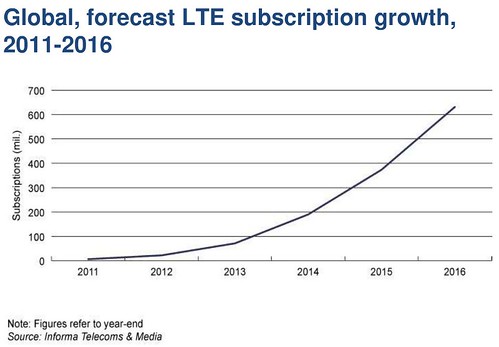
Verizon, MetroPCS, and AT&T will account for the majority of 4G Long Term Evolution connections globally by year-end 2011. Pyramid Research expects that U.S. mobile service providers, with seven million LTE connections, will account for 47 percent of the world’s LTE subscriptions.

Pyramid expects 71 percent of 5.4 million global LTE handset sales will come from the United States in the near term. Separately, Informa Telecoms & Media projects something on the order of 600 million 4G subscriptions in service by about 2016.

The strong demand for mobile broadband in the U.S. market also will allow operators to quickly recoup spending on capital investments. Verizon and NTT Docomo, both the largest operators in their respective countries, each launched LTE in December 2010.

Google Getting into the Cloud Music Business?

After introducing a cloud music service with arguably-limited capabilities, Google is in negotiations with the major record labels to expand that service and also open an MP3 store that would compete with Apple and Amazon.


The new service would most likely be connected to Google’s existing cloud service, "Music Beta," which lets people back up their songs on remote servers and stream them to mobile phones and other devices.

Steve Wozniak Is “A Little Afraid” About The Future Of Apple

Apple co-founder Steve Wozniak says he is “a little afraid about the future of Apple” even though “it could go positive.” Some of his concerns are based on Apple’s iPhone 4S product demo. Watch the video.


If you believe Steve Jobs really was a highly-unusual CEO, with a very-unusual way of approaching product development, that is a rational concern. 

He says the company talked about its dual-core processor, but “Steve doesn’t want us to think about dual-core processors, all we need to know is how do we get our answer, how do we connect to the internet… Human things, not technical things.” 


He also says he doesn’t want Apple to go the way Sony went in its products. Steve Wozniak Is “A Little Afraid” About The Future Of Apple 

Should You Be on Tumblr?

From Irene Albright’s to-die-for “closet”Tumblr is a nice platform for blogging. It might not work in every business vertical, though. 


Partly, that's a matter of format, and partly a matter of audience. The Tumblr audience tends to be younger, so short, highly visual blog posts tend to do much better than text-intensive posts. That might not work for some B2B applications where text is more important.

That's another issue. If the subject matter a business blog deals with is not highly visual, Tumblr might not be the optimal choice.


The quick setup and simplicity of Tumblr make it a good choice for those who want to get a blog up and running right now, who can integrate lots of visual elements and where content is visually oriented and light on text as a way of communicating.

The fashion industry was one of the first to embrace Tumblr from a business perspective. See pret-a-portel.

Brands like Oscar De La Renta and Ann Taylor capitalized on the visual nature of Tumblr by publishing photos of the latest fashions, insider pictures and quick bits from the fashion world. Should You Be on Tumblr?

Social Media Revenue $29 Billion in 2015


Worldwide social media revenue is on track to reach $10.3 billion in 2011, a 41.4 percent increase from 2010 revenue of $7.3 billion, says Gartner. Global social media revenue is forecast to reach $14.9 billion in 2012 and $29.1 billion in 2015.


Advertising revenue is, and will remain, the largest contributor to overall social media revenue. Social media advertising revenue is forecast to total $5.5 billion in 2011, and grow to $8.2 billion in 2012. Advertising revenue includes display advertising and digital video commercials on any device including PCs, mobile and media tablets.
            
Social gaming sales will reach $3.2 billion in 2011, growing to $4.5 billion in 2012.

Social media subscriptions will conribute a modest $236 million in 2011 and total $313 million in 2012. Social media revenue

Google Mobile Ad Revenue $2.5 Billion Run Rate

Mobile advertising forecast
Google says its mobile revenue stream has grown 2.5 times in the last 12 months to a run rate of over $2.5 billion. Google mobile revenue at $2.5 billion Mobile revenue, primarily generated by advertising, could represent seven percent of Google's total revenue of $35.7 billion.

Keep in mind that worldwide mobile advertising revenue was forecast to reach only $3.3 billion in 2011,  according to Gartner. Google's run-rate forecast was built using past-year data, and in all likelihood will exceed that level in 2012, it is safe to predict. 


Worldwide revenue will reach $20.6 billion by 2015, according to Gartner. Search and maps will generate the highest revenue, while video and audio ads will see the fastest growth through 2015. http://www.gartner.com/it/page.jsp?id=1726614

"Enterprise" Mobility a Reflection of Consumer Behavior

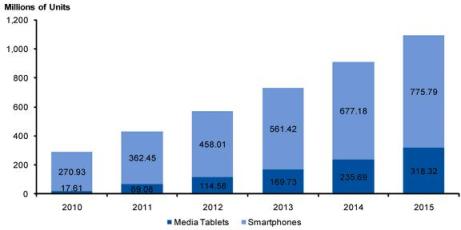
IDC Smart Phone, Tablet Forecast
As has been the case for the last several years, there was a reported "lack of enthusiasm" at the CTIA Enterprise and Applications show.

That meeting has been struggling, some might say, to find a clear mission and role, and some might say it still has not found that role.

Among the reasons, one might say, is that mobile computing and applications are not driven by enterprise users and concerns, but by consumer applications and desires, in the same way that most enterprise innovation now is driven.


Enterprise technology managers controlled the pace and adoption of technology for decades but starting with the launch of the iPhone in 2007, non-technology executives and employees have been demanding the right to use the devices they find so palatable in their regular lives for work purposes. As a result, “enterprise mobile technology” is kind of a misnomer; the dollars, talent, and hype in mobile are going toward companies that are building things for consumers.

Will the 2026 World Cup Create Any Long-Term Economic Benefit for Host Nations?

World Cup long-term economic effects will be negligible, economists at Goldman Sachs say. That might seem unlikely, given the 2026 FIFA Wor...