Wednesday, September 7, 2011
OHands-On With The Motorola Droid Bionic For Verizon - TechCrunch

 Gary Kim was cited as a global "Power Mobile Influencer" by Forbes, ranked second in the world for coverage of the mobile business, and as a "top 10" telecom analyst. He is a member of Mensa, the international organization for people with IQs in the top two percent.
Video Game Sales to Grow
Video game sales are expected to grow from $66 billion worldwide in 2010 to $81 billion by 2016, boosted by a shift to online delivery, according to DFC Intelligence.
Online sales of games are the largest area of growth and they could surpass retail sales as early as 2013, said David Cole, DFC analyst. Games also are shifting away from dedicated game consoles and to multi-purpose devices such as smart phones.
Online sales of games are the largest area of growth and they could surpass retail sales as early as 2013, said David Cole, DFC analyst. Games also are shifting away from dedicated game consoles and to multi-purpose devices such as smart phones.
Gary Kim was cited as a global "Power Mobile Influencer" by Forbes, ranked second in the world for coverage of the mobile business, and as a "top 10" telecom analyst. He is a member of Mensa, the international organization for people with IQs in the top two percent.
Tuesday, September 6, 2011
Tweet Leads to Steak at Airport
When social media entrepreneur, CEO and investor Peter Shankman landed at the Newark Airport on Aug. 17, 2011he was greeted with a porterhouse delivered by a waiter from Morton's Steakhouse.
Shankman was surprised by the gesture, tweeting "Oh. My. God. I don't believe it."
But perhaps he shouldn't have been, since he asked Mortons directly for the item two hours earlier, also via Twitter: "Hey @Mortons - can you meet me at newark airport with a porterhouse when I land in two hours? K, thanks :)"
The case of the airport porterhouse delivery may be an extreme example of actionable social media monitoring, but it also illustrates how restaurants are increasingly leveraging the service.
Shankman was surprised by the gesture, tweeting "Oh. My. God. I don't believe it."
But perhaps he shouldn't have been, since he asked Mortons directly for the item two hours earlier, also via Twitter: "Hey @Mortons - can you meet me at newark airport with a porterhouse when I land in two hours? K, thanks :)"
The case of the airport porterhouse delivery may be an extreme example of actionable social media monitoring, but it also illustrates how restaurants are increasingly leveraging the service.
Gary Kim was cited as a global "Power Mobile Influencer" by Forbes, ranked second in the world for coverage of the mobile business, and as a "top 10" telecom analyst. He is a member of Mensa, the international organization for people with IQs in the top two percent.
Smart Phones Not Optional for Today's Workers

In fact, for many, work is a never-ending cycle. About 37 percent report they work each evening. Some 33 percent work again when they arrived home, 26 percent after dinner, and 19 percent said they work again after they put their children to bed at night.
About 49 percent said they would work in the middle of the night when they were unable to sleep, at least on an occasional basis. The largest percentage recorded was in the category “work before my commute to the office,” with 62 percent responding that they did so at least one to two times per week.
Some 37 percent of survey respondents also report they worked during lunch every day, 66 percent at least once or twice per week. Not surprisingly, workers in North America were the most likely to work through their lunch hours.
Some 45 percent of mobile workers in North America connected to technology during lunch every day. This trend was slightly lower in other geographies. Just a third (33 percent) in Europe worked during lunch every day and 31 percent of those in Asia Pacific.
Mobile workers are not only shifting their work periods to different times of day, they are also working from a variety of different locations. The most common place outside the office is the homes, with 47 percent working from home daily and 99 percent at least occasionally.
But these mobile workers do get out from time to time. 88 percent worked from the road; 84 percent from a coffee shop, restaurant or bar; and 77 percent worked outside using a city-mesh Wi-Fi at least on an occasional basis.
Some 72 percent of the 3,100 respondents said that they used a mobile device on a daily basis within the office, as well.
Some 75 percent of respondents worked more hours because of the increased flexibility in when and where they could work. More than half (55 percent) were working at least 10 or more additional hours each week.
But some were working significantly longer. About 12 percent were working 20 or more additional hours each week as a result of the freedom to choose when and where to work.
In addition to working more hours, these mobile workers also felt more productive when their schedules were flexible. Some 54 percent said that their productivity was substantially improved and an additional 24 percent stated they were marginally more productive. Only three percent felt that the additional flexibility in work times and locations decreased their productivity.
Smart phones have reached close to 100 percent penetration among mobile workers. Across the generations, 96 percent of mobile workers under the age of 45 have a smartphone and 91 percent of those over the age of 55. Relatively new on the market, tablets continue to be the big story of 2011. Currently, 41 percent of mobile workers have a tablet and an additional 34 percent of mobile workers intend to purchase a tablet in the next six months. Taken together, we expect to see 75 percent of mobile workers with a tablet this fall.
Among tablet-owning mobile workers, iPads dominate with 72 percent of the current marketshare in this study. It looks like this will remain the case this year with 63 percent of mobile employees indicating that they plan to purchase or receive an iPad 2 in the next six months, bringing the potential future market share for iPads to 71 percent of tablet-carrying mobile workers.
Some 75 percent of respondents worked more hours because of the increased flexibility in when and where they could work. More than half (55 percent) were working at least 10 or more additional hours each week.
But some were working significantly longer. About 12 percent were working 20 or more additional hours each week as a result of the freedom to choose when and where to work.
In addition to working more hours, these mobile workers also felt more productive when their schedules were flexible. Some 54 percent said that their productivity was substantially improved and an additional 24 percent stated they were marginally more productive. Only three percent felt that the additional flexibility in work times and locations decreased their productivity.
Smart phones have reached close to 100 percent penetration among mobile workers. Across the generations, 96 percent of mobile workers under the age of 45 have a smartphone and 91 percent of those over the age of 55. Relatively new on the market, tablets continue to be the big story of 2011. Currently, 41 percent of mobile workers have a tablet and an additional 34 percent of mobile workers intend to purchase a tablet in the next six months. Taken together, we expect to see 75 percent of mobile workers with a tablet this fall.
Among tablet-owning mobile workers, iPads dominate with 72 percent of the current marketshare in this study. It looks like this will remain the case this year with 63 percent of mobile employees indicating that they plan to purchase or receive an iPad 2 in the next six months, bringing the potential future market share for iPads to 71 percent of tablet-carrying mobile workers.
Gary Kim was cited as a global "Power Mobile Influencer" by Forbes, ranked second in the world for coverage of the mobile business, and as a "top 10" telecom analyst. He is a member of Mensa, the international organization for people with IQs in the top two percent.
Google to Offer $49 1-Gbps Service?
Some observers think the really significant aspect of Google's symmetrical 1-Gbps networks in Kansas City, Mo., Kansas City Kan. and at Stanford University will be the pricing. Google apparently plans to offer 1 Gbps symmetrical broadband access at a price consistent with services offered by other broadband providers, suggesting a monthly price in the neighborhood of $49 a month.
Google wants a test bed to see what sorts of apps might develop when users and developers have access to that sort of bandwidth. But some may say the bigger long-term challenge will be the ability to price such services, and even lower speed 50 Mbps and 100 Mbps services, at standard consumer rates.
Many observers would say that, at such prices, and without other services to contribute to revenue, that no commercial operation could offer and stay in business.
Gary Kim was cited as a global "Power Mobile Influencer" by Forbes, ranked second in the world for coverage of the mobile business, and as a "top 10" telecom analyst. He is a member of Mensa, the international organization for people with IQs in the top two percent.
Sprint Files Lawsuit, But Winning Wouldn't Address Fundamental Issues
Sprint Nextel has filed a new lawsuit against AT&T, AT&T Mobility, Deutsche Telekom and T-Mobile USA seeking to block the proposed acquisition as a violation of Section 7 of the Clayton Act. The Clayton Act allows contestants and the federal government to act in advance of potential antitrust activities in a preemptive way. Clayton Act is an antitrust statute
The lawsuit was filed in federal court in the District of Columbia as a related case to the Department of Justice’s (DOJ) suit against the proposed acquisition.
Sprint’s lawsuit focuses on the competitive and consumer harms which would result from a takeover of T-Mobile by AT&T
There remains substantial disagreement about what might be possible if the wake of a Justice Department and further Federal Communications Commission ruling that the proposed AT&T deal would be anti-competitive. Some believe the same logic might now bar Sprint from attempting to merge with T-Mobile USA, something Sprint clearly has thought about.
Sprint would clearly breathe easier if AT&T did not acquire T-Mobile USA. But that would not resolve any of Sprint’s other fundamental problems, including its lagging rate of subscriber additions, churn issues, liquidity or market share issues.
Needless to say, T-Mobile USA, which has struggled for a decade, still would have to face issues even greater than Sprint's challenges. Sprint already has its 4G network operating, and soon will add Long Term Evolution. T-Mobile USA does not own spectrum allowing it to do so.
Gary Kim was cited as a global "Power Mobile Influencer" by Forbes, ranked second in the world for coverage of the mobile business, and as a "top 10" telecom analyst. He is a member of Mensa, the international organization for people with IQs in the top two percent.
28% Use Location Services
More than a quarter of all American adults—28 percent—use mobile or social location-based services of some kind, mostly to get directions or recommendations related to their current locations.
A much smaller number (five percent of mobile device owners) use their phones to check in to locations using geosocial services such as Foursquare or Gowalla.
About nine percent of Internet users set up social media services such as Facebook, Twitter, or LinkedIn so that their location is automatically included in their posts on those services.
A much smaller number (five percent of mobile device owners) use their phones to check in to locations using geosocial services such as Foursquare or Gowalla.
About nine percent of Internet users set up social media services such as Facebook, Twitter, or LinkedIn so that their location is automatically included in their posts on those services.
 Gary Kim was cited as a global "Power Mobile Influencer" by Forbes, ranked second in the world for coverage of the mobile business, and as a "top 10" telecom analyst. He is a member of Mensa, the international organization for people with IQs in the top two percent.
Google: 44 Percent Of Searches For Last-Minute Holiday Gifts Will Be Mobile
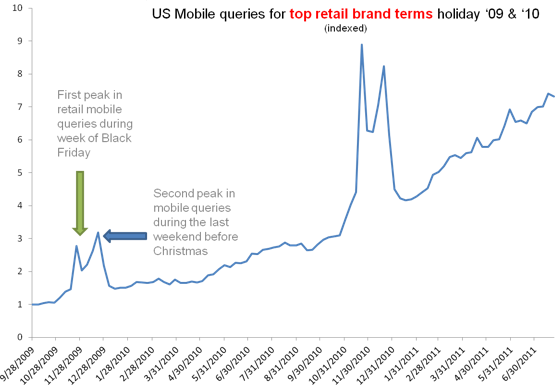 Google now predicts, based on the past two years worth of data, that in the upcoming 2011 Christmas and holiday shopping season, “44 percent of total searches for last minute gifts and store locator terms will be from mobile devices."
That's a fairly staggering prediction. Google believes that 44 percent of all searches for the gift shopping purpose will be generated by smart phones. There are some potential implications for mobile advertisers, who will have to compete for limited screen real estate.
But the findings also are illustrative for the broader trend of mobile use for real-world shopping activities. That has implications for use of mobile coupons, location-based check-ins and offers and mobile wallet applications, even in advance of a widespread shift to use of mobile payment services.
One of the clear "big trends" now is that mobile and online applications and features increasingly are being applied to offline commerce.
One of the clear "big trends" now is that mobile and online applications and features increasingly are being applied to offline commerce.
Gary Kim was cited as a global "Power Mobile Influencer" by Forbes, ranked second in the world for coverage of the mobile business, and as a "top 10" telecom analyst. He is a member of Mensa, the international organization for people with IQs in the top two percent.
Sprint "Simplicity" Demand is Really "Protect Me" Demand
Sprint bases much of its retail pricing strategy on "simplicity." Some might say that is another way of saying "no worry about overage charges. The strategy is well founded, in the Internet access era. Some will not be able to remember it, but America Online, even before that firm began calling itself AOL, and before it decided to essentially abandon the ISP business, used to charge users by the minute.
When AOL switched to "unlimited" usage, freeing users from the need to deal with metered access, usage exploded. For that reason, fixed broadband service plans in the U.S. market have been "unlimited" until quite recently.
That approach generally has not been used in the mobile business, which has more stringent capacity issues. Sprint, for the moment, remains the carrier most associated with "unlimited" access plans. Some Yankee Group research data from the United Kingdom shows the continuing power of the "don't worry about overage charges" approach. About 29 percent of U.K. consumers surveyed indicated they were willing to pay a 10-percent premium to receive protection from unexpected overage charges.
They also were willing to pay more for higher speeds, especially when available "on demand."

When AOL switched to "unlimited" usage, freeing users from the need to deal with metered access, usage exploded. For that reason, fixed broadband service plans in the U.S. market have been "unlimited" until quite recently.
That approach generally has not been used in the mobile business, which has more stringent capacity issues. Sprint, for the moment, remains the carrier most associated with "unlimited" access plans. Some Yankee Group research data from the United Kingdom shows the continuing power of the "don't worry about overage charges" approach. About 29 percent of U.K. consumers surveyed indicated they were willing to pay a 10-percent premium to receive protection from unexpected overage charges.
They also were willing to pay more for higher speeds, especially when available "on demand."
Gary Kim was cited as a global "Power Mobile Influencer" by Forbes, ranked second in the world for coverage of the mobile business, and as a "top 10" telecom analyst. He is a member of Mensa, the international organization for people with IQs in the top two percent.
Sprint User Base is Different
Lots of people have offered, and will continue to offer, advice about how Sprint can do better in the U.S. mobile market, whether or not the AT&T deal to buy T-Mobile USA succeeds, or not. Advice, one might argue, is easy to give, especially when it concerns how any firm, lead by any set of talented managers, can change its fundamental position in a market whose structure is fairly well fixed.
Though some will question the continued relevance, a long-standing study of firms in many industries, taking a look at market share, quality and profit margin, suggests that it is very hard to change firm position in an established industry. Market share patterns
Though the existence of a correlation is not necessarily a causal relationship, there is relatively significant evidence that markets develop patterns. Pareto_principle Among the more-enduring patterns is a tendency towards market concentration by a handful of leaders.
Some might argue, for that reason, that the current U.S. mobile market structure is not unusual, and might become even more concentrated over time. The informal rule of thumb might be that in any market, most of the share i(80 percent or so) is held by a small number of providers (perhaps 20 percent or fewer).
The U.S. mobile industry is more concentrated than that, but you get the point. It would be difficult under the best of conditions for Sprint Nextel to dramatically change its position in the market. But, that noted, there are some apparent differences of end user behavior that could provide something of an opening.
Some of us would not say the differences necessarily offer Sprint a way to change its market position in a dramatic way, but might offer a way to help solidify its current position. The difference is the apparent preference for Android among Sprint users, or perhaps Sprint’s willingness to bank on Android for some highly-popular devices such as the HTC Evo line.
Note recent Yankee Group surveys indicating that Sprint users are heavy users of Android devices. It is of course possible that the data reflects Sprint’s historic inability to sell the Apple iPhone, forcing Sprint to emphasize the HTC Evo as a lead offer, and thus producing the skew Yankee Group found.
One might similarly argue that Verizon Wireless faced the same problem in the days when it also could not sell the Apple iPhone. If so, it always is possible that the Android preferences illustrated by Yankee Group are a tactical, short term user demand trend that easily could change in the future.
Still, no matter what happens with the AT&T bid to buy T-Mobile USA, Sprint is going to have to work pretty hard simply to solidify some distinctive position in the market, even as a “distant third” provider, compared to Verizon Wireless and AT&T.
It does presently appear, however, that Sprint users consume more data, and use Android, more so than customers of the other top four networks.
Though some will question the continued relevance, a long-standing study of firms in many industries, taking a look at market share, quality and profit margin, suggests that it is very hard to change firm position in an established industry. Market share patterns
Though the existence of a correlation is not necessarily a causal relationship, there is relatively significant evidence that markets develop patterns. Pareto_principle Among the more-enduring patterns is a tendency towards market concentration by a handful of leaders.
Some might argue, for that reason, that the current U.S. mobile market structure is not unusual, and might become even more concentrated over time. The informal rule of thumb might be that in any market, most of the share i(80 percent or so) is held by a small number of providers (perhaps 20 percent or fewer).
The U.S. mobile industry is more concentrated than that, but you get the point. It would be difficult under the best of conditions for Sprint Nextel to dramatically change its position in the market. But, that noted, there are some apparent differences of end user behavior that could provide something of an opening.
Some of us would not say the differences necessarily offer Sprint a way to change its market position in a dramatic way, but might offer a way to help solidify its current position. The difference is the apparent preference for Android among Sprint users, or perhaps Sprint’s willingness to bank on Android for some highly-popular devices such as the HTC Evo line.
Note recent Yankee Group surveys indicating that Sprint users are heavy users of Android devices. It is of course possible that the data reflects Sprint’s historic inability to sell the Apple iPhone, forcing Sprint to emphasize the HTC Evo as a lead offer, and thus producing the skew Yankee Group found.
One might similarly argue that Verizon Wireless faced the same problem in the days when it also could not sell the Apple iPhone. If so, it always is possible that the Android preferences illustrated by Yankee Group are a tactical, short term user demand trend that easily could change in the future.
Still, no matter what happens with the AT&T bid to buy T-Mobile USA, Sprint is going to have to work pretty hard simply to solidify some distinctive position in the market, even as a “distant third” provider, compared to Verizon Wireless and AT&T.
It does presently appear, however, that Sprint users consume more data, and use Android, more so than customers of the other top four networks.

 Gary Kim was cited as a global "Power Mobile Influencer" by Forbes, ranked second in the world for coverage of the mobile business, and as a "top 10" telecom analyst. He is a member of Mensa, the international organization for people with IQs in the top two percent.
Monday, September 5, 2011
Hungary Power Wholesaler To Take Slice Of Telecom Market
State-owned Hungarian power wholesaler MVM Zrt. is stepping up efforts to enter the local telecommunications market, MVM communications director Gyorgy Felkai said.
The move would involve taking over business interests currently held by Magyar Telekom Nyrt., Hungary's largest telecommunications firm by market share which is majority-owned by Germany's Deutsche Telekom AG (DTE.XE).
The move would involve taking over business interests currently held by Magyar Telekom Nyrt., Hungary's largest telecommunications firm by market share which is majority-owned by Germany's Deutsche Telekom AG (DTE.XE).
The move, though not unprecedented, remains relatively rare, though energy companies have in the past invested a bit more widely in long-haul communications ventures and assets.
Gary Kim was cited as a global "Power Mobile Influencer" by Forbes, ranked second in the world for coverage of the mobile business, and as a "top 10" telecom analyst. He is a member of Mensa, the international organization for people with IQs in the top two percent.
AT&T Might Not Have to Pay Breakup Fee
AT&T could escape paying a breakup fee to Deutsche Telekom if the T-Mobile USA deal does not receive regulatory clearance, under some circumstances, some say.
"There are a number of options under which the contract will not come into effect," Reuters reports.
As part of the AT&T bid, Deutsche Telekom is supposed to be paid a breakup fee comprising $6 billion in cash and other assets should regulators reject the deal.
Under its agreement with Deutsche Telekom, the deal is only valid if the acquisition receives regulatory approval within a certain time frame, a source told Reuters.
Also, the agreement could become invalid if regulatory conditions for the sale push the value of T-Mobile USA below a certain level, Reuters reports.
AT&T might not have to pay breakup fee
"There are a number of options under which the contract will not come into effect," Reuters reports.
As part of the AT&T bid, Deutsche Telekom is supposed to be paid a breakup fee comprising $6 billion in cash and other assets should regulators reject the deal.
Under its agreement with Deutsche Telekom, the deal is only valid if the acquisition receives regulatory approval within a certain time frame, a source told Reuters.
Also, the agreement could become invalid if regulatory conditions for the sale push the value of T-Mobile USA below a certain level, Reuters reports.
AT&T might not have to pay breakup fee
Gary Kim was cited as a global "Power Mobile Influencer" by Forbes, ranked second in the world for coverage of the mobile business, and as a "top 10" telecom analyst. He is a member of Mensa, the international organization for people with IQs in the top two percent.
Netflix Launches Latin America Service
Netflix is launching its online streaming service throughout Latin America and the Caribbean. Rochelle King, Netflix VP of User Experience and Design launches first in Brazil and over the next week throughout Latin America and the Caribbean, including some 43 countries and territories in all.
By September 12, 2011, people throughout the Americas will be able to instantly watch a broad selection of movies and TV shows streaming from Netflix on computers, game consoles like the WII and PS3, and Smart TVs. Brazilians can now sign up for one month free at www.netflix.com.
By September 12, 2011, people throughout the Americas will be able to instantly watch a broad selection of movies and TV shows streaming from Netflix on computers, game consoles like the WII and PS3, and Smart TVs. Brazilians can now sign up for one month free at www.netflix.com.
Gary Kim was cited as a global "Power Mobile Influencer" by Forbes, ranked second in the world for coverage of the mobile business, and as a "top 10" telecom analyst. He is a member of Mensa, the international organization for people with IQs in the top two percent.
Sunday, September 4, 2011
Lower End Models Will Drive Smart Phone Growth Globally
According to a new report from market research company iSuppli, the number of Smart phones that are shipped will reach 1.03 billion in 2015. This will represent 54.4 percent of the total mobile phone shipments that year.
Within the smart phone market, the fastest-growing category will be low-end models, defined as devices with limited features and lower memory densities relative to higher-end products. Shipments of low-end smartphones are expected to rise at a compound annual growth rate of 115.4 percent during the period from 2010 through 2015, compared to just 16.4 percent for mid-range to high-end smart phones. Lower end smart phones will sell
Within the smart phone market, the fastest-growing category will be low-end models, defined as devices with limited features and lower memory densities relative to higher-end products. Shipments of low-end smartphones are expected to rise at a compound annual growth rate of 115.4 percent during the period from 2010 through 2015, compared to just 16.4 percent for mid-range to high-end smart phones. Lower end smart phones will sell
 Gary Kim was cited as a global "Power Mobile Influencer" by Forbes, ranked second in the world for coverage of the mobile business, and as a "top 10" telecom analyst. He is a member of Mensa, the international organization for people with IQs in the top two percent.
Amazon, Yahoo, Dish Battle for Hulu
 |
| Hulu |
DirecTV was interested, but apparently was not willing to pay as much as the three current contestants.
The three leading bids for Hulu are in the $1.5 billion to $2 billion range, according to the Financial Times.
Some might argue Yahoo is simply desperate to find anything that represents success, in the online video business or elsewhere. Amazon and Dish Network already have active online businesses, and might arguably bring greater resources to bear. Financial Times on Hulu
Gary Kim was cited as a global "Power Mobile Influencer" by Forbes, ranked second in the world for coverage of the mobile business, and as a "top 10" telecom analyst. He is a member of Mensa, the international organization for people with IQs in the top two percent.
Subscribe to:
Posts (Atom)
-
We have all repeatedly seen comparisons of equity value of hyperscale app providers compared to the value of connectivity providers, which s...
-
It really is surprising how often a Pareto distribution--the “80/20 rule--appears in business life, or in life, generally. Basically, the...
-
Financial analysts typically express concern when any firm’s customer base is too concentrated. Consider that, In 2024, CoreWeave’s top two ...

