Wednesday, May 26, 2010

Google Adds Dashboard for Mobile Location History

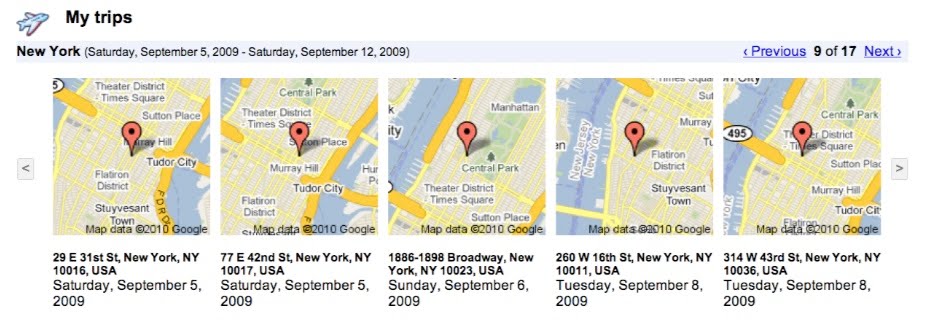
Google has a new beta dashboard for its "Location History" function, which might be useful for people who want to know how they actually behave, rather than how they think they behave, at least from a location perspective. The dashboard, which is private and viewable only by the user, will highlight
location trends.

You might want some detail on trips taken, places visited, or time spent in the house compared to outside it, for example.

The dashboard can be used to review how much time time you have spent at an office location over the last month or year, and whether your patterns are changing, for example.

If you want to know where you stopped on a recent trip, the dashboard can be used to find the answer.

To try out the new dashboard, enable Google Latitude in the background on your phone, turn on Google Location History, and wait a few days (up to a week) to build up enough history for the dashboard to begin showing information.

Facebook Not Completely Set on How It Will Use "Location"

Facebook CEO Mark Zuckerberg says his firm still is not exactly sure what it is going to do in the geo-location area, yet, and hasn't finished building the application.

Sometimes it is quite refreshing to hear influential CEOs frankly say they aren't completely sure how they will use an important feature, or what the business model might be. Perhaps that is a problem when a CEO "never" seems to have answers about such questions, but it is okay to figure it out and get it right, even if it sometimes takes a while.

Of course, it is less comforting when a firm does not basically have enough current revenue to fund current operations, but that isn't Facebook's problem.

73 Democrats tell FCC to Drop Title II Gambit

73 House Democrats have sent a letter to the Federal Communications Commission warning the agency not to go forward with its plan to partially reclassify ISPs as common carriers, a move needed to impose net neutrality rules.

'The uncertainty this proposal creates will jeopardize jobs and deter needed investment for years to come,' wrote Texas Congressman Gene Green. 'The significant regulatory impact of reclassifying broadband service is not something that should be taken lightly and should not be done without additional direction from Congress.'"

Common carrier regulation in the U.S. communications business historically has been good for coverage, bad for innovation. It was good for quality but bad for prices.

Whether common carrier regulation would have the same impact on broadband and innovation in the broadband business is the question

Tuesday, May 25, 2010

Access for "One Price Across Digital Platforms" Will Come

In a move with likely implications for the evolving Internet access business, The New Yorker will let readers pay once for digital access across the iPad, the Kindle and other platforms, hoping to improve on the current industry practice of charging even subscribers for each edition on each device.

The same sort of thing ultimately will happen in broadband access as well, as users start to experience greater pain paying separately, by the device, by the form of access, by the place for their broadband access services.

Both AT&T and Verizon already have spoken about a future scenario where an authorized user can use wireless and wired broadband access, across multiple devices. Think of it as a sort of family plan for individual users, where the "family" includes all the communications-capable devices a particular user wants to use.

If you think the future will feature communications need for a wide variety of appliances, used across home and mobile enviornments, but with differing usage characteristics, a unified plan makes sense.

Android Music versus iTunes: Table Stakes

There's lots of activity in the mobile music space at the moment. Spotify is preparing to launch in the United States and Nokia is rolling out multiple new "Comes With Music territories. But Google is lijely the most significant of the new entrants.

Not that music stores per se are that big a deal on the revenue front. Of course the music download store has never been the end game. The margins are so small that the a la carte download store only has any value as a means to an end, a way to add a sticky application and increase device value, for example, as well as to provide an e-commerce platform, to a lesser extent.

4G Speeds From T-Mobile

T-Mobile USA is touting its "4G speeds" in the Northeastern United States and other major cities across the country. Some are going to argue at the claim, which is properly made. T-Mobile's HSPA+ network will in face operate at speeds fourth-generation network providers are promising.

Users will not care about which air interface gives them their bandwidth, but they will care about the speed. It's true "4G speed" is not the same thing as "4G network," but only carriers care about such things. Users just want the better performance.

The latest activations are in the New York City metropolitan area, including New Jersey and Long Island, Albany, Buffalo, Rochester and Syracuse, Connecticut (Hartford, New Haven, Milford and Stamford) and Providence, R.I.

The faster network already is live in Philadelphia, as well the Washington, D.C. suburbs. Boston and Washington, D.C. are expected to be "lit" in the coming weeks.

Are Millennials A Predictable Part of the Generational Cycle? | Millennial Marketing

That "Millennials" might be different from their parents, but neither generation arguably is so "unique and different" as sometimes might appear. Nearly 20 years ago, William Strauss and Neil Howe wrote “Generations,“ which suggested there is a repeating four-generation pattern in American history.

If at all accurate, Millennials are part of a pattern. Though their common generational experiences mark them as different from the three preceding generations in the cycle, the cycle will repeat, with Millennials in turn succeeded by a generation with different, but broadly predictable outlooks.

Sometimes we mistake the forest for the trees, focusing on how much "technology" is simply a background factor for Millennials. What we overlook is the pattern that suggests why their values and views are different from that of their parents, but also that those values are part of an old pattern.

If so, yet another turn is coming.

Walmart drops price of iPhone 3GS to $97

Handset price is getting to be a non-issue for users who want to buy an Apple iPhone. With the announcement of the next-generation iPhone just weeks away, Walmart has lowered the price of the soon-to-be-replaced 16GB iPhone 3GS to just $97, when purchased with a two-year contract.

Will Apple "Blow Google Out of the Water?"

Google used the occasion of its developer conference to jab Apple. Will Apple take the opportunity at its June 7 meeting to jab back? Most people think it likely will.

"If Google didn't act, we face a draconian future," said Goolge VP Vic Gundotra at Google's recent developer meeting. "One man, one company, one device would control our future," said Gundotra.

At its upcoming Worldwide Developers Conference, Apple is expected to detail its new iPhone operating system, OS 4.


Twitter Bans 3rd-Party Ads

Twitter has is banning third-party advertisements on its site, in a move to control its monetization of the micro-blogging service, and perhaps also to protect users from perceived ad spamming.

The Twitter "Promoted Tweets" platform poses some risks of user annoyance, but might arguably provoke much more irritation if the appropriateness of the promoted messages is not controlled.

As mobile advertising starts to become a more important and bigger revenue stream, control of inventory is going to become a bigger issue, as it always does for ad-supported media.

BBC Looks To Ban Over the Top Use of Its Content

The BBC, saying it seeks to maintain its brand, says it does not want to make its programs available to third parties for VOD distribution on an unbundled basis. In part, that is one more example of how the debate over content pay walls is being played out, and also an example of the broader ways in which the battle between open and closed ecosystems likewise has heated up.

AT&T Launches Free Wi-Fi In Times Square

AT&T is launching a free wi-fi network for its customers in New York City's Times Square, obviously designed to take a load off the 3G network.

The move illustrates both the importance of wireless offload strategies as well as a changing role for fixed-line networks, which are assuming much more importance as mobile video consumption increases.

That might provide small comfort to fixed-line service providers, but comfort nevertheless. The fundamental answer for why broadband fixed line networks will remain relevant in a market that emphasizes mobile service has to do with superior bandwidth.

Fixed lines will remain the "best" way to deliver huge quantities of video to end users, in many venues, including both the linear multi-channel video and over-the-top Internet modes.

Mobile Passed Fixed for Voice in 2000, But Fixed Voice Lines Continue to Grow

You might not be especially surprised that wireless accounts in service surpassed fixed phone lines in Japan, Korea and Finland back in 2000, meaning it has been a decade since a fixed line was the preferred way of using "voice" in the consumer, and part of the business market.

(Click image for larger view)

You might not realize 2000 also was the year that wireless accounts surpassed fixed lines for voice in the U.S. market as well. At the beginning of 2010 there were 2.4 wireless lines in service for every fixed voice line, about 276 million wireless lines compared to about 114 million fixed voice lines.

That said, people often overlook the fact that fixed voice lines in service actually have grown since 2000, from about 100 million lines, up to 114 million lines. The confusion typically is driven by the decline of telco market share compared primarily to the growth of cable operator-supplied lines.

In Japan, cellular phone service was first introduced in 1979. The number of mobile ubscribers exceeded that of fixed phones late 2000.

In Korea, cellular phone service was first introduced in 1984. In 2000, the number of
subscribers exceeded that of fixed telephony.

Finland was the first country to introduce the digital GSM standard in 1992. Mobile revenue surpassed fixed line revenue in 1997.

58% of All U.S. Web Users Visit Social Networking Sites

As popular as social networking has proven to be--eMarketer now says 58 percent of U.S. Internet users visit a social networking site at least once a month--there have been questions about Facebook's business model. The answer typically has been that "a model will be found," as improbably as was the case for Google before it.

Advertising and e-commerce have been the most-frequent answers to the question of how any widely-used "free to use" application can support itself over time. And despite some "privacy" stumbles of late, Facebook continues to explore ways to position itself as an advertising venue, despite some obstacles, related in part to fragmented use of the service (there is no single "home page" everybody goes to, which would create a huge venue for display ads) and the suitability of the content environment (YouTube has the same basic problem).

Still, the rule in media is that whenever a sufficient number of "eyeballs" can be aggregated, advertising becomes viable.

eMarketer estimates that 57.5 percent of Internet users, or 127 million people, will use a social network at least once a month in 2010. That's eyeballs.

Monday, May 24, 2010

Social Networking and Brand Building: B2C Works Better than B2B

The top 10 brands on Facebook, according to number of fans suggests a couple of obvious "lessons" for marketers. All of the top-10 brands are in the consumer space, and all tend to have "enterprise" size marketing budgets. Facebook itself is in the top position, but ignoring that, the list looks like:

#2 Starbucks 7,266,488 Fans
#3 Coca-Cola 5,567,046 Fans
#4 YouTube 5,114,322 Fans
#5 Red Bull 3,727,372 Fans
#6 Disney 3,488,088 Fans
#7 Victoria’s Secret 3,470,724 Fans
#8 Converse 2,749,691 Fans
#9 McDonald’s 2,270,109 Fans
#10 H&M 2,062,377 Fans
#11 MTV 1,924,744 Fans"

In the business-to-business space, and especially for any firm that is small or mid-sized, Twitter probably is a better bet.

CEOs, Managers Using Social Media for Work


You might be surprised to learn that social media is being actively used by business managers, including CEOs, to keep track of news and conduct research, in addition to keeping up with friends.

In a recent survey of 337 social media users in North America and Europe, about 84 percent of social media users indicated they use it to keep up to date on news, while 78 percent also indicated they use social media "to get ideas to help me in my job," says Nigel Fenwick, Forrester Research analyst.

2010: A Turning Point for Telecom?

Watch the Webinar

Some years in telecommunications are pivotal: 1934, 1982, 1996 and 2000, for example, set into motion huge changes that fundamentally shaped the entire industry in transformative ways. Will 2010 prove to be a pivotal year? It might be. One can easily foresee that regulatory frameworks such as "network neutrality" and the "national broadband plan," could affect business models for years to come.

But those are not the only changes. There are new 4G wireless networks coming on line that could, for the first time, drive mobile broadband substitution as smartphone penetration grows from 15% to 50%. Beyond that, questions linger on how consumer behavior was shaped by the "great recession" and if these changes in buying behavior are permanent.

This webinar takes a look at all those questions and discuss possible implications. When the regulatory environment, business models, fundamental technologies and end user demand curves all at change at once, transformative and historical changes are likely.

Social Networking is a Time Waster, Telecommuters Report


Mobile or remote access to email still tops the list of perceived productivity-enhancing tools telecommuters have access to, a survey by iPass finds.

About 85 percent said remote email access enhanced productivity, eclipsing even telephone access, at 75 percent. About 67 percent suggested text messaging and 66 percent reported that instant messaging boosted productivity.

Surprisingly, but maybe not for millions of people who routinely must attend lots of meetings, just 54 percent of mobile workers said meetings enhanced their productivity, while just 48 percent said travel was productivity enhancing. The former report suggests many meetings actually impede people getting their work done, while the latter finding probably only confirms that travel is a time-consuming activity that likewise prevents people from getting more work done.

And despite its popularity, 78 percent of mobile employees report that social media is a drain on their work productivity, as many suspect. Much social networking is a diversion from work, not an enabler of work.

Telecommuters Work Longer Hours, iPass Finds

Do you think you and your co-workers are the only people working much-longer hours than you used to? You are not alone. Though the U.S. Bureau of Labor Statistics estimated the average employee workday at 8.8 hours in 2008, iPass finds after analyzing its data that the average workday for mobile workers was one hour longer, closer to 10 hours a day.

About 34 percent of survey respondents say they work 55 hours or more a week, or at least 11 hours a day. Such workers also telecommute more frequently than the other segments. About eight percent report they are "always" working.

About 62 percent telecommuted at least one day a week, for example. Perhaps not surprisingly, 13 percent they did see a negative impact on their work-life balance.

About 47 percent of respondents say they work 45 to 55 hours a week; in line with modern workday averages.

About 18 percent of respondents report working 40 or fewer hours a week, are most likely to go into the office every day, and less likely to telecommute.

In fact, 19 percent did not telecommute at all.


The surveys suggest, contrary to what some employers seem to believe, that in-office workers spend less time working than workers who are allowed to telecommute, though it is likely the findings are skewed to the extent that telecommuting works best for employees whose jobs are "outcomes" related and are relatively easy to measure.

Skype Expects 1 billion Users by 2015

Skype Technologies expects it will reach one billion registered users, nearly double its current registered user base, by 2015, and half those customers were be business users, says David Gurle, Skype VP.

Business customers will bring in 20 percent to 30 percent more revenue on average than consumers, Gurle predicts.

Since 2009 revenue was $716 million with a bit more than half a billion accounts, if accounts nearly double to about a billion, then Skype income could hit the $1.5 billion level in 2015.

Those figures tell quite a story about the demise of the legacy voice business, which had been underpinned by high-margin international calling and widespread use of fixed lines for voice. In 2000, for example U.S. carriers alone billed $15 billion in international voice revenues. By 2007, U.S. carriers bill about $6.5 billion in international voice, according to Federal Communications Commission data.

Skype now represents 12 percent of international long distance traffic, and earns $716 million. It would be fair to suggest that, 10 years ago, 12 percent of itnernational long distance would have been worth as much as two orders of magnitude more gross revenue.


Sunday, May 23, 2010

Bandwidth Implications of Online Video

It remains to be seen whether more use of Internet delivery for today's video entertainment programming is a good thing for access providers, whatever it may mean for other contributors to the video ecosystem.

The reason is the sheer cost impact of supplying enough bandwidth to support even a part of today's viewing requirements.

Video, in fact, is the chief reason there is a growing gap between ISP revenue from providing access services and the revenue that can be earned by providing such access (click image for larger view).
To be sure, multiple approaches will be taken to better match demand and supply. Price increases, retail price plans better tailored to actual consumption, wireless offload to fixed networks, signal compression and other efforts are likely.

Does Intense Price Competition Drive U.S. Wireless Industry Concentration?

Can price and other forms of competition beneficial for users still occur when markets are highly concentrated? Yes, say Jerry B. Duvall and George S. Ford of the Phoenix Center for Advanced Legal and Economic Public Policy Studies. The question now matters, once again, as the Federal Communications Commission seems to be hinting it thinks the U.S. wireless market is growing unduly concentrated.

The important observation is that, in some markets, even high levels of supplier concentration do not preclude important, even robust levels of competition, on price, quality and other dimensions.

When analyzing levels of competition in a market, economists often, and rationally,  infer it from the level of industry concentration, where higher levels of concentration indicate the presence of market power. But industry concentration is related to the size of a market as well as high sunk costs or intense price competition, or some combination.

High industry concentration can be the result of a limited market or high fixed costs, as for a water, electricity or wastewater system, for example, all cases where fixed costs are so that facilities-based competition is not possible.

In some other markets, high capital investment requirements can create huge barriers to entry. Where that barrier exists, even when competition increases because of new entrants in a market, market concentration could still increase, even in the face of price competition. Market concentration appears to reach a lower bound, despite continuing growth in the size of the market.

It is possible that the apparent lower bound on market concentration could reflect economic and technological constraints that continuing growth in the number of competitors will not, and cannot, affect. In other words, some markets might always feature few competitors, for logical reasons. Few today would agree that telecommunications is a natural monopoly. But neither would many agree that the number of facilities-based contestants can be a large number.

The video entertainment market is less price competitive than the broadband access, fixed voice or wireless markets, but perhaps not because the number of competitors is notably less.

The implication is that telecommunications market structure will always be relatively concentrated compared to industries where entry does not require substantial upfront capital costs.

The relationship between the number of firms and market power, where market power is defined as the ability of firms to price above marginal cost, implies that that some communications firms will now, and in the future, possess some degree of market power, Duvall and Ford say. Competition will not be "perfect," but rather workable.

Still, there is an important observation: tthe more intense is price competition the higher is industry concentration. The typical view of competition has price competition increasing with declines in industry concentration. In other words, the more firms in a market, the more “competitive” that market is.

The implication is that high concentration can be the result of intense price competition, rather than market defects.

In the summer of 2000, the proposed merger of MCI-WorldCom and Sprint was abandoned due to the
challenge of the merger by antitrust authorities. In retrospect, one can note that faulty conclusions were drawn from incomplete analysis. Market power in the long distance industry actually was illusory. Even strong industry concentration did not actually imply serious market power, as price competition, for example, was intense.

The obvious implication is that high levels of wireless industry concentration do not preclude or foreclose robust levels of competition. In fact, robust competition causes industry concentration. See http://www.phoenix-center.org/pcpp/PCPP10Final.pdf, for example.

Saturday, May 22, 2010

Android Seems Built for the "Cloud"

One thing is clear with the release of Android version 2.2: Google seems to be much better positioned for a "cloud-based" approach to features.

The new Android version has a “cloud-to-device” feature that Apple doesn't seem able to match, at least for the moment.

If a user buys an app from the Android Marketplace using a PC web browser, he or she can select an Android device, and the item you just purchased will be pushed directly to that device over the air.

If a user is working in browser, then wants to leave and resume on the Android, that can be done. It is possible, using version 2.2, to push the the current URL from the PC web browser to the Android, over the air. If it’s a web page, it’ll open in the Android web browser; if it’s a Google Maps URL, it’ll open in the Android Maps app.

To the extent that mobiles do have a shot at "replacing PCs" in many cases, such cloud-based features likely will be important.

Google and Apple Likely to Dominate Mobile Advertising

Apple’s ownership of mobile advertising firm iAd gives it advantages over any other advertiser wishing to place ads on iPhone OS devices such as the iPad, iPhone and iPod Touch.

Apple, for instance, can harvest data about how such ads interact with items for sale in the iTunes store that other ad networks cannot access.

Google will be able to do the same on Android OS devices, but the stability of its legacy business has to be questioned, given that much AdMob traffic is generated by iPhones and other Apple devices. Over time, much of that traffic, perhaps all of it, will migrate to iAd, Apple's network.

AdMob’s success to date on the iPhone platform is unlikely to be an accurate predictor of AdMob’s competitive significance going forward, the Federal Trade Commission has concluded. Still, AdMob does essentially triple the number of mobile ad formats Google can sponsor. In addition to search ads, Google now will expand into display and "in application" advertising.

link

How Much Competition Is Possible in Telecommunications?

What makes a market workably competitive? That might not be a tough question in the abstract. Most people would probably agree that multiple competitors in any market are good for competition, and therefore good for consumer welfare. Matters are tougher when looking at capital-intensive industries.

Most people, and most economists, might agree that dams, highways, electrical and water systems tend to be so capital intensive that they are "natural monopolies." In such cases, competition from other firms likely is unworkable because there simply is no way as few as two providers could make money over the long term.

Typically, such firms are allowed to operate as highly-regulated monopolies. 

At the other end of the spectrum, most people might agree that consumer goods tend to be wildly competitive, and do not typically require much reguluation as such, though other "product safety" regulations might be appropriate. Where markets are robust and can function, most people likely tend to believe there is no fundamental need for price and other forms of "monopoly provider" regulation, as consumer choice leads to restraint on predatory supplier behavior. 

But there are some industries in between these relatively clear cases. Airlines once were highly regulated, though perhaps the airline industry has not had perceived monopoly characteristics as did the telephone industry. Many are too young to remember it, but there once was no choice in telecom services. Everybody bought from one supplier, AT&T, in about 85 percent to 90 percent of cases (there always have been some areas served by other providers, on a monopoly basis). 

The point is that the number of firms that a market can sustain is directly related to the size of potential addressable market and the cost of entering that market. In fact, says Ford, "having only a few providers does not imply poor economic performance, but might indicate intense competition." 

The point is that the number of firms that a market can sustain is directly related to the size of potential addressable market and the cost of entering that market. In fact, says Ford, "having only a few providers does not imply poor economic performance, but might indicate intense competition." 

Neither regulators nor most people likely believe anymore that telecommunications actually is a natural monopoly. 


But the industry is hugely capital intensive, so the question does arise: how many competitors in a single market are required so that most of the benefits of competition are reaped? 


There are subsidiary questions such as what the relevant "market" is, but the key question is the number of sustainable competitors a given telecom market can support. Some people used to debate whether services provided by wireless networks were, in fact, part of the same market as the wireline segment of the market. 


The point is that it is possible, perhaps likely, that telecommunications markets cannot sustain acilities-based competition by more than a smallish number of viable competitors. If that is the case, then a small number of competitors is not, by itself, evidence of an uncompetitive market. 


In voice services, this already has proven to be true. There now are three times as many mobile "voice" accounts in service as there are fixed voice lines, and the disparity is growing. In the multi-channel video markets, fixed providers now see the satellite firms eating away at fixed-network market share as well. 


And the next question is the extent to which wireless will likewise expand and displace significant portions of the fixed broadband market as well. The point is that wireless and wireline contestants are in the same market, though not each contender competes in every segment of the market. 

Lots of people appear to believe two competitors is too few. Such views tend to point to cable versus telco competition as the salient example. But recent pricing and product trends in the high-speed broadband and voice markets suggest there is a clear trend of price declines in both markets, as well as a continual "price per megabit per second" as well. The former is important as it suggests competition is working; the latter is important because it suggests competition is forcing providers to upgrade the quality and features of the product over time.

That is not to say everyone is happy with the level of competition, which is workable, if not "complete." But it also remains the case that the number of competitors in either the wired or wireline business "always" will be limited to a relatively small number of competitors, because of the capital intensity of the business and the startling impact of just a few competitors in the market on achieveable business results.

Simply put, beyond several competitors in a single market, it might not be possible for any firm to sustain a business in either the wireless or fixed portions of the market.

For example, a theoretical market with a $1 million revenue potential, a monopoly price of $100 per customer, with $100,000 required to enter the market, with variable costs of $10 per customer, and each additional firm reducing profit margins by 10 percent, would typically result in a market structure where no more than seven firms could make a profit of any sort.

And a normal Pareto distribution would have 80 percent of the profits earned by the first two players, with the typical long tail of profit for the remaining players.

The point is that it is not unusual for a Pareto distribution to exist, though not in "idealized" form, in most markets, including telecommunications, which is a scale business. In fact, if one looks at a single retailers sales of products over a month's time, what one sees is another Pareto distribution. Most of the revenue comes from the sale of just seven percent of products. The point is that highly-uneven and highly-unequal Pareto distributions are commonplace.

So are two players enough to create workable competition? Maybe, though not always. That arguably is true for the consumer high-speed access market.

But one might argue from history that the U.S. wireless market was somewhat competitive in the 1970s when a duopoly essentially existed, but become vigorously competitive when additional spectrum was granted to other players with the "Personal Communications Service" spectrum awards. Since then, the U.S. market has shown strong signs of being robustly competititve on virtually all consumer metrics. In the U.S. wireless market, a two-player market does not seem to have produced as much competition as a three-player or four-player market. Still, returns are unequal and uneven.

Some will point to the dominance of two firms, but that would simply confirm that the wireless market is a typical market, with a Pareto distribution. If one looks at developer interest in creating apps for smartphones, the distribution of interest is a classic Pareto distribution, with the most interest clustered around just a few devices, and then dropping off in a classic "long tail" distribution.

In fact, outsized returns for two firms with outsized market share is the normal and expected state of affairs in any market, especially a market with high capital investment barriers to entry, such as telecommunications. The point is that in a perfectly-competitive scenario, what we now see is what we would expect to see. The normal Pareto distribution would suggest something on the order of 80 percent of revenue, profit or market share to be held by just two firms.
Friday, May 21, 2010

Will iAd Lead to Rapid Rearrangement of Mobile Ad Network Rankings?

Google, at the moment, runs the biggest U.S. mobile advertising network while Apple currently ranks about seventh.

Apple certainly does not expect to remain seventh, and most observers likely believe Apple will ultimately rise up to the top ranks.

That might happen faster if AdMob clients shift over to the iAd network, since the iPhone now accounts for the majority of AdMob revenues.

It wouldn't be unusual if Apple and Google found themselves in the top-two spots before long.

AT&T to Hike Early Termination Fees in June for iPhone, Netbook Contracts

AT&T starting June 1, 2010 will be raising early termination fees for new iPhone and mobile-connected netbook subscribers from the current $175 to $325, the Wall Street Journal reports. The move is certain to outrage consumer advocates and put off potential buyers, and certainly will not help reduce the degree of regulatory scrutiny now being focused on early termination fees and contracts.

Some will speculate the move is designed to limit desertions if Verizon Wireless is able to start selling iPhones in 2012. That doesn't make quite so much sense, since a GSM iPhone won't work on the Verizon network.

Perhaps the more-logical explanation is that a new iPhone model expected to be released in June will provoke a large churn of customers from the older models to the new models.

Nor does the move immediately explain why connected netbooks are seeing the higher charge. A customer able to buy a $199 iPhone is getting a subsidy of about $400, since the retail, non-subsidized price would be $599 without a contract. But the netbook subsidy does not appear to represent that large a subsidy. Perhaps a significantly-better retail plan is coming, or AT&T thinks netbook owners will want to substitute an iPad.

On the other hand, maybe AT&T is simply moving to bring its ETFs more in line with Verizon Wireless ETF fees, which likewise were hiked from $175 to $350 for smartphone devices.

AT&T will pro-rate the new fees, which will fall by $10 for each month that passes in the two-year agreement.

FCC Title II Push is "Reckless," "Risky" and Will Create a "Casino" Environment

Mincing no words, former FCC Commissioner Harold Furchgott-Roth says the Federal Communications Commission's drive to reclassify broadband access as a common carrier service is "reckless" and "risky," will lead to a dampening of investment in networks, years of legal challenge and replaces an investment climate with a "casino" environment.

Of course, the drive to regulate broadband access as a common carrier service, despite being described as a targeted "third way" between unregulated information services and regulated common carrier services can be no such thing. The service either is an unregulated data service or it is a common carrier service under Title II. There is no permanent middle ground, as the FCC can later apply virtually any Title II common carrier obligations if it so desires, once the change is made.

In fact, the FCC's latest effort is the fourth time the FCC has launched inquiries into the status of information services, concluding three times before (Computer Inquiry I, II and III) that information or enhanced services are in fact to remain unregulated.

In light of those decisions, one has to ask: is broadband Internet access a separable telecommunications service plus a separate information service including processing, storage, retrieval, or a single integrated information service that uses telecommunications? If broadband access is deemed to be the former, the FCC might try to regulate some parts of the "access" service under Title II. If broadband access is seen to be the latter, then the current information services classification logically remains in place.

That's the chief problem with the Federal Communications Commission's effort to find some "third way" as it seeks

to impose Title II regulation for the first time, on broadband access services, says Russell Hanser, an attorney at

Wilkinson, Barker & Knauer.

"The uncertainty the proposal creates will create a dampening effect on investment in the broadband business,"

says Harold Furchgott-Roth, former FCC commissioner. Companies aren't sure what will happen and will delay

investment until there is certainty, he says.

The FCC's proposal simply is not conducive to investment, he says. "This is risky," he adds. It "puts businesses at

risk of making decisions they can't be certain about."

Years of litigation are certain to follow if the rules are put into place, Furchgott-Roth says. "The problem is that the proposal is not clear or narrow," and that is the sort of FCC decision that tends to clearly withstand legal challenge," he adds. "Anybody who talks to investors knows how much investors got burned 10 years ago based on faulty interpretations of rules," he says. "This is a casino environment."

If the FCC proceeds, and succeeds, "things will be tied up in courts for years an investors will gravitate to areas with greater certainty and opportunity for profit."

One might argue that means overseas investments will make more sense, or that investments in wireless will make more sense. But the FCC also seems to leaning towards regulating mobile providers more intensely than it already does, arguing that industry concentration is growing.

"There is a very clear correlation between certainty and investment," says Furchgott-Roth. "Unfortunately, both regulation and uncertainty is where we appear to be headed."

Gap Between Bandwidth and Revenue is Key Wireless Business Challenge

In a nutshell, the gap between bandwidth consumption and revenue is the key problem faced by mobile service providers. The reason is simple enough. Everybody agrees the future industry revenue model will be driven by data services, not voice.

And though service providers will sell a mix of simple connectivity services and other value-added features and services, access will remain a huge, perhaps the biggest single revenue source, even in the future.

Given user resistance to paying higher prices for bandwidth, service providers will struggle to close the gap between rising supply of bandwidth and slower-growing ability to price the additional capabilities in any linear fashion.

That is one reason why offloading access from the mobile networks to the fixed landline network is so important, and why a developing rationale for landline network services providers is "wireless offload." Especially as high-bandwidth video becomes a bigger part of the end user demand, it will be necessary to offload as much of the load as possible to fixed networks.

Is Google Is Leapfrogging Apple?


With Android's latest mobile operating system, known as Froyo, apps are synced wirelessly between a user's desktop web browser and phone, music is streamed from a home PC to your handset over 3G, and instructions, such as map directions, search terms, web pages and potential all kinds of other stuff, can be sent to a handset from a desktop browser.

The new sync features are instant.

The FCC Prepares To Beat Down AT&T And Verizon, Lift Sprint – 24/7 Wall St.

The Federal Communications Commission, whether it is wrong or right, is signaling that it may try to undo what consumers and providers, operating through their own willing to pay, have voted with their wallets, arguing essentially that concentration in the wireless market is now a problem.

The problem is that AT&T and Verizon Wireless have grown for logical reasons. They have more capital to spend to grow their businesses, Sprint shot itself with poor customer service and T-Mobile USA simply has not invested in its business to the same degree the other contestants have.

FCC may try to set new rules to “protect” the smaller companies in the cellular business, but, if they need protection, it is because they have been badly run or have not spent enough money to win over customers.

It is true that AT&T and Verizon have the ability to bundle other products to create triple play and quadruple play offers. Sprint and T-Mobile USA do not have similar ability. But that hasn't stopped Dish Network and DirecTV from taking share from the leading fixed line providers in the multi-channel video markets.

Google: It's War with Apple


Google declares war on Apple, setting up about as big a contest between "open" and "closed" development approaches as one could imagine. Not since 1985 have we seen images and philosophical differences such as this.

Will Google TV Fare Better Than Apple TV


One still gets the feeling we are still a bit early for mass adoption of Internet-delivered, TV set displayed video, though we are lots closer than we used to be. But this is an entertaining video, anyhow.


To be sure, Google has assembled quite an ecosystem, Sony, Logitech, Intel, Dish and Best Buy. But it probably is worth remembering that Apple itself describes Apple TV as "a hobby." The point is that lots of companies over the last 10 years have tried to create a mass market appliance that captures Web video and delivers it to the main household viewing screen.

That doesn't mean it will not happen. Someday it will. The issue is whether Google TV can crack the code, or whether content rights agreements still have further to go. Some people will appreciate being able to watch YouTube videos on a high-definition TV. But most people probably do not want to spend several hundred dollars for the ability to do so.

What it seems people do wish to do is watch YouTube and other video on a handheld device, including smartphones and devices such as the iPad, as well as PCs.

Google CEO Eric Schmidt says “we’ve been waiting a long, long time for this day." The issue is whether we'll still be waiting.

Sony will provide the one-stop experience with Sony Internet TV built into an HDTV or a a set-top box with a Blu-ray Disc drive. Logitech plans to offer set-top box that will “seamlessly” add Google TV to current HDTV sets.

Dish Network will be supporting the ecosystem as well, allowing subscribers to add web video to their regular multi-channel video options.

Android and Chrome devices are expected to allow communication between Internet-connected TVs and Android or Chrome-based mobile devices. Users should be able to push content on the phone to the TV.

Best Buy will provide a venue for selling all the new boxes.

$13 Billion in Location-Based Mobile Service Revenue by 2014

Location-based local search and information services will be used by nearly 1.5 billion mobile users by 2014, according to Juniper Research. Total revenues from all mobile location-based services are expected to reach $12.7 billion by 2014.

Here Comes Google TV


It's difficult to know whether Google TV can stoke the market for Internet-aware TV viewing, but the company has assembled quite an ecosystem. It's difficult to know whether Google TV can stoke the market for Internet-aware TV viewing, but the company has assembled quite an ecosystem. 

Verizon To Add "Own" Operating System, Devices


A few mobile services providers are taking clear steps to insert themselves a bit more forcefully into the handset operating system and device business, as Verizon Wireless, Orange and Korea's SKT introducing LiMO-based handsets in 2010. .


For Verizon, LiMo is expected to help create sales volume for high-end mobile Web devices with a Verizon brand. As with the moves by carriers to create a carrier-centric applications community, the move represents an effort to gain more clout in the important device and application space where other partners now dominate.


The LiMO smartphone software platform, unlike the vendor controlled Android, Symbian and Windows, is largely driven by carriers. Therefore, it fits neatly with other operator initiatives to swing the balance of power in mobile services their own way, notably the new Wholesale Applications Community (WAC).

Germany Allocates 4G Spectrum

The German spectrum auction has ended, raising about half the expected revenue. Observers think the credit crunch and huge overspending in the 3G auctions helped ratchet down amounts contestants were willing to spend.

A total of €4.38bn ($5.5bn) was spent on the new spectrum blocks, while analysts at KPMG had forecast income of €8bn for the government as a result of the sales.

As you might expect, the three largest mobile operators, O2, Vodafone and Deutsche Telekom's T-Mobile, each won two paired 5 MHz chunks of spectrum in the 800MHz band, prized because of its propagation characteristics, allowing greater coverage at lower cost, including better signal strength inside buildings.

Thursday, May 20, 2010

Sprint Might be Looking at LTE for its 3G Network

Sprint Nextel Corp. has issued a 'next generation network' request for proposal for its CDMA third-generation mobile network in the United States, and Long Term Evolution (LTE) has emerged as a potential technology choice.

The RFP does not appear to affect the Clearwire network presently using WiMAX, but the "legacy" CDMA network that underpins Sprints current 3G network that operates in the 800 MHz and 1900 MHz frequency bands.

Will the "Bell System" Survive?

"Will the Bell system survive?" asks Allan Ramsay. He argues that a "massive transfer of wealth from Bell to VoIP is underway." We can disagree about how large the wealth transfer is, what VoIP is, or whether voice is on its way to becoming a feature, and not a revenue driver at all. 


It is not a question the Federal Communications Commission appears to think relevant, though. 

What Does "Effective Competition" Actually Look Like?

The U.S. Federal Communications Commission seems to be implying that U.S. wireless markets are "not competitive," though the inference is hard to glean from the FCC's own study on the U.S. wireless market. See the document at (http://hraunfoss.fcc.gov/edocs_public/attachmatch/FCC-10-81A1.pdf)

What "effective competition" looks like varies from market to market, from economist to economist. How many competitors a market must have to be deemed "competitive" is in this case a political question, not an economist's question, though.

There are some businesses where there is no "effective competition" because the market has "natural monopoly" characteristics. You can think of electrical power, waste water, highways and roads (generally speaking), water systems and national defense as clear examples.

Telecommunications once was deemed to be a "natural monopoly," but most regulators around the world now agree that is true only in part. In triple-play markets, for example, effective competition, but not "perfect" competition can occur, in an economic sense, with as few as two players, even though the U.S. market has many more than that in major metro markets, and typically at least two providers even in the rural markets.

In the real world, there are very few examples of major facilities-based competition beyond two major players, although in a few markets there are three facilities-based fixed line providers. As researchers at the Phoenix Center have suggested, in the fixed line triple play markets, imperfect though workable competition does in fact exist with one one dominant telco and one dominant cable provider. 


See http://www.phoenix-center.org/FordWirelessTestimonyMay2009%20Final.pdf, or http://www.phoenix-center.org/pcpp/PCPP12.pdf or www.phoenix-center.org/PolicyBulletin/PCPB11Final.doc.

The problem is what the level of effective competition actually is in the communications market. Presumably the FCC believes three to five competitors in a single market is not enough.

What People Do With Their iPads


A new survey by Changewave Research of iPad owners suggests that the device is being used just about as Apple expected it would: as a content consumption device able to support the types of "content creation" most people do, namely send emails.

It isn't clear whether this usage profile is much different from what most consumers would do with their netbooks, notebooks or desktop PCs, but so far the iPad is not being used as a "content creation" or "work" device, as most would have expected would be the case.
link

Smartphones a New Mass Medium

Smartphone subscribers are still a small slice of the mobile handset market, about 20 percent, inching towards 25 percent, by some estimates, and as high as 30 percent, by other estimates.

By 2013, predictions are that smartphone penetration in the U.S. market will be more than 50 percent, most seem to believe.

It is worth noting that 10-percent penetration is the point in the consumer electronics business when a popular device really accelerates, in terms of penetration, and smartphones are well past that point.

Also, to the extent that smartphones represent a new medium, and that nearly every huge mass medium has been sustained by advertising, it takes no genius at all to predict that advertising and marketing will be a big business in the future (click on image for larger view). 

To the extent that smartphones increasingly will be venues for rich media (video and audio) as well as text, it isn't unfair to describe smartphones as a new "medium," as the Internet, TV, radio and other media are.

Smartphones are "phones," it is true. But they also are a new media format. And hence, the foundation for a new media business.

Google's Views on How to Save the News Business

"Google is killing the news business," many say. Though that might overstate the case, there is no doubt but that the Internet is reshaping business ecosystems in many ways, typically altering not just distribution formats but also profit margins.

But some argue Google also depends on a vibrant "news" and "journalism" business for its own good, "is trying to bring it back to life."

The company’s chief economist, Hal Varian, likes to point out that perhaps the most important measure of the newspaper industry’s viability—the number of subscriptions per household—has headed straight down, not just since Google’s founding in the late 1990s but ever since World War II (click image for larger view). 

In other words, there are some trends in the "news" business that were in place long before the Internet, including a shift first to television news and now Internet news.

This Atlantic magazine piece is long, but it is the Atlantic's forte, after all. It also is authored by James Fallows, an engaging writer. It is worth a read.

It's Inevitable: US is Going to be Greece

Structural financial problems at the state and local government level are inevitable, and have been for some time. Forget all the old arguments about the size of government or the appropriate level of taxes. There now are obvious structural problems that must be addressed, and are not matters of political preference. Local governments face similar problems as state governments do with unfunded pension obligations.

This can cannot be "kicked down the road."

Kellogg Management School analysis of State pension obligations

TeliaSonera: Slow uptake of LTE blamed on no handsets - FierceWireless:Europe

TeliaSonera is thought to have only attracted around 1,000 customers to sign up for its new fourth-generation "Long Term Evolution" network, and the company says lack of handsets are a major reason adoption has been so slow.

The LTE network is said to provide coverage to almost 400,000 residents in Stockholm and Oslo. Ridiculously low adoption is based in part on the fact that, up to this point, TeliaSonera has chosen to launch service with no voice handsets. That has meant that the only thing a 4G network could be used for was PC connections.

As important as that application is for some users, it apparently provides no incentive for most users to switch from 3G to 4G. It remains to be seen whether 4G networks wind up being mostly about "faster downloads" or whether there really are distinctive applications that come to be seen as providing the value of 4G service.

LTE Adoption Will Take Some Time: It Always Does

It will take at least five years before Long Term Evolution devices represent 25 percent of mobile broadband device sales (PC dongles, not phones), once they are introduced, and it might take as long as 16 years before LTE device sales reach their peak, based on past experience with new mobile air interfaces and device sales, according to Keith Mallinson, founder of WiseHarbor Research.

Assuming the first LTE networks activate in early 2011, that implies it will be 2016 before dongles and aircards based on LTE will represent a quarter of broadband dongle and aircard sales.

Mallinson also predicts it will be 2019 before LTE device sales are equal to CDMA-based technology devices, such as those using EV-DO, and HSPA/HSPA+.

History suggests that new mobile technologies to peak demand takes far longer than the five years, and as much as 16 years for a mobile technology to mature.

That suggests today's third-generation networks will be dominant for quite some time. AT&T Mobility, for example, recently surprised observers when it decided that, instead of moving directly to LTE, it would upgrade its existing 3G network to HSPA+. That will prove a quick bandwidth boost from about 3.5 Mbps to 7.2 Mbps for a relatively small amount of capital investment, even as it plans to start building its 4G network in 2011.

But such plans also mean that AT&T can target its 4G build to the most-dense markets, and count on the faster 3G network in less-dense areas that the company might take some time to build out, as typically is the case when new mobile networks are constructed..

link

Mobiles for E-Commerce: 12% of Users

According to the Mobile Marketing Association, about 12 percent of consumers recently surveyed report having used their mobiles to get coupons or other promotions, buy goods or services using the mobile device.

Some 17 percent say they have used their handsets to purchase applications or other digital content. Given current penetration of smartphones, somewhere above 30 percent of the installed base of all mobile phones, those are impressive statistics, since it implies more than half of all smartphone users have downloaded apps, while about 40 percent have used their mobiles for digitally-delivered coupons or promotions.

Twitter for iPhone: No Twitter Account Needed

Twitter for iPhone and iPod touch is available for free on the iTunes App Store and people can even use Twitter to read top tweets, browse trends, find people and read public tweets from users located nearby without actually having a Twitter account.

The whole idea is to make it real easy for people to use Twitter on their iPhones. Discovery and consumption of interesting, relevant information is a central focus.

Quick and easy signup exists within the application so new users won't need to visit the Twitter web site to create an account.

iPhone Users Want VoIP "Dialer"

Toktumi recently conducted asurvey of their Line2 iPhone users asking them if they would be interested inusing Line2 as their primary dialer instead of the built-in iPhone cell dialer.

Apparently, more than ver 82 percent (998 out of 1210) of respondents said they would be interested inswitching to Line2 VoIP as their primary mode of calling.

It isn't so clear whether that represents a desire for lower-cost mobile calling, a desire for a different "dialer" app, or better indoor signal reception. There is some indication it actually is signal reception that drives the results, rather than calling cost or dialer functionality.

The number one reason users gave for trying Line2 was to make calls over Wi-Fi VoIPdue to poor cell reception.

Access Network Limitations are Not the Performance Gate, Anymore

In the communications connectivity business, mobile or fixed, “more bandwidth” is an unchallenged good. And, to be sure, higher speeds have ...