Monday, April 5, 2010

Will FCC Take "Nuclear Option"?

With the caveat that there is no direct relationship between the Federal Communication Commission's "National Broadband Plan" and the separate issue of "network neutrality," the two arguably might be related. The reason is that
a U.S. Court of Appeals for the District of Columbia Circuit could rule that, in fact, the Federal Communications Commission lacks sufficient authority to regulate broadband services, for reasons of network neutrality or mostly anything else related to broadband access and applications.

The Court of Appeals challenge by Comcast argues that the FCC has no authority to censure Comcast for throttling Bittorrent access by its broadband access customers.

New and express authority could, of course, be granted by Congress, but that would take some time. And if the FCC has not current statutory authority to create rules for broadband services, does it have authority to push through a reallocation of 500 megaHertz of wireless spectrum, arguably the centerpiece of its national plan?

If it loses, the FCC can appeal to the Supreme Court. But the court might not take the case, and even if it does, it could take years to get a decision.

So the FCC might try to move based on its current authority to regulate "telecommunications" services such as voice. That would overturn all existing federal rules relating to data services, and would incite a nuclear war with telecommunications providers, just as a threat to regulate cable TV industry as a common carrier also would trigger an all-out legal war with the cable industry.

Whether the FCC wants to trigger first an industry uprising and then years of legislation that will introduce massive uncertainty into the market, is unclear. Certainly the FCC cannot be unmindful of the industry response.

That is why any moves to reclassify broadband access, now a "Title I" data service, as a "Title II" common carrier service, will be a nuclear option. It guarantees that the full weight of the telecommunications industry, and possibly the cable TV industry as well, could be marshalled against any such changes.

And since all FCC thinking now is that only private investment will lead to advances in broadband access, a nuclear war with those interests seems self defeating. Not only will the regulatory fights be huge and determined, but no matter what the outcome, lawsuits will fly for years, further obstructing any serious progress. In the five years after the bloody battle, we will be about where we are now, but five years will have passed.

At a time of tumultuous change in the larger business, a six-year to seven-year period of extreme regulatory uncertainty would be damaging in the extreme, partly because investors would balk at investing and service providers would stop investing in wired facilities.

That's thing about what we used to call "mutually assured destruction." The problem with nuclear weapons under the old "deterrence" doctrine is that actual use of the weapons means failure. The only logic to nuclear weapons is not to use them. Oddly enough, we might stand on the precipice of just such a failure.

Who Bought the First iPads?

Most of the people who lined up in New York and Minneapolis to purchase the iPad on Saturday were already committed Apple users, according to the results of a survey of 448 iPad buyers by Piper Jaffray analyst Gene Munster.

Fully 74 percent of respondents were Mac users (26 percent presently ownanother kind of PC). About 66 percent own iPhones.

As far as intended application use, 74 percent planned to use their iPads to surf the Web; 38 percent to read books; 32 percent to e-mail; 26 percent to watch video; 18 percent to play games and other apps; eight percent to listen to music.

Munster apparently believes Apple has successfully created a new niche between the smartphone and laptop. Some of us are not yet convinced of that. The overwhelming percentage of respondents think they will use their iPads as they would use their laptops or PCs: to surf the Web. The 38 percent who plan to read books are using the iPad as an e-book reader. The other notable application interests also are routinely conducted on existing devices such as MP3 players, PCs or laptops.

About all one properly might conclude is that initial early adopters are Apple enthusiasts. Many of use would guess that people aren't yet sure what they really will do, and how the device might ultimately be positioned in the broader mobile consumer electronics arena.

At least so far, half of the intended positioning seems to be clear, though. Nobody thinks the iPad replaces their smartphone. The key question remains whether iPad represents a new category, or reshaping of an existing category (namely PCs and laptops or netbooks).

link

Sunday, April 4, 2010

How Long to Post-Recession Job Levels? Expect Huge Merger Wave in Any Case

So what does this chart showing job recoveries after recessions since World War II suggest to you (Click on image for larger view)?

Obviously, the immediate past recession was more costly in terms of jobs than any comparable recession since WWII.

The discouraging question is whether the job recovery curve looks more like the shallow "U" shape of the 2001 recession or all the others, which are "V" shaped.

You can make your own decision about which curve will manifest itself this time. But logic suggests the recovery will take a while, simply because the curve already looks more like 2001 than any of the other curves. Also, none of the other recoveries had to face the financial headwinds imposed by our shocking, and growing, deficits, which will crowd out private capital that is the fuel for business growth.

A rough guess, given the depth of losses, which are twice that of the 2001 recession, suggests it might take twice as long for the economy to return to the level of jobs it had when the recession started. That would be 40 months, or roughly 3.3 years from today.

But that assumes no additional fiscal drag from the deficits, and nobody seems to think that is reasonable. So some believe it might take six to eight years. As one might assume, this will make for sluggish sales growth.

In a business such as telecommunications, which irrespective of the recession was in the throes of a massive transformation of its core business model, which will in any case require replacement of perhaps 50 percent of its existing current revenue by new sources over a 10-year period, and perhaps another 50 percent of revenue over perhaps a 20-year period.

Those would challenges enough for virtually any industry, without the pressure of sluggish job and housing growth and high structural deficits. Normally, sluggish growth in the telecommunications business has lead to mergers and acquisitions, since one way to obtain growth in a sluggish market is to buy that growth in the form of acquired customer bases, revenues and assets.

One has to expect quite a lot of that in this environment.

Resurrexit Sicut Dixit

"Has arisen as he said." Happy Easter.

Mobile for the Next Billion Users

Is it possible that simple tools, such as low-cost mobile phones, can have more positive economic and social impact than our typical large-scale government-to-government and typical development aid efforts? The aid establishment might not like the question, or the answers, but MIT NextLab project staff seem to believe the answer is "yes."

“Traditional aid does little for the very poor,” says Jhonatan Rotberg, founder and director of the NextLab program. “Only a fraction of the donated money trickles down to those who need it most."

"But with a mobile phone, poor people can get ahead," he says.

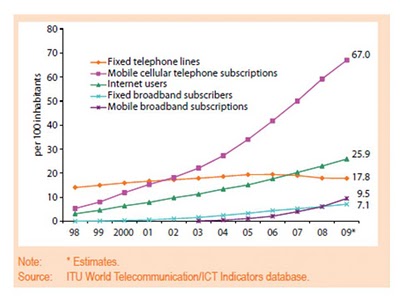
By any measure, recent progress, especially over the past few years, has been quite dramatic: mobile cellular penetration in developing countries has more than doubled since 2005, when it stood at only 23 per cent.

Last year, mobile cellular penetration in developing countries passed the 50 per cent mark, reaching an estimated 57 per 100 inhabitants at the end of 2009. Even though this remains well below the average in developed countries, where penetration exceeds 100 per cent, the rate of progress is remarkable.

Android might be the next big evolution, not that voice and text messaging are propagating. Using Android, devices could be customized for any number of applications that might otherwise be run on a PC, an important development in markets where device cost and access to electricity are issues.

Already, over four billion mobile phones are in use in the world today. The next billion new users, Rotberg says, will be spread out in the developing countries, mainly in Africa and Asia. Android could be important in that regard.

http://www.xconomy.com/boston/2010/03/31/mits-nextlab-designing-technology-for-the-next-billion-mobile-phone-owners/?single_page=true

Is Apple the New and Most-Important Gatekeeper?

Is Apple now more a transformative force in technology-using businesses than Google? Some observers have pointed out that it is possible, perhaps even likely, that Apple's equity value will exceed that of Microsoft in the near future. But Apple now is worth more than Google, with a market capitalization around $214 billion, compared to Google's $159 billion.

To be sure, content companies tend to pay more attention to Apple's moves, while communication companies tend to pay more attention to Google. One might argue that in the communications business, Apple mostly has changed the handset business, and user expectations about what can be done with handsets.

It likely will wind up being more transformative than that. Apple has proven that mobile application stores can be a source of huge end user value in the mobile ecosystem, and potentially a huge driver of revenue and margin in a business that is shifting inexorably towards applications as the driver of communications value overall.

Keep in mind that Apple previously redefined the online music business, if not the whole music business, by some estimates. Apple has had less success in the video arena, but the iPad could signal a potential shift of distribution in the print content business, or at least Apple has been arguing that is its objective.

In the mobile business, virtually everyone agrees that Apple changed end user expectations about what a handset should do, how it should work, and also cracked or broke the historic stranglehood mobile service providers have had over handset features.

In the developing mobile Internet experience, for example, there already are glimmers of a shift of experience from "Web" pages to applications. For a firm such as Google, dependent on search revenues for nearly all of its revenue, that potentially shifts revenue away from search and towards the mobile application as the way people find things.

To the extent that the mobile application, supplied by the application store, becomes the gateway for use of Web-based applications, power and financial success shift towards the app store and the device, and away from the access provider

So the issue that naturally arises is what to make of Apple's influence on the broader technology industry, which generally has moved to an "open" model, where Apple continues to operate on a "partially open" model, closed in terms of operating systems and hardware, but open--with editorial control--for applications.

As attention in the U.S. and some other markets now is turning to "gatekeeper" functions, the implications are that gatekeepers of many sorts now are arising in the Internet ecosystem. Though government regulators typically look at access providers, application providers are emerging as equally-important gatekeepers, as operating systems and browsers have caused concern in the past.

"The iPad is seen by many in the print business as a way of delivering high-value digital content to customers paying real money," notes U.K. technology observer John Naughton. There is a price: Apple will control the distribution channel and take a slice of every transaction.

The iPhone and iPad are really just gateways to the Internet, but are controlled (a better word than "closed") experiences, not the "open" or unfiltered way PCs have been used to access the Internet and its resources.

To the extent that gatekeepers are an issue, we likely will see new concerns about application and experience gatekeepers; nothing so crude as "access" gatekeeping.

Some think Google is the greatest emerging gatekeeper. Perhaps it is Apple.

related article

Saturday, April 3, 2010

Why Buy a Kindle if You Can Use an iPad?

An app to read e-books from Amazon’s Kindle store on the iPad has arrived in iTunes. If that is the case, why buy a Kindle at all? Price, you might correctly note, but wait a couple of years and that problem goes away.

That suggests a major Kindle price cut has to be coming. Historically, many multi-purpose computing devices have sold better than single-purpose devices, when there is a choice. That's why iPhone sales are cannibalizing iPod sales.

With the arrival of the Kindle app, iPad owners will be able to choose whether to read books from Amazon or from Apple. Using the iPad gives users access to all Kindle inventory, with Apple inventory thrown in, as well as color support and the ability to do lots of other things that require Internet access, ranging from email to Web browsing to messaging.

Waiting in Line for iPads...

Lines of people wrapping around the block at the SoHo Apple Store, waiting, presumably, to buy an iPad.

What will be interesting is to see how sales stack up, and I don't mean volume of sales, but whether people decide they want connectivity all the time, like a smartphone, or can live with Wi-Fi access, as iPod touch users now do.

The difference is that the Wi-Fi-only approach makes the iPad more a media consumption device, while full-time connections might make it something else.

What the "something else" might be, remains to be seen. Nobody seems to think it replaces a smartphone. Beyond that, people seem to be unsure about whether it represents an entirely new product category or "just" a new interface for a netbook or laptop.

Google Optimizes Apps For iPad: Which Raises a Question

Google says it has optimized applications for the iPad to take advantage of its large display. Using Gmail on the iPad, for example, users will see a two-pane display that mimics what they are used to seeing on PCs, notebooks or netbooks.

The YouTube and Google Maps apps are preloaded on iPads.

But those features still raise the as-yet-unanswered question: can the iPad uncover significant demand for a new category of device in between a smartphone and a netbook or notebook? Or is the iPad really going to wind up succeeding or failing as a replacement for the netbook or notebook?

Those are quite different outcomes. For me it comes down to the irreducible number of devices I must carry, both locally and when traveling. Around town, the irreducible and desired number is "one." When traveling, because when push comes to shove I use a laptop for work, the irreducible number is "two." Well, actually three, as I carry two mobiles.

Years ago, the irreducible number when traveling briefly floated up to four, when I added the iPod. That turned out to be one item too many, and I no longer travel with it, except when running.

My point is that consumers weighing use of an  iPad will have to decide what it is, before they buy. And that means an identity "crisis" has to be solved before it becomes a huge mass market success. It seems to me to be a very-good media consumption platform, crudely put, an iPod touch on steroids. That will raise the question of the physical need to add more more portable device to the purse or backpack. For some users, that will be a point of friction.

But some people very quickly are going to try seeing whether, in their circumstances, an iPad can displace an existing netbook or notebook. And that could point the way to the iPad becoming a new form of netbook, rather than creating a new category of devices people generally use.

Apple could win, in either scenario, but wins most if it can create a new product category.

link

Friday, April 2, 2010

Telcos "Playing Politics" With SEC Reports and Accounting Charges? Are You Kidding?

One of the calumnies heaped upon telecom service providers is that their recent Securities and Exchange Commission notifications of charges caused by the new health care legislation are somehow a political ploy. Some even say that AT&T and Verizon, for example, are doing so as a political act, because they "contribute to Republican candidates."

As often is the case, such claims are uninformed. In its most-recent report, the Federal Elections Commission reported that AT&T gave exactly the same amount of money to Democrats and Republicans, splitting about $1.7 million 50 percent to Democrats and 50 percent to Republicans, the FEC reports.

The truly unbalanced spending was by union political action committees. The Operating Engineers Union gave 89 percent to Democrats, the International Brotherhood of Electrical Workers gave 99 percent to Democrats, the American Federation of State, County and Municipal Employees gave 99 percent to Democrats, the Teamsters 98 percent to Democrats, the International Association of Frie Fighters gave 88 percent to Democrats, the Carpenters and Joiners Union gave 90 percent to Democrats, the Plumbers/Pipefiters Union gave 95 percent to Democrats.

If you take a look at the chart, the largest telecom-affiliated PACs split their giving between Republicans and Democrats. If one correlates the spending with which political party occupies the White House, or controls the Congress, the pattern of giving by telecom PACis clear: more spending for candidates representing the party in power.

Click on the image for a larger view. 


http://www.opensecrets.org/pacs/toppacs.php

Verizon Takes $970 Million Health Care Cost Charge

Verizon will take a one-time, non-cash tax charge of about $970 million in the first quarter 2010 to account for changes to its financial obligations required by the "Patient Protection and Affordable Care Act," which became law on March 23, 2010.

AT&T announced a similar charge of about $1 billion in March. Both firms have high retiree populations, and have been providing subsidized health care benefits to those retirees under Medicare Part D.

Because of the new law, Verizon and AT&T will no longer receive a Federal income tax deduction for those expenses.

Because future anticipated retiree health care liabilities and related subsidies are already reflected in Verizon’s financial statements, this change requires Verizon to reduce the value of the related tax benefits recognized in its financial statements in the period during which the law is enacted.

Going forward, both firms will face either higher operating costs or will reduce or cancel those retiree benefits.

Some observers have questioned whether the restatements are a "political ploy." Apparently those observers are not aware of how Sarbanes-Oxley legislation works. If the chief officers of a corporation, including its CEO and CFO, materially misrepresent a company's financial position--and $1 billion in a quarter is a material fact--those executives can be sent to jail.

Even medium-sized firms can incur costs of about $1 million a year to comply with Sarbanes-Oxley, by the way, imposing a huge financial drag on enterprises across the United States. And one reason many start-up firms say they will not, or cannot "go public" is the cost of Sarbanes-Oxley compliance costs.

Nor does it appear Sabanes-Oxley has prevented even a single case of corporate malfeasance. Our recent financial crisis does not seem to have been impeded one single bit. But it is a measure of how out of touch some observers seem to be that required accounting for financial obligations is considered a political act.

Thursday, April 1, 2010

Zerista Aims at Small Community Mobile Social Networking


Zerista is a new platform for managing smaller mobile communities, allowing groups to create schedules, send messages, conduct chats, take payments, support checkin operations, send invites, show maps and browse member lists.

This new mobile platform is either an informal or formal mashup of Ning, Eventbrite, Twitter and Foursquare for small groups, in other words.

The business model currently provides free use of the application for groups of 250 or less, then a charge for using the platform to support larger groups, such as convention or trade show groups.

Zerista believes there is a gap in the marketplace between social software for large groups, such as Facebook and Twitter, which are well suited to large macro communities. But those tools might not especially meet the needs of local or "mirco"-sized groups such as soccer leagues, wine clubs or agents working for a single realtor, for example.

In the mobile context, the issue of community "size" is important if you consider the cost of creating a mobile app that could do this, or even several versions of the app to work on a couple major mobile operating systems. Zerista is set up as a "cloud" application that can be published for use by mobile devices without the need to create a special app.


Free Polycom Phones With Speakeasy Offer Through May 31, 2010

Speakeasy, owned by Best Buy, is offering free IP phones to new business customers.until May 31, 2010. Speakeasy is including, free of charge, Polycom SoundPoint IP 321 VoIP-enabled phones to new business customers who purchase unlimited or global Hosted Voice calling plans and have a minimum of five lines.

To the extent that the need to buy new IP phones has been a barrier to adoption, the promotion eliminates that concern.

In addition to offering a free Polycom SoundPoint IP 321 to new customers (MSRP $139), Speakeasy is also announcing their new hardware lineup including two new Polycom phones and three new Cisco phones. Speakeasy's phone lineup now includes the Polycom SoundPoint IP 335, 650, 670, and SoundStation IP 6000; as well as the Cisco SPA 504G, SPA 509G and SPA 525G. Special prices are available for a limited time only for customers wishing to upgrade from the free phone offer to one of these new models.

http://www.speakeasy.net/press/pr/Speakeasy_offers_free_phones.php

Conflicting Employment Numbers in March: What the Heck Does That Mean?

There are conflicting numbers on unemployment coming out. The number of people applying for unemployment benefits fell 6,000 in the week ended March 27, 2010 to a seasonally adjusted 439,000, the Labor Department reports.

On the other hand, A day after the monthly ADP survey showed a private sector job loss of 23,000 compared to a predicted 40,000 gain, employment consulting firm, Challenger Gray, said employers cut 67,611 jobs last month.

The ADP and Challenger numbers indicate that after an improvement in the unemployment picture in January and February, March employment numbers began to decline again, though the Labor Department figures suggest a continued recovery.

So far, the recession has caused the loss of 7.2 million jobs, and the Administration $787 billion stimulus package may have slowed the rate of attrition, but it has not begun to reverse it.

The importance of the unemployment numbers is obvious enough. Consumer spending drives at least 66 percent to 70 percent of all gross domestic product. Until consumer spending recovers, the economy cannot recover.

If the jobless numbers begin to deteriorate again, there will be serious concern about the viability of the recovery.

"The March jobs picture may be the beginning of a trend that America cannot afford to live through for a second time, if there is any hope of a recovery this year," says financial analyst Douglas McIntyre of 247wallst.com.

There is some possibility that the difference between the Labor Department figures and the ADP and Challenger Gray numbers is that the latter are biased to private sector employment, and there obviously has been an increase in temporary jobs caused by the hiring of workers taking the U.S. Census.

The worrisome implication is that private sector employment continues to struggle, and might even have worsened in March 2010, if that is possible.

All of this matters to every citizen, and obviously to any business that sells products to consumers, including communication and video service providers. Historically, voice, broadband, mobile and video services have held up quite well in recessions, and that seems to be the case for the most-recent recession as well.

That is not to say market share shifts halted, or that some legacy products struggled while rising new products gained. Voice market share continued to shift away from telcos and to cable operators and wireless; mobility overall did well while use of smartphones and mobile broadband grew as if there was no recession. Cable operators generally continued to lose video market share to telcos and satellite providers. But all those trends were in place before the recession, and are not caused by it.

If the housing market remains stalled, and unemployment remains high, it seems unlikely there will be too much change in consumer markets. Business markets could be another matter. Most businesses can put off making needed investments for a year or two. But no business can afford to postpone required investments indefinitely.

That suggests business investments could be a brighter spot for service providers in the business segments.

source

View on 2020, Sponsored by Ericsson

If you enjoy "futurists," take a look at new series of videos sponsored by Ericsson and taking a look at various perspectives on "the future," some with direct relevance for communications, others less so.

http://www.ericsson.com/campaign/20about2020/index.html

Covad and MegaPath Merge, More Activity Expected

Covad Communications Companyand MegaPath say they have agreed to a merger combining their businesses to create a larger managed services company serving business customers, though Covad's wholesale operations will continue as well.

D. Craig Young, MegaPath CEO, will take the post of Executive Chairman of the combined businesses, while Pat Bennett, CEO of Covad, who will continue as Chief Executive Officer.

Covad offers IP broadband services in more than 4,400 central offices nationwide through its commercial and wholesale distribution channels, though the bulk of revenue still comes from the wholesale side of the business, where Covad sells service to wholesale partners including AT&T, Verizon Business, and Sprint.

MegaPath sells hosted VoIP, managed security, MPLS VPNs for connecting multiple sites, and SSL VPNs to19,000 direct SMB and enterprise customers.

Consolidation in the telecommunications industry is not new, nor is consolidation in the competitive telecom industry, so the deal is not a surprise in that regard. The "roll up" is a time-tested growth strategy in the competitive communications, cable and wireless industries. . Nor is it surprising that company executives say more deals are coming.

Telecom is a scale business, and scale is doubly important when margins are under pressure, as is the case for virtually all legacy telecom products. When profit margins get squeezed, financial performance can be maintained by selling more units. And that means more scale.

The combined businesses will be owned by Platinum and MegaPath investors.

Interest in Content Marketing Grows, Especially in Mobile Context

There are two huge takeaways from Junta42's new survey of 250 marketing professionals in North America: the dramatic growth of content marketing and the upsurge of interest in mobile content (blogs, social networks, video, newsletters, white papers, webinars, podcasts, custom events, magazines and so forth).

(click images for larger view)

Approximately 10 percent of marketers already are leveraging content through mobile applications and 38 percent say mobile content is something they need to know more about. Of all content marketing areas, only mobile marketing rose year over year re: educational needs, says Junta42.

56 percent of companies plan to increase budgets for mobile marketing in 2010 and a hike of 17 percent in 2010 marketing budgets will be funded by drawing money away from traditional channels such as print.

For the third straight year, marketers are planning to spend significantly more on their content marketing efforts in 2010 and 59 percent of marketing professionals surveyed plan to increase their spending on content initiatives, compared to 56 percent in 2009 and 42 percent in 2008.

Content marketing comprises 33 percent of the total marketing budget, in fact. Smaller companies are spending more on their content marketing as a percentage of budget than larger companies. Small
companies (less than 99 employees) spend approximately 40 percent of their total budget on content initiatives.

Larger companies (100 employees or more) spend an average of 18 percent of their budget for content marketing.

source

Tuesday, March 30, 2010

Three Things Verizon and Google Agree On

Despite differences on some other important issues, Verizon CEO Ivan Seidenberg and Eric Schmidt, Google CEO, agree on some matters related to the Federal Communications Commission's "National Broadband Plan."

In an opinion piece authored for the Wall Street Journal, the two executives say three plan elements are praiseworthy.

Not surprisingly, both agree on the plan's nod to health-care information technology, education and job training, and a smart electricity grid. All of those initiatives will tend to create opportunities for both companies.

Both agree on spurring the highest-quality broadband possible, dependent on private investment.

Both say they agree on the importance of making high-speed Internet connections available to all Americans.

The Internet has thrived in an environment of minimal regulation, they say. "While our two companies don't agree on every issue, we do agree generally as a matter of policy that the framework of minimal government involvement should continue," Schmidt and Seidenberg say.

The FCC underscores the importance of creating the right climate for private investment and market-driven innovation to advance broadband. That's the right approach and why we are encouraged to see the FCC's plan, they say.

You might argue all of these are "motherhood and apple pie" sorts of issues, which is true. But it might be significant that both can agree to support, in principle, "minimal government involvement." That doesn't mean the two firms agree on key network neutrality principles or rules. But it does seem to signal a willingness to consider approaches which allow markets to sort out issues.

As typically is the case in communications regulation, regulators will weigh what is possible and prudent, given the different interests, and take those interests into account, crafting solutions that balance the various interests, giving each side something important, while neither side gets all its wants.

That is likely to be case for network neutrality as well.

Is FiOS Slowdown Related to Possible Verizon Restructuring?

Verizon's apparent slowdown of further FiOS construction could be driven by any number of good reasons, including new skepticism about the financial return, alternate approaches to achieving the same goal, or perhaps other required uses for cash flow.

The need to start shifting free cash flow to dividend payments to minority partner Vodafone, or even a more-drastic reshuffling, such as a merger between Verizon and Vodafone, are possible drivers as well. Vodafone is a significant 45-percent minority investor in Verizon, and just about everyone has been expecting some adjustment of the relationship at some point, with the options including each company buying out the other, although a change in the majority ownership status is not inconceivable.

But a full-fledged merger also might be on the table.

"People familiar with the matter say there are three options being considered by the two sides," the Telegraph reports. The first is a full merger of Vodafone with Verizon Communications; the second would be for Verizon Communications to begin paying a dividend to Vodafone; and the third would be for both companies to sell their respective stakes in Verizon Wireless either to each other or to a third party.

It is that second possible outcome that suggests Verizon might have other needs for its free cash.

In fact, some observers have suggested Verizon Communications would prefer to buy out Vodafone's stake in Verizon Wireless. But analysts say selling the Verizon Wireless stake is not an option for Vodafone because it would result in a giant tax charge as well as deprive Vodafone of about 30 percent of its total annual revenue.

While they are “not aware of any increases in market concentration from such a merger that would raise serious antitrust issues at the U.S. Department of Justice,” a deal that is structured to give Vodafone control over all of Verizon's assets, including landline, would raise national-security questions, though.

source

eBay Expects $1.5 Billion in 2010 Merchandise Sales Using Mobile Apps

Online retailer eBay is launching two iPhone apps, one for the eBay.com global marketplace and one for eBay’s new classifieds site, eBayClassifieds.com, part of its plan to sell $1.5 billion worth of merchandise directly from mobile sites.

With the new eBay Selling and eBay Classifieds mobile apps, consumers can easily photograph and list an item in 60 seconds or less, eBay says. Consumers can now list for free in eBay’s auction format, reaching 90 million active eBay users around the world, or in eBay Classifieds, to reach buyers in their local communities.

Plus, in addition to selling, buying has never been easier with eBay’s leading mobile shopping app and mobile platform and the new eBay Classifieds mobile app.

On April 3, eBay will take mobile commerce a step further, with a new version of the eBay app for iPad. The company earlier had released a mobile app for Android devices as well.

source

Suddenlink Launches 107 Mbps Broadband Access Service

Suddenlink, an operator of rural and suburban cable TV systems, says it has started offering residential customers in several, suburban-Austin communities (Georgetown, Pflugerville, and Leander) its new “High Speed Internet MAX 107.0” service, featuring a download speed up to 107 megabits per second (Mbps) and an upload speed up to 5 Mbps.

The MAX 107.0 service is the result of “Project Imagine,” a new Suddenlink program that calls for approximately $350 million of capital investments nationwide through 2012, above and beyond the company’s traditional capital spending levels.

Through “Project Imagine,” the company aims to expand to substantially all Suddenlink communities: video-on-demand service; the capability for up to 200 high-definition (HD) TV channels; and industry-leading DOCSIS 3.0 technology, which enables Internet download speeds of 20, 50, and more than 100 Mbps.

Suddenlink is preparing to launch either MAX 107.0 or MAX 50.0 Internet service in a number of other communities this year, with details to be announced later. MAX 50.0 service will feature a download speed of up to 50 Mbps.

That will give Suddenlink bragging rights in the speed wars. What remains unclear, as has been the case for other providers offering 50 Mbps service, is how many customers actually will buy the fastest speeds, rather than lower-speed and medium-speed services.

So far, no U.S. provider of access at speeds ranging from 50 Mbps to 100 Mbps has been willing to say, in public, what percentage of customers buy such plans, or even the actual number of customers who buy. One suspects that is because relatively few consumers actually think they need such speeds, or that the value-price relationship is better than that of the medium-speed services.

source

Tiered Mobile Broadband Pricing "Inevitable"

Tiered pricing--where higher amounts of use will result in higher prices--is inevitable, say analysts at Coda Research Consultancy, driven by U.S. mobile data consumption toward 327TB per month in 2015.

With compound annual growth rates of 117 percent, tiered pricing for mobile internet access will become unavoidable, the company predicts. Most of that increase will come from video, which is growing at a
138 percent CAGR to reach 224TB per month in 2015. At that point, mobile video will represent two thirds of mobile handset data traffic.

The key problem, though, is peak demand, at only some cell sites, as already is the case.

“As carrier networks now stand, network utilization will reach 100 percent in 2012 during peak times," says Steve Smith, Coda Research Consultancy co-founder. That is going to mean actual blocking of access during peak hours, much as users on older fixed networks once experienced occasional "fast busy" signals that indicated no circuits were available for use.

Use of pricing mechanisms will help, as it always does, by allowing consumers to make choices about their consumption. Many object that tiered pricing will face huge opposition from consumers conditioned to "unlimited" usage.

I suspect that will prove wrong. Buckets of usage already have been accepted by consumers who understand they can pay less for lower buckets of use, or more money for higher or unlimited use.

What users manifestly do not like is unpredictability; uncertainty about how high their bills will be at the end of the month. So long as consumers have accurate ways to measure their own usage, and an ability to adjust their plans as needed, without penalty, users will adapt easily to buckets of broadband usage.

In fact, consumers may well appreciate being able to decide for themselves whether they want to pay more to get more, or can simply adjust their usage at certain times of day, or at some places, or delay using some applications, in exchange for lower prices.

Mobile video users will grow at about a 34 percent CAGR, to reach 95 million users in the U.S. market in 2015. Use of mobile social networking will grow at a 21 percent CAGR to 2015.

Non-text-messaging-derived data revenues will climb at a 17 percent CAGR, and will comprise 87 percent of all data revenues in 2015, says Coda.

Monday, March 29, 2010

IBM Likes M2M or "Internet of Things" Potential


Why IBM, among others, is bullish on the potential for using mobile broadband networks for all sorts of useful things other than Web surfing or voice calls from mobile phones.

Operator App Stores Get More Traction Than You Might Think

Though many observers, including many service provider executives, might be skeptical about the long-term viability of operator-sponsored mobile application stores, a new study by Nielsen suggests consumers are favorably impressed with operator app stores, as compared to handset stores such as the Apple App Store.

(click image for larger view)

Many observers believe device app stores will ultimately gain favor, but a new Nielsen survey finds ongoing loyalty to carrier stores.  As of the end of 2009, half of all applications users were accessing carrier app stores according to Nielsen’s new App Playbook service.

That is not to say the Apple App Store has lost any luster in the United States. The relatively new BlackBerry App World Store also was the second most popular app store, in part because of BlackBerry’s industry-leading installed base.

But carrier application stores were not as far behind as some might think. About 84 percent of respondents said they were satisfied with the Apple App Store, while 81 percent said they were happy with the Android Market.

Some 59 percent of respondents said they were satisfied with the BlackBerry App World. About 56 percent reported satisfaction with the Windows Marketplace.

Most mobile carrier stores compare favorably with BlackBerry. About 64 percent of respondents were satisified witht he AT&T Application Store, while 65 percent said they were satisfied with the Sprint Application Store.

Some 66 percent said they were happy with the T-Mobile Application Store and 62 percent reported they were satisfied with the Verizon Application Store.

Nielsen’s App Playbook  surveys more than 4,000 application downloaders in the United States every six months about their mobile application usage.

more detail

Ofcom Wants Better Consumer Information About Broadband Access Speeds

Ofcom, the U.K. communications regulator, is not happy with the accuracy of information provided consumers about their real-world broadband access services, and wants to revise the reporting process so better information is provided.

Mystery shoppers commissioned by Ofcom have found that 15 percent of the time, "potential customers" were not given an estimate of their access line speed, and 42 percent were only given one after prompting the sales agent near the end of the sales process.

The accuracy of the information proved to vary. In some cases, users were given double the line speed of another provider for the same line and technology, and sometimes received different answers over the phone when compared with the website of the same service provider. The majority of line speeds also did not match (within 1Mbps) the speeds given by the BT Wholesale line checker.

There is no question but that "best effort" broadband services are difficult to accurately predict or describe. It is true that users will sometimes experience bursts that correspond with the advertised "up to" speed. Most of the time, actual experienced sustained rates are lower, because of contention ratios and actual end user volume.

So Ofcom proposes that ISP's provide speed estimates based on line length, line capacitance and line attenuation, all measures that will provide a better approximation of typical download speeds.

Ofcom also wants to ensure that shoppers are given this information early in the sale process, particularly before payment information or a request for service is made.

Ofcom also seek to ensure that factors that affect broadband speed are explained. Specifically, Ofcom wants to ensure that shoppers are told how network capacity, congestion on the Internet and traffic management policies could affect performance. Consumers also should be told that actual throughput speeds will be lower than advertised or theoretical line speeds.

U.K. consumers already have the right to be moved to a cheaper, lower speed option when the plan they bought does not measure up. In cases where their is but one tier of service, Ofcom wants to allow consumers to leave their contracts without penalty.

Ofcom apparently will try to get such changes made voluntary. If changes aren't agreed to, or implemented, a regulatory review may occur, which could lead to formal regulation.

Such policies are not unreasonable consumer protection efforts. The problem is that formal guarantees are next to impossible so long as connections operate on a "best effort" basis.

Even on a quality-assured connection, which would have to be based on packet prioritization policies, throughput will vary throughout the day, based on overall contention for network resources, though far less than is the case on a "best effort" connection.

To closely match expected routine performance with an advertised top speed will require packet prioritization.

source

Mobile Presence-Based Services $6 Billion by 2012

The value of presence-based mobile services will increase to more than $6 billion by 2012, according to Juniper Research.  Increasing smartphone penetration in developed markets, coupled with rising global usage of mobile instant messaging will help to drive the trend, says John Levett, Juniper Research analyst.

Juniper thinks the key drivers will include presence-based text message alerts and services, geolocation applications that allow people to collaorate, share location details and take advantage of local knowledge, as well as social Web applications including social networking, user-generated content, blogs and dating apps.

Up to this point, revenues from presence-based services are almost exclusively derived from operator-billed mobile IM accounts. The amount of that activity faces two contradictory trends, one might argue.

On one hand, mobile IM will tend to fare better as end user adoption of 3G or 4G services increases. Broader adoption of 3G and 4G should therefore lead to heavier use of mobile IM, which should drive higher revenues. Mobile Web applications such as IM work best, and therefore encourage use, on faster data networks.

On the other hand, operator-billed IM revenues often are based on user inability to easily use over-the-top VoIP and IM applications that do not drive operator revenues. Over time, access to such open applications will deprive operators of the ability to profit from captive IM application access.

Juniper believes there is a way to thread the needle, as mobile broadband becomes a standard service for most developed-market customers and as operators move to embrace mobile VoIP in ways that include them in the revenue streams created by some over-the-top providers.

source

Sunday, March 28, 2010

Is Another National LTE Network Needed?


Do businesses and consumers in the United States need one more fourth-generation nationwide wireless network, aside from the existing Clearwire, soon-to-be-built Verizon and AT&T networks, as well as regional networks being created by regional mobile providers and cable companies, not to mention high-speed 3G networks running at top speeds of 22 Mbps?

Though no firm answer can be given to that question, we might find out relatively soon whether investors think there is a need for another facilities-based 4G network of national coverage.

Harbinger Capital, which recently merged with SkyTerra, proposes to build a fully integrated satellite-terrestrial network to serve North American mobile users, with a national 4G terrestrial network covering 260 million people by the end of 2013.

The planned network would launch before the third quarter of 2011 and cover nine million people, with trials set initially for Denver and Phoenix. The next milestone is that 100 million people have to be covered by the end of 2012, 145 million by the end of 2013 and at least 260 million people in the United States by the end of 2015. Harbinger told the FCC that all major markets will be installed by the end of the second quarter of 2013.

The original thinking has been that wireless services within a number of vertical markets that are highly dependent upon the ubiquitous coverage and redundancy to be provided by its satellite network would be the core of the business strategy. But Harbinger might think there is a market broader than that as well.

Harbinger actually is required by the Federal Communications Commission to provide wholesale access to third parties, and also to restrict total Verizon Wireless and AT&T traffic to no more than 25 percent of total, to provide more competition in the market.

The big issue is whether there is substantial need for additional spectrum at this point. One might argue that industry requests, as well as FCC proposals, for allocation of an additional 500 megaHertz of spectrum for mobile broadband are clear evidence of need.

But there are other issues of market structure and competition. Assuming hundreds of new megaHertz of spectrum can eventually be relocated, most observers think the buyers of such spectrum would be the largest mobile providers such as AT&T and Verizon.

The Harbinger network, by definition, would largely be a platform for other providers, as it would operate as a wholesale provider.

The key business issue is whether there actually is sufficient business demand for another national 4G terrestrial network, though. Sprint and Clearwire both have relatively lavish amounts of spectrum already, and both have shown a willingness to sell wholesale capacity.

One might argue the key differentiator would be the satellite roaming features that would be available on handsets that normally default to the terrestrial network. But the bigger test will be of investor sentiment, as Harbinger will have to raise billions to build the new terrestrial network.

The 36,000 base stations that Harbinger plans to use, along with the tower sites, backhaul and other gear associated with a terrestrial network will require billions of dollars worth of investment.

Analyst Chris King at Stifel Nicolaus estimates that Verizon’s LTE network will cost about $5 billion to deploy. Clearwire has also spent billions on its network, with analyst estimates ranging from $3 billion to about $6 billion. There is no particular reason to think the ubiquitous terrestrial network Harbinger expects to build would cost less.

Investors will have to be found first, before there is a chance to test the thesis that another facilities-based 4G network is needed.

Tesco Abandons VoIP Market

U.K. retailer Tesco, which began selling consumer VoIP service in 2006, now is pulling the plug, though it will continue to sell mobile service. Without reading more into the news than is warranted, the move is illustrative of the fact that consumer VoIP might be less an innovation than some had hoped for, and certaintly is a less-robust business than anticipated, especially compared to mobile service, at least for the moment.

That is not to say other competitors, with different assets, can fare better. But the April 27, 2010 shutoff at least suggests that the "VoIP" market has not proven to be the lucrative business Tesco once believed it was, given its ability to support and market the business, as well as the evolution of end user demand, which arguably has tipped in the direction of mobility.

Earlier in the last decade, there was much more apparent optimism that fixed-line VoIP would "change telephony forever," creating significant new opportunities for non-traditional providers.

One might argue that VoIP's primary impact has been to accelerate voice price erosion, without creating a significant new market, though it has been the way cable operators have taken market share from telcos.

Tesco says "trends in technology have moved forward since we launched Internet phone so that this is no longer a sustainable service". One might infer that means mobility now is the "hot" service.

"Tesco Internet Phone" was basically a Skype-style PC offering, though the supermarket did offer a Vonage-style terminal adapter version as well.

That is not to say further innovation in voice services is impossible, or in fact unlikely. There will be advances. The issue is whether the scale, impact and economic importance of such voice innovations is going to approach the advances being made in mobility, broadband, Internet and Web services.

related article

Friday, March 26, 2010

TV Advertising the Google Way

Google is making it easier for online advertisers to get TV-style ads, with obvious implications for both PC-based an mobile-based screens.

CBS Gets Ready for iPad

If a video content provider reauthors its content to run using HTML5 instead of Flash, what does that mean? That the content is intended to run on Apple's iPad. And that is what CBS.com appears to be doing.

None of this means the multi-channel video entertainment business is in trouble, by any means. But it is likely to be a step towards a future where that is a serious question.

related story

Smartphones a Majority of all U.S. Devices in 2011

By 2011, there will be more smartphones in use in the U.S. market than feature phones, Nielsen now projects.

The share of smartphones as a proportion of overall device sales has increased to 29 percent for phone purchasers in the last six months and 45 percent of respondents to a Nielsen survey indicated that their next device will be a smartphone.

Given normal handset replacement cycles, it is possible to project that the installed base of devices will shift dramatically over the next two years. For those of you who wonder about such things, that would likely make the United States one of the world leaders in smartphone usage.

related story

Verizon Slows FiOS Build: Implications for National Broadband Plan?

Many things have changed since Verizon Communications first began its FiOS construction program in 2004, and in the years leading up to that decision, when hot debates were held about the wisdom of fiber-to-neighborhood versus fiber-to-home networks.

Mobile broadband, especially the faster 3G and new 4G networks, now will begin to offer a serious alternative for a signficant number of end users.  Consumer resistance to paying higher prices for higher-speed fixed broadband (50 Mbps and above) has not lessened.

Cable companies have solidified their position as specialists in the consumer services segment, with the exception of wireless. Given cable's position in consumer video and voice, financial returns from fiber-to-home deployments, in the mass market, are getting harder to justify, not easier.

In many ways, leading U.S. telcos have found that their strengths in wireless and enterprise services are matched by relative cable strength in the mass market video and voice product segments.

Also, opportunity costs arguably have risen over the last 10 years, opportunity cost representing the potential gains a company might have made if capital had been deployed elsewhere,, such as wireless or software, instead of high-capacity fiber access.

In the background are concerns about the long-term relative value of multi-channel entertainment and voice revenues as well, which dampen financial returns from those two core services.

Take all of that into account and the apparent lessening desire on Verizon's part to continue investing in fiber to the home is logical, perhaps even prudent.

Given capital scarcity, burgeoning wireless and mobile broadband opportunities, as well as the slower growth for legacy services such as entertainment video, fixed access and voice, it would be hard to argue with an argument that effort is better placed squarely in the wireless arena, rather than fixed line services.

For that reason, it is not a complete surprise that Verizon seems to be slowing its FiOS program, which had been nearing the end of the major construction phase, in any case. The company says it no longer will seek to build FiOS in communities where it has not already gotten video franchises issued.

That means Verizon apparently will not undertake FiOS builds in Baltimore and downtown Boston, for example, a scenario many of us would not have predicted.

Verizon is still negotiating for franchises in some smaller communities, mainly in New York, Massachusetts and Pennsylvania, but it is not working on securing franchises for any major urban areas.

Verizon never committed to bringing FiOS to its entire local-phone service area, originally planning to make service available to about 18 milliion households by the end of 2010, a goal it will reach. Since the program began, however, Verizon also has been selling assets in less-populated areas in the Midwest and West Coast.

The recruitment of new FiOS TV subscribers slowed last year. In the fourth quarter, it added 153,000 subscribers, little more than half of the number it added in the same period the year before.

At the end of last year, Verizon had 2.86 million FiOS TV subscribers and 3.43 million FiOS Internet subscribers (most households take both).

Investors never have liked the FiOS program, which will wind up costing an estimated $23 billion. FiOS likely has been a key reason Verizon has been able to compete with cable companies.

Verizon is the only major U.S. phone company to draw fiber all the way to homes and the only one to offer broadband speeds approaching those available in Japan and South Korea. But the financial returns have not been so overwhelming that the decision to expand the program is completely clear.

Verizon's experience might be an implicit warning to policymakers that although the goal of 100 Mbps service, provided to 100 million U.S. homes, by 2020 is a fine stretch goal, but might face trouble if it means consumers have to pay significantly more for such service. Consumers might prefer 20 Mbps to 30 Mbps for $50 to $60 a month, rather than 50 Mbps for $100 a month, and certainly more than 100 Mbps for $150 to $200 a month.

related article

Healthcare Plan to Cost AT&T $1 Billion

AT&T says it is taking a $1 billion charge for the first quarter of 2010 to account for increases in its costs because of the new health care plan. It isn't clear what the on-going hit to earnings might be.


AT&T says it also will also evaluate changes to its health care benefits for employees and retirees, to avoid paying such charges in the future, of course. 

Nexus One Outsells iPhone in February...Sort of


Sales of the Google Nexus One are now on the rise and beat the iPhone by 16 percent in February 2010, says RCS Limited, which expects the trend to continue. That data, based on U.K. results, contrasts with sales in the United States, where initial sales have been modest.

It isn't clear that the statistic means a whole heck of a lot, though. Sales practices are quite different in the U.S. market, compared to others where devices often are bought "unlocked" and at full retail prices. Since most U.S. iPhones are bought at subsidized prices, while many to most Nexus One devices are bought at full retail price, the sales comparisons are difficult. Any expensive device sold primarily "unlocked and at full retail" is going to have low sales volume in the U.S. mobile market.

Also, the Nexus One has been viewed by many as a "demonstration" project whose real objective is to show what can be done when Android open-source software and hardware are tightly integrated.

According to a report by Flurry, Google sold roughly 135,000 of its new Nexus One phones in its first 74 days on the market. By contrast, Apple sold 1 million of the original iPhones in the first 74 days, while Motorola sold 1.05 million Droid phones -- which are based on Google's Android software -- during the same timeframe.

link

U.S. to Lead in 4G Deployment? Does it Matter?

People sometimes are fixated on global rankings that have marginal importance, such as which country has the highest penetration of mobility, broadband, Internet usage or some similar metric. Aside from methodological issues that make such rankings difficult, it isn't clear that such rankings mean much of anything.

Consider the fact that the United States will have around 20 million Long Term Evolution subscriptions by end of 2012, and an additional six million mobile WiMAX subs, which would represent close to 25 percent of the global total of 4G subscriptions, says Strategy Analytics.  That would, by anybody's estimation, make the United States a "leader" in 4G adoption. But it isn't clear that particular distinction means much, by itself.

In times past the United States has been called a "laggard" in mobile phone penetration, "behind" other nations in use of text messaging and now is called by some a middling country in terms of broadband penetration. But the United States appears on track to become "the leading battleground" for 4G mobile services, says Susan Welsh de Grimaldo, Strategy Analytics director.

"With broad commitments to LTE and WiMAX service launches, US operators will speed up the competition and create one of the most influential markets for new mobile broadband services and devices," she says.

The point is that cross-national comparisons are difficult, and often of questionable value. The U.S. market no longer is "behind" in text messaging or mobile adoption in any meaningful way. And while one always can argue average or typical speeds are not the fastest in the world, most countries that are "ahead" on such measures are very-small countries with high population density, which makes construction far easier than is the case for a continent-sized country with lower density.

Nor will it mean quite so much to say the United States will "lead" in 4G, either. Lagging broadband metrics do not seem to have inpaired U.S. leadership in software and Internet development, for example.

link

Wednesday, March 24, 2010

Bharti Airtel Introduces Mobile Bazaar

Can text messaging be used to create a mobile version of eBay in India? Bharti Airtel intends to find out, by introducing "Mobile Bazaar," a way to buy and sell virtually anything that is legal using a standard mobile phone capable of text messaging.

The SMS-based service enables buyers and sellers to find each other and conduct transactions with each other using only text messaging, especially short codes, with no need for a mobile browser or data connection.

For starters, Bharti has set up a community for trading mobile phone devices, and will create similar communities for real estate, automobiles and electronics.

The initiative is interesting for the same reason many such innovations are throughout much of the world. Though mobile broadband will be a more-logical approach in markets such as the United States, there are many markets where text messaging and voice are the two ubiquitous communication modes.

In many places, a simple text message in the morning can give a farmer what he or she needs to know before settingout on a seven-mile walk to market. That's very valuable, in terms of fostering economic development.

source

Sprint and Clearwire Might Go LTE for 4G

Sprint Nextel and Clearwire executives have said for some time that WiMAX and Long Term Evolution are similar enough that Clearwire could switch to LTE at some point. But that is more likely to happen when another technology migration to "fifth-generation" technology happens, not in the fourth generation.

In one respect, battles over air interface are simply part of the mobility business. Just as AT&T and T-Mobile opted for the GSM air interface while Sprint and Verizon opted for the rival CDMA air interface, and similar battles were fought over 2G standards, carriers will have to migrate their platforms over time, just as they always have.

The evolution from GSM (3G) to LTE (4G) will still require a new network, with a new air interface, operating on discrete spectrum and requiring new handsets and software. For that reason, each technology generation requires a fork lift upgrade and a refresh of consumer terminals as well. That's just part of the business.

So though Clearwire and Sprint chose WiMAX for 4G, their options for 5G remain open, and both Dan Hesse, Sprint CEO, and Bill Morrow, Clearwire CEO, say they could opt for an LTE derivative for 5G.

Hesse says the choice of WiMAX was based on the fact that Sprint could not wait for LTE standards to jell. It had a business need to move, so it did. "WiMax was tried-and-true tested technology at the time we made the choice," he says. "We couldn't wait."

related article

AT&T Microcell Launch in April

AT&T will begin its national roll out of femtocells, which it brands as the AT&T 3G MicroCell" beginning in mid-April, with new markets activating in cities across the continental U.S. for the next several months.

The AT&T 3G MicroCell improves in-building reception for mobile devices by creating a local mobile repeater site, like a Wi-Fi connection does. The femtocell uses the home broadband connection for access, offloading mobile traffic to the fixed broadband network and therefore avoiding any reception problems in the home or building.

Developed in conjunction with Cisco and in a public trial in select markets since September, AT&T 3G MicroCell is available for a one-time cost of $149.99.

Consumers with AT&T 3G MicroCell will be able to easily activate the device the same day it is purchased.  Customers may define up to 10 mobile phone numbers that can use the femtocell and up to four devices can operate on it simultaneously. There is no recurring cost, but mobile minutes will be deducted from a user's account as they would be if on a mobile macro-cell.

Customers on "Family Talk" plans can pay an additional $19.99 a month to make unlimited calls from the Microcell, without deducting any minutes from their plans.

Consumers who select 3G MicroCell calling plans at purchase are also eligible to receive a $100 mail-in-rebate toward the purchase of AT&T 3G MicroCell. Customers who also purchase a new line of broadband service with AT&T (DSL or U-verse 1.5MB or higher) are also eligible for $50 rebate.

further details

In 2 Years, Mobile Bills Will be Based on Data, Not Voice Buckets

Sprint Nextel Chief Executive Dan Hesse said that in about two years, monthly mobile phone bills will focus on the amount of data used and move away from the number of available voice minutes.

Of course they will. The entire global telecom business is migrating from a voice revenues model to a broadband revenue model. Along the way, some voice services or applications will be offered at no incremental cost, or very-small amounts of money. In other cases access to voice services will simply be bundled with other features and services, much as one today can buy, for one flat price, unlimited mobile Web access, text messaging and voice.

That doesn't mean data usage will billed as electricity, water or natural gas are. It does mean retail packaging will shift, over time, to methods that emphasize "access" to a network and many services, rather than a simple metered approach.

Observers rightly note that most U.S. consumers do not like strictly-metered usage for the simple reason that it creates billing variability. Consumers prefer the predictability of fixed monthly charges, which accounts for some of the popularity of "buckets of usage." But that doesn't necessarily mean people object to some broad correlation between intensity of usage and the size of monthly bills.

Hesse's comments also reflect the simple reality that, for many people, voice is less important compared to texting, instant messaging and other things that can be done with a mobile device. Hesse is only saying that end user value should be related in some rather obvious way to retail pricing.

related article

FCC Has No Authority to Regulate Internet, Verizon EVP Says

The Federal Communications Commission does not have the explicit power to regulate the Internet, and should wait for Congress to grant it that authority, says Tom Tauke, Verizon EVP. The statement is not as controversial as some might think, as Comcast has challenged such authority in federal court, and many observers think Comcast will prevail.

Comcast has challenged the FCC’s authority to punish it for throttling the bandwidth of customers using bitTorrent programs to share huge files.

“The authority of the FCC to regulate broadband providers under the so-called ‘Information Services’ title, or Title I, of the Communications Act [is] at best murky,” Tauke said. “In confronting this hard question about jurisdictional authority, we [are] also faced this policy question: If Title I and Title II don’t apply to the Internet space, what are you saying about the authority of government in this space?

“In a market developing at these speeds, the FCC must follow a piece of advice as old as Western Civilization itself: first, do no harm," said Tauke.

“Today about 96 percent of Americans have access to at least two providers of wireline broadband and as many as three wireless providers, and more than 55 million Americans can connect to a broadband network capable of delivering at least a 50 Mbps stream," Tauke said.

AT&T, Cable Companies, Intel, Microsoft Back Broadband Stimulus Application

A newly-formed coaltion of cable companies, AT&T, Intel, Microsoft and industry trade and non-profit groups have created a "Digital Adoption Coalition" to apply for funding under the "broadband stimulus" program.

The Digital Adoption Coalition includes AT&T, BendBroadband, Bresnan Communications, Bright House Networks, Cablevision Systems Corp., Charter Communications, Comcast, Cox Communications, Connected Nation, Eagle Communications, Inc., Dell, Intel Corporation, Mediacom Communications Corp., Microsoft, Midcontinent Communications, the National Cable & Telecommunications Association (NCTA), One Economy Corporation, Sjoberg’s Cable TV, Suddenlink Communications, Time Warner Cable, US Cable Group, and USTelecom.

To improve broadband access, services, and technology in approximately 250,000 low-income households nationwide, the coalition would work with the U.S. Department of Housing and Urban Development to increase broadband outreach efforts in public housing, project-based Section 8 properties, and multi-family assisted communities.

One Economy, a global nonprofit, filed an application with NTIA on March 15 on behalf of the coalition for funding through the Broadband Technology Opportunities Program (BTOP) to support digital literacy training, discounted computers, and project administration.

Tuesday, March 23, 2010

Apple iPad Niche Awaits Discovery

Google wasn't sure what its business model might be when it launched its search engine. Apple probably isn't quite sure what people might do with its iPad, either.

Apple's  "iWork" suite positions the iPad as a road warrior device, at least for users who don't mind the lack of multitasking or cameras, and mostly want access to email and Web browsing. But some might argue that is precisely what some users already do, but using smartphones.

Or will the iPad wind up being a media playback device more akin to an iPod "touch" with a much-larger screen? Or, instead of revealing or creating the existence of a new and sizable niche between the touchscreen smartphone and the netbook, perhaps the iPad might, in either the current or a later iteration, reset expectations for what a "netbook" or "notebook" PC actually is, and ought to be.

That seems most likely for relatively casual users, at least at the moment. Previous attempts to create a new "tablet" market failed. Apple's Newton was a flop, and Microsoft's "Tablet PCs" didn't do much better. But those devices were aimed at business users.

The consumer market for "tablet" style is probably best envisioned as a larger-screen version of the iPod touch and competing media players, the Kindle and its many e-reader readers. Media consumption, not "computing," could be the new niche.

The ability to convince traveling business users to lug one more device with them does not seem promising. On the other hand, the iPad will require a backpack; it doesn't fit in a pocket or most purses.

 more detail

T-Mobile USA's New Broadband Network Will Cover 180 Million, Offer Speeds of 21 Mbps or 22 Mbps

T-Mobile USA says it expects to have 100 metropolitan areas in the United States covered by its upgraded high-speed wireless network, which should operate up to about 21 Mbps or 22 Mbps in the downstream direction, by the end of 2010.

The new HSPA-Plus network is a "3G" technology that operates at speeds very comparable to 4G alternatives, and might very well give T-Mobile the fastest national network, for at least a while, by the end of the year.

HSPA Plus will cover roughly 180 million Americans by the end of the year, T-Mobile USA says. The technology is already live in some regions, including the New York metropolitan area, the Washington DC suburbs, and will be coming soon to Los Angeles.

Oddly, many observers continue to insist there is "no competition" in the U.S. broadband market. Aside from cable operators and telcos, there now are going to be four mobile broadband networks in national operation by the end of the year, offering speeds equivalent to, or faster, than is available in many markets from terrestrial providers.
It doesn't appear that consumers view the iPad primarily as an e-book reader, but more as a media appliance, a comScore study suggests.

Though 37 percent of respondents indicated they were “likely” or “very likely” to read books on the device, nearly half indicated a high likelihood of using the iPad for browsing the Internet (50 percent) and receiving and sending email (48 percent).

More than one third said they would use it for listening to music (38 percent), maintaining an address book or contact list (37 percent), watching videos or movies (36 percent), storing and viewing photos (35 percent) and reading newspapers and magazines (34 percent). says comScore.

“These devices have the potential to be incredibly disruptive to the way consumers currently access digital content," says Serge Matta, comScore EVP.

The big issue is whether there exists a sizable market for a digital appliance somewhere between a netbook or notebook PC and an iPhone. In that regard, when asked whether they would use an iPad “instead of” or “in addition to” other digital devices, the highest amount of potential substitution was for the iPod Touch (37 percent).

Conversely, despite widespread belief that the iPad might threaten netbook adoption, only 22 percent of consumers said they would use an iPad in place of a netbook.

The most important device attributes that consumers indicated they would like to have included in the iPad were: ability to use multiple applications/programs at once (43 percent), having a screen the same size as a laptop or desktop computer (37 percent) and having a built-in camera (34 percent). Among iOwners, the percentages were substantially higher at 56, 66 and 51 percent, respectively.

Some 34 percent of males indicated they were likely to use the iPad for playing action, strategy or role-playing games, as did 28 percent of females. More than half of those 18 to 24 year olds (53 percent) said they were likely to use the iPad for gaming.

Younger consumers indicated a high willingness to pay for news and magazines specially formatted for e-readers. About 68 percent of 25 to 34 year olds and 59 percent of 35 to 44 year olds said they were willing to pay for this type of content.

If comScore's results prove to be correct, the iPad will emerge as a media appliance.

more detail

CTIA Reports Gains, As It Always Does

Almost nothing is more predictable than the CTIA reporting that revenues, subscribers and wireless data increased over the last six-month period. In fact, many of us cannot remember a six-month period where that has not happened. So it is that the CTIA says wireless data service revenues increased 25.7 percent from the last half of 2008 to reach more than $22 billion for the last half of 2009, CTIA-The Wireless Association says.
nsu
Wireless data revenues now represent more than 28 percent of all wireless service revenues. The number of data-capable devices has grown to 257 million units, up from 228 million at the end of 2008.

About 50 million of these devices are smart phones or wireless-enabled PDAs and nearly 12 million are wireless-enabled laptops, notebooks or aircards.

More than 822 billion text messages sent and received on carriers’ networks during the last half of 2009, amounting to almost five billion messages per day at the end of the year.

As of December 2009, the industry survey recorded more than 285 million wireless connections. This represents a year-over-year increase of more than 15 million.

Also, wireless penetration is now equal to more than 91 percent of the U.S. population, CTIA says.

Other highlights of the survey include wireless customers using more than 1.12 trillion minutes in the last half of 2009, up 38 billion from the last half of 2008—and breaking down to 6.1 billion minutes-of-use per day. Wireless service revenues for the last half of 2009 amounted to almost $77 billion—up from a little more than $75 billion in the last half of 2008.

Access Network Limitations are Not the Performance Gate, Anymore

In the communications connectivity business, mobile or fixed, “more bandwidth” is an unchallenged good. And, to be sure, higher speeds have ...